"This is an unofficial community project. Not affiliated with or endorsed by WSO2."
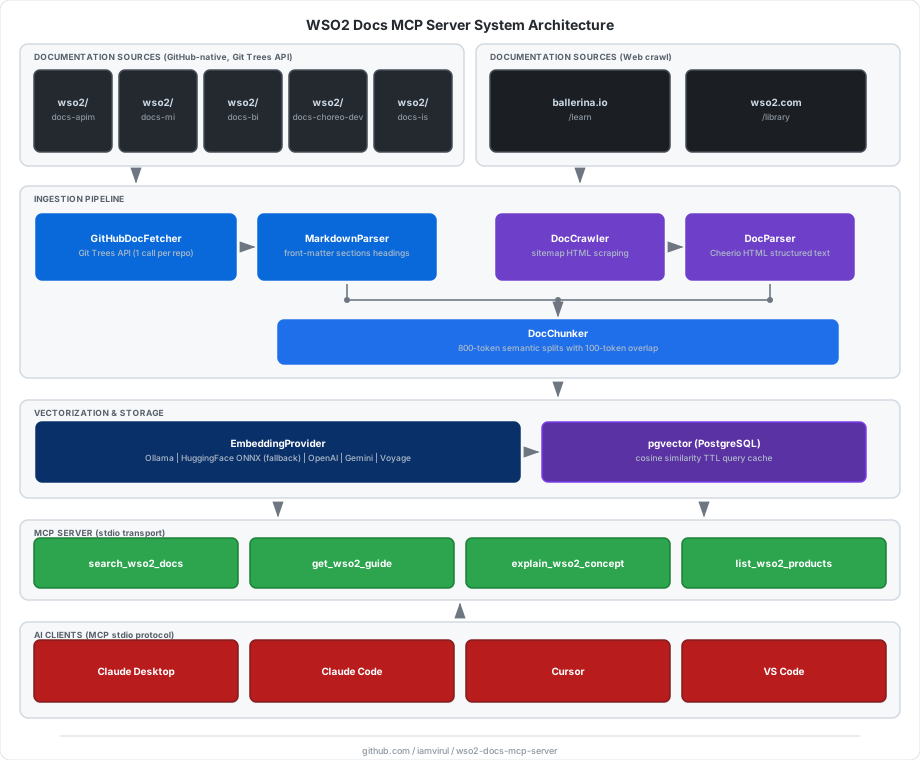
A production-ready Model Context Protocol (MCP) server that provides AI assistants (Claude Desktop, Claude Code, Cursor, VS Code) with semantic search over WSO2 documentation via Retrieval-Augmented Generation (RAG).
Semantic search over WSO2 docs (APIM, IS, MI, Choreo, Ballerina) via RAG and pgvector.
Install the package globally to get the wso2-docs-mcp-server, wso2-docs-crawl, and wso2-docs-migrate commands available system-wide:
npm install -g wso2-docs-mcp-server
Prefer no global install? You can use npx wso2-docs-mcp-server, npx wso2-docs-crawl, and npx wso2-docs-migrate in every step below - just replace the bare command with its npx equivalent.
1. Start pgvector
Download the docker-compose.yml and start the database:
curl -O https://raw.githubusercontent.com/iamvirul/wso2-docs-mcp-server/main/docker-compose.yml
docker compose up -d
Run migration again whenever you change EMBEDDING_DIMENSIONS (i.e. switch embedding provider). The script detects and handles dimension changes automatically.
4. Index WSO2 documentation
# Index all products (first run downloads the embedding model automatically)
DATABASE_URL="postgresql://wso2mcp:wso2mcp@localhost:5432/wso2docs" \
  wso2-docs-crawl

# Index a single product (faster, great for testing)
DATABASE_URL="postgresql://wso2mcp:wso2mcp@localhost:5432/wso2docs" \
  wso2-docs-crawl --product ballerina --limit 20

# Force re-index even unchanged pages
DATABASE_URL="postgresql://wso2mcp:wso2mcp@localhost:5432/wso2docs" \
  wso2-docs-crawl --force
Available product IDs: apim, mi, bi, choreo, is, ballerina, library
5. Configure your AI client
The MCP server is launched on demand by your AI client - no background process needed.
Claude Desktop - edit ~/Library/Application Support/Claude/claude_desktop_config.json:
No Ollama? Skip this step. The server detects Ollama is not running and automatically falls back to HuggingFace ONNX inference - the model downloads on first use with no extra setup.
3. Configure environment
cp .env.example .env
# Defaults work out of the box with Ollama.
# Only edit if using a cloud provider (OpenAI / Gemini / Voyage).
4. Start pgvector
docker compose up -d
# pgAdmin available at http://localhost:5050 ([email protected] / admin)
5. Run database migration
npm run db:migrate
Note: Run migration again whenever you change EMBEDDING_DIMENSIONS (i.e. switch embedding provider). The script detects and handles dimension changes automatically.
6. Index documentation
# Index all products
# On first run the embedding model is downloaded automatically (Ollama or HuggingFace)
npm run crawl

# Index a single product (faster, great for testing)
npm run crawl -- --product ballerina --limit 20

# Force re-index even unchanged pages
npm run crawl -- --force
7. Build and start the MCP server
npm run build
npm start
For development (no build step):
npm run dev
8. Configure your AI client
Replace /ABSOLUTE/PATH/TO/wso2-docs-mcp-server with your actual clone path.
Claude Desktop - edit ~/Library/Application Support/Claude/claude_desktop_config.json:
claude mcp add wso2-docs \
  --transport stdio \
  -e DATABASE_URL="postgresql://wso2mcp:wso2mcp@localhost:5432/wso2docs" \
  -e EMBEDDING_PROVIDER="ollama" \
  -- node "/ABSOLUTE/PATH/TO/wso2-docs-mcp-server/dist/src/index.js"

# Verify
claude mcp list
See config-examples/claude_code.sh for a convenience script.
Cursor - create .cursor/mcp.json - see config-examples/cursor_mcp.json.
VS Code - create .vscode/mcp.json - see config-examples/vscode_mcp.json.
MCP Tools
Tool
Description
search_wso2_docs
Semantic search across all products. Optional product and limit filters.
get_wso2_guide
Search within a specific product (apim, mi, bi, choreo, is, ballerina, library).
explain_wso2_concept
Broad concept search across all products, returns 8 top results.
list_wso2_products
Returns all supported products with IDs and base URLs.
Example response
[
  {
    "title": "Deploying WSO2 API Manager",
    "snippet": "WSO2 API Manager can be deployed in various topologies…",
    "source_url": "https://apim.docs.wso2.com/en/latest/install-and-setup/...",
    "product": "apim",
    "section": "Deployment Patterns",
    "score": 0.8712
  }
]
Local Embeddings
The default EMBEDDING_PROVIDER=ollama runs entirely on your machine with no API key. The startup sequence is:
Is Ollama running?
├── Yes → Is model present?
│         ├── Yes → Ready (instant)
│         └── No  → Pull via Ollama (streamed, runs once)
└── No  → Download ONNX model from HuggingFace Hub (~250 MB, cached after first run)
           and run inference in-process via @huggingface/transformers
Both paths use nomic-embed-text / Xenova/nomic-embed-text-v1 by default and produce identical 768-dim vectors, so you can switch between them without re-indexing.
Hardware acceleration (HuggingFace ONNX fallback)
When Ollama is not available, the server auto-detects the best compute backend:
Machine
Detection
ONNX dtype
Batch size
Throughput
Apple Silicon (M1/M2/M3/M4)
process.arch === 'arm64'
q8 INT8
32
~9 ms/chunk
NVIDIA GPU
nvidia-smi probe
fp32
64
GPU-dependent
All others
fallback
q8 INT8
16
~10 ms/chunk
Why q8 on Apple Silicon instead of CoreML/Metal?
CoreML compiles Metal shaders on first use (~20 min cold-start). For the typical chunk sizes produced by this server (6–20 chunks per page), the CPU↔GPU transfer overhead eliminates any inference gain. INT8 quantized inference on ARM NEON SIMD is consistently ~100× faster than fp32 CPU with zero cold-start cost.
fp32 CPU (before): ~1,000 ms/chunk   (68 chunks ≈ 68 s of embedding)
q8  ARM NEON:          ~9 ms/chunk   (68 chunks ≈  0.6 s of embedding)  ← ~100× speedup
Note: For small crawls (≤ 10 pages) total wall-clock time is dominated by network I/O
(HTTPS fetches to docs sites), so the end-to-end improvement is modest. The embedding
speedup becomes significant at scale - crawling 500+ pages where embedding previously
accounted for hours of runtime. For best crawl performance, run Ollama (ollama serve)
which parallelises inference natively and has no per-chunk overhead.
Environment Variables
Core
Variable
Default
Description
DATABASE_URL
-
PostgreSQL connection string (required)
EMBEDDING_PROVIDER
ollama
ollama | openai | gemini | voyage
EMBEDDING_DIMENSIONS
768
Must match model output dimensions
CRAWL_CONCURRENCY
5
Concurrent HTTP requests during crawl
CHUNK_SIZE
800
Approximate tokens per chunk
CHUNK_OVERLAP
100
Overlap tokens between chunks
CACHE_TTL_SECONDS
3600
In-memory query cache TTL
TOP_K_RESULTS
10
Default search result count
Ollama (default)
Variable
Default
Description
OLLAMA_BASE_URL
http://localhost:11434
Ollama server URL
OLLAMA_EMBEDDING_MODEL
nomic-embed-text
Model pulled and used via Ollama
HUGGINGFACE_EMBEDDING_MODEL
Xenova/nomic-embed-text-v1
ONNX fallback when Ollama is not running
Cloud providers
Variable
Default
Description
OPENAI_API_KEY
-
Required if EMBEDDING_PROVIDER=openai
OPENAI_EMBEDDING_MODEL
text-embedding-3-small
OpenAI model
GEMINI_API_KEY
-
Required if EMBEDDING_PROVIDER=gemini
GEMINI_EMBEDDING_MODEL
text-embedding-004
Gemini model
VOYAGE_API_KEY
-
Required if EMBEDDING_PROVIDER=voyage
VOYAGE_EMBEDDING_MODEL
voyage-3
Voyage model
Embedding dimension reference
Provider
Model
Dimensions
Ollama / HuggingFace
nomic-embed-text / Xenova/nomic-embed-text-v1
768 (default)
Ollama / HuggingFace
mxbai-embed-large / Xenova/mxbai-embed-large-v1
1024
Ollama / HuggingFace
all-minilm / Xenova/all-MiniLM-L6-v2
384
OpenAI
text-embedding-3-small
1536
OpenAI
text-embedding-3-large
3072
Gemini
text-embedding-004
768
Voyage
voyage-3
1024
Voyage
voyage-3-lite
512
Scheduled Re-indexing
# Run a one-off re-index (checks hashes, skips unchanged pages)
npm run reindex

# Or from the project directory using node-cron (runs daily at 2 AM)
DATABASE_URL=... node -e "
  const { ReindexJob } = require('./dist/jobs/reindexDocs');
  const job = new ReindexJob();
  job.initialize().then(() => job.scheduleDaily());
"
# Type-check
npx tsc --noEmit

# Run crawl with tsx (no build needed)
npm run crawl -- --product ballerina --limit 5

# Run server in dev mode
npm run dev
W
Wso2 Docs
io.github.iamvirul·4 estrellas·
Semantic search over WSO2 docs (APIM, IS, MI, Choreo, Ballerina) via RAG and pgvector.
Aún no hay lista de herramientas. Los servidores remotos la reciben tras la primera comprobación de estado.
Preguntas frecuentes
Preguntas
¿Cómo instalo Wso2 Docs?
Copia en esta página la configuración stdio para Cursor, Claude Desktop, Claude Code o VS Code. Usa la instalación del publicador, no un proxy de PlugMCP.
¿Wso2 Docs necesita una clave de API?
El publicador indica estas variables de entorno: DATABASE_URL, EMBEDDING_PROVIDER, OPENAI_API_KEY, GEMINI_API_KEY, VOYAGE_API_KEY.
¿Qué transporte usa Wso2 Docs?
Wso2 Docs se ejecuta localmente por stdio.
¿Cuándo se comprobó Wso2 Docs por última vez?
Última comprobación: 2026-11-15. Semantic search over WSO2 docs (APIM, IS, MI, Choreo, Ballerina) via RAG and pgvector.