Potencia tu agente
El comando propio del publicador. No es un endpoint de PlugMCP.
Host a copy with our keys and logs.
uvx hot-memory-mcp==0.9.0Claude Code no tiene enlace de instalación para un comando local. Copia el comando de abajo y ejecútalo en una terminal.
MEMORY_MCP_DB_PATH=<value> MEMORY_MCP_EMBEDDING_MODEL=<value> claude mcp add io.github.michael-denyer-hot-memory-mcp -- uvx hot-memory-mcp==0.9.0Ejecútalo en una terminal.
{ "mcpServers": { "io.github.michael-denyer-hot-memory-mcp": { "command": "uvx", "args": [ "hot-memory-mcp==0.9.0" ], "env": { "MEMORY_MCP_DB_PATH": "<value>", "MEMORY_MCP_EMBEDDING_MODEL": "<value>" } } }}claude_desktop_config.json
¿URL remota o un comando en tu máquina? En qué se diferencian las dos instalaciones
Ejecutar en PlugMCP
A new server you create. It is not this listing's official endpoint. Use the publisher install when you want their URL and their credentials.
AbrirStop re-explaining your project every session.
Memory MCP learns what matters and keeps it ready — instant recall for the stuff you use most, semantic search for everything else.
Every new chat starts from scratch. You explain your architecture again. You paste the same patterns again. Your context window bloats with repetition.
Other memory solutions help, but they still require tool calls for every lookup — adding latency and eating into Claude's thinking budget.
Memory MCP fixes this with a two-tier architecture:
SessionStart and UserPromptSubmit hooks before Claude even starts thinking. Claude Code adds a hook's stdout to the conversation, so no tool call is needed.The system learns what you use and promotes it automatically. Your most valuable knowledge becomes instantly available. No manual curation required.
# Install package
uv tool install hot-memory-mcp   # or: pip install hot-memory-mcp

# Add plugin (recommended)
claude plugins add michael-denyer/memory-mcp
The plugin gives you auto-configured hooks and slash commands. Embeddings run on sentence-transformers on every platform, including Apple Silicon.
Add to ~/.claude.json:
{
  "mcpServers": {
    "memory": {
      "command": "memory-mcp"
    }
  }
}
See Reference for full configuration options.
Restart Claude Code. Run memory-mcp-cli bootstrap once to seed memories from your project docs; the hooks inject whatever is promoted, but nothing seeds itself.
First run: Embedding model (~90MB) downloads automatically. Takes 30-60 seconds once.
flowchart LR
    subgraph LLM["Claude"]
        REQ((Request))
    end

    subgraph Hot["HOT CACHE · 0ms"]
        HC[Session context]
        PM[(Promoted memories)]
    end

    subgraph Cold["COLD STORAGE · ~50ms"]
        VS[(Vector search)]
        KG[(Knowledge graph)]
    end

    REQ -->|"hook stdout"| HC
    HC -.->|"draws from"| PM
    REQ -->|"recall()"| VS
    VS <-->|"related"| KG
The hot cache (~10 items) reaches Claude through two plugin hooks. SessionStart runs memory-mcp-cli hot-cache --force and UserPromptSubmit runs memory-mcp-cli hot-cache, and Claude Code adds each command's stdout to the conversation. The command prints only when the text differs from what the session last saw, which is cheap while the set is stable and reprints in full when it shifts. The set combines recent recalls, predicted next memories, and top promoted items. Promoted memories (~20 items) is the backing store of frequently-used memories. Memories used 3+ times auto-promote; unused ones demote after 14 days.
Most memory systems make you pay a tool-call tax on every lookup. Memory MCP's hot cache bypasses this entirely — a hook prints your most-used knowledge into the conversation before Claude starts thinking.
The Engram Insight: Human memory doesn't search — frequently-used patterns are already there. That's what hot cache does for Claude.
See Reference for all 10 slash commands and full tool API.
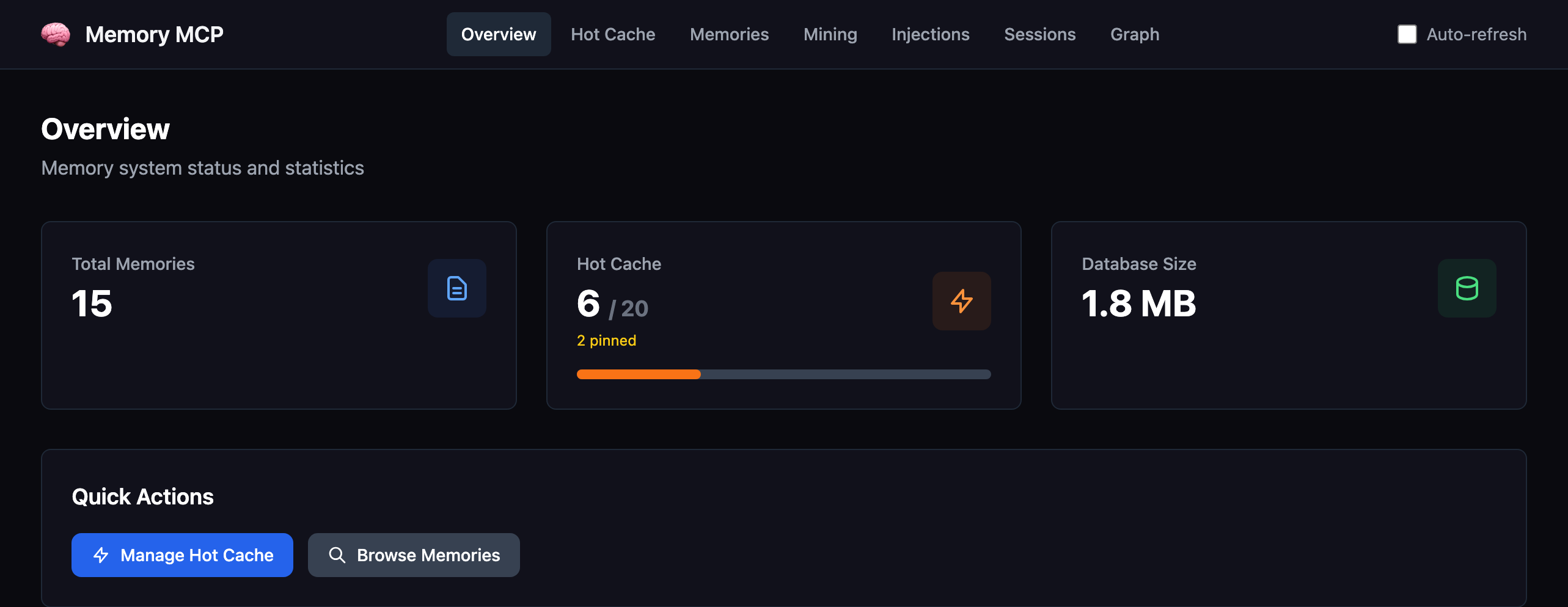
memory-mcp-cli dashboard # Opens at http://localhost:8765
Browse memories, hot cache, injection history, sessions, and the knowledge graph.
Memory MCP is designed to run as three complementary components:
The plugin is recommended for most users — it auto-configures the MCP server and adds productivity features. Run the dashboard alongside when you want visibility into what's being stored.
MIT
Two-tier memory: hot cache (0ms) + semantic search. Self-organizing.
{ "mcpServers": { "io.github.michael-denyer-hot-memory-mcp": { "command": "uvx", "args": [ "hot-memory-mcp==0.9.0" ], "env": { "MEMORY_MCP_DB_PATH": "<value>", "MEMORY_MCP_EMBEDDING_MODEL": "<value>" } } }}Herramientas
Aún no hay lista de herramientas. Los servidores remotos la reciben tras la primera comprobación de estado.
Preguntas frecuentes
Copia en esta página la configuración stdio para Cursor, Claude Desktop, Claude Code o VS Code. Usa la instalación del publicador, no un proxy de PlugMCP.
El publicador indica estas variables de entorno: MEMORY_MCP_DB_PATH, MEMORY_MCP_EMBEDDING_MODEL.
Hot Memory se ejecuta localmente por stdio.
Última comprobación: 2026-11-15. Two-tier memory: hot cache (0ms) + semantic search. Self-organizing.
