Zero-G Reverse Engineering Anything & Sandboxed Closed-Loop Rust Parity Verifier for Gemini 4 Argon + Google Antigravity 2.0
REA-Argonaut (package: rea-argonaut, CLI: , MCP server: ) is a cross-platform (, , ) reverse-engineering and verified Rust reconstruction suite, engineered as a first-class and server.
Built as a full superset of morluto/rea (Reverse Engineer Anything), REA-Argonaut preserves all 35 original REA reverse-engineering domains (187 tools) while introducing the ArgonZeroG architecture and 7 new high-throughput forensic, recon-kit & verification tools (194 total MCP tools across 39 contract domains) designed for long-context frontier reasoning models.
[!IMPORTANT]
Active Development & Rolling Updates:REA-Argonaut is continuously updated with new forensic capabilities, architectural refinements, and parity harness enhancements. Check Discussions Announcements or click Watch in the top-right corner for the latest drops.
[!TIP]
New to Reverse Engineering or Vibe Coding? Start with the Visual User Guide:
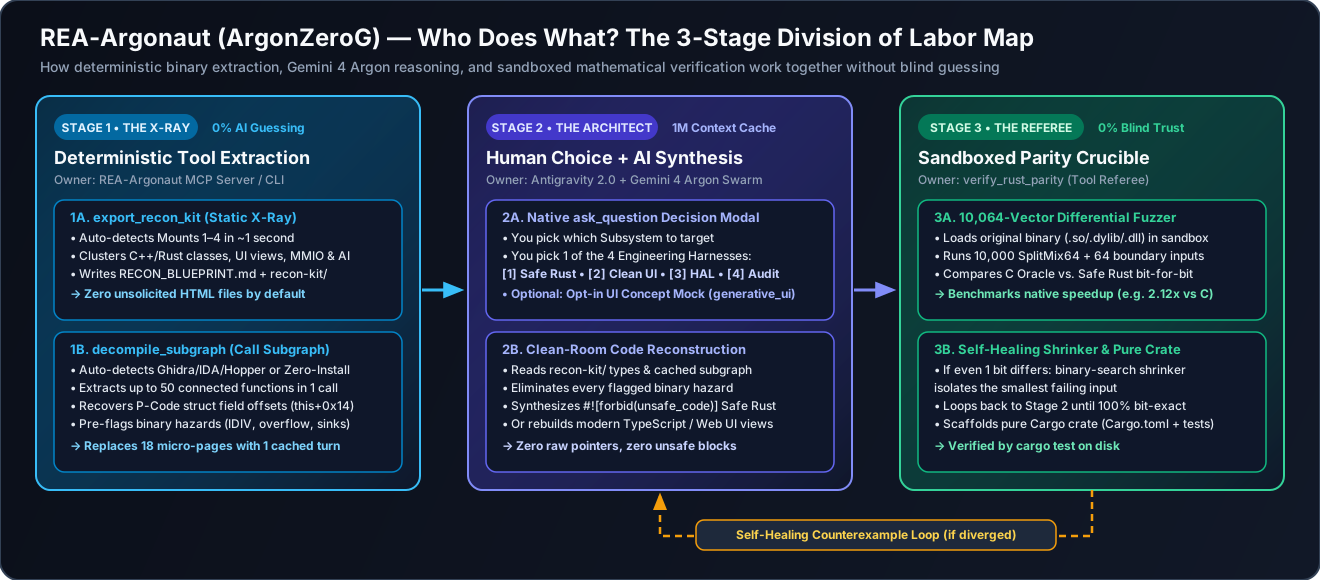
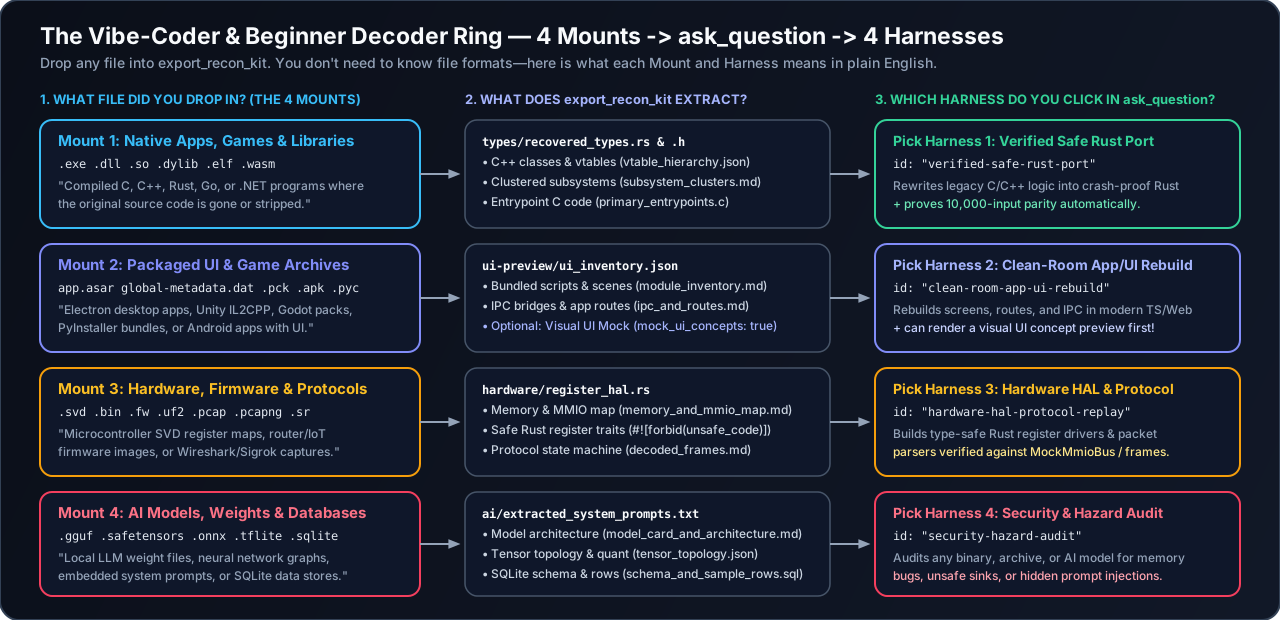
Read USER_GUIDE.md — The Zero-to-Hero Visual Field Manual & Decoder Ring for a plain-English walkthrough of the 3-Stage Division of Labor, what each of the 4 Mounts extracts, how to choose between the 4 Engineering Harnesses when Antigravity prompts you via ask_question, and copy-paste starter prompts.
Why REA-Argonaut? (ArgonZeroG Architecture)
Legacy MCP reverse-engineering servers were architected for small-context models, enforcing tiny pagination limits (64-character string previews, 50-line pseudocode slices, 20-row table pages) that force frontier agents into hundreds of sequential RPC round-trips and destroy KV context-cache reuse.
REA-Argonaut eliminates token-scarcity bottlenecks across six architectural pillars:
Single-Call Call-Graph Extraction: Traverses a target binary's call graph (BFS or DFS, cycle-safe up to max_depth: 5 and max_nodes: 256) and returns an entire subsystem's decompiled C pseudocode, disassembly, cross-references (XREFs), referenced string literals (2048-char previews), P-Code inferred struct field offsets (inferred_struct_offsets), and latent binary hazards (latent_hazards) in one deterministic JSON payload.
95%+ Context-Cache Reuse: Emits a topologically ordered, immutable subgraph representation so multi-turn agent reasoning and Rust reconstruction reuse cached KV prefixes instead of fragmenting context across dozens of micro-paginated tool calls.
Raised ArgonZeroG Limits Across Canonical Tools:
search_strings: max_preview_length raised to 2048 (default: 512), limit raised to 2000 (default: 250).
procedure_pseudocode / analyze_function: max_lines raised to 5000 (default: 1000, detail: "full" by default).
procedure_disassembly: max_instructions raised to 5000 (default: 1000).
4-Phase Recon-to-Argon Handoff: Materializes RECON_BLUEPRINT.md and the structured 4-Mount recon-kit/ workspace directory (Mount 1: native-binary, Mount 2: packaged-ui-archive, Mount 3: hardware-firmware-protocol, Mount 4: ai-model-data) in a single execution-free pass (mock_ui_concepts: false by default, producing zero unsolicited HTML files).
Native ask_question Harness Routing: Pairs with Antigravity's native ask_question decision control so users choose which subsystem and which of the 4 Harnesses (verified-safe-rust-port, clean-room-app-ui-rebuild, hardware-hal-protocol-replay, security-hazard-audit) to execute.
Tier 1 (Deep Decompiler Engine — Auto-Detected via provider: "auto"): Works directly with standard desktop installations of Ghidra (11.x and 12.x), IDA Pro (idat / idalib), Hopper Disassembler, and JEB. By default, REA-Argonaut drives their built-in headless runners in the background so the AI agent never blocks on GUI dialogs—while also exporting standard C headers (recon-kit/types/recovered_types.h) that you can import into your interactive Ghidra or IDA Pro desktop GUI (File -> Parse C Source) for side-by-side visual analysis.
Tier 2 (ZeroInstallNativeProvider Zero-Install Fallback): Out-of-the-box binary layout, symbol/section discovery, stripped C++ RTTI/VTable slot seeding (ClassName__vslot_N_<addr>), call-graph extraction, and disassembly when Ghidra/Hopper/IDA are not installed:
Linux (ELF): GNU binutils (objdump, readelf, nm) + native ELF header parser.
Windows (PE/COFF):llvm-objdump, dumpbin + native PE/COFF header/import/export parser.
Python Layout & Crash Bridge (bridge/pwntools/layout_impl.py & recorded_crash_impl.py): Dual-path backend supporting pwntools when installed and a 100% Python stdlib fallback on clean hosts.
4. 100% Vanilla REA Superset (187 Retained Tools) + 7ArgonZeroG Forensic Verticals (194 Total MCP Tools Across 39 Domains)
In addition to every original REA capability (JavaScript/Web bundles, Source Maps, Chrome DevTools/CDP, Frida, GDB/LLDB/WinDbg, Android APK/DEX, iOS IPA, JVM/JAR, .NET CIL, WebAssembly, Electron ASAR, Mach-O/ELF/PE, Hermes/React Native, Lua, Flash SWF, Archives, PCAP/HAR, EVM/Solidity, Firmware, Symbolic Execution, YARA/Capa), REA-Argonaut adds purpose-built forensic verticals:
inspect_rust_cpp_binary — Stripped Rust & Modern C++ Binary Forensics:
Recovers crate names and exact versions from .cargo/registry/src/... paths and core::panicking::Location tuples even in strip --strip-all binaries.
Native TypeScript Rust _RNv v0 and legacy _ZN symbol demangler + Itanium (_Z) and MSVC (?) C++ demangler.
Reconstructs C++ VTables and RTTI (typeinfo) across ELF (SHT_RELA PIE relocation resolution), Mach-O, and PE binaries without launching a heavy decompiler session.
Automated Differential FFI Harness: Compiles a C reference implementation (or loads an existing .so / .dylib / .dll via dlopen/dlsym) alongside a candidate #![forbid(unsafe_code)] Rust reconstruction (rustc --crate-type cdylib) and runs 10,000+ SplitMix64 randomized + boundary test vectors (0, 1, -1, MIN, MAX, powers of two, bitmasks) in-process.
Deterministic Counterexample Shrinking: Automatically binary-searches any diverging input down to the minimal failing argument tuple (counterexample.shrunk_inputs, bit_diff_summary) so the agent can self-heal its Rust port in a closed loop.
Clean Cargo Crate Scaffolding (scaffold_output_dir): Scaffolds a 100% pure #![forbid(unsafe_code)] Rust Cargo crate (Cargo.toml, src/lib.rs, tests/parity_regression.rs) with zero HTML clutter by default (html_report_path / --html-report is strictly opt-in).
OS-Native Sandboxed Execution: Runs compiled harnesses inside isolated OS sandboxes:
Dynamically inspects os.availableParallelism() and os.totalmem() at startup (src/config/AdaptiveResourceProfile.ts) to scale JavaScript AST worker pools, Headless Ghidra JVM heap (-XX:ActiveProcessorCount, -Xmx), and concurrent subprocess budgets across laptops, CI containers, and 128-core workstations with zero hardcoded CPU limits.
Quickstart
1. Install & Build
npm install
npm run build
2. Run the End-to-End ArgonZeroG Showcase
Compile a multi-function C cryptographic/compression pipeline (argon_cipher_pipeline), strip all symbols, extract the whole call-graph in one decompile_subgraph call, inspect stripped Rust/C++ panics & VTables, stream-inspect a GGUF AI model header, and prove bit-exact C-to-Rust parity across 10,000 FFI test inputs:
REA-Argonaut gratefully acknowledges and builds upon morluto/rea (Reverse Engineer Anything, Copyright (c) 2026 morluto, MIT License), preserving its complete multi-domain reverse-engineering architecture, process supervision, and decompiler bridges while extending it with the ArgonZeroG subgraph engine, zero-install cross-platform fallback, specialized forensic inspectors, and sandboxed Rust parity verifier. See LICENSE and THIRD_PARTY_NOTICES.md for full details.
R
REA Argonaut
PNWcoastie·12 estrellas·
Zero-G Reverse Engineering Anything & Verified Safe Rust Reconstruction for Gemini 4 Argon + Google Antigravity 2.0 (4-Mount Recon Kits, Whole-Subgraph Extraction, 10,000-Vector Differential Parity Re
Aún no hay lista de herramientas. Los servidores remotos la reciben tras la primera comprobación de estado.
Preguntas frecuentes
Preguntas
¿Cómo instalo REA Argonaut?
Copia en esta página la configuración stdio para Cursor, Claude Desktop, Claude Code o VS Code. Usa la instalación del publicador, no un proxy de PlugMCP.