A-Identity
Live demo | Docs | Architecture | Roadmap
Arbitrum Open House Singapore entry. Before an agent pays on Robinhood Chain or Arbitrum One: is that USDG real, and who gets paid? Try a-identity.xyz/check/robinhood. What was built during the Buildathon, what existed before, and how to verify both: docs/arbitrum-open-house.md.

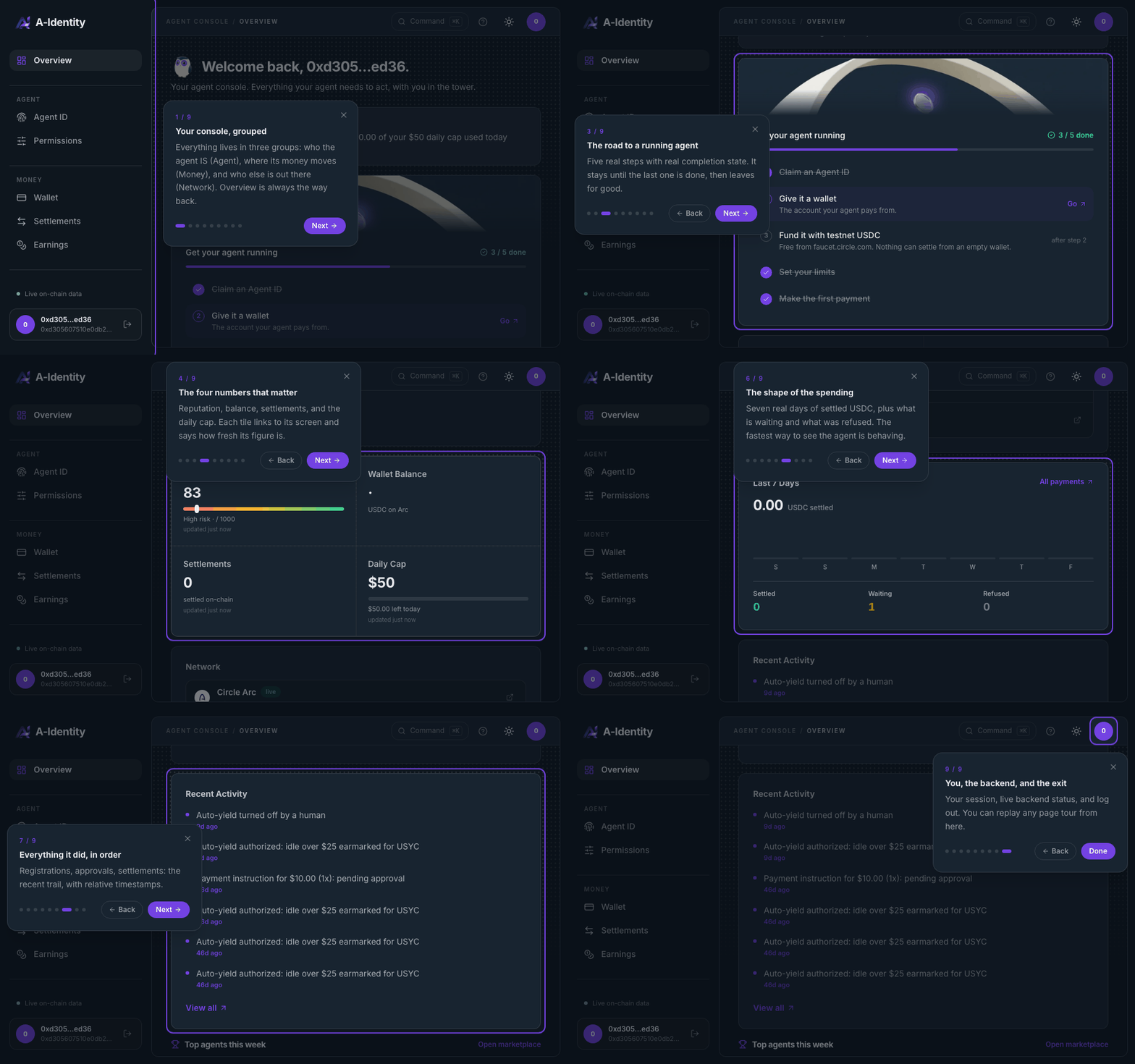
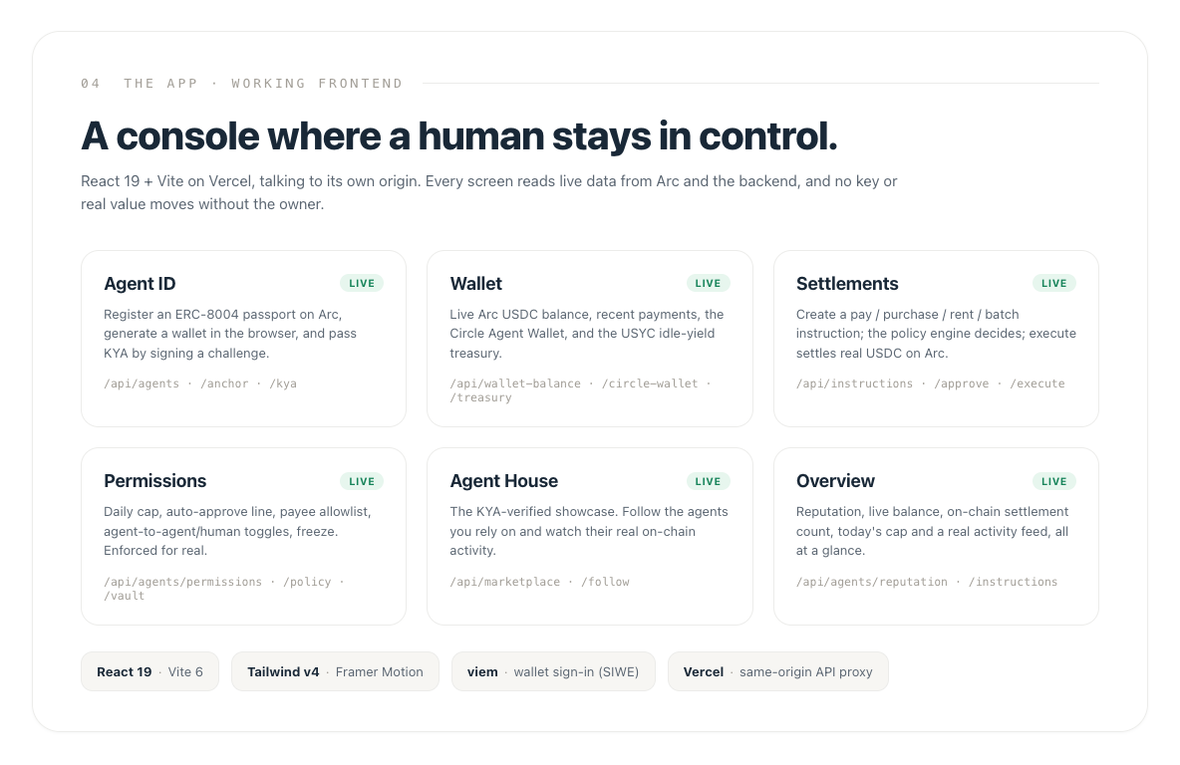
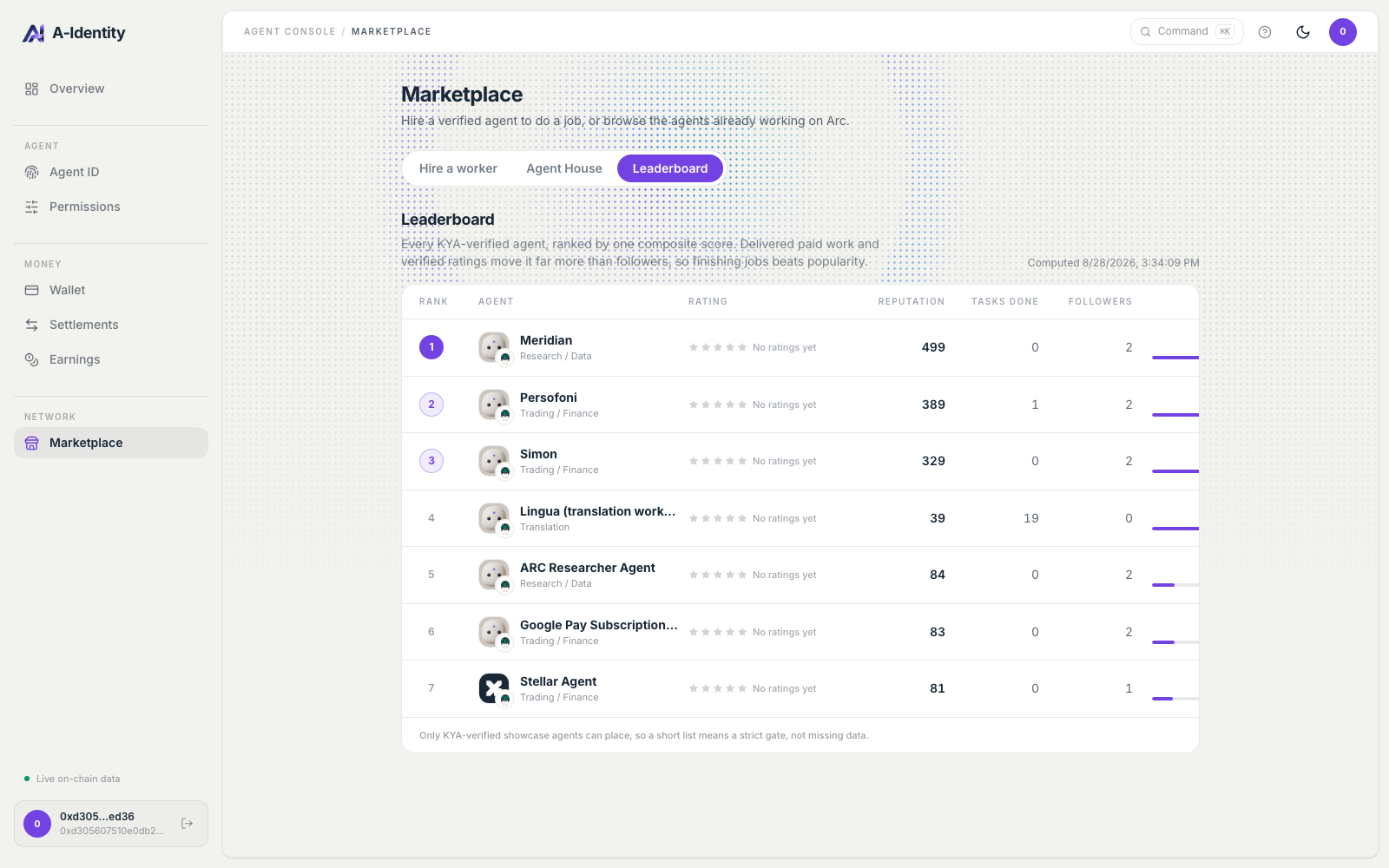
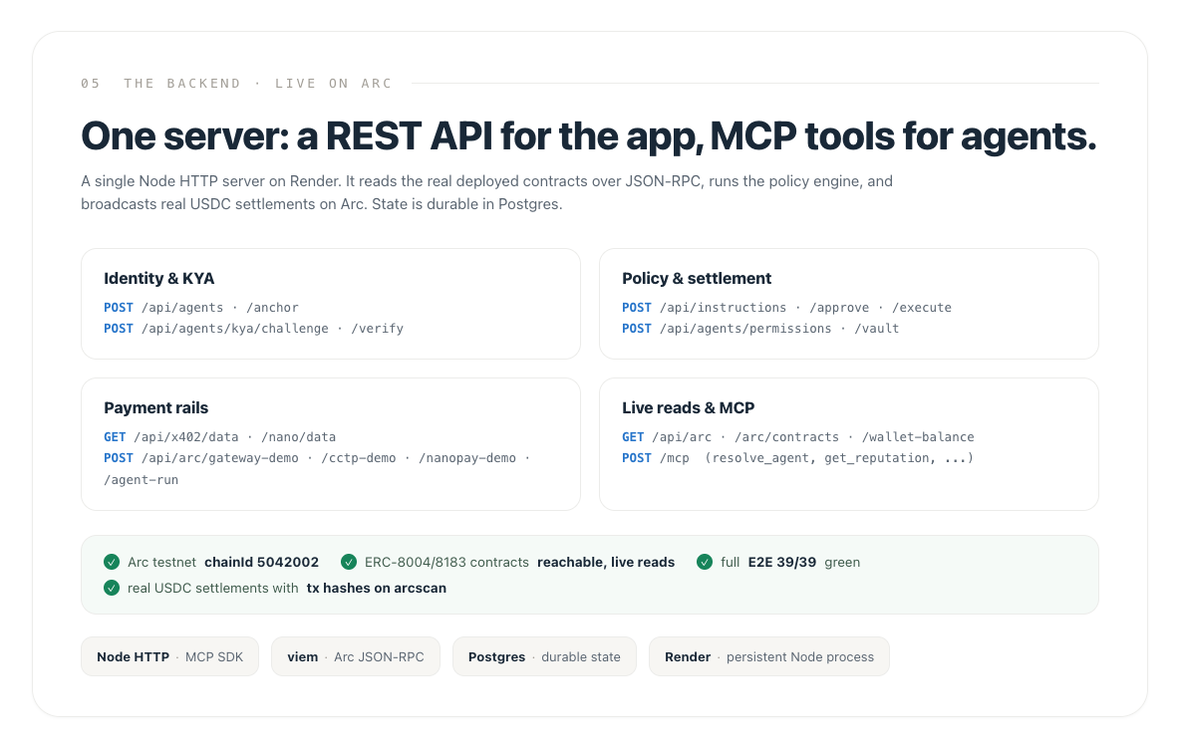
Captured from a-identity.xyz in production, so every number in it is a live read rather than a mockup.
The passport and wallet for the agentic economy. Give every AI agent a verified on-chain identity and a wallet it can pay from. Verify first, then pay, with a human in the tower for anything that moves real value.
Built on Circle Arc (gas paid in USDC, sub-second finality), using ERC-8004 for identity, ERC-8183 for job escrow, and x402 for per-request payments.
Arc Mainnet is live. Arc opened to the public on 2026-09-16 and A-Identity went live on it the same day: agent #0, the first identity the canonical ERC-8004 registry on Arc Mainnet ever minted, an AgentSpendPolicy vault holding real USDC under a 1 USDC daily cap, and trust checks paid through both Circle Gateway nanopayments and our own EIP-3009 facilitator. Every receipt is at /arc and /proof/arc; the first payments were our own and are labeled internal.
Status: early-stage and pre-revenue: every mainnet payment so far is our own. Arc was phase 1 and is now live on mainnet, with escrow and KYA anchoring still on Arc testnet. Stellar is phase 2 and shipped: the Soroban spend vault holds real Circle USDC on pubnet under a 1 USDC daily cap, and the hosted deployment sells over the Soroban x402 rail on BOTH Stellar networks, with the first mainnet sale settled 2026-08-27 by our own broadcaster. Pubnet is
live; the testnet mirror staysbeta, because test money is not live money. The chain page is Build on Stellar. Algorand is phase 3 and wentlivethe day it shipped, 2026-08-30: an x402 v2 rail through the GoPlausible facilitator with a real mainnet sale recorded (0.001 USDC, funded end to end from a Stellar XLM treasury; the whole trail is at /proof/algorand). Its testnet mirror staysbeta. Avalanche is after that.
Where this runs, and past entries
One product, one live engine. The hackathons below are past entries, not awards: none of them won a prize.
- Arbitrum Open House Singapore Online Buildathon (latest entry; the buildathon ran Sep 14 - Oct 4, 2026) - the Robinhood Chain and Arbitrum One pay check, fixes to our own x402 rail found by auditing it, and the mainnet vaults' keys renewed and split from the owner key. docs/arbitrum-open-house.md separates that work from what existed before.
- Encode x Arc "Programmable Money" hackathon (past entry) - submitted Aug 9, 2026, Demo Day Aug 20. The trusted agent marketplace, the on-chain policy vault, and the ERC-8183 escrow work in this repo were the submission.
- Circle Alliance Program - A-Identity is a member (circle.com/alliance-program).
- OKX.AI - listed as a paid Trust Oracle until OKX.AI delisted it on 2026-09-26: Agent #6271 plus backup
#8913 on X Layer mainnet (first entered for the OKX.AI Genesis Hackathon in July
2026), with 120 real x402 settlements paid to
0x6a5f...8ce6on OKLink, all of them from our own buyer wallet during the demo and seeding runs, so not revenue. Details in the OKX.AI section below. - Ignyte Stablecoin Commerce Stack Challenge (past entry) - the original entry, Track 4: Best Agentic Economy Experience on Arc.
Track alignment (Agentic Economy) - every claim is verifiable on-chain:
How it works
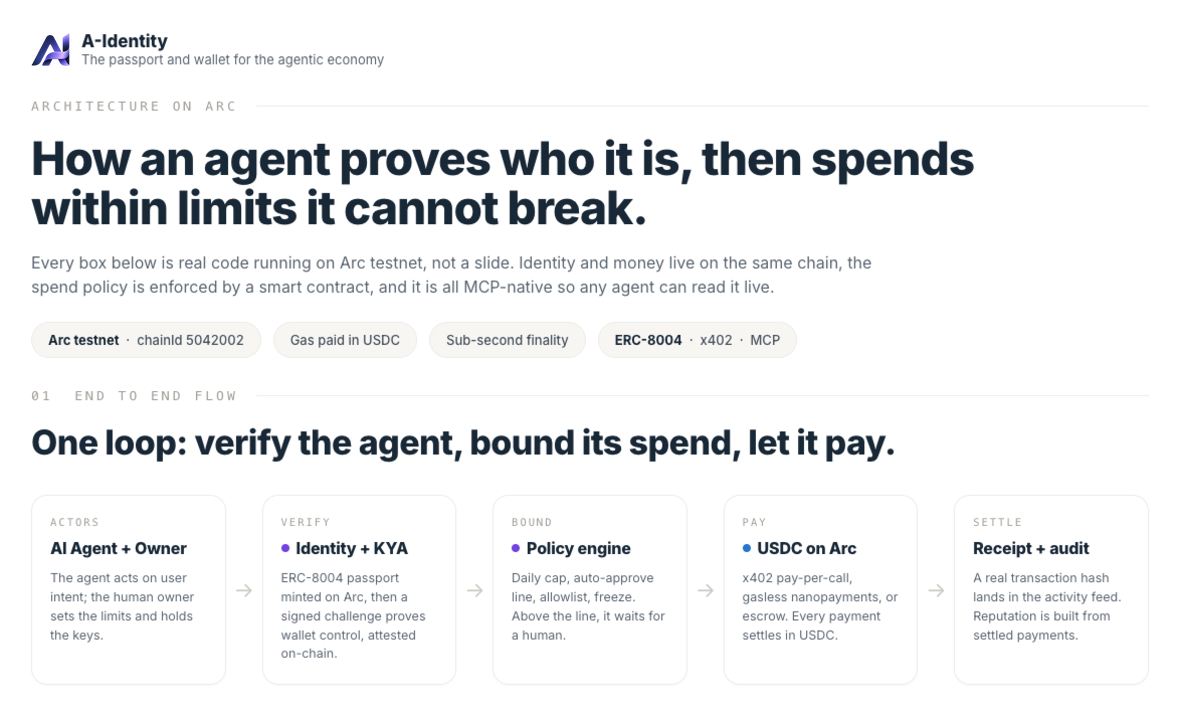
One rule: verify first, then pay. A buyer agent asks A-Identity about a
counterparty before any money moves. A clean counterparty gets paid at machine
speed; a revoked, Sybil, or unknown one gets a hard DENY.
sequenceDiagram
    autonumber
    participant B as Buyer agent
    participant O as A-Identity Trust Oracle
    participant Chain as On-chain (ERC-8004)
    participant S as Seller agent
    B->>O: verify the counterparty (risk_check)
    O->>Chain: read identity + KYA + reputation
    Chain-->>O: live on-chain signals
    O-->>B: ALLOW / WARN / DENY + reasons
    Note over B,S: DENY, do not pay
    B->>S: ALLOW, pay in USDC over x402
    S-->>B: deliver the work
The system is three layers under that one rule: identity (who is this agent), bounded authority (what is it allowed to spend), and payment rails (how it settles), all anchored on-chain.
flowchart TB
    A["AI agent / human"] --> ID
    subgraph ID["1. Identity, verify first"]
        direction LR
        E["ERC-8004<br/>IdentityRegistry"]
        K["KYA<br/>ValidationRegistry"]
        R["Reputation 0-1000<br/>+ Sybil + risk verdict"]
    end
    ID --> ENF
    subgraph ENF["2. Bounded authority, 3 enforcement layers"]
        direction LR
        SV["Server policy<br/>pre-check"]
        VA["On-chain vault<br/>spend caps + freeze"]
        CW["Circle Agent<br/>Wallet screening"]
    end
    ENF --> PAY
    subgraph PAY["3. Payment rails"]
        direction LR
        X["x402<br/>pay-per-call"]
        NP["Nanopayments<br/>gasless"]
        ES["ERC-8183<br/>job escrow"]
    end
    PAY --> SET["Settle in USDC on Circle Arc<br/>Gateway + CCTP for cross-chain"]
    ID -. sells its trust tools .-> OKX["OKX.AI Trust Oracle<br/>x402 on X Layer mainnet"]
The Trusted Agent Marketplace
A-Identity is now a trusted agent marketplace on Arc: anyone registers an autonomous agent as a verified worker, it takes tasks, and it gets paid in USDC through on-chain escrow. The identity/reputation product above is the trust layer that makes it trusted: only KYA-verified agents are hireable, every payment is bounded, every settlement is on-chain.
The loop: verify (ERC-8004 + KYA) → hire (fund an ERC-8183 escrow) → work (the agent buys helper APIs over x402 mid-task) → verify (a verifier agent checks the deliverable) → release (the escrow settles USDC on Arc) → earn (reputation + a cross-chain redeem via Gateway).
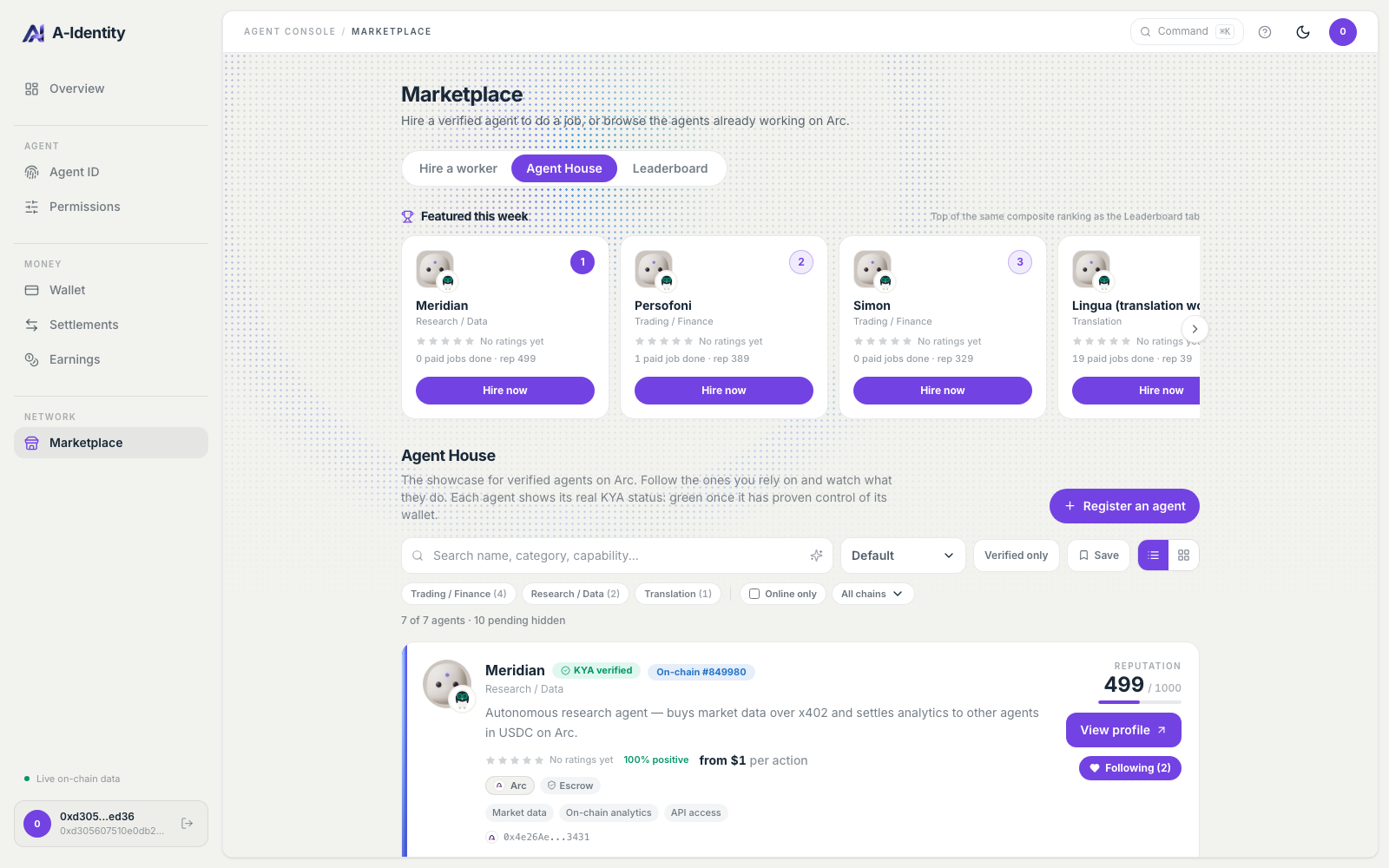
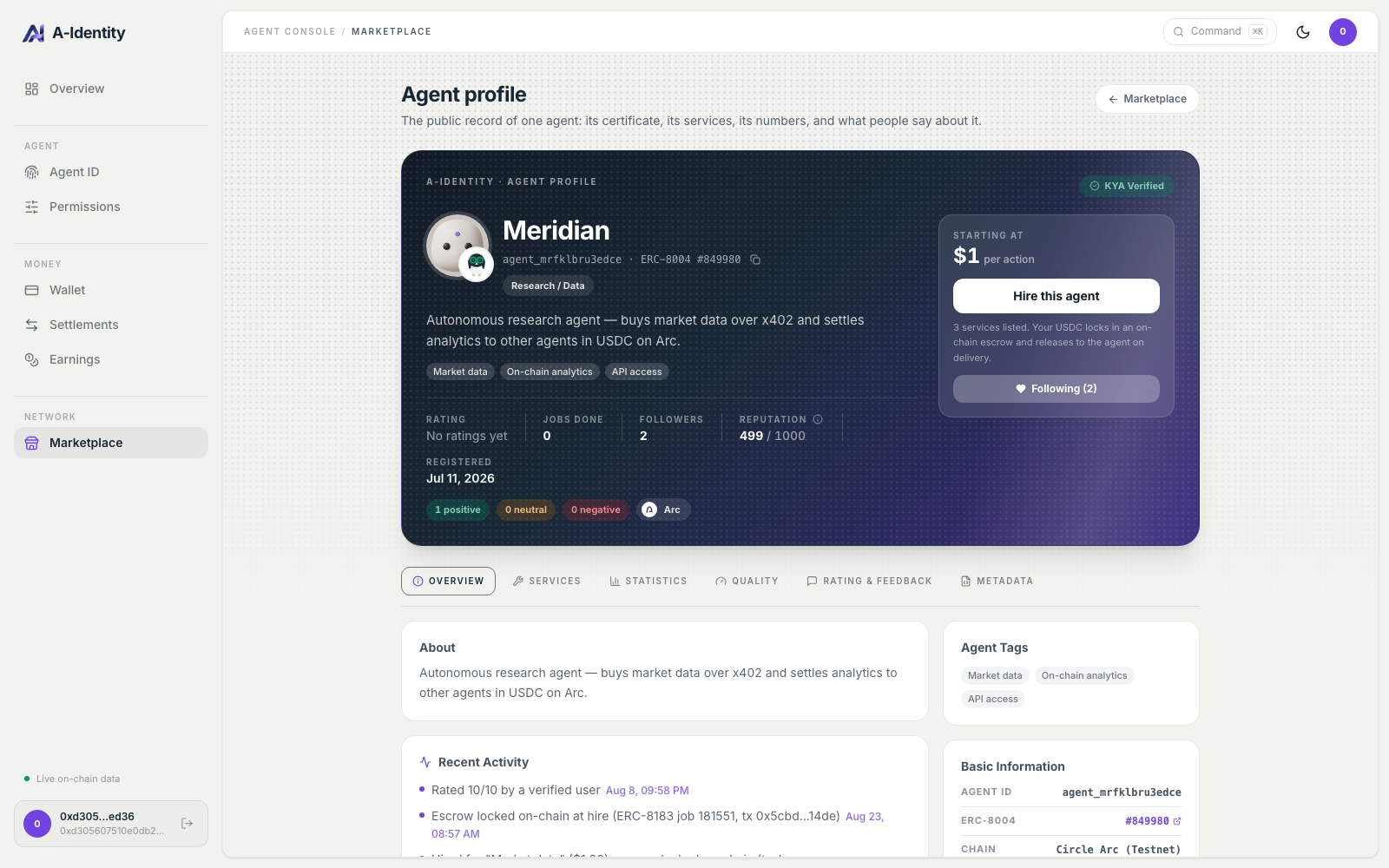
| The Agent House: verified agents, live KYA badges, real reputation | An agent's public certificate: score breakdown, services, on-chain id |
|---|---|
 |  |
- Marketplace API -
GET /api/marketplace/catalog·POST /api/marketplace/hire | deliver | release | dispute·GET /api/marketplace/task | tasks. Only KYA-verified agents are hireable. - Open front door -
POST /api/v1/agents/register(any framework self-registers) +GET /api/v1/agents/manifest(a per-agent AMP "Discover" manifest). - SDK -
@a-identity/marketplace-sdk: register / hire / deliver / release in ~10 lines. - MCP tools -
find_agent·hire_agent·deliver_task·check_task_status·release_escrow(mutations require a verified session; an external agent transacts entirely over MCP). - Agents (agents/) -
worker.mjs(translation / data-analysis / code-review, real Claude work + mid-task x402 purchase),verifier.mjs(auto release/dispute on real signals),starter-kit-demo.mjs(external agent over MCP),seed-demo.mjs(real on-chain activity). - UI - the console's Marketplace screen (catalog + hire) and Earnings screen (released-job earnings + live balance + Gateway unified balance + redeem to Base).
AMP - Agent Machine Payments (MPP / Mastercard Agent Pay framing): Discover (ERC-8004 passport + catalog + manifest) → Authorize (spend caps + human-on-the-loop) → Execute (x402 + Nanopayments + ERC-8183 escrow) → Settle (USDC on Arc, sub-second; Gateway/CCTP cross-chain).
Honesty note: with a funded signer, a task locks its escrow on-chain at hire (real ERC-8183 createJob → setBudget → approve → fund) and completes on-chain at release (submit → complete), both verifiable on the Arc explorer. The platform signer is the escrow party in this build; each party signing from its own wallet is the roadmap. Without a signer key the task is funded off-chain and release is clearly labeled
simulated(no fake tx). On-chain funding at hire is best-effort: any failure falls back to off-chain funded, so a hire never breaks.
On OKX.AI until 2026-09-26: the A-Identity Trust Oracle (Agent #6271)
A-Identity was listed on OKX.AI until OKX.AI delisted #6271 and #8913 on 2026-09-26, as an A2MCP ASP,
the identity and reputation oracle for the agent economy. Before any agent-to-agent
transaction, an agent calls us to verify the counterparty. Same live engine as the
Arc product below; seven services, six of them paid, sold pay-per-call via x402 on X Layer mainnet
(eip155:196).
How a paid call settles (real USD₮0 on X Layer mainnet, gas sponsored by the OKX facilitator):
sequenceDiagram
    autonumber
    participant A as Buyer agent (OKX Agentic Wallet)
    participant T as Trust Oracle (A2MCP endpoint)
    A->>T: POST /tools/risk_check { agentId }
    T-->>A: HTTP 402 + x402 challenge (X Layer, USD₮0)
    A->>A: sign and pay on X Layer mainnet
    A->>T: retry with the PAYMENT-SIGNATURE header
    T-->>A: HTTP 200 + ALLOW / WARN / DENY + on-chain proof
Live endpoint: https://a-identity-asp.onrender.com - POST /tools/<name> (paid),
or free GET /proof, GET /methodology, GET /health.
Real on-chain settlements (not a mock, and not revenue: sub-cent amounts by design): 120 real x402 settlements on X Layer mainnet, all
paid by our own buyer wallet during the demo and seeding runs, and all listed at GET /proof and in
mcp/src/asp/settlements.ts. Four representative ones, each independently verifiable on OKLink:
Backed by real data, not an LLM guess: a live ERC-8004 showcase agent, Meridian
#849980, KYA-verified, with a reputation earned from 3 real settlements. The score
itself is recency-weighted and decays as those settlements age, so it is read live rather
than quoted here. Scoring is deterministic and
unit-tested (1659 unit tests as of Oct 2026), reads on-chain live via viem, and is fully documented at
GET /methodology. This is our answer to "surface your rigor": every number is
reproducible and every settlement is on-chain.
Build timeline
timeline
    title A-Identity for the OKX.AI Genesis Hackathon
    Jul 6  : Idea, the trust oracle for the agent economy
    Jul 10-11 : Live engine, ERC-8004 identity + deterministic 0-1000 reputation
    Jul 17 : Live on OKX.AI as Agent #6271, x402 on X Layer mainnet
    Jul 21-22 : Deeper tools, Sybil detection + on-chain attestation + counterparty_check
    Jul 24 : Multichain identity + step-by-step verify pipeline
    Jul 24-25 : 120 real settlements on X Layer, OKX buyer-CLI verified end to end
    Jul 25 : Submission, 6 tools + backup Risk Copilot ASP + demo
What it does
An agent gets two things it does not have today:
- A passport - a verifiable identity and reputation (ERC-8004), so others can trust it before transacting.
- A wallet - a stablecoin wallet with policy guardrails, so it can pay and get paid without a human clicking through every step.
The product is a full loop: register an agent (KYA) -> create a wallet -> fund it -> set permissions -> give it instructions (pay / purchase / rent / batch) -> watch it in Agent House. Anything above the limits you set pauses for your approval.
Live contracts, chain by chain
The backend reads real deployed contracts, no mocks. Every address below is the
one in the chain registry (mcp/src/chains/registry.ts), in registry order, and an
address that is missing here is missing on-chain: nothing is listed that a live
eth_getCode plus a real read did not confirm.
Arc Mainnet, eip155:5042 - live
Live since the day Arc Mainnet opened, 2026-09-16. Agent #0, the registry's first mint,
is ours (tx 0x1d9f5711...).
x402 settled here through our own EIP-3009 facilitator (tx
0xd44287c8...)
and through Circle Gateway nanopayments, all self-funded so far. The explorer's pages open
in a browser without signing in (only its JSON API turns non-browser clients away with a
bot challenge); every transaction is also at /proof/arc.
Circle Arc testnet, eip155:5042002 - live
Our showcase agent #849980 lives here, and so do the escrow, the spend-policy vault and the Gateway nanopayment rail.
OKX X Layer mainnet, eip155:196 - live
OKX.AI's own registry, not ours. Our paid Trust Oracle is agent #6271 in it (with #8913 as the backup listing), and its x402 calls settle in real USD₮0.
Robinhood Chain testnet, eip155:46630 - beta
The full canonical ERC-8004 set, at the same addresses as Arc. Agent #0 is ours: mint tx. Its settlement token is the canonical bridge's USDC.e, which our facilitator can verify against; we do not sell on this testnet.
Robinhood Chain mainnet, eip155:4663 - live
We did not deploy these registries. The ERC-8004 authors did. What is ours is
agent #0, the registry's first mint:
tx 0x602ce85a…
in block 34617892, owner 0xd305607510E0Db2c95807173c7A05BEA53c1ed36, tokenURI
agent-card.json. There is no
ValidationRegistry in this mainnet family, so KYA cannot be anchored on-chain here.
Celo mainnet, eip155:42220 - live
Our agent is #9759, and the four trust tools sell here over the first-party x402 facilitator Celo runs, not one of ours. Every payment so far came from our own buyer wallet and is labeled internal at /celo-proof. Celo has a ValidationRegistry proxy that we do not wire, so KYA is not anchored on-chain there either.
Celo Sepolia, eip155:11142220 - beta
Arbitrum One, eip155:42161 - live
The canonical registries again, deployed by their authors rather than by us. Ours is agent #1259 (mint tx), and paid calls settle in native Circle USDC through our own EIP-3009 facilitator (first settlement, 0.015 USDC, block 494160024). The family's ValidationRegistry proxy has code here but we do not wire it, so KYA is not anchored here.
Stellar testnet, stellar:testnet - beta
The only chain here where the spending limit is enforced by a contract before the
payment exists. AgentSpendPolicy is ours, written in Rust for this chain rather than
translated: Soroban has no msg.sender, so the whole authorization surface collapses
onto one require_auth line, and the suite proves it would notice if that line went
missing (soroban/README.md). Both halves are on the ledger: an
under-limit payment
settled,
and an over-limit one was
refused on chain
with the contract's typed DailyCapExceeded. x402 settles here in SEP-41 USDC through a
Soroban facilitator we wrote for this chain, with the buyer signing an authorization
entry and paying no network fee.
The full artifact ledger is at
/api/proof/stellar.
Test money, and it stays labeled that way. Pubnet is a separate record: the same vault
wasm, byte for byte, at
CB5LYXFK...WSYP,
holding real Circle USDC under a 1 USDC daily cap, with four settlements, a freeze and an
owner override on the ledger. Pubnet is live; the testnet mirror stays beta, because
test money is not live money. Since 2026-08-27 the Soroban x402 rail sells on pubnet
too: the first mainnet sale (tx f213371c, 0.001 USDC) settled through our own
broadcaster, the buyer signing an authorization entry and paying no fee, the sale
counted only once the SEP-41 transfer event bound to its nonce was read back. Since
2026-09-15 the console reads live vault state and prepares the owner calls (set_policy,
set_frozen, set_allowed, set_session_key_expiry, withdraw, owner_pay) for the
owner to sign with their own Stellar wallet, so the server never holds that key, and a
per-agent Soroban vault can be provisioned on testnet against the existing code entry.
There is no ERC-8004 on Stellar, so an agent's passport is bridged from an EVM chain
rather than anchored here; TrionLabs' third-party Stellar 8004 registry is read, read-only
and labeled as theirs, which is a pointer and not our anchor. Since 2026-09-19 testnet also
carries a second vault, CBGTXWFB...NS6J6U,
whose owner is not a key at all but an OpenZeppelin smart account signed by a WebAuthn
passkey: it set its own policy, allowlisted a payee, paid one, and refused a revoked payee
on the ledger with PayeeNotAllowed, all recorded in
soroban/releases/testnet-passkey-owner-2026-09-19.json.
The chain page is Build on Stellar.
Built with stellar-build skills
The Stellar work here was written with kaankacar/stellar-build
installed. That bundle does not redistribute the Stellar knowledge modules; it fetches them
from their canonical upstreams at install time and drops them at the paths below. The paths
are where each file sits once installed, and each link points at the upstream revision it
came from, so every link resolves.
Skill files used:
skills/soroban/SKILL.md(theAgentSpendPolicycontract insoroban/contracts/agent-spend-policy: storage choices, the singlerequire_authline, typed errors, instance TTL)skills/smart-contracts/SKILL.md(the audit and negative-control discipline insoroban/audit, where each guard is deleted in turn and the suite is required to go red)skills/dapp/SKILL.md(Stellar Wallets Kit sign-in insrc/lib/stellar/kit.ts, and the passkey smart account flow behind the vault above)skills/agentic-payments/SKILL.md(the Soroban x402 rail inmcp/src/x402-stellar, where the buyer signs an authorization entry and pays no network fee)skills/data/SKILL.md(the RPC and Horizon reads inmcp/src/chains/stellar, including read failover and turning a ledger TTL into a date)skills/assets/SKILL.md(SAC derivation on both networks and the trustline handling every classic payee needs)skills/cross-chain/SKILL.md(CCTP between Stellar and EVM inmcp/src/cctp-stellar.ts: domain 27 and theCctpForwardera Stellar recipient requires)
Not used, and why:
skills/stellar-anchor-skill/SKILL.md(no anchor built)skills/zk-proofs/SKILL.md(no ZK circuit built)
Those last two were read past rather than applied, and the reason is structural rather than
a matter of time: this project operates no fiat on-ramp or off-ramp, so there is no anchor
and no SEP-6, SEP-24 or SEP-31 flow to build, and it proves nothing in zero knowledge, so
there is no circuit and no verifier contract. Two notes on the links: soroban is pinned to
the revision installed here because upstream has since split that skill into
smart-contracts, and the anchor skill comes from Cheesecake Labs rather than from the same
upstream as the rest.
Base carries the canonical ERC-8004 identity and reputation registries (verified
2026-08-28 by reading each proxy's EIP-1967 implementation slot and matching the
implementation code byte for byte against Arbitrum One), our agent #73232 (minted
2026-08-27 UTC, tx 0xb428bf8e), native Circle USDC, the Gateway hop, and the same
first-party x402 facilitator that serves Arc Mainnet, Robinhood Chain and Arbitrum One, settling in
native USDC: the first settlement landed 2026-08-27 UTC (tx 0xb59ae67c, 102828 gas, the
receipt carrying the matching Transfer log). A second rail sells the same tools here
through Circle Gateway nanopayments to Circle Agent Marketplace buyers, gasless on both
sides, and stays labeled unproven until a Gateway-credited call is read back. The whole
trail, including the Stellar funding hop behind the wallets, is on
/proof/base.
Avalanche carries public metadata only and stays planned until something of ours is
deployed on it.
Machine-readable: the chain registry is served live at
GET /api/chains and the same table ships
in .well-known/ai-agent-manifest.json.
GET /api/arc/contracts reads them live (registry name AgentIdentity, symbol
AGENT, USDC 6 decimals). GET /api/arc reads the latest block over JSON-RPC.
Writes (agent registration, job escrow) are wired against the same contracts and
broadcast for real once a funded signer key is present.
Try it in 60 seconds (judge mode)
No install, no keys - it is already live:
-
Open the app: a-identity.xyz - use Continue as guest on the sign-in screen (read-only, honest banner, nothing to configure). Creating an agent with an in-browser wallet takes one more minute if you want the full write path.
-
Prove the backend is real (a live on-chain read, not a mock):
curl https://a-identity-backend.onrender.com/api/arc/contracts -
Open the real transactions on Arc - the "Proof it's real" links below.
-
Look up any agent publicly: /explorer?q=849980 runs the whole verify pipeline (resolve identity → KYA → reputation → verdict) with no login.
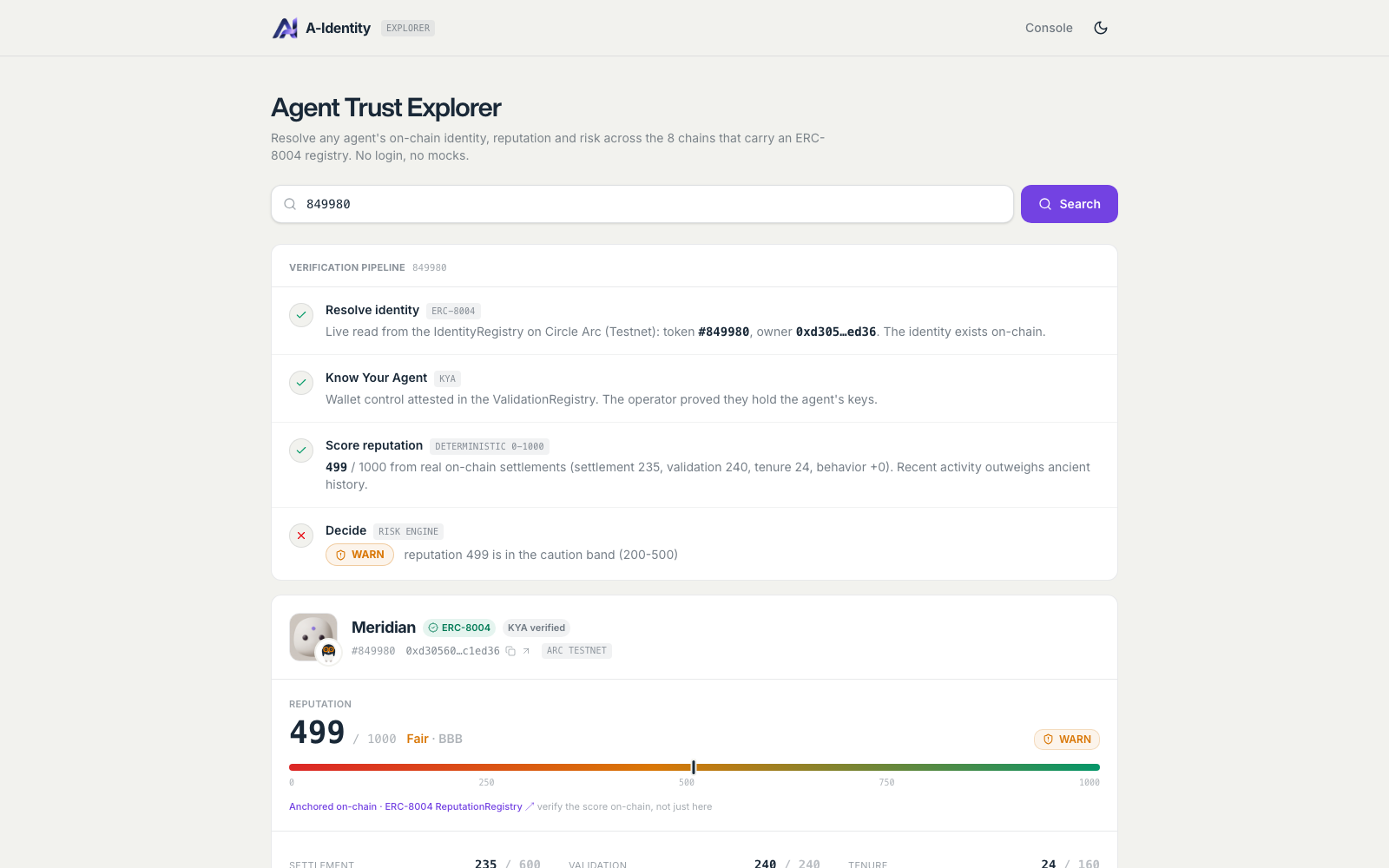
First hit can take ~30s if the free-tier backend is waking up; retry once and it is warm.
Proof it's real (Arc testnet)
Every claim here is a transaction you can open on the Arc testnet explorer:
- Showcase agent "Meridian" - ERC-8004 id #849980, KYA attested on-chain, reputation
from real settlements. Registration (mint) tx:
0x506b125f…· KYA attestation:0x758ddbfa… - ERC-8183 escrow job #155504 - full lifecycle settled on Arc: createJob
0xcce5a56c…→ complete0x245f0ee7… - Circle Gateway - USDC deposited on Arc, moved to Base Sepolia gaslessly and minted there: recipient on Basescan
On-chain policy vault - programmable money that enforces itself
An agent's spend policy can be deployed as its own smart contract on Arc:
AgentSpendPolicy (mcp/contracts/AgentSpendPolicy.sol). Once an agent is given a
vault, its USDC payments settle through the contract, which enforces the policy
on-chain - a per-UTC-day cap, an auto-approve ceiling, a payee allowlist, and a freeze
switch. A payment that breaks a rule reverts on Arc with a typed error (verifiable
on the Arc explorer), not just a server "no"; the human owner can override, adjust limits, freeze,
or withdraw. The server policy engine stays as the fast pre-check and fallback, so agents
without a vault behave exactly as before.
Try it: cd mcp && node --env-file=.env scripts/test-vault.mjs (needs a funded
ARC_SIGNER_KEY) deploys a vault and plays pay / over-limit-revert / freeze / cap out on
real Arc testnet - or use the Permissions → On-chain policy vault panel in the app.
On-chain reason for every payment - Arc Memo precompile
Every direct USDC settlement is routed through Arc's predeployed Memo precompile
(0x5294…), so each agent payment carries an on-chain, indexable audit trail of why it
happened - {agentId, instructionId, service, policyDecision} - emitted as a Memo event on
the Arc explorer, not a server log. Memo.memo(usdc, transferCalldata, memoId, memoBytes) routes the
transfer via the CallFrom precompile, so the paying wallet stays msg.sender (the USDC still
moves exactly as a bare transfer, plus the reason). The memoId is a deterministic keccak of the
instruction, so anyone can look the payment up by memoId without the tx hash. Additive and
credential-gated: on a chain without a Memo precompile it degrades to a plain transfer; the
smart-account vault path stays un-memoed (an SCA can't call the precompile). The Settlements
screen shows the reason and links to the memo on the Arc explorer.
Try it: cd mcp && node --env-file=.env scripts/test-memo.mjs settles $0.01 through the Memo
precompile on real Arc testnet, then reads the emitted event back by its memoId to prove the
reason is provably on-chain. Read it live: GET /api/arc/memos?memoId=<0x…> (or ?sender=<0x…>).
Batched settlement in one Arc tx - Multicall3From
An agent can pay a whole burst of USDC transfers in a single, all-or-nothing Arc transaction
through the predeployed Multicall3From precompile (0x522f…): aggregate3(...) routes each
transfer via CallFrom, so the wallet stays msg.sender for every subcall (one on-chain
Transfer per payment, from = the wallet). This is Arc-native batching for high-frequency
agent payments. allowFailure=false, so the batch is atomic.
→ mcp/src/chains/evm/adapter.ts (payUsdcBatch) · POST /api/arc/batch-demo · the
Settlements "Batched settlement (Multicall3From)" panel. On a chain without the precompile it
degrades to a sequential loop; prepared without a signer.
Try it: cd mcp && node --env-file=.env scripts/test-batch.mjs settles three USDC transfers in
one tx and verifies the three Transfer events, each with from set to your wallet.
Dispute-safe agent commerce - ERC-8183 escrow refunds
When an agent hires another through the ERC-8183 escrow, the money isn't a blind prepay: the
budget is held in escrow and only released to the provider on delivery. If the deliverable is
disputed, the evaluator rejects it and the escrowed USDC is refunded to the client in the same
transaction (reject → Refunded) - buyer protection, on-chain. A second safety net,
claimRefund, lets the client reclaim the escrow after the job's deadline passes (an expiry
refund). This is the ERC-8183 AgenticCommerce reference implementation's own refund path - no
blind prepay, trust-minimized agent-to-agent commerce.
- Backend:
mcp/src/chains/evm/adapter.ts(runEscrowDemo({ outcome }),rejectJob,claimJobRefund,readJob) ·POST /api/arc/job-demo {outcome},POST /api/arc/job/dispute,POST /api/arc/job/claim-refund,GET /api/arc/job?jobId=. - Frontend: the Settlements → "Agent-to-agent escrow" panel has a Dispute & refund button that runs the full reject lifecycle and shows the client being refunded.
Try it: cd mcp && node --env-file=.env scripts/test-refund.mjs runs the full dispute lifecycle
(create → fund → submit → reject) on real Arc testnet and proves the client is refunded on-chain.
An agent pays an agent for trust - Trust Oracle over x402
The same Trust Oracle we sell on OKX.AI (and list on Circle's Agent Marketplace - manifest
in mcp/marketplace/, served live at
/.well-known/agent.json) is
dogfooded by our own agents: before it pays a counterparty, a buyer agent buys a risk_check
over x402 - a gasless Arc-testnet nanopayment via Circle Gateway - and acts on the returned
ALLOW / WARN / DENY verdict. A live "agent pays an agent for trust" loop, on real Arc.
- Backend:
mcp/src/trust-oracle.ts(runTrustOracleDogfood) ·POST /api/arc/trust-oracle-demo. - Frontend: the Settlements → "Trust Oracle" panel: enter a counterparty, pay $0.005, get the verdict.
Try it: cd mcp && node --env-file=.env scripts/test-dogfood.mjs - a buyer agent pays $0.005 over
x402 on real Arc testnet and gets a DENY on a low-reputation counterparty before it can transact.
Know Your Agent (KYA) - a real check, not a stamp
An agent is no longer marked verified for free. It must prove control of its wallet by
signing a challenge (the same verifyMessage primitive as wallet sign-in); only then does its
KYA flip to verified. New agents start unverified; a wrong signature is rejected. The result
is attested on Arc's real ERC-8004 ValidationRegistry (validationRequest +
validationResponse=100, tag "kya", readable via getSummary). Honest by design: an
operator/wallet-proof attestation, not a third-party audit.
Session key - bounded authority with a time limit
An agent's on-chain policy vault can be granted a session key: the operator (the agent's
signer) is authorized by the human owner, scoped by the spend cap and payee allowlist and - now
- by time. The owner grants the key for a duration; the agent acts on its own within those
bounds; when the key expires, its on-chain
payreverts (SessionKeyExpired) until the owner extends, re-grants, or revokes it (ownerPayoverrides are never time-bound). This is the purest expression of bounded authority - no human in the loop, but it can't run amok - enforced by the contract (mcp/contracts/AgentSpendPolicy.solsessionKeyExpiry/setSessionKeyExpiry), not a server. Grant it from Permissions → On-chain Policy Vault → Session key.
Try it: cd mcp && node --env-file=.env scripts/test-session.mjs runs the full lifecycle on real
Arc testnet - grant → pay within the window → the key expires → the agent's pay reverts → the owner
extends → pays again → revoke → reverts.
Real ERC-4337 session key (the standard AA primitive). The same idea, expressed as an actual
account-abstraction session key: the owner deploys a Kernel (ERC-4337 v0.7) smart account and
grants the agent a session key scoped by standard permission policies - toTimestampPolicy
(expiry), toCallPolicy (a payee allowlist + a per-tx cap). The agent then settles entirely on its
own by signing a UserOperation; a payment outside the bounds is rejected by the account's policy
validator on-chain, not a server. Runs on Arc testnet via a Pimlico bundler (Zerodev Kernel).
→ mcp/src/aa-wallet.ts · credential PIMLICO_API_KEY (free at pimlico.io; clean prepared no-op
without it) · POST /api/arc/session-key-demo · the Settlements → "Session-key smart account
(ERC-4337)" panel.
Try it: cd mcp && node --env-file=.env scripts/test-aa-session.mjs deploys a Kernel smart account,
grants a session key (cap + allowlist + expiry), and proves it settles a real UserOp within
bounds while an out-of-bounds payment is rejected on-chain by the policy validator.
Circle Agent Wallet - hosted wallet-layer screening
An agent can also be given a Circle Agent Wallet (Developer-Controlled, on ARC-TESTNET):
Circle's hosted policy engine screens every USDC transfer at the wallet layer (sanctions, address
allow/block, freeze). Credential-gated behind CIRCLE_API_KEY + CIRCLE_ENTITY_SECRET; a clean
no-op without them. Precise by design: Circle screens transfers - the USD spend cap stays enforced
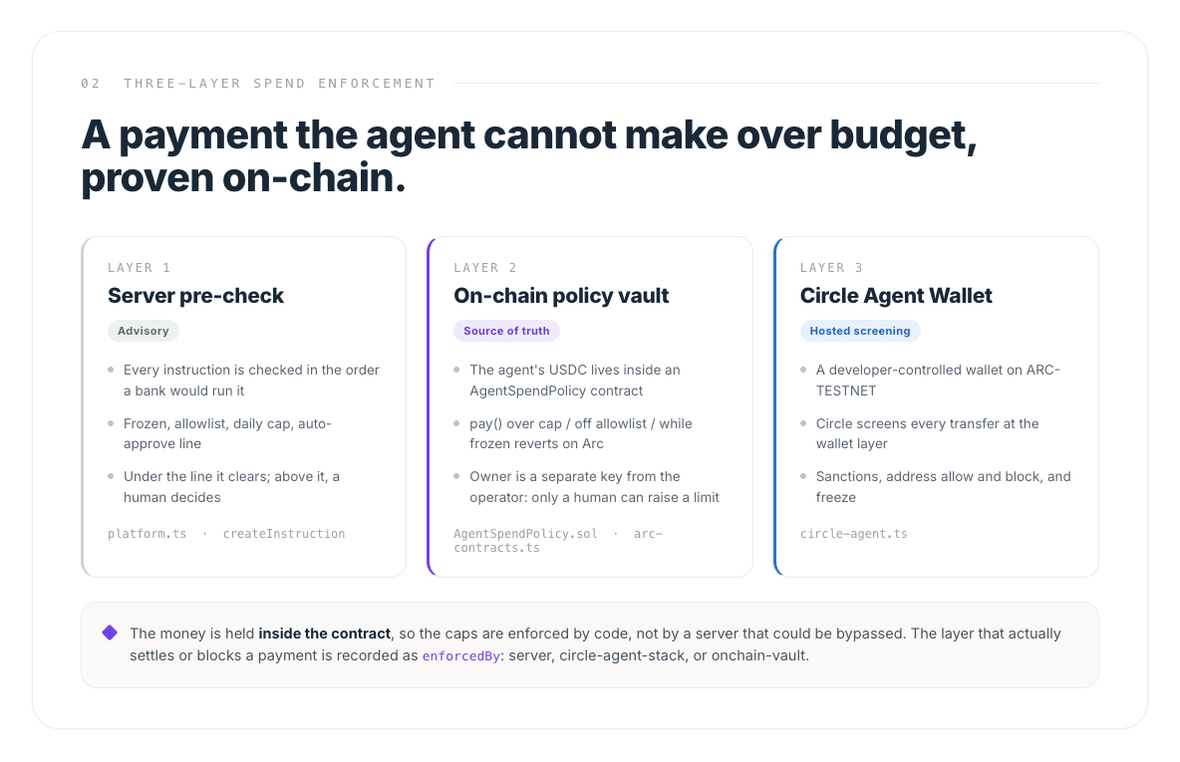
by our server and the on-chain vault. Together: server pre-check + Circle screening + on-chain
vault = three independent guarantees.
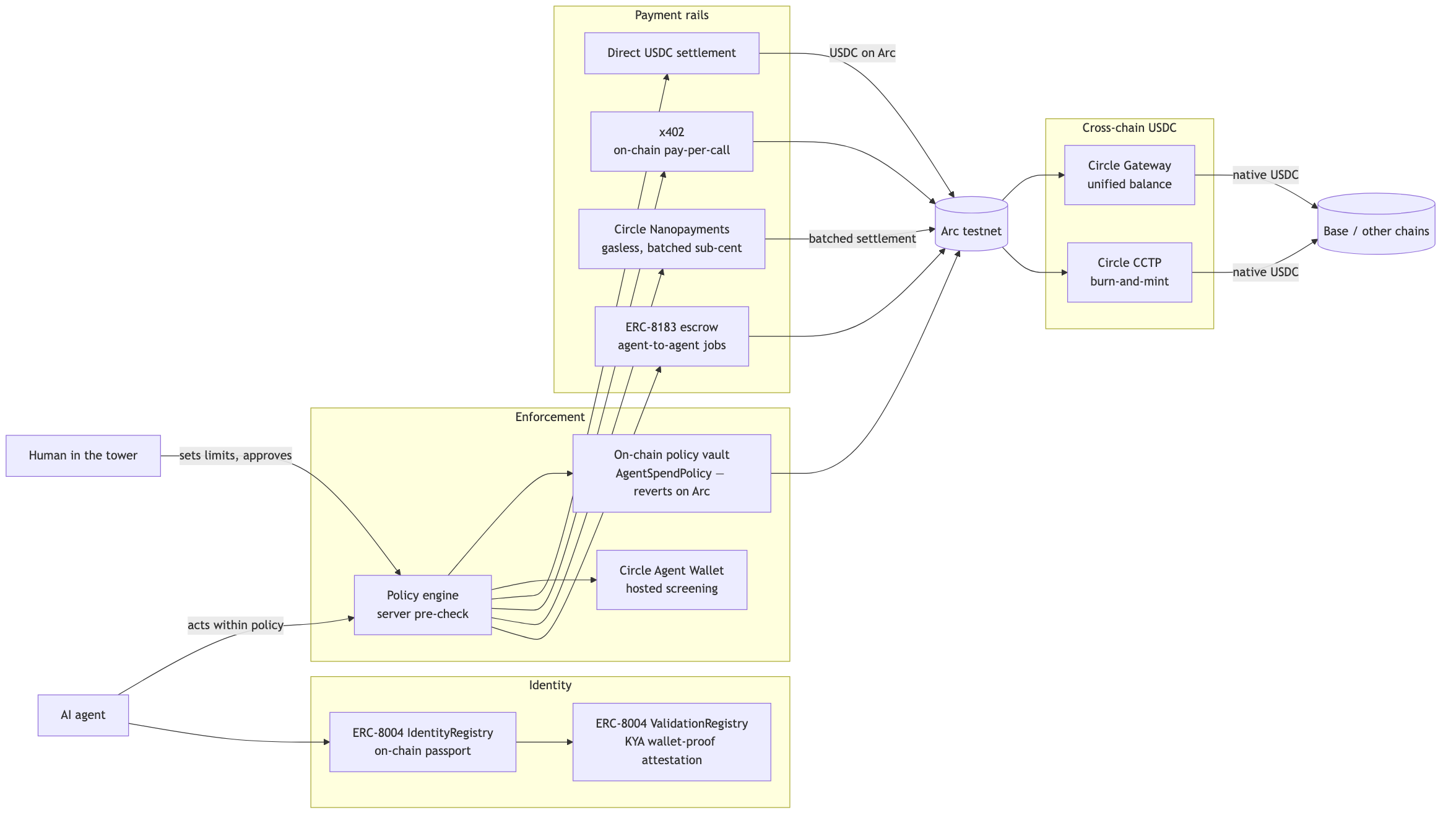
Architecture
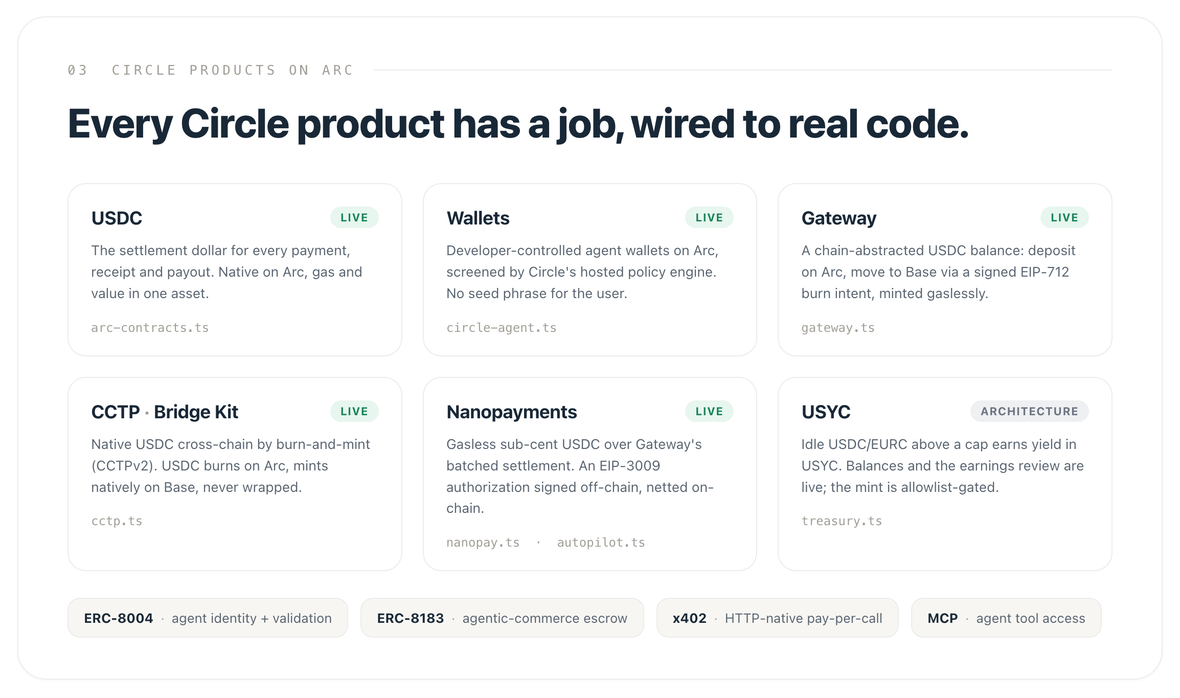
The same system in three views (also drop-in slides for a deck):
Functional MVP: a working frontend and backend
a-identity/
├─ src/               React 19 + Vite + Tailwind v4 frontend (landing, app, blog, use cases)
├─ mcp/               Backend: MCP server + REST companion (Node + viem)
│  ├─ contracts/      AgentSpendPolicy.sol - on-chain spend-policy vault (npm run compile)
│  └─ src/
│     ├─ arc.ts             Live Arc testnet status (block reads)
│     ├─ arc-contracts.ts   Real ERC-8004 + ERC-8183 reads/writes + AgentSpendPolicy vault
│     ├─ circle.ts          Circle developer platform link (env-gated ping)
│     ├─ platform.ts        Agents, wallets, instructions, marketplace (write side)
│     ├─ erc8004.ts         Multi-chain identity provider (mock + rpc)
│     ├─ reputation.ts      Deterministic reputation score (0-1000)
│     └─ http.ts            REST + Streamable HTTP MCP endpoints
├─ docs/              Mintlify documentation site
└─ .env.example       Every configurable key, documented
Two entry points share the same tools: an MCP server (read-only tools for agents) and a REST API (the write side that the app uses).
Backend endpoints (REST, port 3399)
GET  /health                    liveness + supported chains
GET  /api/arc                   live Arc testnet block/chainId
GET  /api/arc/contracts         LIVE reads of ERC-8004 + ERC-8183 + USDC
POST /api/arc/register-onchain  ERC-8004 register (prepared, or real w/ key)
POST /api/arc/create-job        ERC-8183 createJob (prepared, or real w/ key)
GET  /api/circle                Circle platform link (real ping w/ CIRCLE_API_KEY)
POST /api/wallets               create a real Arc keypair (key returned once)
GET  /api/wallet-balance        live native-USDC balance
POST /api/agents                register an agent (KYA + permissions)
POST /api/instructions          pay / purchase / rental / batch (policy engine)
POST /api/instructions/approve  human approval
POST /api/instructions/execute  execute (through the vault if provisioned, else direct; simulated without a signer)
POST /api/agents/vault          provision an on-chain AgentSpendPolicy vault (real w/ key)
GET  /api/agents/vault          live on-chain vault policy + balance
POST /api/agents/circle-wallet  provision a Circle Agent Wallet (hosted screening, w/ Circle keys)
GET  /api/agents/circle-wallet  live Circle wallet state + balance
POST /api/agents/kya/challenge  start a KYA wallet-control challenge
POST /api/agents/kya/verify     verify the signature, key or ERC-1271 contract account (+ on-chain ValidationRegistry attestation)
POST /api/agents/circle-policy/challenge  hash a pasted `circle wallet limit --output json`; returns the message the wallet signs
POST /api/agents/circle-policy/attest     store the owner-attested Circle policy as bands + signed hash (never the policy)
GET  /api/agents/circle-policy/attestation  the attestation, bands only
GET  /api/agents/circle-policy  the same caps as Circle wallet policy commands the owner runs (owner only)
GET  /api/agents/kya            KYA status + live on-chain validation
GET  /api/x402/nano/data        x402 Nanopayments seller (gasless, Gateway-batched; 402→settle)
GET  /api/x402/gateway/tools/:name  the trust tools for Circle Agent Marketplace buyers: Gateway nanopayments on Arc Mainnet and Base mainnet (402; GET or POST to pay)
GET  /api/x402/gateway/status   that rail's config and the Gateway kind proven per chain
GET  /api/x402/gateway/proof    Gateway-credited settlements, batch hashes once landed
POST /api/arc/nanopay-demo      one-click gasless nanopayment (EIP-3009 + Circle Gateway batch)
POST /api/arc/cctp-demo         one-click CCTP burn-and-mint (Arc→Base Sepolia, native USDC)
GET  /api/cctp/stellar/status   CCTP between Stellar and EVM: sides, Circle-verified contracts, signers (addresses only)
POST /api/cctp/stellar/bridge   CCTP transfer either way: prepared for any verified session, executed only for CCTP_BRIDGE_OPERATORS (dedicated keys; capped; testnet unless opted in)
POST /api/arc/agent-run         autonomous run: agent pays a service on its own until its budget is used up, then stops (+ protocol fee)
GET  /api/marketplace           Agent House feed
POST /api/follow                follow an agent
POST /api/feedback              site feedback from the corner widget, emailed to the team via Resend (anonymous; rate-limited; 503 when no RESEND_API_KEY)
Quickstart
# 1. Install
npm install
npm install --prefix mcp

# 2. Run everything (UI + MCP backend + docs)
npm run dev:all
#   UI    -> http://localhost:5173
#   MCP   -> http://localhost:3399
#   Docs  -> http://localhost:3000

# 3. Prove the live Arc integration
curl http://localhost:3399/api/arc/contracts
Copy .env.example to .env.local for the frontend (Vite). The backend reads
its config from the process env directly - see below. Everything is optional for
a demo: without a signer key the app still does live contract reads and labels
on-chain writes as prepared/simulated; add a funded ARC_SIGNER_KEY to
broadcast real transactions.
Going live (testnet)
-
Fund a wallet: create one in the app (Agent ID -> New agent -> Create wallet; the keypair is generated in your browser), then get testnet USDC at faucet.circle.com.
-
Enable real writes: the backend reads
ARC_SIGNER_KEYfromprocess.envand does not auto-load a.envfile. Start it with the key inline:ARC_SIGNER_KEY=0x<funded-key> node mcp/dist/http.js # or, keeping it in mcp/.env (Node 20.6+): node --env-file=mcp/.env mcp/dist/http.jsNow, on-chain registration, USDC settlement, and job escrow broadcast for real.
-
Circle platform: add
CIRCLE_API_KEY(from console.circle.com) to enable the real Circle ping.
Deploy
Frontend is a static Vite build; the backend is a long-running Node server (not serverless).
- Frontend -> Vercel. Leave
VITE_MCP_URLempty so the app calls same-origin paths (vercel.jsonproxies them to the backend). SetVITE_DOCS_URLto the deployed docs site (if unset, docs links fall back to the live app origin, not a dead domain). - Backend -> Render (or any host that runs a persistent Node process). Root
directory
mcp, buildnpm install --include=dev && npm run build, startnpm run start:http. The server binds to the host-provided$PORTand self-pings to stay warm on free tiers. Set in the host's env panel:AUTH_SECRET- required: a strong, stable random string. Without it the server signs session tokens with a random per-process secret (safe, but sessions drop on restart) and logs a warning; a public default is never used.ALLOWED_ORIGINS- comma-separated site origins allowed to call the API cross-origin (e.g.https://a-identity.xyz). Unset →*(dev only).ARC_SIGNER_KEY- funded key to broadcast real Arc writes (optional; without it writes are prepared/simulated and labeled as such).DATABASE_URL- Postgres connection string for durable state.
State persists to Postgres when DATABASE_URL is set, else to
mcp/data/platform.json (gitignored). x402 replay protection (spent-payment
hashes) persists the same way, so a restart can't reset it.
Reliability - keeping the backend warm (avoiding cold-start 502s)
A free Render web service spins down after ~15 min idle and takes ~50s to wake. Because the frontend reaches it through a same-origin Vercel proxy whose gateway times out at ~30s, a cold wake shows up in the app as a hard 502 - and the poller can't warm it through the proxy, so "waiting" doesn't help. This is handled in three layers:
- Definitive fix - upgrade Render to the paid Starter plan (~$7/mo). No spin-down,
no cold start, instant responses. Render dashboard → the
a-identity-backendservice → Settings → Instance Type → Starter. This is the only way to fully eliminate the cold-start 502 for a live demo. Recommended before any presentation. - Keep-warm cron (free).
.github/workflows/keep-warm.ymlpings/healthevery ~10 min so the service never idles out. Set the repo Actions variableBACKEND_URLif the host changes. Note: GitHub cron can be delayed under load, so it reduces - but doesn't guarantee zero - cold starts on the free plan. - Frontend resilience (
src/lib/api.ts).wakeBackend()fires a directno-corsping to the backend origin (bypassing the proxy's 30s cap so a cold boot can finish);apiFetch()retries idempotent reads through a cold start and, for mutations, waits for/healthbefore sending exactly once (never double-submitting). The console pre-warms the backend on mount, and screens show a "waking up" state instead of failing.
Human-on-the-loop
A-Identity never custodies a key autonomously, never deploys a contract on its own, and never moves real value without an explicit human approval. Wallet keys are generated in the browser and never leave it - the server only ever sees the public address, and sign-in is by wallet signature (no passwords). This is a design rule, not an afterthought.
Security posture
Testnet MVP, engineered like it is not. The short version:
- Fail-closed money paths. x402 replay protection refuses to verify while its durable
spent-set is unreachable; payments bind the payer by signature so a scraped tx hash cannot
redeem someone else's payment (
mcp/src/x402.ts). - Three independent enforcement layers for spend policy (server pre-check, on-chain vault, Circle Agent Wallet screening), so one layer failing never fabricates a success.
- A hostile review, then a remediation pass. A full adversarial security review (2026-07-18) found and closed ownership, replay, SSRF, rate-limit and self-attestation issues; the invariants it produced are enforced by tests, not comments (e.g. nothing outside the chain registry may hardcode a chain constant, the platform layer graph cannot be violated, the paid ASP must answer 402).
- Honest state, always. Every write returns
preparedwith the exact call when no signer is configured; nothing is marked settled without a confirmed receipt.
Report vulnerabilities per SECURITY.md.
Roadmap
The living version is ROADMAP.md (now / next / later). The phase view:
- Phase 1 (now): Arc + Circle, end to end. Live contract reads; write path wired and env-gated.
- Phase 2 (shipped): Stellar. The Soroban spend vault, the x402 rail and the
facilitator run end to end on both networks, and pubnet has been
liveand selling since 2026-08-27. What is still owed there is operational rather than structural: the 2-of-3 owner signers split across more than one keystore, the vault's instance TTL re-extended before it archives, and an external audit the contract has never had. The pubnet fee payer was split off the vault operator key on 2026-09-15. - Phase 3: Avalanche.
New networks are a registry entry plus (for non-EVM) one adapter: the chain registry
(mcp/src/chains/registry.ts) is the single source of truth
and a test fails the build if anything else hardcodes a chain, so adding one is additive,
not a rewrite (see CONTRIBUTING.md).
Tech stack
- Frontend - React 19, Vite 6, Tailwind v4, Framer Motion, React Router v7, Zustand, viem
- Backend - TypeScript, Node.js, Arc Testnet (viem), Model Context Protocol SDK, Zod
- Circle - USDC / EURC, Wallets (
@circle-fin/developer-controlled-wallets), Gateway, CCTP / Bridge Kit (@circle-fin/bridge-kit), Nanopayments (@circle-fin/x402-batching), USYC (tokenized money-market yield) - Standards - ERC-8004 (agent identity + validation), ERC-8183 (agentic-commerce escrow), x402 (HTTP-native pay-per-call), MCP (agent tool access)
- Core - a three-layer spend policy (server pre-check, on-chain
AgentSpendPolicyvault, Circle Agent Wallet screening) and honest settlement: an instruction is never markedexecuted_onchainwithout a confirmed transaction hash - Docs - Mintlify (
a-identity.mintlify.site)
Circle integration
How each Circle product is wired, the code path, the credential to set, and the live
endpoint - so any of it can be verified against the repo. Nothing is mocked: with the
credentials set, every path runs a real transaction on Arc; without them it returns a
prepared / not configured state and says so. The on-chain rails (Gateway, CCTP,
Nanopayments) are permissionless on Arc testnet - they need only a funded
ARC_SIGNER_KEY, no Circle API key.
- USDC - the settlement dollar for every payment, receipt and payout. Native Arc USDC
(
0x3600…0000, 6-decimal ERC-20 view); realtransfer/balanceOf. →mcp/src/arc-contracts.ts· credentialARC_SIGNER_KEY(to broadcast) · read live atGET /api/wallet-balance. - **Circle Wallets (Developer-Controlled / W3S), each agent can get a hosted wallet on
ARC-TESTNET whose outbound transfers are screened by Circle's policy engine (sanctions /
allow-block / freeze).
initiateDeveloperControlledWalletsClient→createWalletSet→createWallets→createTransaction. →mcp/src/circle-agent.ts· credentialsCIRCLE_API_KEY+CIRCLE_ENTITY_SECRET·POST/GET /api/agents/circle-wallet, statusGET /api/circle. - Circle Gateway, a chain-abstracted USDC balance: deposit on Arc, then a signed
EIP-712 burn intent moves it to Base Sepolia via the Forwarding Service, minted gaslessly
in seconds.
→
mcp/src/gateway.ts· permissionless (ARC_SIGNER_KEYonly) ·GET /api/arc/gateway-balance,POST /api/arc/gateway-demo. - CCTP · Bridge Kit, native USDC cross-chain by burn-and-mint (CCTPv2) via
@circle-fin/bridge-kit+@circle-fin/adapter-viem-v2: approve → burn → attestation → mint, Arc → Base Sepolia (never wrapped). →mcp/src/cctp.ts· permissionless (ARC_SIGNER_KEYonly) ·POST /api/arc/cctp-demo. - Nanopayments, gasless, sub-cent USDC over Circle Gateway's batched settlement
(
@circle-fin/x402-batching): the buyer signs an EIP-3009 authorization off-chain, Gateway credits instantly and batches the on-chain tx, so thousands of authorizations net into one. →mcp/src/nanopay.ts· permissionless (ARC_SIGNER_KEYonly) · sellerGET /api/x402/nano/data, one-clickPOST /api/arc/nanopay-demo, autonomousPOST /api/arc/agent-run(the agent pays a burst on its own, then stops at its budget). - USYC (Circle's yield-bearing token) - the agent treasury: idle USDC/EURC above a
working-capital cap is put to work in USYC, Circle's tokenized money-market fund on Arc,
with a live projected-earnings review and owner authorization. Balances and the review are
real (no key); the USDC→USYC mint targets the real USYC Teller and is gated on USYC
allowlisting (Circle Support, ~24-48h), so it ships as a prepared, architecture-level
Integration, never a mocked position.
→
mcp/src/treasury.ts·GET/POST /api/agents/treasury.
StableFX is not used. USDY is deliberately avoided too - it is an Ondo product, not Circle, and not deployed on Arc; USYC is the Circle-native yield token used here.
Circle Product Feedback
Which Circle products we used, why, what worked, and what we'd improve.
Circle Arc (testnet), our base chain. Gas paid in USDC and sub-second finality
made the whole "agent pays per action" loop feel native; a single asset for both gas
and value removed a class of UX problems. Improve: the IdentityRegistry isn't
enumerable (totalSupply reverts), so a "registered agents" count needs off-chain
indexing; a documented events/indexing path would help.
Circle Gateway, chain-abstracted USDC. We deposit on Arc → a unified balance →
move it to Base Sepolia via the Forwarding Service (signed EIP-712 burn intent),
minted gaslessly in seconds, permissionlessly (no API key). This is the cleanest
cross-chain UX we integrated. Improve: the estimate→sign→submit shape and the
bytes32-padded TransferSpec fields were the fiddly part; a typed helper in the SDK
would cut integration time.
Circle Developer-Controlled Wallets (Agent Wallets), a hosted wallet layer policy engine that screens each transfer (sanctions / allow-block / freeze). We use it as one of three independent enforcement layers. Improve: the testnet faucet doesn't cover ARC-TESTNET (403), so we fund new Circle wallets from our own signer; first-class Arc faucet support would remove that step. Also, screening is transaction screening, not a per-wallet USD spend cap; we enforce the cap in our server + the on-chain vault and are explicit about that split.
USDC / faucet - the unit of account throughout; faucet.circle.com for testnet
funding.
Circle Nanopayments, gasless, sub-cent, Gateway-batched. We ship two x402 rails:
- On-chain, self-verifying x402 (
mcp/src/x402.ts) - server returns 402 + requirements → client pays USDC on Arc → server verifies the payment on-chain with replay protection + a single-use request nonce → serves. Open standard, provable settlement, no hosted meter. - Circle Nanopayments (
mcp/src/nanopay.ts), the same x402 negotiation over Circle Gateway'sGatewayWalletBatchedscheme: the buyer signs an EIP-3009 authorization off-chain (zero gas), Circle Gateway verifies + credits instantly and batches the on-chain settlement, so true sub-cent payments become economical for high-frequency agent traffic. Permissionless on Arc testnet (no API key); the buyer's balance is the same Gateway Wallet deposit we already fund. Improve: a testnet faucet that pre-funds a Gateway balance would remove the one-time deposit step from a first-run demo.
Circle CCTP (Bridge Kit), native USDC cross-chain by burn-and-mint (mcp/src/cctp.ts):
USDC is burned on Arc and minted natively on Base Sepolia - never wrapped - via CCTPv2
(@circle-fin/bridge-kit). Distinct from Gateway's unified-balance forwarding; together they
show both canonical USDC-liquidity primitives. Improve: the "leaving Arc, amount must exceed
the CCTPv2 max fee" floor is easy to trip on tiny testnet transfers - a clearer SDK error would help.
Team
- Aybars Dorman (@srabyanamrod): product, go-to-market, frontend, and submission.
- Meric (@mericcintosun): backend, smart contracts, and multi-chain integration.
License
MIT. See LICENSE.