cgx
Turn any Git repository into a queryable knowledge graph.
Power your agent
पब्लिशर का इंस्टॉल। PlugMCP एंडपॉइंट नहीं।
Host a copy with our keys and logs.
रजिस्ट्री में अभी कोई पैकेज्ड रिलीज़ नहीं है। रिपॉज़िटरी का README देखें.
रिमोट URL या आपकी मशीन पर कमांड? दोनों इंस्टॉल में क्या अंतर है
PlugMCP पर चलाएँ
A new server you create. It is not this listing's official endpoint. Use the publisher install when you want their URL and their credentials.
लॉन्च🚀 v0.5.3 — ownership fix:
cgx analyzewas minting one bogusAuthornode per file (named after the file path), which polluted the graph with ~one singleton community per file. Authorship is now keyed by contributor, socgx docsownership is correct and the Louvain community count drops accordingly. Docs-vault polish: the Glossary collapses singleton communities and drops zero-count node kinds, undocumented module notes lose the empty "Description" column,CrossClusterDepsno longer emits dangling wiki-links, andOwners.mdshows a real contributor → files-owned table.cgx update --autonow verifies the version actually changed instead of always reporting success. v0.5.3 →v0.5.2 —
cgx todosno longer flags JSDoc prose (Note:,**Warning:**, the word "bugs") as annotations: matching is now case-sensitive with word boundaries, and the displayed text shows the actual matching line instead of the/**block opener.cgx todoson an indexed repo with no annotations now says "No annotation comments found." instead of suggestingcgx analyze. The terminal graph layout falls back to a deterministic grid when the force-directed simulation diverges, fixing a rare NaN/Inf crash in the TUI. README clarifications: vault layout diagram,node_count_maxpredicate. v0.5.2 →v0.5.1 — bisect-friendly git hooks: the cgx-managed
post-checkout/post-commithooks now skip duringgit bisect,git rebase, andgit merge, socgx bisect-scriptworks insidegit bisect runwithout dirtyingAGENTS.md/CGX_SKILL.md. Bisect-script also now exits125(skip) on empty predicate files and whenrule_violations_maxis set without--rule-violations N, instead of silently passing. v0.5.1 →v0.5.0 —
cgx docs generate --vaultturns your indexed repo into an Obsidian-ready documentation vault (project overview, dep purposes, unused-dep detection, per-file TL;DR, role classification) · docstring extraction now covers Rust, Go, Java, PHP, Python (was TypeScript-only) ·cgx bisect-scriptplugs intogit bisect runto find commits that break declarative graph predicates · newGraphDbqueries:get_file_summary,get_public_api,list_entry_points,get_cross_cluster_deps. Release notes →Earlier: v0.4.0 —
cgx watch,cgx query context, Claude Code PreToolUse hook, cache management.
   STRUCTURAL                         TEMPORAL
   what calls what                    what changes together

   AuthService                        payments.ts ─┐
       │                                            │ 87% co-change
       ├── login()                                  │ (no import edge!)
       │     └── db.query()           flags.ts  ────┘
       └── logout()                          ▲
             └── session.clear()             │
                                       hidden coupling
                                       lives here
Every other code-analysis tool only shows you the left side. cgx builds both — by parsing your AST with Tree-sitter and overlaying your full Git history. The temporal graph is where most bugs and refactor risk actually live.
# 1. Install
brew install aayushbahukhandi/cgx/cgx       # or: cargo install cgx-cli

# 2. Index your repo (functions, imports, git history — all in seconds)
cd your-project && cgx analyze

# 3. Open the WebGL graph in your browser
cgx view --web

# 4. Ask architectural questions in milliseconds
cgx query blast-radius "AuthService"        # what breaks if I change this?
cgx hotspots                                # high churn × coupling = danger zone

# 5. Wire up your AI editor (Cursor, Claude Code, Windsurf, Codex)
cgx setup
After cgx analyze, two files land in your repo root: CGX_SKILL.md (instructs your AI to query the graph instead of opening files) and AGENTS.md (prose architecture summary). Both auto-regenerate on every commit.
cgx docs generate --vault           # writes into your Obsidian vault (auto-detected or configured)
cgx docs generate --local           # writes into ./cgx-docs/
cgx docs generate --vault --force   # full rebuild
cgx docs generate --vault --incremental   # only regenerate files whose graph slice changed
cgx docs status                     # show what would regenerate
cgx docs prompts --next             # stream unfilled AI prose stubs into Claude/Cursor
The vault has a layered structure built straight from your graph:
cgx-docs/
├── .obsidian/                          ← Obsidian workspace settings (auto-created)
├── README.md                           ← project description + dep summary + nav
├── 00-Overview/
│   ├── Architecture.md                 ← stack, languages, dep purposes + unused-dep detection,
│   │                                     files-by-role, largest groups, entry points
│   ├── HowToNavigate.md                ← reading path for new contributors
│   └── Glossary.md                     ← node kinds + communities
├── 10-PublicAPI/<group-slug>.md        ← exported symbols per source directory
│                                         (e.g. source-core.md, test-helpers.md)
├── 20-Architecture/
│   ├── Groups.md                       ← primary navigation: by source directory
│   ├── Communities.md                  ← raw Louvain clusters
│   ├── CrossClusterDeps.md
│   └── EntryPoints.md
├── 30-Modules/<role>/<file>.md         ← per-file: TL;DR + role badge + structure table
│                                         with inline docstring descriptions + callers/
│                                         callees + tests + ownership + ``
│                                         AI stub. <role> is `source` or `test`.
├── 40-Risk/
│   ├── Hotspots.md
│   ├── ComplexityHigh.md
│   ├── DeadCode.md
│   └── Duplicates.md
└── 50-Ownership/
    ├── Owners.md
    └── BlameGraph.md
cgx itself never calls an LLM. Each module note ends with a self-contained `` block that bundles every fact your AI needs to write prose (exported symbols, callers/callees, tests, owners, metrics, existing docstrings). Paste it into Claude/Cursor — your schedule, your API key, your cost.
Configure the default vault in .cgx/config.toml:
[docs]
vault_path = "/Users/you/Documents/Obsidian Vault"   # used by --vault
output_dir = "./cgx-docs"                             # used by --local
wiki_links = "obsidian"                               # or "markdown"
prompt_packets = true
frontmatter = true
cgx bisect-script plugs into git bisect run and evaluates declarative predicates over the freshly-indexed graph at each commit:
# 1. Generate a starter predicate file
cgx bisect-script --example > .cgx/bisect.toml

# 2. Edit .cgx/bisect.toml — anything you can express against the graph:
#    node_count_min, node_count_max, nodes_exist, nodes_missing, nodes_alive,
#    rule_violations_max

# 3. Bisect
git bisect start
git bisect bad HEAD
git bisect good v0.4.1
git bisect run cgx bisect-script --analyze
Exit codes: 0 = good, 1 = bad, 125 = skip — exactly what git bisect run expects. Use --analyze to re-index on every commit visited.
brew install aayushbahukhandi/cgx/cgx
To update:
brew upgrade aayushbahukhandi/cgx/cgx
cargo install cgx-cli
The installed binary is named cgx. If cgx --version prints command not found, add Cargo's bin directory to your PATH:
# zsh (~/.zshrc) or bash (~/.bashrc / ~/.bash_profile)
export PATH="$HOME/.cargo/bin:$PATH"
# fish (~/.config/fish/config.fish)
fish_add_path "$HOME/.cargo/bin"
cargo installcompiles from source and may take a few minutes. Run it again to update.
Download the latest release from GitHub Releases. Replace VERSION with the tag shown on that page (e.g. v0.4.0).
# macOS arm64 (Apple Silicon)
curl -L https://github.com/AayushBahukhandi/cgx/releases/latest/download/cgx-VERSION-aarch64-apple-darwin.tar.gz | tar xz
sudo mv cgx /usr/local/bin/

# macOS x86_64 (Intel)
curl -L https://github.com/AayushBahukhandi/cgx/releases/latest/download/cgx-VERSION-x86_64-apple-darwin.tar.gz | tar xz
sudo mv cgx /usr/local/bin/

# Linux x86_64
curl -L https://github.com/AayushBahukhandi/cgx/releases/latest/download/cgx-VERSION-x86_64-unknown-linux-gnu.tar.gz | tar xz
sudo mv cgx /usr/local/bin/
Windows: download the .zip from the releases page and place cgx.exe in a directory on your %PATH%.
cgx --version
cgx doctor      # checks your setup and editor integrations
Starting from v0.1.6, cgx checks for updates once a day and prints a notice when a newer version is available. You can also check and update manually:
cgx update          # show installed version, latest version, and upgrade instructions
cgx update --auto   # detect your install method and upgrade automatically
Set CGX_NO_UPDATE_CHECK=1 to disable the background check.
On v0.5.2? Run
cgx update --autoor reinstall. v0.5.3 fixes a graph-ingestion bug wherecgx analyzecreated one bogusAuthornode per file (named after the path), inflating the community count with per-file singletons and producing a meaningless ownership view. Re-runcgx analyze --forceafter upgrading so authorship is re-keyed by contributor — you'll see the community count drop andcgx docsownership become correct. Also polishes the docs vault (Glossary, module-note structure tables, cross-cluster links, owners table) and makescgx update --autoverify the upgrade actually changed the version. No schema changes.On v0.5.1? Run
cgx update --autoor reinstall. v0.5.2 is a polish release:cgx todosno longer reports JSDoc prose (Note:,**Warning:**, the word "bugs") as annotation tags, and the displayed text is now the matching line rather than the/**opener — re-runcgx analyze --forceto re-extract tags. The TUI also gets a deterministic grid fallback when the force-directed sim diverges, preventing a rare NaN/Inf crash. No schema changes.On v0.5.0? Run
cgx update --autoor reinstall. v0.5.1 fixes the cgx-managed git hooks so they no-op duringgit bisect/rebase/merge(previouslygit bisect run cgx bisect-scriptwould dirtyAGENTS.mdandCGX_SKILL.mdat every step and break the next checkout).cgx bisect-scriptalso now exits125(skip) instead of silently passing when the predicate file is empty or whenrule_violations_maxis set without--rule-violations N. Re-runcgx analyzeonce after upgrading so the new hook template is installed.On v0.4.x? Run
cgx update --autoor reinstall. v0.5.0 addscgx docs generate --vault(Obsidian documentation vault with project overview, per-file TL;DR, role classification, dep purposes + unused-dep detection, AI prose stubs),cgx bisect-script(drop intogit bisect run), docstring extraction for Rust/Go/Java/PHP/Python (was TypeScript-only), and four newGraphDbquery methods. Re-runcgx analyzeafter upgrading to populate the newdoc_commentdata.On v0.3.0? Run
cgx update --autoor reinstall. v0.3.1 fixescgx complexity --combined(now uses file-level churn), addscgx test coverage --by=community, improvescgx todosempty-result messages, shows available built-in rules incgx rules list, and adds a stale-index warning tocgx complexity. Also adds previously undocumented commands:cgx impact,cgx init,cgx list,cgx query deps,cgx query community.On v0.2.x? Run
cgx update --autoor reinstall. v0.3.0 addscgx todos,cgx docs coverage,cgx complexity,cgx test coverage/gaps,cgx deps health,cgx review,cgx rules check,cgx dupes,cgx explain, andcgx timeline— a full suite of advanced code intelligence commands. Re-runcgx analyze --forceafter upgrading to refresh the graph with new columns (complexity, doc_comment, is_tested, test_count).On v0.1.9 or older? Run
cgx update --autoor reinstall. v0.2.0 added dead code detection (cgx query dead-code) and fixed cross-file call tracking —new ClassName(), static method calls, and module-level function calls now all create proper edges, eliminating the majority of false positives.
After cgx analyze, a CGX_SKILL.md file appears in your repo root. Any AI assistant that can read files and run terminal commands — Claude Code, Cursor, GitHub Copilot Chat, Gemini CLI — will automatically use it.
The skill file tells your AI:
cgx query instead of reading source filesget_blast_radius) and CLI equivalents (cgx query blast-radius) in one placeResult: Your AI stops reading source files to answer an architectural question and runs one cgx query command instead. get_repo_summary costs ~150 tokens; reading a single large source file costs 15,000–50,000. Same answer, without opening a file.
/cgx slash command in Claude Codecgx setup # installs ~/.claude/skills/cgx/SKILL.md + registers /cgx
After running cgx setup, type /cgx in Claude Code to analyze any repo interactively — even repos that haven't been pre-indexed. Works like /graphify but for structural code queries rather than knowledge graph building.
cgx setup # auto-detects your editors and writes their MCP configs
Restart your editor. cgx now exposes 10 typed tools your AI can call directly:
Every response includes a _summary field — a plain-text sentence the model reads first before parsing JSON, so it can skip deeper inspection when not needed.
Example: Ask "refactor the login function to add rate limiting" in Claude Code. It calls get_blast_radius, get_neighbors, and get_file_owners — 3 tool calls, under 200 tokens total — then writes the code knowing exactly what it needs to update.
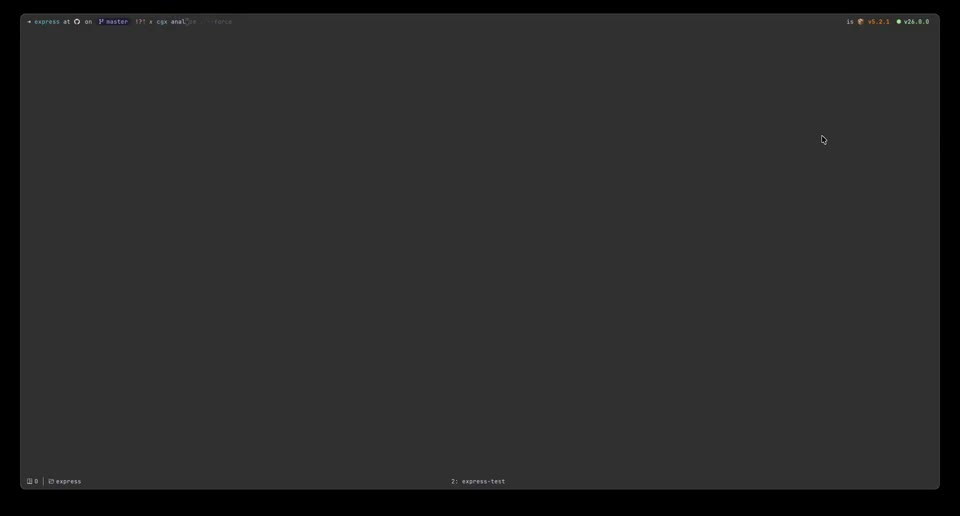
CLI
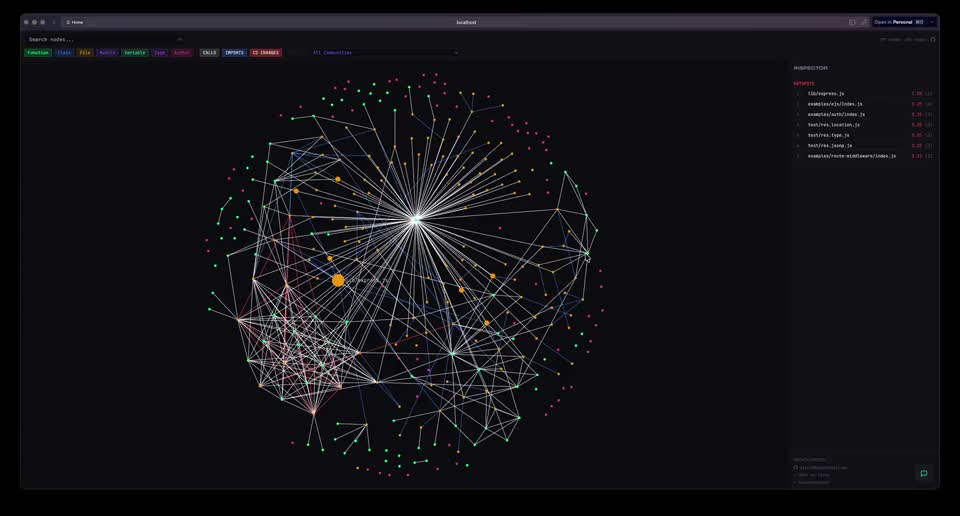
Web UI
cgx analyze                        # index current repo
cgx analyze ./path                 # index any local path
cgx analyze github:owner/repo      # clone from GitHub and index (stored in ~/.cgx/clones/)
cgx analyze --watch                # live-reload on file save
cgx analyze --incremental          # re-parse only changed files (used by git hooks)
cgx analyze --no-git               # skip git history layer
cgx analyze --force                # full clean re-index
cgx analyze --verbose              # verbose output during analysis
cgx analyze --no-cluster           # skip community detection
cgx analyze --quiet                # suppress output
cgx view                       # terminal TUI (works over SSH)
cgx view --web                 # browser WebGL graph — auto-analyzes if not indexed
cgx view --community=3         # scope TUI view to a cluster
In the terminal TUI, press
eon a selected node to view its ego-graph (neighbors up to 2 hops).
cgx share                      # upload graph to a GitHub Gist → hosted viewer URL
cgx share --token ghp_xxx      # use a specific GitHub token
cgx share --public             # make the Gist public (default: secret)
# To unshare: gh gist delete <gist-id>   (shown in cgx share output)
cgx share requires a GitHub token with gist scope. It uses (in order): --token, GITHUB_TOKEN env var, or gh auth token if you have the GitHub CLI installed.
The returned URL looks like:
https://aayushbahukhandi.github.io/cgx/?data=https://gist.githubusercontent.com/...
Anyone can open that link in a browser — no cgx install needed.
cgx publish                    # push self-contained graph site to gh-pages branch
cgx publish --dry-run          # preview what would be pushed
cgx publish --badge            # print README badge markdown
cgx query find "AuthService"            # locate any symbol
cgx query find "login" --kind=Function  # filter by kind
cgx query deps "AppError"               # dependencies of a node
cgx query blast-radius "deleteUser"     # what breaks if this changes?
cgx query chain "login -> AppError"     # trace a call chain (format: "from -> to")
cgx query community 7                   # all nodes in community #7
cgx query dead-code                     # unreferenced exports, unreachable functions, zombie files
cgx query dead-code --kind=exports      # filter: exports | functions | variables | files | disconnected
cgx query dead-code --confidence=high   # only high-confidence candidates
cgx query dead-code --summary           # count table by category and confidence
cgx query search "session"             # search by symbol name
cgx query owners src/payments/index.ts  # git blame ownership for a file
cgx hotspots                   # high churn × high coupling = danger zone
cgx blame-graph                # ownership by contributor
cgx diff HEAD~5                # architecture diff between commits
cgx impact                     # downstream impact of changes in the last 7 days
cgx impact --since=14          # look back N days
cgx todos                                    # list all TODO/FIXME/HACK/NOTE tags
cgx todos --kind=FIXME                       # filter by tag kind
cgx todos --comment-type=jsx                 # only JSX {/* */} comments
cgx todos --comment-type=jsx_commented_code  # JSX code blocks that are commented out
cgx todos --json                             # output as JSON
cgx docs coverage                            # % of exported functions with doc comments
cgx complexity                     # top 20 functions by cognitive complexity
cgx complexity --threshold=0.15    # functions with score > 0.15
cgx complexity --combined          # sort by complexity × churn combined risk
cgx test coverage                  # overall test coverage stats
cgx test coverage --by=community   # breakdown by cluster
cgx test gaps                      # untested high-coupling functions
cgx test suggest                   # prioritized test-writing list
cgx deps health                    # full report — packages, versions, CVE counts
cgx deps health --critical         # only CVE-affected packages
cgx deps audit                     # fast CVE count per package
cgx deps outdated                  # packages with newer versions available
cgx review                         # current branch vs main/master
cgx review feature/my-branch       # specific branch vs main
cgx review HEAD~5                  # last 5 commits
cgx review --format=markdown       # GitHub PR comment format
cgx review --format=github-actions # GitHub Actions annotation format
cgx rules check                    # run all rules in .cgx/rules.toml
cgx rules check --rule=no-cycles   # run a specific rule
cgx rules list                     # list all defined rules
Example .cgx/rules.toml:
[[rules]]
name = "no-circular-dependencies"
built_in = "no_cycles"
severity = "error"

[[rules]]
name = "no-direct-db-access-outside-repository-layer"
description = "Only repository files should import from db/"
severity = "error"
query = """
SELECT n.path, e.dst FROM edges e
JOIN nodes n ON n.id = e.src
WHERE e.kind = 'IMPORTS' AND e.dst LIKE '%/db/%'
  AND n.path NOT LIKE '%/repository/%'
"""
Built-in rules: no_cycles, max_coupling, max_complexity, require_docs_for_public.
cgx dupes                          # all clone pairs (threshold 80%)
cgx dupes --threshold=0.9          # near-identical clones only
cgx dupes --kind=exact             # exact duplicates only
cgx explain AuthService            # explain a specific symbol
cgx explain src/auth/              # explain a folder
cgx explain --onboard              # full onboarding guide for the repo
cgx explain --onboard --out=ARCHITECTURE.md  # write to file
cgx timeline                       # snapshot last 20 commits
cgx timeline --commits=50          # last N commits
cgx timeline --since=2024-01       # since a date
cgx timeline --json                # output as JSON
cgx export --format=json       # full graph JSON
cgx export --format=mermaid    # paste into any README
cgx export --format=graphml    # import into Gephi / yEd
cgx summary                    # repo stats: nodes, edges, languages, communities
cgx doctor                     # run diagnostics on your install
cgx clean                      # remove indexed data for current repo
cgx clean --all                # remove ALL indexed repos
cgx status                     # show index status for registered repos
cgx init                       # create .cgx/config.toml with defaults
cgx init --yes                 # non-interactive with defaults
cgx list                       # list all indexed repos with node/edge counts
The browser UI (cgx view --web) includes a built-in chat panel. Ask natural language questions about your codebase.
export OPENAI_API_KEY=sk-...
cgx serve
export ANTHROPIC_API_KEY=sk-ant-...
export CGX_CHAT_PROVIDER=anthropic
export CGX_CHAT_MODEL=claude-haiku-4-5
cgx serve
ollama pull codellama
export CGX_CHAT_PROVIDER=ollama
export CGX_CHAT_MODEL=codellama
cgx serve
export CGX_CHAT_PROVIDER=openai-compatible
export CGX_CHAT_BASE_URL=https://api.together.ai/v1
export CGX_CHAT_API_KEY=your-key
export CGX_CHAT_MODEL=meta-llama/Llama-3-70b-chat-hf
cgx serve
cgx serve                              # start server (auto-opens browser)
cgx serve --no-open                    # start server without opening browser
Privacy note: cgx chat sends only graph metadata to the AI — node names, file paths, churn scores, community labels. It never sends your source code. With Ollama, nothing leaves your machine.
Want a language added? Open an issue or submit a PR — new parsers are one file in crates/cgx-engine/src/parsers/.
cgx has no config file for basic usage. Everything has sensible defaults.
cgx automatically skips build artifacts: node_modules/, target/, dist/, *-dist/ (e.g. web-ui-dist/), .next/, coverage/, vendor/, venv/, *.min.js, *.bundle.js, and similar.
For custom exclusions, create .cgxignore in your repo root — same syntax as .gitignore:
# .cgxignore
generated/
proto/
vendor/
*_pb.ts
.cgxignore files in subdirectories also work (scoped to that subtree).
For further customization, create .cgx/config.toml in your repo root:
[analyze]
# Languages to parse (default: all supported)
languages = ["typescript", "javascript", "python"]

# Directories to skip (prefer .cgxignore for per-repo exclusions)
exclude = ["vendor/", "generated/", "*.pb.go"]

# Git history window for churn calculation (days)
churn_window_days = 90

# Minimum co-change count to create a CO_CHANGES edge
co_change_threshold = 2

[chat]
# Default provider (openai | anthropic | ollama | openai-compatible)
provider = "ollama"
model = "codellama"
ollama_host = "http://localhost:11434"

[serve]
port = 7373
auto_open = true

[skill]
auto_generate = true
cgx is built in Rust (core engine) and TypeScript (web UI).
cgx-engine  — Tree-sitter parsing, DuckDB storage, git analysis,
              Leiden clustering, export, skill generation
cgx-cli     — All user-facing commands, TUI (Ratatui), HTTP server (Axum),
              web UI embedded via rust-embed (self-contained binary)
cgx-mcp     — MCP stdio server (JSON-RPC 2.0)
web-ui      — Vite + React + Sigma.js WebGL graph
The graph is stored locally at ~/.cgx/repos/<hash>.db — one DuckDB file per repo. No external services, no cloud, no network required for local use.
cgx is MIT licensed and welcomes contributions.
git clone https://github.com/AayushBahukhandi/cgx
cd cgx
cargo build --workspace
npm install && npm run build

# Run tests
cargo test --workspace

# Lint
cargo clippy --workspace -- -D warnings -D clippy::unwrap_used
cargo fmt --all
Best places to contribute:
crates/cgx-engine/src/parsers/See CONTRIBUTING.md for the full guide.
v0.4.0 — Live Indexing & Agent Workflow (shipped)
cgx watch — top-level watch command with debounced incremental re-analyze on file changes (--debounce-ms tunable)cgx query context <symbol> — one-shot agent briefing: callers + deps + community + risk in ~400 tokens, with --json for tool consumptioncgx hook + cgx setup --hooks — opt-in Claude Code PreToolUse hook that injects file context on Edit/Write/MultiEditcgx clean --orphaned — sweeps stale registry entries AND unreferenced .db files in ~/.cgx/repos/cgx clean --budget <SIZE> — LRU eviction (e.g. --budget 2G); opt-in auto-eviction via CGX_MAX_CACHE_BYTES env varRepoEntry.last_used_at — touched on every query for LRU trackingconsole::stylecgx doctor hints at cgx clean --orphaned when orphaned registry entries are detectedv0.3.2 — Bug Fixes (shipped)
cgx share — fixed: viewer now loads the shared graph instead of the published cgx graph when ?data= URL param is presentcgx publish — fixed: crash on repos with subdirectories in assets/ (invalid git tree entry)cgx share — now prints gh gist delete <id> in output so users know how to unsharev0.3.1 — Bug Fixes & Documentation (shipped)
cgx complexity --combined — fixed: now correctly uses file-level churn (not always-zero function churn)cgx test coverage --by=community — implemented: community-level test coverage breakdown tablecgx todos empty-result messages — fixed: "No FIXME annotation comments found." instead of "Run cgx analyze"cgx complexity stale warning — warns when all scores are 0.00 and suggests --force re-indexcgx rules list — now shows all 4 available built-in rules even without a .cgx/rules.tomlcgx query chain format — README corrected to "A -> B" formatcgx query search — clarified as symbol-name search (not full-text code search)cgx impact, cgx init, cgx list, cgx query deps, cgx query community — documented in READMEv0.3.0 — Advanced Code Intelligence (shipped)
cgx todos — annotation index (TODO/FIXME/HACK/NOTE/BUG/OPTIMIZE/WARN/XXX, JSX comments)cgx docs coverage — documentation coverage by communitycgx complexity — cognitive complexity scoring per functioncgx test coverage / cgx test gaps — test coverage overlay via TESTS edgescgx deps health / cgx deps audit — dependency CVE health (OSV API)cgx review — PR review brief (blast radius, hotspots, missing tests, reviewers)cgx rules check — architecture fitness functions (SQL + built-in rules)cgx dupes — duplicate/clone detection via normalized AST fingerprintscgx explain — architecture explainer for symbols, folders, and full onboardingcgx timeline — git commit timeline snapshotsNext
cgx changelog — generate changelogs from graph diffscgx query <cmd> --budget=tokens with importance-ranked truncation)cgx query search --semantic with optional LLM summaries)MIT — use it in anything, commercial or otherwise.
Built with Rust 🦀 · Tree-sitter · DuckDB · Sigma.js
Star this repo if cgx saves you time.
Turn any Git repo into a queryable knowledge graph. Tree-sitter + git history + DuckDB + WebGL graph. MCP server for Cursor & Claude Code.
टूल
अभी टूल सूची नहीं है। रिमोट सर्वर को पहले हेल्थ चेक के बाद सूची मिलती है।
FAQ
इस पेज पर Cursor, Claude Desktop, Claude Code या VS Code के लिए stdio कॉन्फ़िग कॉपी करें। यह पब्लिशर का इंस्टॉल इस्तेमाल करता है, PlugMCP प्रॉक्सी नहीं।
इस रिकॉर्ड में कोई ज़रूरी एनवायरनमेंट वेरिएबल दर्ज नहीं है।
Cgx stdio पर लोकल चलता है।
पिछली जाँच 2026-10-26 को हुई। Turn any Git repo into a queryable knowledge graph. Tree-sitter + git history + DuckDB + WebGL graph. MCP server for Cursor & Claude Code.
