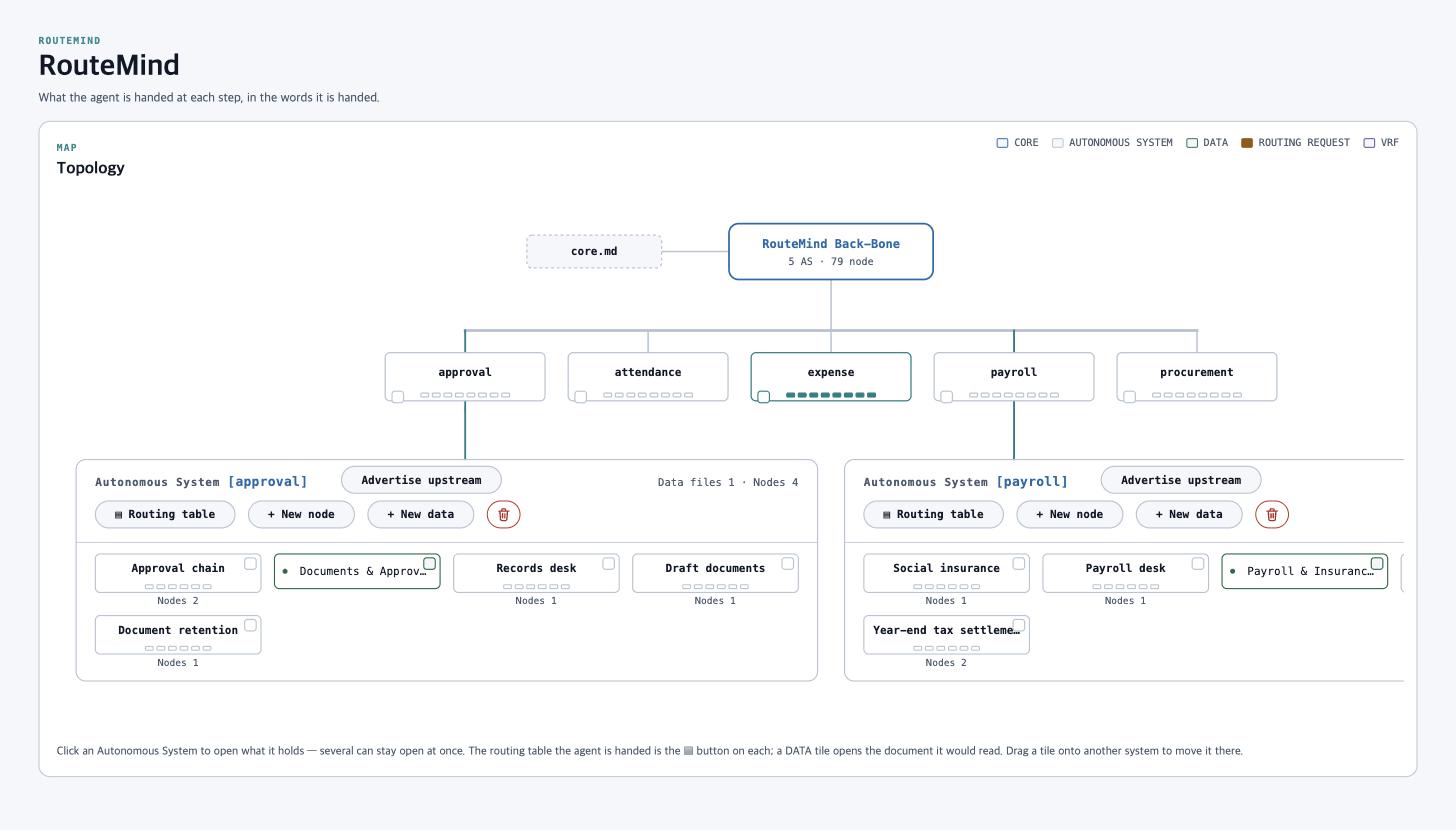
A routing table for an agent, written and kept by people. You split a body of documents into
areas. Each area describes, in one sentence, when someone should come to it. An agent reads that list
of sentences first, chooses, and walks down a tree of short lines to the document. The map shows you
the tree, and one click shows you the exact text the agent is given at each step.
Dynamic routing for agent knowledge. Areas advertise when they're relevant; the agent routes before it reads. MCP server, git-backed, no database.
स्टार
4
टूल
—
अपटाइम
—
The domain is not in the code. The areas, the lines and the documents are data, kept in your own git
repository. Every change is a commit.
The bet
RouteMind does not replace retrieval. It makes one bet:
Where documents resemble each other — revisions of one rule, rows that differ by a code, policies
that differ by one condition — a routing table that people write and maintain finds the right
document more reliably than similarity search. The price is several times the cost per question,
plus the labour of keeping the table true.
The bet is lost if any of these turns out to be true:
Retrieval is already good enough on real documents. Then the walk costs more and buys nothing.
Keeping the map costs more than the wrong answers it prevents. The map is human work, every
week.
A large map loses the agent. Measured once, small: 5 areas against 30, with confusable
neighbours, did not change which area was chosen (eval/scale/). Dozens of real areas
or tens of thousands of documents have not been tried.
None of these has been settled on real data. Everything measured so far is listed below, together
with what it does not show.
How it works
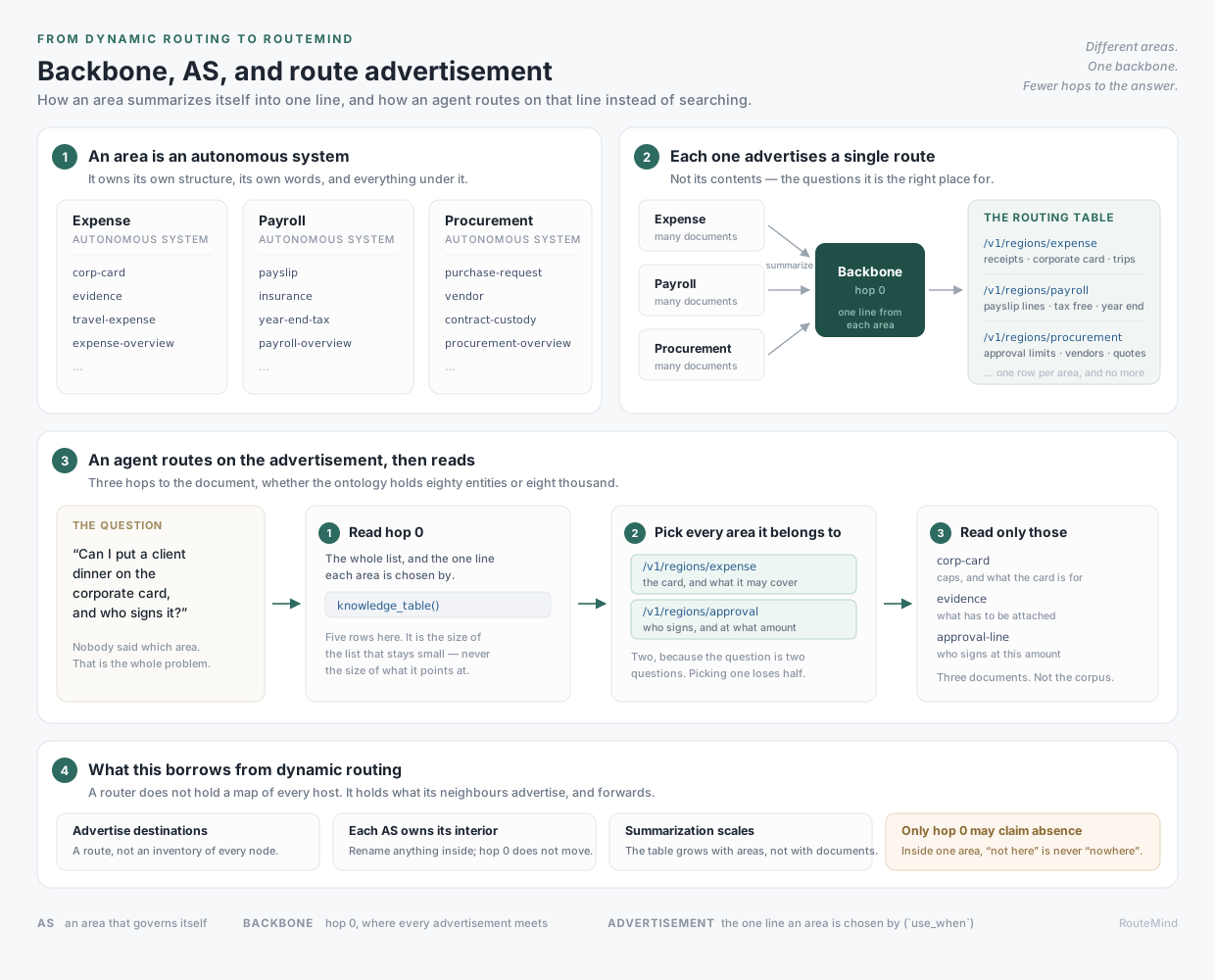
The idea is borrowed from routing on a network. An area advertises when it is relevant, not
everything it holds. That keeps the first list the same size whether the areas hold 80 documents or
8,000.
   BACK-BONE ─ the whole map. Hop 0: one row per area, nothing else,
       │       and the only place "it is not here" may be said
       │
       ├── AS  expense    "what to do with a receipt · whether the corporate card
       │        │          may be used here · how much a business trip pays"
       │        ├── AS  corp-card   ← an area holds areas: the same thing one level
       │        │    └── card-limit   down, describing itself the same way
       │        └── AS  evidence
       ├── AS  approval   "whom to put in the approval chain · …"
       └── AS  payroll    "what this payslip line means · …"
use_when is the only text the agent reads before it chooses an area. An area with a title and
no reason is an area nobody picks.
Each table describes only its own area. An area's table says what that area holds, never what
the whole map lacks. Only someone who has read hop 0 may conclude that something is not here.
Every walk starts at hop 0, and every step records why it was taken. The MCP server enforces
this. The map replays any walk from the last six hours.
Writing is a set of decisions. When an agent files a document, it may create a holder and move
siblings under it in the same change. Every line whose table changes must be either kept or
rewritten, or nothing is written. (docs/CHANGE.md)
Two containers and no database. ontology is the API and the only process that touches your git
repository. web serves the map and acts as a proxy. mcp/knowledge_mcp.py is the agent's door: a
single stdlib-only file with four tools — read a table, read a document, place a document, read
another RouteMind.
What was measured — and what it does not show
The setting. 700 questions over one frozen corpus of 1,126 documents, in four arms, with one fresh
agent per question:
plain RAG
+ reranker
RouteMind walk
question in the documents' own codes
0.991
1.000
1.000
question in a person's words
0.028
0.069
1.000
a rule two revisions back
0.200
0.200
1.000
overall
0.507
0.531
0.999
All three columns are scored the same way: a question that needs two documents counts only when both
are found, and an accepted alternative document counts for the one it stands in for. Until 2026-10-10
the retrieval columns counted any one of the documents, which was more lenient than the walk's
scoring (0.516 / 0.541 overall). An independent audit found the difference (15 of 1,400 rows;
issue #2, finding F-RM-01), and bench/attribution.py
re-derives these numbers from the saved results.
Read it as a stress test, not a benchmark.
The corpus is synthetic and was built so that retrieval fails. Each answer has many near-identical
rivals: other revisions, neighbouring codes. eval/COLLAPSE.md describes how
that was constructed. On questions phrased in the documents' own words, retrieval scores 0.99 and
the walk adds nothing.
One domain, one map, one author side. The corpus is a fictional back office. The 700 questions
are templated by the project (bench/crowd.py, bench/temporal.py), not written by outsiders. The map's sentences were written by people who knew the corpus. No
real organisation's documents have been measured. The question of who labels the ground truth is
still open (eval/PREREGISTRATION.md).
It costs far more. A walk takes 6.7 tool calls, 23–111 seconds and $0.12–$0.28 per question,
against one sub-second embedding call. That is 20–100× the cost. For 320 of the 700 questions,
retrieval already found the answer first time.
The map is a single point of failure. The one miss in 700 came from a wrong sentence in the map,
not a wrong document, and the agent followed it. An agent that trusts the map inherits the map's
errors, and nothing flags them.
Flat or folded (eval/depth/, 2026-10-09/10). The same 73 questions on two trees:
area tables of 15–23 rows behind holders, against the same documents with every holder removed
(61–244 rows per area). With a Sonnet-class walker both trees scored 65/73, with Opus 67/73
(the same questions missed on both); the flat tree cost 2.3–2.4× the input. With a Haiku-class walker the flat tree scored higher — 66 vs 61 — because every
holder is one more decision a weak model can get wrong. Folding buys tokens, not accuracy, and costs
a weak model accuracy.
Behaviour (eval/philosophy/, 2026-10-10). Twelve questions through the real
MCP door, Sonnet and Haiku: every walk started at hop 0 with a reason on every step; every question
with no answer in the documents was answered "not here", with no invented rule; deliberately false
lines were answered around by reading the document. But the agents did not report the false lines
until one instruction asked them to (1/4 → 4/4), nor a false hop-0 sentence until the server pointed out
that the walk had switched areas (0/2 → 2/2). The census-style miss was reproduced on purpose: a false
hop-0 sentence into an area whose plausible page does not point onward trapped 3 of 4 walks; one more
instruction brought that to 2 of 4, and the remaining case — a partial table that looks complete — is
not fixed.
Twelve questions, one run each — read it as "did not fail", not as a rate.
Everything is in the repository: the corpus generator (bench/), the gold sets (eval/gold/), and
every run including the failures (eval/runs/). Re-running needs an API key —
bench/README.md.
When not to use it
Your documents do not resemble each other. If retrieval already finds the right page, a walk
only adds cost and latency.
The cost of each question matters more than its accuracy. A walk takes several model calls and
tens of seconds.
Nobody will own the map. A table that no one maintains goes stale. A stale table is worse than
none, because the agent follows it confidently.
You need it hosted, multi-tenant or hardened today. See below.
Known limits
Evidence
one synthetic corpus, one domain, model-written or templated questions; no real organisation's data
Scale
agent routing measured at 5 and 30 areas (30 with thin distractor areas) on about 1,100 documents; the service timed at 10,000 documents (reads 0.1–0.2 s, a write 2 s). Agents on a map that large are untested
Models
Sonnet- and Opus-class on the stress test; Haiku-class only on the depth and behaviour runs, where folded tables cost it accuracy
Staleness
no mechanism decides which version is current. That is said by a person, in a line. Ages from git help someone ask; they do not decide (docs/AGE.md)
Maintenance
change sets keep the lines over a change in step, but they are days old and unproven in real use. The map has no editor for a multi-step change
Absence
"not here" is only as good as hop 0's sentences. A missing sentence and a missing document look the same to the agent
Operations
one maintainer; single node; one git repository; basic auth; the default install listens on the network (docs/AUTH.md)
Overlays
the working set for multi-area questions is off by default (docs/OVERLAY.md)
Where it stands
A research prototype with one maintainer and no outside team known to be running it.
measured
not measured
next
the collapse stress test above
any real organisation's documents
a corpus someone else wrote, with questions someone else wrote
a misroute into an area that holds a plausible wrong answer
a map whose facts each live once
Worth trying if your team keeps answering from the wrong revision, or retrieval keeps returning the
neighbouring row. Reports of where it fails are the most useful thing you can send:
GitHub Issues.
Quickstart
Docker with docker compose. The containers include Python and git.
git clone https://github.com/CSP911/routemind.git routemind && cd routemind
./install.sh --port 9000
→ http://localhost:9000. On a first install it asks whether to start from the example back office
(examples/back-office: five areas, 74 documents) — say yes unless you have data of your
own ready. You can run it again safely: an existing .env is kept. An optional LLM adds a ✨ Suggest
button that drafts a line for you to edit; nothing else depends on it.
docs/INSTALL.md · already running one: docs/UPGRADE.md.
An agent. Claude Code finds the server in .mcp.json, which reads the port from .env:
claude # in the same directory; approve the "knowledge" server once, then /mcp lists four tools
For any other MCP client, run the same server — it finds the install the same way, or take --api:
Layout: ontology/ the API · web/ the map and proxy · mcp/ the agent's door · static/ the
screen · check/ every check · data/repo your map, the only thing to back up.
अभी टूल सूची नहीं है। रिमोट सर्वर को पहले हेल्थ चेक के बाद सूची मिलती है।
FAQ
सवाल
Routemind कैसे इंस्टॉल करें?
इस पेज पर Cursor, Claude Desktop, Claude Code या VS Code के लिए stdio कॉन्फ़िग कॉपी करें। यह पब्लिशर का इंस्टॉल इस्तेमाल करता है, PlugMCP प्रॉक्सी नहीं।
क्या Routemind के लिए API key चाहिए?
इस रिकॉर्ड में कोई ज़रूरी एनवायरनमेंट वेरिएबल दर्ज नहीं है।
Routemind कौन सा ट्रांसपोर्ट इस्तेमाल करता है?
Routemind stdio पर लोकल चलता है।
Routemind की पिछली जाँच कब हुई थी?
पिछली जाँच 2026-10-28 को हुई। Dynamic routing for agent knowledge. Areas advertise when they're relevant; the agent routes before it reads. MCP server, git-backed, no database.