⚡ TURBO FLOW — THE RULES LAYER FOR AI-WRITTEN CODE.
One product lives here: rig-lite/ — a portable governance kit. It ships no harness, installs nothing, and depends only on bash. Drop it into any repo and your agents get laws with teeth.
Versions 1–4 (2025–2026) packaged an agentic development environment around Claude Code and Ruflo — at its peak, 215+ MCP tools and 60+ agents. In September 2026 the project pivoted to a thinner, governed approach, and by v5.2 (October 2026) the orchestration stack was fully removed: Turbo Flow is now the rules layer (rig-lite), and the integrated successor, , runs in private beta. Site: · full story: · .
The rules layer for AI-written code — rig-lite: a fail-closed cross-model review gate, a written constitution, git-versioned memory. Any harness, any repo. v1-4 were the agentic dev environment.
Bintang
185
Tool
—
Uptime
—
Turbo Flow is an open-source project by Adventure Wave Labs (Marcus Patman).
Turbo Flow bundles no agent and no orchestrator. It names harnesses by role, and works with any tool that reads AGENTS.md and can run bash:
Role
Who
How the kit uses it
Builder
ZCode (GLM), Claude Code, Codex, Gemini, Grok
gate.sh --builder <cli> knows the family; anyone can build
Reviewer
Claude Code or Codex CLI — never the builder's family
the gate auto-detects and refuses same-family review
Orchestration (optional)
Ruflo, as a Claude Code mod
bring it if you want swarms — the kit doesn't care
ZCode builds · Claude Code reviews (Ruflo mod installed when you want orchestration) · Codex backs up the review. That loop runs in production on this repo today: every PR since rig-lite landed (v5.0) was built by one family, reviewed by another, merged by a human.
🎬 The demos — the boot and the daily driver
The boot (recorded in a fresh Codespace)
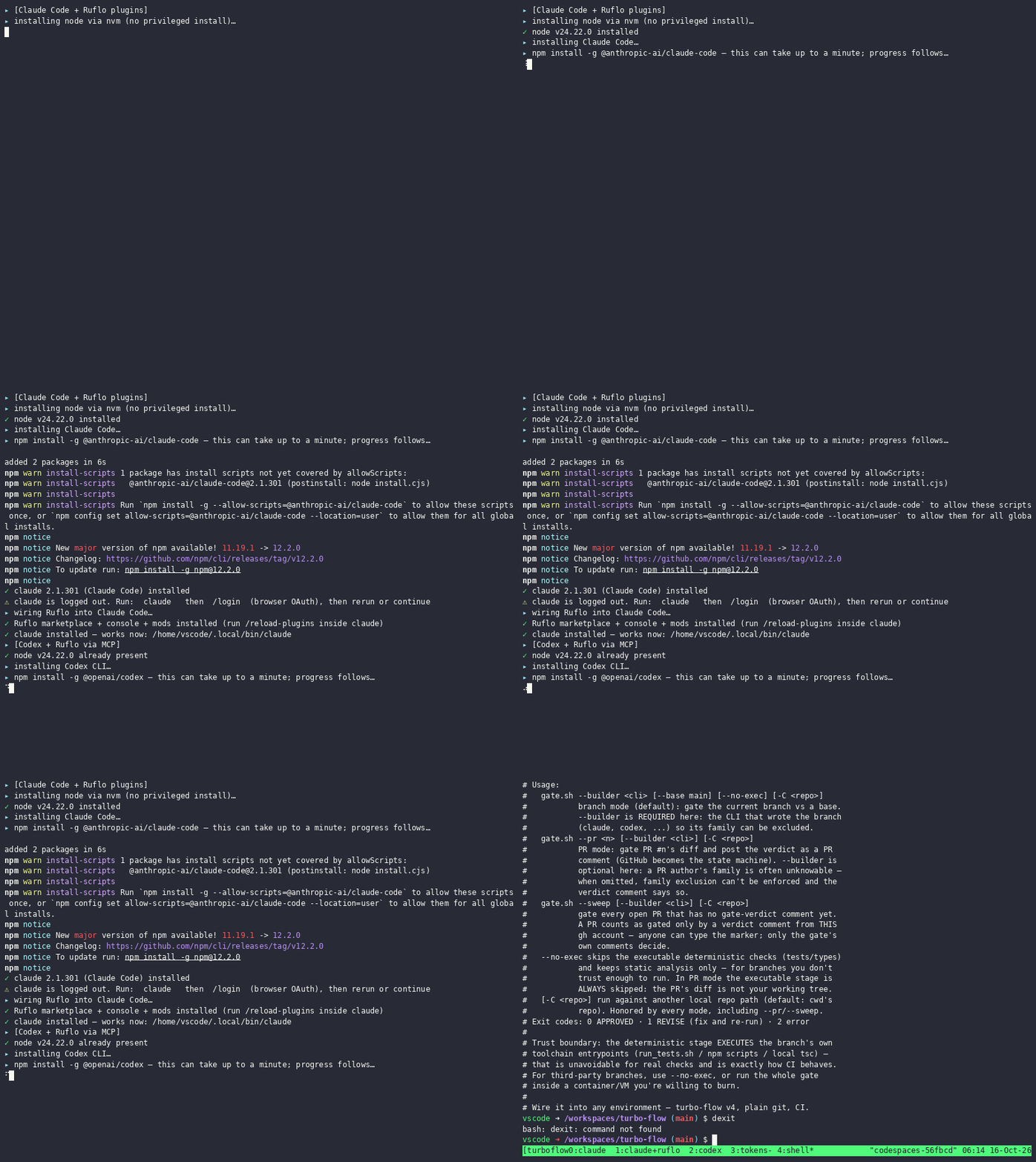
A fresh Codespace from main (unauthenticated): the first shell triggers the boot (no menu), Claude Code + Codex + Ruflo install visibly, then tmux fires with all 5 windows — each landing inside its harness.
The daily driver — tf (one command for everything)
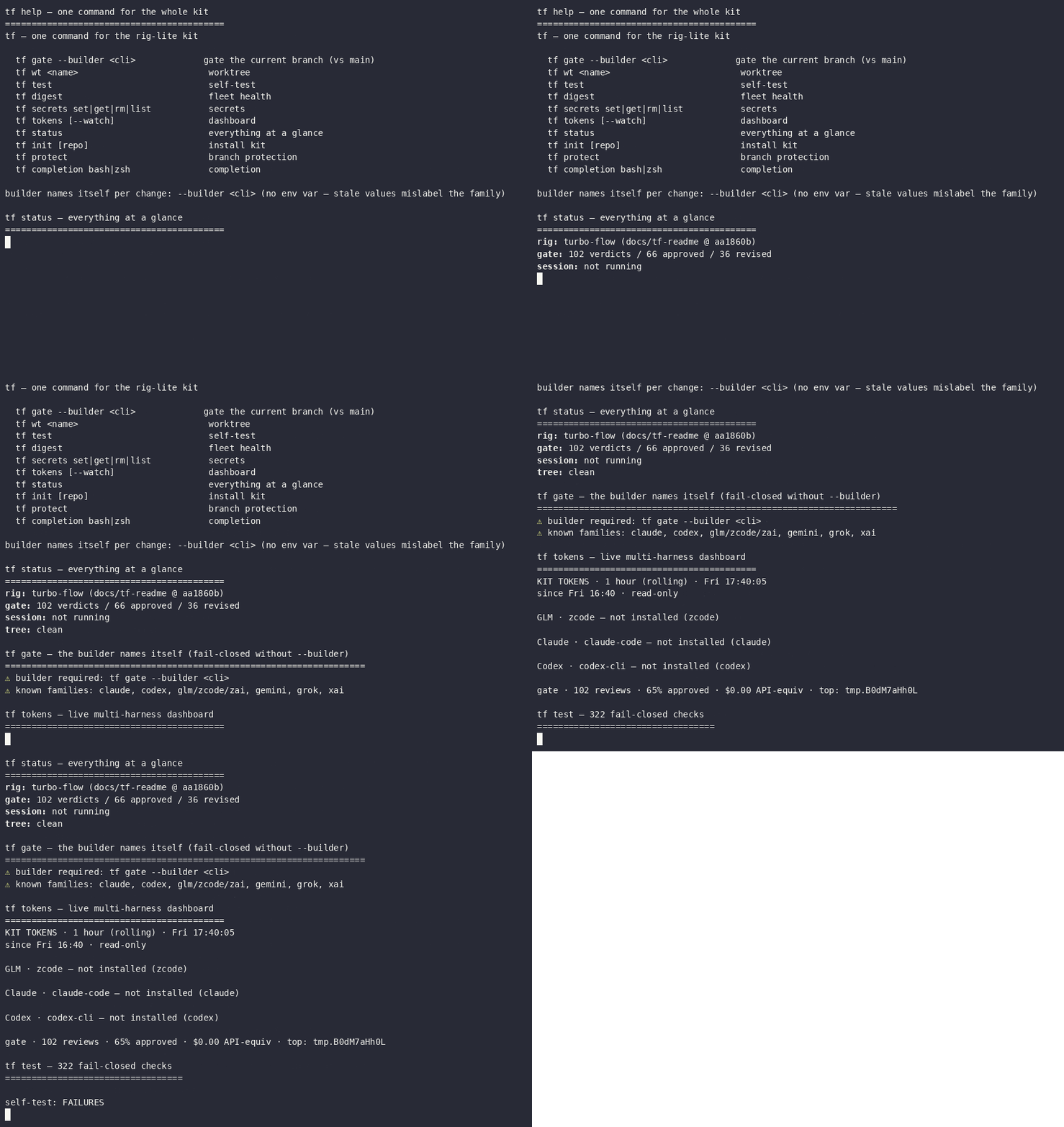
Recorded on the same Codespace: tf help shows every subcommand, tf status gives the at-a-glance view (repo, gate verdict counts, tree health), tf gate fails closed without --builder, tf tokens shows the live dashboard, and tf test runs the full suite. The tf command is installed automatically in Codespaces and by init-repo.sh anywhere else.
The gate survived 17 rounds of review
rig-lite/gate.sh was itself reviewed by a model family that didn't write it — and got REVISE'd seventeen times before earning APPROVED (counted from the gate's own JSONL log). The findings are exactly the class the gate exists to catch: a prompt-injection hole that let a diff approve itself, a fail-open path that skipped review entirely, a quoting bug that swallowed failing tests, a silent-reviewer misdiagnosis. Every fix became a self-test. Builder ≠ reviewer isn't a slogan in this repo — it's the reason this script is trustworthy.
rig-lite — one kit, ten minutes, no new dependencies
a cross-model review gate — deterministic checks first (they're free), then a reviewer from a different model family must return a parseable APPROVED / REVISE. Fail-closed; never merges. --pr <n> gates a GitHub PR and posts the verdict as a comment; --sweep gates every open PR that has no verdict yet; -C <repo> gates another checkout. Every verdict lands in a local JSONL log the digest joins.
makes the gate a GitHub rule, not a promise: one command turns on branch protection with the gate's verdict as a required status check (gate-verdict, set by gate.sh on the exact SHA it reviewed), so main can't take an un-gated PR even by accident. It does not make merging human-only: --require-review demands an approving review (an account permission, not proof of who typed it), and any account with merge rights can still merge an approved PR — keeping merges human-only is an access-control decision (whose accounts hold merge rights) that protection can't make for you. --dry-run / --status to look before touching. Its companion workflow gate-check.yml re-checks on every push and, once the gate posts APPROVED, flips the PR's own check green by itself — fork PRs get the exact one-click re-run instead, because GitHub won't link their runs to the PR.
one-command onboarding for any repo: a thin AGENTS.md (constitution pointer + project cheat-sheet) and the CLAUDE.md → AGENTS.md symlink. Never clobbers existing files.
one command, one file: repo health for your whole fleet — merge queue joined with gate verdicts, merged PRs, dirty/behind working copies, site liveness, stale codespaces, repo-hygiene gaps.
the background tier as a portable prompt pack: 9 scheduled tasks (morning digest, security scan, memory consolidation, weekly retro, repo-hygiene pass, site sentinel, gate canary, portability canary, nightly sweep) plus two ways to schedule them.
live token-burn dashboard across zcode + claude + codex + gate — reads each CLI's local usage data read-only; --watch live view, --json, TZ-pinned fixture self-test covering every adapter (including malformed-shape rows). The first open-core drop from Turbo Rig. On macOS the default run also reads the Claude OAuth token from the Keychain and calls Anthropic's usage endpoint for plan bars — --no-quota skips both.
the kit's own fail-closed test suite (hundreds of checks); says so when shellcheck-gated coverage is skipped.
Ten-minute install
# from any repo you want to govern:
bash /path/to/turbo-flow/rig-lite/init-repo.sh   # writes AGENTS.md + installs tf, never clobbers
export PATH="$HOME/.local/bin:$PATH"              # tf lives here (init warns if not on PATH)
tf test                                            # prove the kit (322 checks)
tf gate --builder <your-cli>                       # gate your first change
tf status                                          # everything at a glance
No Codespace? Fine — it's bash. Want the 30-second container tour anyway? Open this repo in a Codespace; postCreate runs the self-test and installs tf on PATH automatically. That's the whole install surface.
Your first five minutes in the rig
In a Codespace (or after running bash workspace.sh), you're inside a 5-window tmux session. Here's what to do:
1. Log in (once per box — the only manual step)
Ctrl+B 0    → jump to the claude window, type /login (browser OAuth)
Ctrl+B 4    → jump to the shell, type codex login (browser); then Ctrl+B 2
After that, every window opens ready for work, forever on this box.
2. Look around
Keys
What you see
Ctrl+B 0
claude — reviewer when window 1 is claude-glm; otherwise use codex (window 2) to review
Ctrl+B 1
builder — claude-glm if wired, else claude with ruflo plugins loaded
Ctrl+B 2
codex — your OpenAI lane (ruflo reachable via MCP)
Ctrl+B 3
tokens — live burn across all three harnesses, always updating
Ctrl+B 4
shell — free bash for git, builds, anything
Ctrl+B d
detach (come back any time — the session survives)
3. Gate your first change
The tf command is installed automatically in Codespaces (and by init-repo.sh anywhere else). In the shell window (Ctrl+B 4), from any branch you or an agent built:
# prove the kit works:
tf test

# gate a branch — the builder names itself (--builder is required):
tf gate --builder claude    # if claude wrote it → a non-Anthropic reviewer checks it
tf gate --builder glm       # if claude-glm wrote it → claude reviews (cross-family)

# gate a GitHub PR (verdict posted as a comment on the PR):
tf gate --pr 7 --builder codex    # codex wrote it → claude reviews

# everything at a glance:
tf status
The gate exits 0 (approved) or 1 (revise — fix and re-run). It never merges; you do.
Full command list: tf help
4. Your daily loop
tf wt my-feature             # isolated worktree for parallel work
# ... build in window 1, ask a DIFFERENT family (window 0 or 2) to read the diff ...
tf gate --builder <who-wrote-it>  # gate before the PR (defaults to --base main)
# ... push, open the PR, gate it ...
tf digest                         # fleet health: merge queue × verdicts × site liveness
Detached and want back in? In a Codespace, every new terminal auto-attaches. Locally: run bash workspace.sh again.
Harnesses — installed by the boot, menu on demand
The kit ships no harness, and the boot no longer asks: a fresh Codespace auto-installs the default pair (Claude Code + Codex + the Ruflo wiring) on the first shell, visibly, then drops you straight into the tmux rig. The interactive menu is still there on demand — setup-harness.sh — for GLM, all-of-the-above, or skip:
OpenAI login · Ruflo wired through MCP (~/.codex/config.toml)
GLM
Claude Code on your GLM Coding Plan key (docs.z.ai, Anthropic-protocol endpoint) via a dedicated claude-glm launcher — plain claude stays your Anthropic reviewer, so builder ≠ reviewer survives by construction
When the install finishes, you land inside a 5-window tmux rig: claude (the Anthropic reviewer) · the builder window — claude-glm when you chose the GLM path (a genuine cross-family pair with window 1), otherwise plain claude honestly labeled same-family (wire it later: ./setup-harness.sh --glm), with the ruflo plugins pre-loaded (the slash commands were executed at install time — verify any time with /plugin) · codex · the tokens dashboard live (rig-lite/tokens.py --watch) · a free shell. Detach any time; the session survives (every new terminal auto-attaches to the same rig — that's the design). TF_NO_TMUX=1 is a total opt-out: no boot install, no auto-attach. Keys are read hidden and stored with 600 permissions, and everything installs user-space (nvm + npm global prefix). The GLM path is fail-closed: a missing or incomplete glm.env makes claude-glm refuse to run rather than silently fall back to an Anthropic session. One shared surface, stated plainly: Ruflo plugins installed via the Claude/GLM paths load in bothclaude and claude-glm (they're tooling, not model — the reviewer's model stays Anthropic, so builder ≠ reviewer holds). --claude / --codex / --glm flags run it non-interactively.
Where the v4 environment went
Turbo Flow v4 packaged and wired a Claude Code + Ruflo environment. Ruflo grew its own onboarding (npx ruflo@latest init wizard, plugin marketplace, built-in memory and console), which retired the reason a wrapper repo existed. The v4 install chain lives on in the v1.0.1 → v4.0 tags; the v5 line is governance-first and orchestration-agnostic.
Join the private beta
The kit is the portable extract of Turbo Rig — gate + constitution + memory + automations running as one integrated system, on your machine, across your repos.
Beta feedback: open an issue or start a discussion here — this repo is the beta's public tracker.
Does builder ≠ reviewer actually matter?
The builder is never its own reviewer — a design choice, not something the audited week measured. What one recent week of building Turbo Rig with Turbo Rig measured is the gate's strictness: 141 PRs · 868 gate verdicts · 687 REVISE (79%) · 104 parallel lanes — verdicts cover the gate-live window (Sept 16–21), merges the full week, and every merge was held by a human. Every number re-derived from the primary logs in the public verification dossier: https://www.turbo-rig.com/evidence (the 116-task figure previously cited here without attribution is a published external result — Xiang et al., “Cross-Model LLM Code Review,” Agentic SE @ KDD’26, arXiv:2607.21656 — not our data; cited as such now). The badge at the top is the receipt.
About Adventure Wave Labs
Adventure Wave Labs builds Turbo Flow and Turbo Rig — packaging, setup automation, and the governance layer that holds when the agents get fast. The orchestration core referenced by v4 was Ruflo by rUv; Turbo Flow integrates, and now points at it, rather than rebuilding it.
Turbo Flow v5.2 — the rules layer. One kit, any harness, humans merge.
Ecosystem
Built with and powers these tools — star the ones you use:
Orchestration, when you want it: Ruflo as a Claude Code mod.
Stay Connected
If Turbo Flow ships value for you, follow @marcuspat on GitHub — agentic tooling, Rust crates, and open-source infra drop regularly.
License
MIT — Copyright (c) 2025-2026 Adventure Wave Labs
T
Turbo Flow
marcuspat·185 bintang·
The rules layer for AI-written code — rig-lite: a fail-closed cross-model review gate, a written constitution, git-versioned memory. Any harness, any repo. v1-4 were the agentic dev environment.
Belum ada daftar tool. Server remote mendapatkannya setelah pemeriksaan kesehatan pertama.
FAQ
Pertanyaan
Bagaimana cara menginstal Turbo Flow?
Salin konfigurasi stdio untuk Cursor, Claude Desktop, Claude Code, atau VS Code di halaman ini. Konfigurasi ini memakai instalasi dari penerbit, bukan proxy PlugMCP.
Apakah Turbo Flow memerlukan kunci API?
Tidak ada variabel lingkungan wajib yang tercantum di catatan ini.
Transport apa yang digunakan Turbo Flow?
Turbo Flow berjalan secara lokal melalui stdio.
Kapan Turbo Flow terakhir diperiksa?
Terakhir diperiksa 2026-11-13. The rules layer for AI-written code — rig-lite: a fail-closed cross-model review gate, a written constitution, git-versioned memory. Any harness, any repo. v1-4 were the agentic dev environment.