에이전트 강화
게시자가 제공하는 설치 방식입니다. PlugMCP 엔드포인트가 아닙니다.
원격 URL인가요, 내 컴퓨터에서 실행하는 명령인가요? 두 설치 방식의 차이
PlugMCP에서 실행
A new server you create. It is not this listing's official endpoint. Use the publisher install when you want their URL and their credentials.
실행A faster Excalidraw MCP server built around real vendor icons. AI agents draw architecture diagrams with official AWS, Azure, GCP, OCI, and Kubernetes icons — not generic rectangles — in one-shot batches on a live canvas they can see and refine.
Two things set it apart from the upstream fork it grew from:
search_official_icon + add_image pull actual vendor icons instead of drawing shapes that only approximate them.This repo provides:
Keywords: Excalidraw MCP server, AWS/Azure/GCP icons, AI architecture diagrams, diagrams as code, Claude Code skill, Codex CLI skill, Cursor MCP, Mermaid to Excalidraw.
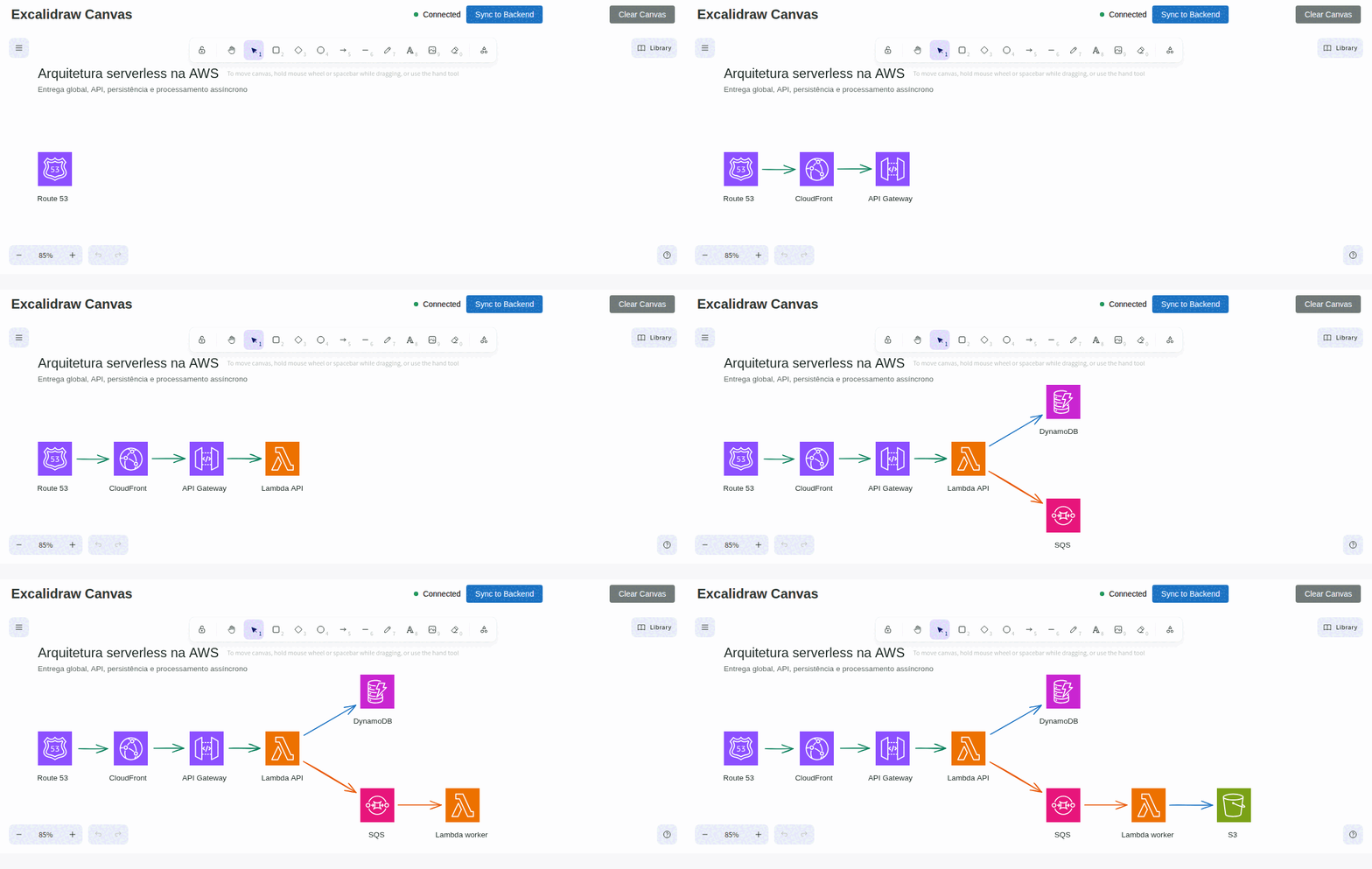
An AI agent builds a serverless AWS architecture step by step with Route 53, CloudFront, API Gateway, Lambda, DynamoDB, SQS, and S3.
This repo contains two separate processes:
http://127.0.0.1:3000)EXPRESS_SERVER_URLExcalidraw now has an official MCP — it's great for quick, prompt-to-diagram generation rendered inline in chat. We solve a different problem.
TL;DR — The official MCP generates diagrams. We give AI agents a full canvas toolkit to build, inspect, and iteratively refine diagrams — including the ability to see what they drew.
search_official_icon + add_image pull real vendor icons — official AWS/Azure/GCP/OCI packs (user-supplied, see Vendor Icons), bundled Kubernetes, simple-icons (CC0), Tabler (MIT), and Iconify (~200k icons, fetched on demand and cached). No more generic rectangles for an "RDS" or "Compute Engine".search_library_items + insert_library_item for libraries.excalidraw.com shapes.read_diagram_guide accepts diagramType (network, cloud-aws, cloud-gcp, cloud-azure, c4, erd, flowchart, sequence) and returns that domain's standard conventions — canonical icons, boundary containers, shape semantics.batch_create_elements with autoLayout: true arranges nodes and removes overlaps; validate_layout flags overlaps, cramped spacing, and crossing arrows.get_element, clear_canvas, export_scene, import_scene, export_to_image, duplicate_elements, snapshot_scene, restore_snapshot, describe_scene, get_canvas_screenshot, read_diagram_guide, export_to_excalidraw_url, set_viewportdescribe_scene) and see it (get_canvas_screenshot returns an image) — enabling iterative refinementread_diagram_guide returns best-practice color palettes, sizing rules, layout patterns, and anti-patterns — dramatically improves AI-generated diagram qualityexport_to_excalidraw_url encrypts and uploads the scene to excalidraw.com, returns a shareable link anyone can openset_viewport with scrollToContent, scrollToElementId, or manual zoom/offset — agents can auto-fit diagrams after creation.excalidraw JSON filesalign_elements / distribute_elements fully implemented, points type normalization, removed invalid label type, removed HTTP transport dead code, ungroup_elements now errors on failureskills/excalidraw-skill/ (portable instructions + helper scripts for export/import and repeatable CRUD)agent-browser)main.tsx)Prereqs: Node >= 20, npm
npm ci
npm run build
Terminal 1: start the canvas
PORT=3000 npm run canvas
Security note: The server defaults to binding on
127.0.0.1only. If you need to expose it on a network interface (e.g. Docker, remote access), setHOST=0.0.0.0— but ensure you have network-level access controls in place, as the API has no built-in authentication.
Open http://127.0.0.1:3000.
Terminal 2: run the MCP server (stdio)
EXPRESS_SERVER_URL=http://127.0.0.1:3000 node dist/index.js
Canvas server:
docker run -d -p 3000:3000 --name excalidraw-icons-canvas ghcr.io/iagogfe/excalidraw-icons-mcp-canvas:latest
MCP server (stdio) is typically launched by your MCP client (Claude Desktop/Cursor/etc.). If you want a local container for it, use the image ghcr.io/iagogfe/excalidraw-icons-mcp:latest and set EXPRESS_SERVER_URL to point at the canvas.
The MCP server runs over stdio and can be configured with any MCP-compatible client. Below are configurations for both local (requires cloning and building) and Docker (pull-and-run) setups.
Config location:
~/Library/Application Support/Claude/claude_desktop_config.json%APPDATA%\Claude\claude_desktop_config.json~/.config/Claude/claude_desktop_config.jsonLocal (node)
{
  "mcpServers": {
    "excalidraw": {
      "command": "node",
      "args": ["/absolute/path/to/excalidraw-icons-mcp/dist/index.js"],
      "env": {
        "EXPRESS_SERVER_URL": "http://127.0.0.1:3000",
        "ENABLE_CANVAS_SYNC": "true"
      }
    }
  }
}
Docker
{
  "mcpServers": {
    "excalidraw": {
      "command": "docker",
      "args": [
        "run", "-i", "--rm",
        "-e", "EXPRESS_SERVER_URL=http://host.docker.internal:3000",
        "-e", "ENABLE_CANVAS_SYNC=true",
        "ghcr.io/iagogfe/excalidraw-icons-mcp:latest"
      ]
    }
  }
}
Use the claude mcp add command to register the MCP server.
Local (node) - User-level (available across all projects):
claude mcp add excalidraw --scope user \
  -e EXPRESS_SERVER_URL=http://127.0.0.1:3000 \
  -e ENABLE_CANVAS_SYNC=true \
  -- node /absolute/path/to/excalidraw-icons-mcp/dist/index.js
Local (node) - Project-level (shared via .mcp.json):
claude mcp add excalidraw --scope project \
  -e EXPRESS_SERVER_URL=http://127.0.0.1:3000 \
  -e ENABLE_CANVAS_SYNC=true \
  -- node /absolute/path/to/excalidraw-icons-mcp/dist/index.js
Docker
claude mcp add excalidraw --scope user \
  -- docker run -i --rm \
  -e EXPRESS_SERVER_URL=http://host.docker.internal:3000 \
  -e ENABLE_CANVAS_SYNC=true \
  ghcr.io/iagogfe/excalidraw-icons-mcp:latest
Manage servers:
claude mcp list              # List configured servers
claude mcp remove excalidraw # Remove a server
Config location: .cursor/mcp.json in your project root (or ~/.cursor/mcp.json for global config)
Local (node)
{
  "mcpServers": {
    "excalidraw": {
      "command": "node",
      "args": ["/absolute/path/to/excalidraw-icons-mcp/dist/index.js"],
      "env": {
        "EXPRESS_SERVER_URL": "http://127.0.0.1:3000",
        "ENABLE_CANVAS_SYNC": "true"
      }
    }
  }
}
Docker
{
  "mcpServers": {
    "excalidraw": {
      "command": "docker",
      "args": [
        "run", "-i", "--rm",
        "-e", "EXPRESS_SERVER_URL=http://host.docker.internal:3000",
        "-e", "ENABLE_CANVAS_SYNC=true",
        "ghcr.io/iagogfe/excalidraw-icons-mcp:latest"
      ]
    }
  }
}
Use the codex mcp add command to register the MCP server.
Local (node)
codex mcp add excalidraw \
  --env EXPRESS_SERVER_URL=http://127.0.0.1:3000 \
  --env ENABLE_CANVAS_SYNC=true \
  -- node /absolute/path/to/excalidraw-icons-mcp/dist/index.js
Docker
codex mcp add excalidraw \
  -- docker run -i --rm \
  -e EXPRESS_SERVER_URL=http://host.docker.internal:3000 \
  -e ENABLE_CANVAS_SYNC=true \
  ghcr.io/iagogfe/excalidraw-icons-mcp:latest
Manage servers:
codex mcp list              # List configured servers
codex mcp remove excalidraw # Remove a server
Config location: ~/.config/opencode/opencode.json or project-level opencode.json
Local (node)
{
  "$schema": "https://opencode.ai/config.json",
  "mcp": {
    "excalidraw": {
      "type": "local",
      "command": ["node", "/absolute/path/to/excalidraw-icons-mcp/dist/index.js"],
      "enabled": true,
      "environment": {
        "EXPRESS_SERVER_URL": "http://127.0.0.1:3000",
        "ENABLE_CANVAS_SYNC": "true"
      }
    }
  }
}
Docker
{
  "$schema": "https://opencode.ai/config.json",
  "mcp": {
    "excalidraw": {
      "type": "local",
      "command": ["docker", "run", "-i", "--rm", "-e", "EXPRESS_SERVER_URL=http://host.docker.internal:3000", "-e", "ENABLE_CANVAS_SYNC=true", "ghcr.io/iagogfe/excalidraw-icons-mcp:latest"],
      "enabled": true
    }
  }
}
Config location: ~/.gemini/antigravity/mcp_config.json
Local (node)
{
  "mcpServers": {
    "excalidraw": {
      "command": "node",
      "args": ["/absolute/path/to/excalidraw-icons-mcp/dist/index.js"],
      "env": {
        "EXPRESS_SERVER_URL": "http://127.0.0.1:3000",
        "ENABLE_CANVAS_SYNC": "true"
      }
    }
  }
}
Docker
{
  "mcpServers": {
    "excalidraw": {
      "command": "docker",
      "args": [
        "run", "-i", "--rm",
        "-e", "EXPRESS_SERVER_URL=http://host.docker.internal:3000",
        "-e", "ENABLE_CANVAS_SYNC=true",
        "ghcr.io/iagogfe/excalidraw-icons-mcp:latest"
      ]
    }
  }
}
host.docker.internal to reach the canvas server running on your host machine. On Linux, you may need --add-host=host.docker.internal:host-gateway or use 172.17.0.1.npm run canvas (local) or docker run -d -p 3000:3000 ghcr.io/iagogfe/excalidraw-icons-mcp-canvas:latest (Docker)./absolute/path/to/excalidraw-icons-mcp with the actual path where you cloned and built the repo.This repo includes a skill at skills/excalidraw-skill/ that provides:
SKILL.md): step-by-step guidance for drawing, refining, and exporting diagramsreferences/cheatsheet.md): MCP tool and REST API referencescripts/*.cjs): export, import, clear, healthcheck, CRUD operationsThe skill complements the MCP server by giving your AI agent structured workflows to follow.
mkdir -p ~/.codex/skills
cp -R skills/excalidraw-skill ~/.codex/skills/excalidraw-skill
To update an existing installation, remove the old folder first (rm -rf ~/.codex/skills/excalidraw-skill) then re-copy.
User-level (available across all your projects):
mkdir -p ~/.claude/skills
cp -R skills/excalidraw-skill ~/.claude/skills/excalidraw-skill
Project-level (scoped to a specific project, can be committed to the repo):
mkdir -p /path/to/your/project/.claude/skills
cp -R skills/excalidraw-skill /path/to/your/project/.claude/skills/excalidraw-skill
Then invoke the skill in Claude Code with /excalidraw-skill.
To update an existing installation, remove the old folder first then re-copy.
All scripts respect EXPRESS_SERVER_URL (default http://127.0.0.1:3000) or accept --url.
EXPRESS_SERVER_URL=http://127.0.0.1:3000 node skills/excalidraw-skill/scripts/healthcheck.cjs
EXPRESS_SERVER_URL=http://127.0.0.1:3000 node skills/excalidraw-skill/scripts/export-elements.cjs --out diagram.elements.json
EXPRESS_SERVER_URL=http://127.0.0.1:3000 node skills/excalidraw-skill/scripts/import-elements.cjs --in diagram.elements.json --mode batch
sync mode to make canvas match a file.See skills/excalidraw-skill/SKILL.md and skills/excalidraw-skill/references/cheatsheet.md.
Full schemas are discoverable via tools/list or in skills/excalidraw-skill/references/cheatsheet.md.
read_diagram_guide accepts an optional diagramType — the client LLM identifies the diagram domain from the user's request and passes it to get that domain's standard convention appended to the guide (canonical icons, boundary containers, shape semantics, flow direction):
Conventions live in src/diagramConventions.ts; validated by npm run test:conventions.
search_official_icon works out of the box with bundled Kubernetes icons, simple-icons, Tabler, and Iconify (fetched on demand). Official cloud-vendor packs (AWS, Azure, GCP, OCI) are not bundled — each vendor requires accepting its own license, so you download them yourself and drop the SVGs under icons/<vendor>/. These folders are git-ignored and never redistributed by this repo.
Drop the .svg files directly under the folder (subfolders are fine — the index walks recursively). Local packs take priority over Iconify in search results. After adding a pack, restart the MCP server so the icon index picks it up.
The CI runs the same checks with npm run test:ci (bind, cache traversal,
library behavior and diagram conventions) and npm run test:e2e:ci (Mermaid
conversion and arrow dragging in Chromium). Docker publication waits for the CI
and security workflows of the same commit, plus the Trivy misconfiguration
scan; a tag that was not validated by those workflows cannot publish.
The release workflow expects a repository secret named NPM_TOKEN with publish
permission for excalidraw-icons-mcp. It validates that the release tag matches
the version in package.json, checks the token with npm whoami, and publishes
only after CI and security are green. Configure npm trusted publishing instead
if you prefer OIDC over a long-lived token.
The workflows cannot prevent a direct push by themselves. Protect main in
GitHub, require pull requests and require the CI, security and Docker checks
before merge. Also restrict who can push version tags; otherwise someone with
write access can bypass the validation by pushing directly.
curl http://127.0.0.1:3000/health
npm run test:bind
List tools:
npx @modelcontextprotocol/inspector --cli \
  -e EXPRESS_SERVER_URL=http://127.0.0.1:3000 \
  -e ENABLE_CANVAS_SYNC=true -- \
  node dist/index.js --method tools/list
Create a rectangle:
npx @modelcontextprotocol/inspector --cli \
  -e EXPRESS_SERVER_URL=http://127.0.0.1:3000 \
  -e ENABLE_CANVAS_SYNC=true -- \
  node dist/index.js --method tools/call --tool-name create_element \
  --tool-arg type=rectangle --tool-arg x=100 --tool-arg y=100 \
  --tool-arg width=300 --tool-arg height=200
If you use agent-browser for UI checks:
agent-browser install
agent-browser open http://127.0.0.1:3000
agent-browser wait --load networkidle
agent-browser screenshot /tmp/canvas.png
EXPRESS_SERVER_URL points at the running canvas server.All previously listed bugs have been fixed in v2.0. Remaining items:
export_scene / snapshots as a workaround.export_to_image and get_canvas_screenshot rely on the frontend doing the actual rendering. The canvas UI must be open in a browser.Contributions welcome!
npm run type-check
npm run build
This project started as a fork of yctimlin/mcp_excalidraw, which provides the live canvas + MCP foundation. On top of it, this fork adds standardized icon search and insertion (official AWS/Azure/GCP/OCI/Kubernetes packs, simple-icons, Tabler, Iconify), per-domain diagram conventions, auto-layout, and performance improvements. The demo above was recorded with this project's MCP server and official AWS icons.
MIT — original work © 2024 MCP Excalidraw Server (yctimlin), modifications © 2026 Iago Gonçalves.
Excalidraw MCP server with real vendor-icon search & insertion (AWS/Azure/GCP/OCI/Kubernetes) for AI-built architecture diagrams — live canvas, 31 tools
도구
아직 도구 목록이 없습니다. 원격 서버는 첫 상태 확인 후에 도구 목록이 생깁니다.
FAQ
이 페이지에서 Cursor, Claude Desktop, Claude Code 또는 VS Code용 stdio 설정을 복사합니다. PlugMCP 프록시가 아니라 게시자의 설치 방식을 사용합니다.
이 레코드에는 필수 환경 변수가 등록되어 있지 않습니다.
Excalidraw Icons은(는) stdio를 통해 로컬에서 실행됩니다.
마지막 확인: 2026-10-28. Excalidraw MCP server with real vendor-icon search & insertion (AWS/Azure/GCP/OCI/Kubernetes) for AI-built architecture diagrams — live canvas, 31 tools
