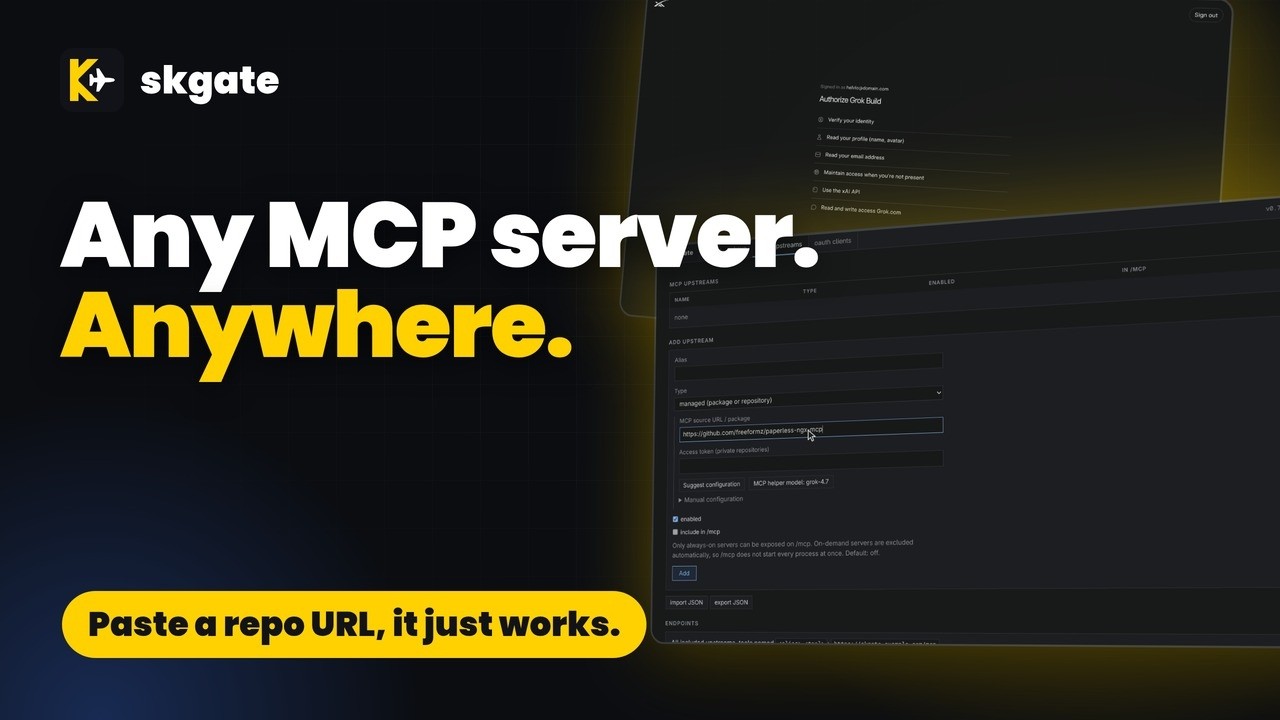
Self-hosted MCP gateway and LLM proxy. Serve any MCP server or REST API behind OAuth 2.1, run stdio/git MCP servers on demand, and proxy AI providers (OpenAI, Anthropic, Gemini, Grok, Ollama) through one OpenAI-compatible API with model aliases and virtual keys. Grok subscription works with no API key.
"sk" is how a lot of SI API keys start, and "gate" is for gateway. Not a great name, but it's ours.
The plane in the logo is an inside joke. The public wouldn't understand it, and I'm not about to explain it. Sorry.
Quality
Yes
Quick start
You need an OIDC provider with a confidential client for skgate. Admin login is OIDC only. Trying it on one machine? docs/quickstart.md runs skgate with a bundled provider and no accounts.
Open https://skgate.example.com/admin and sign in through your OIDC provider.
mcp upstreams > Add upstream: a remote MCP server, or a GitHub repository, npm package, or PyPI package that skgate runs for you (see Add an MCP server with Suggest configuration).
Point your MCP client at https://skgate.example.com/mcp or the site root for every included upstream, or at https://skgate.example.com/mcp/<alias> for one upstream. Sign in when it asks.
Image tags:
latest: proxy + managed MCP servers. Bundles Node.js (npx), pnpm, Bun (bunx), Deno, Python (uv, uvx), Go, .NET and git.
slim: proxy only
To upgrade, back up ./data, then docker compose pull && docker compose up -d.
Proxy your SI providers
skgate is also an OpenAI-compatible API in front of your SI providers. Point your apps at one address; switch the provider behind them without changing the apps. User-defined model aliases give your apps a stable model name of your choosing.
Grok can use subscription sign-in with no API key. Other providers use that provider's API key (OpenAI, Anthropic, Gemini, Mistral, DeepSeek, Groq, OpenRouter, Ollama, LM Studio, and any OpenAI-compatible endpoint).
status > Grok > Sign in: open the shown address, enter the code, approve. skgate keeps the sign-in fresh.
keys > enter a name > Create key. Copy the sk-... key; it is shown once.
Use it: base URL https://skgate.example.com/v1, API key sk-... (see Examples).
These base URLs all reach the same API: /v1, /api, /api/v1, and the bare host. Use whichever form your client expects.
Other providers: status > Add provider, pick one and enter its API key. Type the provider's address in any form; skgate finds the one that works.
from openai import OpenAI

client = OpenAI()  # reads the two variables above
r = client.chat.completions.create(model="<id from /v1/models>", messages=[{"role": "user", "content": "Say hi"}])
print(r.choices[0].message.content)
Aliases are user-defined: skgate ships with none. Pick any name and point it at a model. This example uses grok-latest, but the name is up to you.
Change the target in this one place and every app using that name switches at once, with no client config changes.
Grok > Aliases: New aliasgrok-latest, Target modelgrok-4.7, Add alias.
Needs the latest image and an MCP helper model from any ready provider. The first time, Pick MCP helper model next to the button opens the model picker right on the page.
mcp upstreams > Add upstream > Type managed process:
MCP source URL / package, one of:
Source
Runs as
@modelcontextprotocol/server-everything
npm package, npx
pypi:mcp-server-time
PyPI package, uvx
https://github.com/example-org/notes-mcp
git repo: clone, install, run (private: Suggest asks for a token)
Suggest configuration. skgate fetches the README and manifests (package.json, pyproject.toml, server.json).
The MCP helper model proposes the command, args, install step, and env names (secret or not, required or optional). The Manual configuration fields fill in, with a confidence and any warnings.
Nothing is saved yet. Set the variables the server needs.
Set an alias, fill in the variables you need (empty ones are not passed to the server), Save. The server is at https://skgate.example.com/mcp/<alias>.
If the button is greyed out, hover it. Use Pick MCP helper model beside it, or add a provider on status first.
URL
Serves
https://skgate.example.com/mcp/<alias>
One upstream
https://skgate.example.com/mcp
Every upstream marked In /mcp
https://skgate.example.com/ (MCP clients)
Same aggregate as /mcp when Accept/Content-Type look like MCP; browsers still go to /admin
Hosted connectors use OAuth (leave client ID and secret empty). Scripts and CLIs send a key:
The aggregated /mcp includes remote, OpenAPI and always-on upstreams marked In /mcp. On-demand servers are left out, so /mcp never starts them. Point a client at /mcp/<alias> to use one.
Remote and OpenAPI upstreams have no process; there is nothing to idle.
An admin Stop keeps a server stopped until Start or Restart.
Remote, stdio and git servers behind OAuth 2.1 (docs)
Live tool updates
Connected clients hear when an upstream's tools change after an update, a reinstall or a tool switched on or off, and pick up the new tools without reconnecting
REST APIs as tools
Give an OpenAPI description, pick the operations (or let Suggest names and selection name them and pick a core set), and MCP clients get them as tools (docs)
Tested MCP clients
Clients tested by the author against a live skgate. Status is what happened, not a promise.
Client
Status
Notes
ChatGPT
OK
Claude
OK
Grok
OK
Hermes
OK
Open WebUI
OK
Use OAuth 2.1; register and authorize the client.
Gemini
Warning
Connects, but never calls tools.
Home Assistant
Warning
Needs a manual OAuth client ID and secret. Only one MCP upstream can be used.
Cline
Untested
Continue
Untested
Cursor
OK
Goose
Untested
LibreChat
Untested
VS Code
Untested
Windsurf
Untested
Zed
Untested
Directory mode
skgate stdio starts a small read-only MCP server on stdin and stdout. It exists so MCP directories and scanners, which start a server and ask what it offers, can look at skgate. It is not for real use: to run skgate, use the Docker image above.
It needs no settings, opens no port, reads no database and uses no network. It has three tools: about, list_features and config_help. They describe skgate and nothing else. More in docs/mcp.md.
How skgate compares
A rough guide from each project's docs as of 2026-10-13. Check them for current features.
skgate.example.com {
    # Host and X-Forwarded-* are set by default; no body limit, no response timeout
    reverse_proxy skgate:8080 {
        flush_interval -1                             # SSE streaming
    }
}
defaults
    mode http
    timeout connect 5s
    timeout client  1h                                # long streams
    timeout server  1h
    timeout tunnel  1h

frontend https
    bind :443 ssl crt /etc/haproxy/certs/skgate.pem alpn h2,http/1.1
    option forwardfor                                 # X-Forwarded-For; Host is kept, responses are not buffered
    http-request set-header X-Forwarded-Proto https
    default_backend skgate

backend skgate
    option httpchk GET /healthz
    server skgate skgate:8080 check
# a2enmod ssl proxy proxy_http headers
<VirtualHost *:443>
    ServerName skgate.example.com
    SSLEngine on
    SSLCertificateFile    /etc/ssl/skgate/fullchain.pem
    SSLCertificateKeyFile /etc/ssl/skgate/privkey.pem

    # keep Host
    ProxyPreserveHost On
    RequestHeader set X-Forwarded-Proto "https"
    # long streams
    ProxyTimeout 3600
    # flushpackets: no buffering (SSE)
    ProxyPass        / http://skgate:8080/ flushpackets=on
    ProxyPassReverse / http://skgate:8080/
</VirtualHost>
OIDC setup
Client setting
Value
Type
Confidential, client_secret_basic or client_secret_post
Flow
Authorization code with PKCE S256
Redirect URI
https://skgate.example.com/admin/oidc/callback
Scopes
openid profile email groups (if groups is rejected: OIDC_SCOPES=openid profile email)
Without OIDC_ISSUER, OIDC_CLIENT_ID and OIDC_CLIENT_SECRET, skgate starts but the admin stays closed.
Every user your provider lets in is an admin. Restrict the provider, or set OIDC_ALLOWED_EMAILS / OIDC_ALLOWED_GROUPS.
Hints for Authelia, Authentik, Keycloak, Zitadel and Pocket ID: docs/oidc.md.
Security notes
Virtual keys are stored as SHA-256 hashes; upstream credentials are AES-256-GCM encrypted.
/authorize needs an admin session.
Managed upstreams run admin-supplied commands; use the slim image to disable them.
/register, /token, /authorize and admin forms cut off a request body that arrives too slowly. Uploads and streams (/v1, /mcp) have no such limit.
A key can be allowed in the URL (?key=) for clients that cannot send headers. It is off per key by default, because URLs leak into logs, history and referrers.
skgate is built with SI assistance: coding agents write much of the code, tests and docs.
Every change is reviewed by the author, and the security paths (OAuth, tokens, secrets) are human reviewed and tested. Reviews by frontier models are a supplement, not a substitute. Issues and pull requests that put it to the test are welcome.
Self-hosted MCP gateway and LLM proxy. Serve any MCP server or REST API behind OAuth 2.1, run stdio/git MCP servers on demand, and proxy AI providers (OpenAI, Anthropic, Gemini, Grok, Ollama) through
Self-hosted MCP gateway and LLM proxy. Serve any MCP server or REST API behind OAuth 2.1, run stdio/git MCP servers on demand, and proxy AI providers (OpenAI, Anthropic, Gemini, Grok, Ollama) through one OpenAI-compatible API with model aliases and virtual keys. Grok subscription works with no API key.
Ferramentas
Ferramentas
Ainda não há lista de ferramentas. Servidores remotos recebem uma após a primeira verificação de saúde.
Perguntas frequentes
Perguntas
Como instalo Skgate?
Copie nesta página a configuração stdio para Cursor, Claude Desktop, Claude Code ou VS Code. Ela usa a instalação do publicador, não um proxy do PlugMCP.
O publicador lista estas variáveis de ambiente: PUBLIC_URL, OIDC_ISSUER, OIDC_CLIENT_ID, OIDC_CLIENT_SECRET.
Qual transporte Skgate usa?
Skgate roda localmente via stdio.
Quando Skgate foi verificado pela última vez?
Última verificação: 2026-11-13. Self-hosted MCP gateway and LLM proxy. Serve any MCP server or REST API behind OAuth 2.1, run stdio/git MCP servers on demand, and proxy AI providers (OpenAI, Anthropic, Gemini, Grok, Ollama) through one OpenAI-compatible API with model aliases and virtual keys. Grok subscription works with no API key.