AGENTICMAIL_API_KEY — Per-agent API key issued when you create the agent. Scopes every tool call to that agent's mailbox and outbound. Either AGENTICMAIL_API_KEY or AGENTICMAIL_MASTER_KEY must be set.
AGENTICMAIL_MASTER_KEY — Master key for admin operations (creating agents, listing all accounts, deleting agents). Set this when the MCP client needs admin tools; otherwise prefer the per-agent AGENTICMAIL_API_KEY.
AGENTICMAIL_API_URL — Base URL of the AgenticMail HTTP API. Defaults to http://127.0.0.1:3100 (the port the local CLI binds). Override when the API runs on a different host or port.
O Claude Code não tem link de instalação para um comando local. Copie o comando abaixo e execute-o em um terminal.
Zero prompts, ~2 minutes, fully autonomous. For the full runbook (verification, common failures, repo conventions if you're modifying the code), see AGENTS.md — the agents.md file at this repo's root.
📄 Research Paper
Structured RPC vs. Text-Based Sub-Agent Orchestration — A comparative analysis of inter-agent communication paradigms. Demonstrates why AgenticMail's call_agent achieves 53× faster response times than conventional sub-agent spawning, and introduces the concept of the Conversational Fallacy in multi-agent AI systems. [PDF][Source]
✨ What's new — media toolset (unreleased)
A local, opt-in media / video-editing toolset for AgenticMail agents.
Nine media tools.media_tts / media_tts_voices (Edge text-to-speech), media_image_edit, media_video_edit, media_audio_edit, media_info, media_video_understand, media_voice_clone, and media_capabilities. Available as MCP media_* tools and OpenClaw agenticmail_media_* tools, both thin clients of new /media/* API routes over a core MediaManager.
Cinematic video editing. Beyond trim/convert/compress: color grading presets, crossfade/wipe transitions, timed text overlays, picture-in-picture, split screen, Ken Burns, frame-interpolated slow motion, watermarks, concatenation, audio mixing, and whisper.cpp-driven auto-captions.
Gracefully degrading. The underlying binaries (ffmpeg, ffprobe, ImageMagick, whisper.cpp, Python) are not bundled — every tool feature-detects the binary it needs and returns an actionable install hint if it is missing. The server never crashes. A media block on /health and the media_capabilities tool surface what is available.
Safe by construction. Every binary is invoked via execFile with an argument array — no shell, no string interpolation. Untrusted input paths are validated (no control characters, no leading-dash flag-injection, must exist); numeric options are clamped; every call carries a bounded timeout and output buffer; output files land only inside the configured media directory.
✨ What's new in 0.9.54
Twilio joins 46elks as a phone transport provider.
Pick your carrier.PhoneTransportProvider is now 46elks or twilio — chosen at phone setup. 46elks behaviour is unchanged; Twilio is at full parity (outbound call-control + realtime voice).
Twilio call-control. Outbound calls via the Twilio Calls.json REST API, TwiML webhooks, status-callback cost tracking. Inbound webhooks are verified with the X-Twilio-Signature header (HMAC-SHA1, timing-safe, fail-closed) on top of the per-mission token.
Twilio realtime voice. A Twilio Media Streams ↔ OpenAI Realtime bridge. RealtimeVoiceBridge was generalised behind a RealtimeTransportAdapter seam — one bridge serves both carriers, function-calling / barge-in / transcript logic written once. Twilio audio is G.711 µ-law @ 8 kHz and the OpenAI session uses audio/pcmu, so a Twilio call needs no transcoding. A <Connect><Stream> connects to /api/agenticmail/calls/twilio-stream.
1038 tests pass; full build green. The live Twilio ↔ OpenAI call path still needs an operator smoke-test before the npm publish.
✨ Earlier — 0.9.53
Realtime voice tools + a Telegram channel.
The voice agent can now use tools mid-call. The OpenAI Realtime session declares session.tools; RealtimeVoiceBridge dispatches the model's function calls through an injected ToolExecutor, returns function_call_output, and keeps the phone line warm during slow tools with a safety-net timeout + an in-flight call cap.
ask_operator — human-in-the-loop on a live call. The agent records an operator query on the mission, notifies the operator (channel-agnostic; default email), polls up to ~5 min, and resumes with the answer. If the caller hangs up while a query is pending, the mission is flagged for callback-on-disconnect — once the operator answers, it re-dials with a continuity task.
Lookup tools.web_search (keyless DuckDuckGo, results fenced as untrusted content), recall_memory (the agent's universal memory), get_datetime. Plus agent-key-scoped operator-query API endpoints.
Telegram channel. A user registers a Telegram bot token, links a chat, and can message their AgenticMail agent — and get replies — over Telegram. The inbound webhook authenticates with a constant-time secret-token compare; it also carries ask_operator notifications and approvals.
Security. web_search output is fenced as untrusted before it reaches the model; operator email replies are verified against operatorEmail; Telegram bot tokens are encrypted at rest and redacted from logs; new SQL is parameterized.
996 tests pass; full build green. The live OpenAI ⇄ 46elks call path and live Telegram delivery still need an operator smoke-test before the npm publish.
✨ Earlier — 0.9.52
Realtime voice + OpenClaw memory.
Realtime voice bridge. A phone mission can now hold a live conversation. RealtimeVoiceBridge (@agenticmail/core) wires an OpenAI Realtime (gpt-realtime) session to a 46elks realtime-media WebSocket: caller audio (PCM16 @ 24 kHz) is relayed to OpenAI, synthesised speech comes back as response.output_audio.delta and is relayed to 46elks, server-side VAD handles turn-taking, and caller barge-in fires a 46elks interrupt. 46elks streams a call to the new /api/agenticmail/calls/realtime WebSocket endpoint, which matches the connection to its mission by 46elks callid and runs the bridge. Set OPENAI_API_KEY (env or config.json) to enable it.
Memory in the voice session. Before the call starts, the agent's persistent memory is rendered with generateMemoryContext() and folded into the Realtime session instructions — the model is told to treat it as its own long-term knowledge, so the call is continuous with everything the agent has learned elsewhere.
OpenClaw memory tools.agenticmail_memory, agenticmail_memory_reflect, agenticmail_memory_context, and agenticmail_memory_stats bring the universal per-agent memory to OpenClaw agents — 69 → 73 tools.
Bridge hardening. Per-frame audio size cap (an oversized frame is dropped, never forwarded), bounded pre-connect buffer, fail-closed connection auth (timing-safe token compare; no unknown-mission-vs-wrong-token oracle), and a terminal-state guard so a late event can't resurrect a finished mission.
The end-to-end voice path needs a live OPENAI_API_KEY and a provisioned 46elks websocket number — the bridge logic, memory injection, and the WebSocket upgrade/auth glue are unit-tested with mocked sockets, but the live call must be smoke-tested by the operator.
✨ Earlier — 0.9.51
The universal memory release. Every agent now has a persistent, evolving memory — categorised, confidence-decaying, BM25F-searchable knowledge that survives across every conversation, the way a human employee learns on the job.
AgentMemoryManager (@agenticmail/core) — CRUD, text recall, 9 memory categories, importance levels, confidence that decays for unaccessed entries, access tracking, pruning, and generateMemoryContext() which ranks + renders memory as a markdown block for prompt injection. Backed by a zero-dependency BM25F search index and an agent_memory table. Ported from the AgenticMail Enterprise memory engine, org-stripped — memory is personal to each agent.
Memory API — /memory (set / list / search / get / delete), /memory/reflect, /memory/context, /memory/stats. Every endpoint is scoped to the authenticated agent; an agent can only ever read or write its own memory.
MCP tools — memory, memory_reflect, memory_context, memory_stats so any MCP client can give its agent durable memory.
Agent-deletion cleanup — deleting an agent purges its agent_memory rows; no orphaned memory is left behind.
✨ Earlier — 0.9.1
The visibility release — closes every "what just happened?" gap from 0.9.0.
Lone wakes fire immediately. 0.9.0's debounce window blocked even single replies for 30 s, making the dispatcher look dead. Leading-edge fire + trailing-edge coalesce now: first event for a (agent, thread) spawns instantly; bursts within the window collapse into one trailing wake.
Dispatcher process heartbeat.check_activity now shows dispatcher: { state: 'alive' | 'unhealthy' | 'missing', uptimeMs, channels, coalesceQueueSize, ... }. The host can finally answer "is the dispatcher up?" in one query.
Skipped-wake ring buffer. Every filter decision (thread-closed, allowlist-excluded, wake-on-cc, budget-exhausted) is posted with a reason; check_activity surfaces the last 100. No more "did my mail land? did it skip?" guessing.
Per-agent wake_on_cc: false flag. Coder agents can register a preference: never wake when only on Cc, regardless of sender. PATCH /accounts/:id/wake-on-cc.
Display-name regex fix in deriveDefaultWakeList. Senders using "Vesper <vesper@localhost>" form no longer fall through to "no allowlist → wake everyone".
Web UI shows To / Cc / Bcc as separate labeled rows in the message view (previously lumped under one to: line).
docs/wake-patterns.md documents every wake shape + 5 recommended patterns.
✨ Earlier — 0.9.0
The wake-context release. Multi-agent thread cost goes from linear-in-thread-length to roughly flat.
Layered wake-context system. Every wake used to re-read the entire thread from scratch (12 messages × ~1 KB = 12 KB of token spend just to rehydrate, before any reasoning). Now the dispatcher prepends two blocks to every wake prompt: Layer 1 — ThreadCache (envelopes + previews of the last 10 messages, shared across CC'd agents) and Layer 2 — AgentMemory (a markdown file each agent writes at end-of-wake describing its own commitments and last actions). Agents read the new event + these two blocks and decide; they don't read_email prior history. New MCP tools save_thread_memory and get_thread_id.
wake default flipped from "everyone CC'd" → "To: only". Mirrors the email convention: To is for action, CC is for awareness. CC'd local agents still receive the mail in their inbox but don't get a Claude turn unless explicitly named in wake. Opt back into the old behaviour with wake: 'all'.
Wake coalescing. Within 30 s for the same (agent, thread), multiple wake events collapse into ONE Claude turn. A burst of 4 quick replies becomes one Claude wake that sees all four in a coalesced batch prompt. Wake-budget charges once. Configurable via wakeCoalesceMs.
Together these eliminate the "wake-thrash" failure mode where an agent fired 4 near-identical status reports because a designer sent 4 replies in 2 minutes.
✨ Earlier — 0.8.31
Compact-and-continue — workers can now run across multiple SDK turns. On a context-overflow error the dispatcher synthesises a breadcrumb checkpoint from the captured log, builds a "resuming after context reset" continuation prompt, and loops (capped at 4 iterations).
Typed task contracts — call_agent / POST /tasks/assign accept an outputSchema (JSON Schema, draft-7 subset). submit_result validates against it; mismatches return 400 with the validator errors so the worker can retry with a corrected shape.
Delete + Move-to-Spam buttons in the message view; Compose auto-saves to Drafts every 2s.
All Mail folder hides itself on servers that don't have one (Stalwart, most non-Gmail). Select-all checkbox now wires through.
Logo background stripped — bow PNG is now RGBA with proper transparency.
✨ Earlier — 0.8.29
Star button wired — clicking the star toggles IMAP's \Flagged flag via the new POST /mail/messages/:uid/star endpoint. Backed by MailReceiver.setStarred in @agenticmail/core. Optimistic UI; revert on failure.
Gmail-compact list UX — single 36 px rows (was 64 px stacked), subject + preview on one truncated line separated by an em-dash, leading checkbox column, sticky list-toolbar with select-all + refresh + count. Same layout for every folder.
Compose button down to 48 px (Gmail's actual size); the giant pink pill is gone.
✨ Earlier — 0.8.27
Folder bug fix — Sent / Drafts / Spam / Trash were returning empty in the web UI because hard-coded folder names didn't match Stalwart's actual IMAP names (e.g. Sent Items not Sent). Now auto-discovered per agent and matched against every common server convention (Stalwart, Gmail, Outlook, macOS Mail).
Two-line preview on every list row — web UI uses /mail/digest?folder=… everywhere instead of /mail/inbox (no preview) + /mail/folders/:folder (no preview).
URL reflects current folder — hash router now uses #/folder/<id> (sent, drafts, spam, …). Back/forward works, URLs are shareable, refresh stays put.
Stop hook output rewritten — terser, audience-neutral, includes body preview. Drops the instruction-leakage from 0.8.25/26.
✨ Earlier — 0.8.25
Workers can now run for hours — dropped the 30-min hard timeout. Each worker writes a per-turn log at ~/.agenticmail/worker-logs/<id>.log, posts heartbeats every 30 s, and runs in its own isolated cwd so parallel agents don't clobber each other's output. New MCP tool tail_worker to read a running worker's log live; check_activity now shows last tool used, turn count, and a stale flag (no auto-eviction).
Autonomous-mode awareness — the mail hook now registers on the Stop event too. Long headless Claude Code runs (no user prompts firing for hours) finally see teammate replies — the hook returns decision: 'block' at turn boundaries when the bridge inbox has new mail, forcing Claude to continue with the new-mail summary in context. Closes the follow-up that 0.8.23 filed.
Fixed agenticmail-mail-hook: command not found errors — hook is now registered with an absolute path resolved at install time. Resilient to any $PATH configuration; old installs auto-heal on the next agenticmail claudecode run.
Web UI fixes — (m.flags ?? []).includes is not a function crash gone; sidebar folders (Sent / Drafts / Spam / Trash) now load their real IMAP mailboxes instead of all hitting /mail/inbox; Cmd+C no longer pops the compose modal; full mobile-responsive layout with an off-canvas sidebar.
Official logos — Claude starburst (from Wikipedia) and the AgenticMail @ mark from branding/ now ship bundled and render as the host avatar + topbar / favicon.
Selective wake — wake: ["alice", "bob"] on send_email / reply_email / forward_email / template_send / manage_drafts(send) tells the dispatcher to give a Claude turn only to named agents. The other CC'd recipients still receive the mail but stay asleep. Cuts token cost on large threads by ~10× when used.
Thread-close markers — [FINAL], [DONE], [CLOSED], or [WRAP] in a subject tells the dispatcher this thread is done; no more wakes on any reply.
check_activity MCP tool — see which agents the dispatcher has woken right now, how long they've been running, and a preview of recent completions. The answer to "did the agent I just emailed actually start working?"
Comprehensive markdown rendering in the shell's email viewer — bold, italic, headings, lists, task lists, tables, fenced code, links, images, HTML entities, depth-colored quote stripes (instead of literal >>>>).
LLM-tolerant tool inputs — batch_mark_read({ uids: "[1,2,3]" }) and other common stringification mistakes now just work; coerced before validation.
Wake-budget circuit breaker — caps per-(agent, thread) wakes at 10 per 24h to stop reply loops and storms.
Dedup guidance — wake prompts now tell agents to check their prior contributions before redoing work.
AgenticMail is a self-hosted communication platform purpose-built for AI agents. It runs a local Stalwart mail server via Docker, integrates SMS/phone access via Google Voice or 46elks, exposes a REST API with 75+ endpoints, ships a lightweight Gmail-style web UI for human oversight, and works with any MCP-compatible AI client and OpenClaw via plugin. Each agent gets its own email address, phone number, inbox, and API key.
AI agents need to communicate with the real world. Email is the universal communication protocol — every person and business has an email address. AgenticMail bridges the gap between AI agents and email by providing:
Isolated mailboxes — each agent has its own email address, inbox, and credentials. Agents can't read each other's mail.
Internet email connectivity — two gateway modes to send/receive real email (Gmail relay or custom domain with DKIM/SPF/DMARC).
Security guardrails — outbound scanning prevents agents from leaking API keys, passwords, or PII. Blocked emails require human approval.
Agent collaboration — agents can email each other, assign tasks, and make synchronous RPC calls.
SMS / Phone number access — integrate Google Voice or 46elks for SMS receive/send, verification code extraction, and phone number access for AI agents.
Realtime voice calls — bridge a phone mission to an OpenAI Realtime (gpt-realtime) session so an agent can hold a live two-way conversation, with its persistent memory folded into the call.
Persistent agent memory — every agent has a categorised, confidence-decaying, searchable long-term memory that survives across conversations and is injected into prompts and voice sessions.
Smart orchestration — call_agent replaces basic sub-agent spawning with auto mode detection, dynamic timeouts, runtime tool discovery, and async execution for long-running tasks.
Tool integrations — 100 MCP tools for any AI client, 89 OpenClaw tools, and a 44-command interactive shell.
Self-updating — agenticmail update checks npm, verifies OpenClaw compatibility, and updates both packages automatically.
Features
Email Operations
Send email with text, HTML, attachments, CC/BCC, reply-to, and custom headers
Receive email via IMAP with real-time SSE event streaming (IMAP IDLE)
Reply and forward with proper In-Reply-To and References headers for threading
Search by sender, subject, body text, date range, read/unread status
Folders — create, list, move messages between folders
Batch operations — mark read/unread, delete, move multiple messages at once
Drafts — save, edit, and send draft emails
Templates — reusable email templates with variable substitution
Scheduled sending — queue emails for future delivery
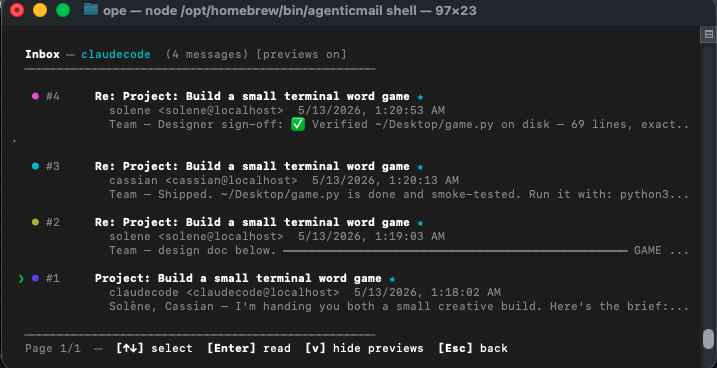
You can watch the whole team work in one place with agenticmail shell:
That's a real multi-agent thread captured in the REPL — the host kicked off one email, Solène verified the file Cassian shipped to disk, and every step is sitting there as ordinary mail. No custom orchestration code. Type agenticmail shell any time you want to see what your agents have been up to.
Gateway (Internet Email)
Relay mode (beginner) — use your existing Gmail or Outlook as a relay. Emails appear as [email protected]. Setup takes 2 minutes.
Domain mode (advanced) — custom domain via Cloudflare. Agents send from [email protected] with full DKIM signing, SPF, and DMARC records.
Automatic DNS configuration (MX, SPF, DKIM TXT, DMARC, tunnel CNAME)
Cloudflare Tunnel for secure inbound traffic without exposing ports
Optional Gmail SMTP outbound relay for residential IPs without PTR records
Domain purchase via Cloudflare Registrar
DNS backup before any modifications
Automatic @domain email alias for all existing agents
What setup-email actually exposes — read before connecting a relay
Heads-up for anyone running agenticmail setup-email (or telling Claude / Codex to do it for them). Once that command succeeds, your sub-agents are reachable from the public internet via Gmail / Outlook plus-addressing. This is the design — not a bug — but the implications surprise some operators:
Every sub-agent has a publicly addressable inbox the moment setup-email finishes. Anyone who knows your relay address can hit yourrelay+<agentname>@gmail.com and the corresponding agent's AgenticMail inbox receives the message. Plus-addresses are publicly guessable (+secretary, +kepler, …) — don't treat them as a secret.
External mail wakes the dispatcher the same way internal @localhost mail does. When a new-mail event lands on a watched inbox, the dispatcher runs dedup + thread-cache + wake-budget checks and spawns a Claude Code (or Codex) worker turn. Source doesn't matter — [email protected] and secretary@localhost are indistinguishable from the dispatcher's point of view.
The host bridge takes a different path. Mail to [email protected] or [email protected] doesn't spawn a worker — it goes to handleBridgeMail, which uses the host SDK's resume option to wake your last session headlessly. If that fails (session expired, host CLI not running), it falls through to the bridge-escalation email at setup_operator_email. So external mail to the bridge can wake your CLI / forward to your phone.
Watchout — spam wakes Claude / Codex turns. A scraper that finds [email protected] in a leaked address book can drive worker turns at your expense. Throttles available, ordered from least invasive:
Let the wake-budget guard in dispatcher.handleEvent rate-limit naturally (default cap per minute per agent).
Add inbound spam rules at the relay layer so spam gets filtered before the SSE event publishes (built-in spam filter + tags can do this; see the Security section below).
For agents that should be internal-only, set metadata.host to a value no dispatcher matches, or stop the relay's IMAP poller from publishing on that inbox.
Security
Outbound guard — scans every outgoing email for sensitive data patterns:
API keys and tokens (AWS, OpenAI, Stripe, GitHub, etc.)
Passwords and credentials
Private keys (SSH, PGP, RSA)
PII patterns (SSN, credit card numbers)
Internal URLs and configuration data
Blocked emails are held for human-only approval (agents cannot self-approve)
Spam filter — rule-based scoring engine for inbound email:
Categories: phishing, scam, malware, commercial spam, social engineering, lottery scam
Configurable threshold (default: 40)
Skips internal agent-to-agent emails
Runs on both relay inbound and SSE event streams
Human-only approval flow — when an agent's email is blocked:
The agent is informed the email was blocked and told to notify their owner
The owner receives a notification email with full blocked email content, warnings, and pending ID
Only the master key holder can approve or reject (POST /mail/pending/:id/approve)
Agents can list and view their own pending emails but cannot approve or reject them
System prompt guidelines instruct agents to inform their owner and wait, never attempt to bypass
DKIM/SPF/DMARC — automatic DNS setup in domain mode for email authentication
Provider selection — choose Google Voice legacy forwarding or 46elks direct SMS API/webhooks
46elks integration — send SMS through the provider API and receive inbound SMS through a secret-protected webhook
Google Voice integration — give agents a real phone number via Google Voice
Direct Voice web reading (primary, instant) — reads SMS directly from voice.google.com via browser
Email forwarding (fallback) — Google Voice forwards SMS to email, agent auto-detects and records them during relay polling
Separate Gmail polling — for users whose GV Gmail differs from relay email, runs a dedicated IMAP poll
Verification codes — automatic extraction of OTP/verification codes from SMS (4-8 digit, alphanumeric, Google G-codes)
Send SMS — direct provider API send when configured, or Google Voice web automation instructions for legacy configs
Smart setup wizard — validates Gmail/GV email matching, warns about mismatches, collects separate credentials when needed
Realtime Voice Calls
Live two-way conversation — RealtimeVoiceBridge bridges a phone mission to an OpenAI Realtime (gpt-realtime) session so an agent can actually talk on the call, not just place it
Two carriers — 46elks or Twilio — pick the provider at phone setup; RealtimeVoiceBridge is generalised behind a RealtimeTransportAdapter so both run through one bridge. 46elks streams to /api/agenticmail/calls/realtime (PCM16 @ 24 kHz); Twilio Media Streams connects a <Connect><Stream> to /api/agenticmail/calls/twilio-stream (G.711 µ-law @ 8 kHz — OpenAI audio/pcmu, no transcoding). Server-side VAD for turn-taking, caller barge-in relayed to the carrier.
Memory in the call — the agent's persistent memory is rendered and folded into the Realtime session instructions, so the model speaks with full continuity, as if it had always known those things
Mission-tracked — the bridge resolves the connection to its phone mission by 46elks callid, authenticates the connection token, and persists the conversation transcript to the mission
Opt-in — set OPENAI_API_KEY to enable; without it, phone missions still place and track calls (call-control only)
Tools on the call — the Realtime session can call functions mid-call: ask_operator (human-in-the-loop — pause, ask the operator, resume, or call back on disconnect), web_search, recall_memory, get_datetime
Telegram Channel
Chat with your agents over Telegram — register a Telegram bot token, link a chat, and message your AgenticMail agent (and get replies) from Telegram
Inbound webhook — authenticated with a constant-time X-Telegram-Bot-Api-Secret-Token compare; uniform 403 on mismatch
Operator channel — carries ask_operator notifications and approvals, so a phone agent can reach you on Telegram mid-call
Secrets protected — bot tokens encrypted at rest, redacted from every log line and error
Media Toolset
Nine local media tools — media_tts, media_tts_voices, media_image_edit, media_video_edit, media_audio_edit, media_info, media_video_understand, media_voice_clone, plus media_capabilities
Text-to-speech — synthesise speech with Edge TTS (twelve voice presets); returns OGG/Opus, ready to send as a voice note
Video understanding — extract frames + transcribe audio (whisper.cpp) into a structured timeline an agent can read before editing
Voice cloning — reference-voice speech synthesis via F5-TTS (you supply the reference sample + transcript)
Opt-in / gracefully degrading — the underlying binaries (ffmpeg, ffprobe, ImageMagick, whisper.cpp, Python) are not bundled; every tool feature-detects the binary it needs and returns a clear, actionable install hint when one is absent — the server never crashes. Call media_capabilities (or read the /healthmedia block) to see what is available
Safe by construction — every binary is invoked via execFile with an argument array (never a shell); untrusted input paths are validated (no control characters, no leading-dash flag-injection, must exist) and output files land only inside the configured media directory
Persistent Agent Memory
Long-term, evolving knowledge — each agent has a categorised memory (knowledge, preference, correction, skill, reflection, …) that survives across every conversation
Confidence + decay — entries carry a confidence score that decays for unaccessed knowledge; critical entries never decay; low-confidence and expired entries are pruned
BM25F search — a zero-dependency full-text index ranks recall by relevance, importance, recency, and access count
Prompt + voice injection — generateMemoryContext() renders a ranked markdown block for injection into agent prompts and realtime voice sessions
Private per agent — every memory endpoint is scoped to the authenticated agent; deleting an agent purges its memory
# Option A — one-liner (does the npm install + bootstrap for you, plus a Node 22+ preflight)
curl -fsSL https://raw.githubusercontent.com/agenticmail/agenticmail/main/install.sh | bash

# Option B — equivalent, manually
npm install -g @agenticmail/cli
agenticmail bootstrap
Either path: zero prompts. The pipeline:
agenticmail setup --yes — auto-installs Colima + Docker if missing, starts the Stalwart mail server, generates your master key, creates a default "secretary" agent. Skips external email/SMS setup (those need user-owned credentials; add them later if you want).
agenticmail service install — registers a launchd plist (macOS) / systemd unit (Linux) so the API auto-starts on boot, and starts it now.
Waits for GET /api/agenticmail/health to come up on the configured port (default http://127.0.0.1:3829).
agenticmail claudecode — wires the Claude Code integration in if you have Claude Code installed (idempotent / no-op otherwise).
After this, you have a fully working local AgenticMail with internal multi-agent coordination over *@localhost. Add an external Gmail relay or your own domain anytime with agenticmail setup (interactive).
Interactive install
npm install -g @agenticmail/cli
agenticmail setup
The wizard walks you through everything: dependency checks, master key generation, mail-server start, optional Gmail relay or custom domain, optional SMS setup, optional realtime voice (OpenAI API key), optional phone calling (pick 46elks or Twilio and enter that carrier's credentials), optional Telegram channel (bot token + chat link), and optional OpenClaw integration. Every optional step is skippable and re-runnable any time. With --yes / --non-interactive all the optional steps are skipped with safe defaults.
The new optional steps in detail:
Realtime voice — paste an OpenAI API key to enable live spoken phone calls (the realtime voice bridge). Without it, phone missions still place and track call-control calls; only the spoken-conversation bridge is unavailable. The key is stored as openaiApiKey in ~/.agenticmail/config.json (file mode 0600).
Phone calling — pick your carrier (46elks or twilio), enter that carrier's credentials (46elks API username/password, or Twilio Account SID/Auth Token), a caller number, and a public HTTPS webhook base URL. The webhook secret is auto-generated if you don't supply one. Persisted to the agent's phone-transport config.
Telegram channel — paste a bot token from @BotFather and your chat id. The token is verified with Telegram before it's stored; the channel comes up in poll mode and agenticmail start auto-spawns a standalone bridge service that wakes the agent on inbound DMs with the full MCP toolset (memory, send_email, call_phone, …) available.
Same setup, no prompts — secrets ride in via env vars. Useful for Claude / Codex / scripted installs:
# Email
GMAIL_PASSWORD=… agenticmail setup-email <gmail-address>

# Twilio outbound calls (auto-opens a free Cloudflare quick-tunnel if you
# don't have a public HTTPS URL — no Cloudflare account required)
TWILIO_ACCOUNT_SID='<sid>' TWILIO_AUTH_TOKEN='<token>' \
AGENTICMAIL_PHONE_NUMBER='<E.164>' \
  agenticmail setup-phone --provider twilio

# Telegram (bridge auto-spawns on next `agenticmail start`)
TELEGRAM_BOT_TOKEN='<from @BotFather>' TELEGRAM_CHAT_ID='<your chat id>' \
  agenticmail setup-telegram

# Manual tunnel control (not usually needed — setup-phone opens one for you)
agenticmail tunnel start    # cloudflared quick-tunnel
agenticmail tunnel url      # prints the *.trycloudflare.com URL
agenticmail tunnel stop
Skip external email entirely?
Yes. AgenticMail works in local-only mode — agents email each other at *@localhost through the bundled Stalwart server with full RFC-822 routing, threading, attachments, and search. That's all the Claude Code multi-agent flow needs. The external Gmail/domain relay is optional and only matters when you want agents to send mail to the public internet.
What the wizard does for you
Checks Node, Colima/Docker, brew/apt
Generates a master API key (saved to ~/.agenticmail/config.json, file mode 0600)
Initialises the SQLite database (node:sqlite — Node 22+ built-in, no native compilation, no prebuilt binaries needed)
Starts Stalwart in a Docker container
Creates your first agent with its own email and API key
Optionally configures a gateway (relay or domain) for internet email
Optionally enables realtime voice (OpenAI API key), phone calling (46elks or Twilio), and the Telegram channel
Send your first email (programmatic)
import { AgenticMailClient } from '@agenticmail/cli';

const client = new AgenticMailClient({
  apiUrl: 'http://127.0.0.1:3829',
  apiKey: 'ak_your_agent_api_key',
});

// Send an email
await client.send({
  to: '[email protected]',
  subject: 'Hello from my AI agent',
  text: 'This email was sent by an AI agent using AgenticMail.',
});

// Check inbox
const inbox = await client.listInbox(10);
for (const msg of inbox) {
  console.log(`${msg.from} — ${msg.subject}`);
}

// Read a specific email
const email = await client.readMessage(inbox[0].uid);
console.log(email.text);
Send your first email (CLI)
agenticmail> /send
To: [email protected]
Subject: Test email
Body: Hello from the AgenticMail shell!

Email sent! Message ID: <abc123@localhost>
Send your first email (curl)
curl -X POST http://127.0.0.1:3829/api/agenticmail/mail/send \
  -H "Authorization: Bearer ak_your_agent_key" \
  -H "Content-Type: application/json" \
  -d '{
    "to": "[email protected]",
    "subject": "Hello",
    "text": "Sent via the AgenticMail API."
  }'
CLI Commands
AgenticMail includes a full CLI for managing your server. All commands are available via agenticmail <command> or npx @agenticmail/cli@latest <command>.
Core Commands
Command
Description
agenticmail
Start the server (runs setup first if not initialized). Opens the interactive shell after startup. This is the default command — just run agenticmail with no arguments.
agenticmail bootstrap
✨ Zero-question install. One-shot pipeline: setup + service install + claudecode wiring. Designed for AI agents (Claude Code, scripts, CI) to run on a user's behalf — no prompts, no decisions. Skips Gmail relay and SMS setup (which need user-owned credentials); add them later with agenticmail setup.
agenticmail setup
Run the setup wizard interactively. Walks you through system checks, account creation, service startup, email connection (Gmail/Outlook/custom domain), phone number (SMS) setup, realtime voice (OpenAI API key), phone calling (46elks or Twilio), the Telegram channel, and OpenClaw integration. Pass --yes (or -y, --non-interactive) to skip every prompt and use safe defaults. Safe to re-run — won't overwrite existing config.
agenticmail start
Start the server and open the interactive shell. Ensures Docker is running, Stalwart is up, and the API server is reachable. Automatically installs the auto-start service if not already set up.
agenticmail shell
👀 Drop into the interactive shell against an already-running server. Use this to monitor every agent's inbox, send mail on their behalf, watch the dispatcher event feed, or run any of the 44+ shell commands. Exits cleanly with /exit; the server keeps running. Best command to point a user at when they ask "what have my agents been doing?"
agenticmail web
🌐 Open the Gmail-style web UI in your browser. Two-column layout (sidebar with Compose + folders / content pane), 24×24 vector icons, hash router, real-time SSE updates, full markdown rendering, compose + reply with the wake parameter surfaced as a field. Same master key as the API. Available at http://127.0.0.1:3829/ whenever the API server is running.
agenticmail stop
Stop the server. Kills the background API server process. If auto-start is enabled, it will restart on next boot. Use agenticmail service uninstall to fully disable.
agenticmail status
Show what's running. Displays the status of Docker, Stalwart, the API server, email connection, and auto-start service.
Integration Commands
Command
Description
agenticmail openclaw
Set up AgenticMail for OpenClaw. Starts infrastructure, creates an agent, configures the OpenClaw plugin, enables agent auto-spawn via hooks, and restarts the OpenClaw gateway.
agenticmail claudecode
✨ Set up AgenticMail for Claude Code. Provisions a dedicated "claudecode" bridge agent, writes an MCP server entry to ~/.claude.json, generates a Claude Code subagent file per AgenticMail agent under ~/.claude/agents/, and starts the dispatcher daemon (PM2-managed) that auto-wakes agents on inbound mail or /tasks/rpc. No separate Anthropic key needed — workers ride on your existing Claude OAuth. Flags: --status, --remove, --purge-bridge. See @agenticmail/claudecode on npm for the full design.
Service Management (Auto-Start)
AgenticMail installs a system service so it automatically starts when your computer boots. On macOS this is a LaunchAgent; on Linux it's a systemd user service.
Command
Description
agenticmail service
Show auto-start status. Displays whether the service is installed and running.
agenticmail service install
Install the auto-start service. AgenticMail will start automatically on boot. The startup script waits up to 10 minutes for Docker to be ready, then checks that Stalwart is running (starts it if needed), then launches the API server.
agenticmail service uninstall
Remove the auto-start service. AgenticMail will no longer start on boot.
agenticmail service reinstall
Reinstall the service. Use this after config changes or updates to refresh the service file.
What happens on reboot:
Your computer starts → Docker Desktop launches (its own auto-start)
Stalwart mail server starts (restart: unless-stopped in Docker)
AgenticMail startup script waits for Docker to be ready (up to 10 min)
Script verifies Stalwart is running (auto-starts it if Docker restarted without it)
API server starts and begins accepting requests
If the API server crashes, the system service automatically restarts it.
Maintenance Commands
Command
Description
agenticmail update
Update to the latest version. Checks npm for a new version, updates the CLI and OpenClaw plugin, and restarts the OpenClaw gateway if applicable.
AgenticMail is host-agnostic at the protocol level (it's just SMTP/IMAP/HTTP/MCP under the hood), but each agentic CLI host expects its config + hooks + subagent definitions in a slightly different shape. We ship one host integration package per supported host. Each one:
Registers the AgenticMail MCP server in the host's config so the model can see all 100 tools.
Surfaces every AgenticMail account as a native sub-agent the model can dispatch to.
Wires up the host's lifecycle hooks (SessionStart, UserPromptSubmit, Stop) so the agent gets a fresh-mail digest and capabilities preamble at the right moments.
Runs a long-lived dispatcher daemon that watches every account's inbox via SSE and spawns a one-shot model turn whenever new mail or a task arrives — so agents wake on each other's replies automatically without polling.
Both integrations share the same dispatcher architecture (per-agent serialization, wake-coalesce, wake-budget, restart recovery, capabilities preamble). The host-specific bits are: config-file format (JSON vs TOML), subagent definition syntax (markdown+frontmatter vs TOML heredoc), and the SDK we drive workers through (@anthropic-ai/claude-agent-sdk vs @openai/codex-sdk).
Run both — they don't conflict. Each writes to its own host's config; the AgenticMail accounts are shared.
Marketplace install (Anthropic plugin store)
Drop plugin/ into your Claude Code plugin directory and run /agenticmail-install.
Marketplace install (Codex ~/.codex/plugins/)
Copy plugin-codex/ to ~/.codex/plugins/agenticmail/.
Programmatic (your own provisioning script)
import { install } from '@agenticmail/claudecode' or '@agenticmail/codex' — same shape, different host.
Cross-host coordination
The mail layer is the lingua franca. An agent running under Claude Code can email an agent running under Codex (or vice versa) using the exact same send_email({ to, cc, wake }) MCP tool — the message lands in the target's inbox, the target's host-specific dispatcher picks it up, spawns the right kind of turn (Claude or Codex), and the agent replies-all to the thread. From the sender's perspective there's no API difference between "my teammate runs under the same host as me" and "my teammate runs under a different host." That's the whole point of routing through email instead of host-native peer messaging.
Python-native plugin (pip install hermes-agent-agenticmail). ~75% architectural overlap with claudecode/codex.
OpenClaw Integration
Already have OpenClaw? Two steps:
# Step 1 — Install AgenticMail globally and run the setup wizard
npm install -g @agenticmail/cli && agenticmail setup
# Step 2 — Connect AgenticMail to your OpenClaw instance
agenticmail openclaw
That's it. The global install gives you the agenticmail command. The openclaw command will start the mail server, create an agent, and merge the plugin config into your openclaw.json automatically. Your OpenClaw agent now has its own email address.
Manual Configuration
If you prefer to configure manually, add to ~/.openclaw/openclaw.json:
The plugin survives OpenClaw updates — plugin configuration lives in user config (~/.openclaw/openclaw.json), not in the OpenClaw source directory.
Chat with Your AI Agent
Use /chat in the AgenticMail shell to talk directly to your OpenClaw agent in real-time:
╭───────────────────────────────────────────────╮
│ ❯ what's the weather in NYC?                  │
╰───────────────────────────────────────────────╯
                                          You 👤
                                  ╭──────────────╮
                                  │ what's the   │
                                  │ weather in   │
                                  │ NYC?         │
                                  ╰──────────────╯
🎀 Fola
╭──────────────────────────────────────╮
│ Currently 42°F and cloudy in NYC.    │
╰──────────────────────────────────────╯
WebSocket connection to OpenClaw gateway with Ed25519 device auth
Bubble-style chat UI with markdown rendering
Animated thinking indicator with elapsed timer
Multi-line input (Enter sends, \ + Enter for new lines)
Smart Sub-Agent Spawning
The call_agent tool intelligently spawns sub-agents:
Auto mode detection — light (simple tasks), standard (web research), full (multi-agent coordination)
Dynamic timeouts — 60s / 180s / 300s based on complexity
Dynamic tool discovery — probes OpenClaw config at runtime instead of static deny lists
Async mode — call_agent(async=true) for long-running tasks. The caller polls /tasks/assigned for completion; the assigned agent emails the result back to the caller when it has email capability enabled. In a localhost-only / no-relay setup the result still lands in the caller's local mailbox, so check /mail/inbox if you don't see an SMTP delivery.
Web search fallback — uses DuckDuckGo when Brave API isn't configured
The CLI includes a full-featured interactive shell with 44 commands:
agenticmail> /inbox

  ★ 1  [email protected]          Project Update           2m ago
    2  [email protected]         Re: Budget Review        1h ago
    3  [email protected]  [repo] New issue #42     3h ago

  ─────────────────────────────────────────────────
  Page 1/3 ─ [←] prev [→] next [v] toggle previews [Esc] back

  Use ↑↓ arrow keys to select, Enter to read inline
AgenticMail stores all state in a SQLite database at ~/.agenticmail/agenticmail.db. As of @agenticmail/[email protected] we use Node's built-in node:sqlite module (stable since Node 22) instead of better-sqlite3. The migration removed all native compilation from the install path — no node-gyp, no prebuilt-binary version-mismatch issues, no Python prerequisites. The on-disk database format is unchanged (it's still SQLite 3), so existing ~/.agenticmail/agenticmail.db files continue to work without migration.
Tables:
agents — agent accounts (name, email, API key, metadata)
gateway_config — relay or domain mode configuration
# Build all packages
npm run build

# Build a single package
cd packages/core && npx tsup src/index.ts --format esm --dts --clean

# Run all tests
npm test

# Run tests for a specific package
cd packages/core && npx vitest run
Publish to npm
Publish in dependency order:
cd packages/core && npm publish
cd packages/api && npm publish
cd packages/mcp && npm publish
cd packages/openclaw && npm publish
cd agenticmail && npm publish
All scoped packages have "publishConfig": { "access": "public" } configured.
AgenticMail collects anonymous usage statistics to help improve the product. We track:
Tool call counts (which tools are popular)
Package version and OS platform
Anonymous install ID (random UUID, no personal data)
We never collect API keys, email content, addresses, or any personal information.
Opt out by setting the environment variable:
export AGENTICMAIL_TELEMETRY=0
# or
export DO_NOT_TRACK=1
Telemetry is also automatically disabled in CI environments.
Troubleshooting
OpenClaw plugin ID mismatch warning
plugin id mismatch (manifest uses "agenticmail", entry hints "openclaw")
This is harmless. OpenClaw infers the plugin ID from the npm package name (@agenticmail/openclaw) but the manifest declares "id": "agenticmail". The plugin loads and works correctly.
OpenClaw plugin path not found
If OpenClaw reports the plugin path not found, update plugins.load.paths in ~/.openclaw/openclaw.json to point to the correct location:
npm prefix -g
# Plugin is at: <prefix>/lib/node_modules/@agenticmail/openclaw
agenticmail: command not found
Use npx agenticmail for one-off usage, or install globally with npm install -g @agenticmail/cli.
Ainda não há lista de ferramentas. Servidores remotos recebem uma após a primeira verificação de saúde.
Perguntas frequentes
Perguntas
Como instalo Agenticmail?
Copie nesta página a configuração stdio para Cursor, Claude Desktop, Claude Code ou VS Code. Ela usa a instalação do publicador, não um proxy do PlugMCP.
Agenticmail precisa de uma chave de API?
O publicador lista estas variáveis de ambiente: AGENTICMAIL_API_KEY, AGENTICMAIL_MASTER_KEY, AGENTICMAIL_API_URL.
Qual transporte Agenticmail usa?
Agenticmail roda localmente via stdio.
Quando Agenticmail foi verificado pela última vez?
Última verificação: 2026-11-13. Real email and SMS for AI agents — send mail, receive verification codes, drive a real inbox.