Solana Security Standard
The Solana Security Standard —
SOL-0XXrules distilled from $514M of real exploits, firing as you code in every AI tool (Claude Code, Codex, Cursor, Windsurf…), your editor, and CI. By the auditors who find them.
Potencialize seu agente
O comando do próprio publicador. Não é um endpoint do PlugMCP.
Host a copy with our keys and logs.
npx -y @jelleo/[email protected]O Claude Code não tem link de instalação para um comando local. Copie o comando abaixo e execute-o em um terminal.
claude mcp add io.github.copenhagen0x-solana-security-mcp -- npx -y @jelleo/solana-security-mcp@1.5.0Execute em um terminal.
{ "mcpServers": { "io.github.copenhagen0x-solana-security-mcp": { "command": "npx", "args": [ "-y", "@jelleo/[email protected]" ] } }}claude_desktop_config.json
URL remota ou um comando na sua máquina? Como as duas instalações diferem
Rodar no PlugMCP
A new server you create. It is not this listing's official endpoint. Use the publisher install when you want their URL and their credentials.
AbrirDo publicador
The Solana Security Standard —
SOL-0XXrules distilled from $514M of real exploits, firing as you code in every AI tool (Claude Code, Codex, Cursor, Windsurf…), your editor, and CI. By the auditors who find them.
Scan Solana/Anchor code against the Solana Security Standard and serve the ruleset to MCP clients.
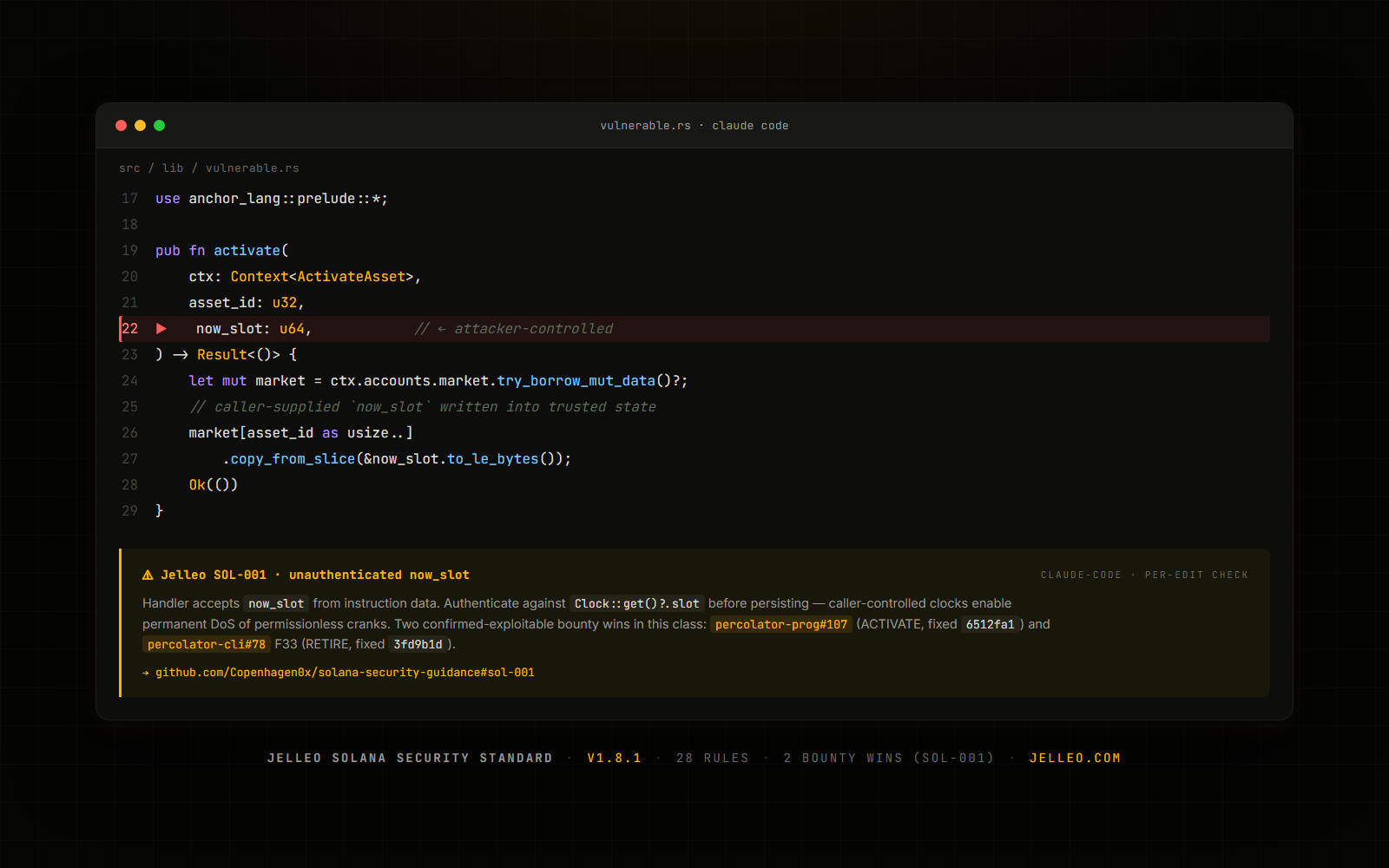
The same SOL-0XX rules flag Solana-specific bugs while you code — caller-controlled clock values, cross-market state asymmetry, wrapper handlers that drift from engine logic, missing Anchor constraints, and 52 bug classes in all, drawn from real audits.
Works in: Claude Code · Codex · Copilot · Cursor · Windsurf · Cline · Aider · any MCP client · the VS Code extension (Open VSX) · the CLI · Semgrep · GitHub Actions. Pick your surface below.
mkdir -p .claude && \
  curl -sL https://raw.githubusercontent.com/Copenhagen0x/solana-security-standard/main/plugin-guidance.md \
       -o .claude/claude-security-guidance.md && \
  curl -sL https://raw.githubusercontent.com/Copenhagen0x/solana-security-standard/main/security-patterns.yaml \
       -o .claude/security-patterns.yaml
plugin-guidance.md is the compact ≤8 KB plugin digest (every rule as a one-line cue, generated from the full claude-security-guidance.md); it lands as the plugin's .claude/claude-security-guidance.md. Full per-rule detail is one MCP call (list_solana_security_rules) or one click (the master on GitHub) away.
Then make sure you have Anthropic's security-guidance plugin installed:
/plugin install security-guidance@claude-plugins-official
/reload-plugins
Done. Open a Solana program file in Claude Code and the plugin will catch issues as you write.
(This pulls from main with no integrity check. For supply-chain-sensitive use, see Verified install below.)
Or install the whole standard as a Claude Code plugin (the MCP scan tool + a /scan command, auto-wired):
/plugin marketplace add Copenhagen0x/solana-security-standard
/plugin install solana-security-standard@solana-security-standard
For CI or supply-chain-sensitive setups, pin to a release tag and verify the download against the published CHECKSUMS.txt instead of pulling main:
Note: the
plugin-guidance.mddigest ships from v1.11.0 onward. Pin the latest release tag in the flow below.
TAG=v1.12.0   # the digest ships from v1.11.0 on; older tags use claude-security-guidance.md directly
BASE="https://raw.githubusercontent.com/Copenhagen0x/solana-security-standard/$TAG"
tmp=$(mktemp -d) && cd "$tmp" && mkdir -p semgrep
curl -fsSL "$BASE/CHECKSUMS.txt"                          -o CHECKSUMS.txt
curl -fsSL "$BASE/plugin-guidance.md"                     -o plugin-guidance.md
curl -fsSL "$BASE/security-patterns.yaml"                 -o security-patterns.yaml
curl -fsSL "$BASE/semgrep/solana-security-standard.yaml"  -o semgrep/solana-security-standard.yaml
sha256sum -c CHECKSUMS.txt          # Linux — all three must print "OK"; aborts on any mismatch
# macOS (no sha256sum): shasum -a 256 -c CHECKSUMS.txt
mkdir -p "$OLDPWD/.claude"
cp security-patterns.yaml "$OLDPWD/.claude/"
cp plugin-guidance.md "$OLDPWD/.claude/claude-security-guidance.md"   # rename to the plugin's expected filename
# the verified semgrep ruleset stays in $tmp/semgrep/ — point `semgrep --config` at it or copy where you need it
Pinning to a tag freezes you to a known release (a tampered main can't reach you); the checksum confirms nothing was altered in transit. (Hashes are over the LF bytes GitHub serves — verify the downloaded files, not a CRLF local checkout.) Tags from v1.9.1 on are SSH-signed — verify origin with git verify-tag v1.12.0 (key + steps in SECURITY.md). (Checksums and the in-repo allowed-signers can't defend against a full account compromise that rewrites both — the signed tag, verified out of band, is the origin check for that.)
Gate every pull request on the standard. The same SOL-0XX patterns run as a check, with inline annotations on the diff:
# .github/workflows/solana-security.yml
name: Solana Security Standard
on: [pull_request]
permissions:
  contents: read
  security-events: write   # optional — enables inline PR annotations
jobs:
  scan:
    runs-on: ubuntu-latest
    steps:
      - uses: actions/checkout@v4
      - uses: Copenhagen0x/solana-security-standard@v1
        with:
          paths: ./programs        # what to scan (default: .)
          # fail-on-findings: true # red X on findings (default)
          # upload-sarif: true     # GitHub code scanning (default)
          # min-tier: high         # noise floor: drop LOW-tier hygiene findings
          # baseline: .sss-baseline.json  # gate only on NEW findings (see cli/README)
Then show the world you adopt it — drop this badge in your README:
[](https://github.com/Copenhagen0x/solana-security-standard)
npx @jelleo/solana-security-standard scan ./programs
Human, JSON, or SARIF output; exits non-zero on findings (so it gates any CI). Zero dependencies. Details in cli/.
Every machine rule is scored against its canonical vulnerable/fixed example pair on every change — see BENCHMARK.md (generated, CI-enforced: a rule that stops detecting its bug, or starts flagging its fix, cannot merge).
The VS Code extension shows SOL-0XX findings as inline warning squiggles as you
type, in Rust and TypeScript/JS files. Same engine as the CLI, 100% local (no telemetry). Install it
from Open VSX — works in Cursor,
Windsurf, and VSCodium; on stock VS Code, sideload the .vsix from extensions/vscode/
(the Microsoft Marketplace listing is pending publisher verification). Details in extensions/vscode/.
Already have a Semgrep pipeline? Point it at the ported ruleset:
semgrep --config https://raw.githubusercontent.com/Copenhagen0x/solana-security-standard/main/semgrep/solana-security-standard.yaml ./programs
The same SOL-0XX rules as pattern-regex rules. Details in semgrep/.
Most AI coding tools read a rules/instructions file. integrations/ ships the SOL-0XX
standard in each tool's native format — all generated from the one source — so your assistant writes
and reviews Solana/Anchor code against the rules. Copy the file for your tool (full matrix in
integrations/README.md):
Prefer the Model Context Protocol? The MCP server gives any MCP client (Cline, Copilot,
Cursor, Claude, Windsurf) a scan_solana_code tool plus the full rule set — no file to copy:
{ "mcpServers": { "solana-security-standard": { "command": "npx", "args": ["-y", "@jelleo/solana-security-mcp"] } } }
100% local, same scanner as the CLI. Details in mcp/.
hacks/ maps real, disclosed Solana exploits to the SOL-0XX rule class each one falls under —
Wormhole, Mango Markets, Cashio, Crema, Nirvana, Cypher, Loopscale, and more ($514M+ in documented
losses). Every entry is cited, and incidents no code rule can prevent (stolen keys, off-chain wallets)
are flagged as such rather than misattributed — the same honesty the rest of this repo holds itself to.
Browse the database →.
content/content/ is a standalone explainer for all 52 rules: what each catches, the fix, whether
it is machine-checkable or review-only, the real exploits in that class (cross-linked to the Hacks
Database), and a code example where one exists. One page per rule — all generated from the standard +
patterns + hacks + examples, so nothing drifts.
disclosures/ feedThe standard is a living one. disclosures/ ingests a new Solana disclosure — a GitHub
Security Advisory, an Immunefi report, or a security-fix PR — and proposes a candidate Hacks-Database
entry with suggested SOL-0XX mappings for a human to verify. It never auto-writes (a cited DB only takes
reviewed entries). As an internal sanity check, the keyword classifier surfaces a labeled rule among its
ranked suggestions for every exploit already catalogued — self-consistency on our own root-cause text,
not a blind-accuracy or top-1 claim.
52 rules: 49 on-chain Solana program bug classes, plus 3 integrator / client-side rules (SOL-029–031) for the TypeScript/web3.js that builds and sends transactions (bots, keepers, integrators). SOL-001 covers two confirmed-exploitable bounty wins (the same caller-controlled now_slot class fixed in both the ACTIVATE and RETIRE branches of percolator). Most of the rest are drawn from documented Solana audit patterns — some from our published disclosures (with maintainer triage classifications noted in the Source column), some from public bug-class taxonomy; the integrator trio came from a live buyback-worker report.
We disclose exactly where each rule came from. Some are confirmed-exploitable bounty wins; some are documented patterns we surfaced but the maintainer classified differently in triage. We list both kinds because all of them are real Solana attack surfaces worth flagging — but we don't claim bounty credit we didn't earn.
SOL-001 — TWO confirmed-exploitable bounty wins (same class, two code paths). ACTIVATE branch: percolator-prog#107, fixed in 6512fa1. RETIRE branch: percolator-cli#78 F33, fixed in 3fd9b1d. Both maintainer-acknowledged via Lean theorem-prover models. Our suggested authenticated_slot_or_fallback patch shipped verbatim.
SOL-002 — public class, not our bounty. The cross-market pnl_pos_bound_tot inflation class was publicly disclosed at percolator-prog#104 by another researcher. Included because the pattern is reproducible across perp-DEX programs.
SOL-003, SOL-004, SOL-005 — patterns from our bounty 5 disclosure. All three were in our #78 submission (36 findings total). Maintainer triage outcomes: F1 already fixed in 0925ed4 before triage; F2 engine-side (separate disclosure pending at aeyakovenko/percolator); F12 latent (reachable when the 14-asset cap is lifted). Real Solana patterns worth flagging in future code, none paid as new bounties.
SOL-021, SOL-022, SOL-023 — patterns from our percolator v16 engine audit. F1 (terminal-close deadlock) was fixed by the maintainer as "Finding C". F2 (write-only impaired insurance counter) is disclosed at percolator#74 — code-confirmed, not yet reproduced on-chain. F3 (fee rounding) is Low. Code-analysis patterns, not claimed as paid bounties.
The remaining rules (SOL-006 through SOL-020, plus SOL-024 through SOL-028) cover documented Solana / DeFi audit patterns — signer/owner/PDA verification, Anchor constraints, CPI authority, lamport drains, Token Program ID confusion, integer overflow, oracle staleness, slippage bounds, etc. Standard auditor checklist territory.
All published cycle reports: jelleo.com/cycles
The standard is two source files — a YAML of deterministic patterns and a Markdown threat-model + rule catalog — plus a self-contained scanner. Every surface runs the same rules: the CLI, GitHub Action, editor extension, MCP server, and Semgrep apply them directly. In Claude Code specifically, Anthropic's security-guidance plugin reads the two files and reviews edits at three layers:
.claude/security-patterns.yaml for regex/substring rules. Our file provides 30 deterministic patterns..claude/claude-security-guidance.md for semantic guidance. Our file provides the Solana threat model + 52-rule catalog + review checklist.Every time a rule fires, the reminder text includes the rule ID (e.g. Jelleo SOL-001:) and a link back to this repo so you can see the underlying bounty case study.
The examples/ directory contains 30 paired vulnerable/fixed snippets — one for every machine-checkable rule (Rust on-chain; TypeScript for the integrator rules). They're self-tested: the scanner must fire on each vulnerable file and clear on each fixed one, so they can't drift from the rules. Useful for understanding a bug class before reading the rule definition.
PRs welcome — especially:
Open an issue first if you're proposing a new rule category. Keep rules focused: each one should catch a single bug class with a low false-positive rate. Quality over quantity.
This repo follows Semantic Versioning. Pin a tagged release rather than main (the plugin-guidance.md digest ships from v1.11.0 onward):
curl -sL https://raw.githubusercontent.com/Copenhagen0x/solana-security-standard/v1.12.0/plugin-guidance.md \
     -o .claude/claude-security-guidance.md
A bare curl like this has no integrity check — for checksum + signed-tag verification use the Verified install flow above.
See CHANGELOG.md for the full version history.
MIT — use anywhere, attribution appreciated.
Jelleo — continuous Solana program audits. Every cycle is Ed25519-signed and Merkle-rooted; all artifacts public at jelleo.com/cycles.
Each new bounty cycle we publish adds rules to this guidance. If you want a deeper audit of your Solana program, see jelleo.com.
Scan Solana/Anchor code against the Solana Security Standard and serve the ruleset to MCP clients.
{ "mcpServers": { "io.github.copenhagen0x-solana-security-mcp": { "command": "npx", "args": [ "-y", "@jelleo/[email protected]" ] } }}Ferramentas
Ainda não há lista de ferramentas. Servidores remotos recebem uma após a primeira verificação de saúde.
Perguntas frequentes
Copie nesta página a configuração stdio para Cursor, Claude Desktop, Claude Code ou VS Code. Ela usa a instalação do publicador, não um proxy do PlugMCP.
Este registro não lista nenhuma variável de ambiente obrigatória.
Solana Security Standard roda localmente via stdio.
Última verificação: 2026-11-09. Scan Solana/Anchor code against the Solana Security Standard and serve the ruleset to MCP clients.
