MCP server that gives AI coding agents (Claude Code, Codex, Cursor)
accurate knowledge of the Siemens NXOpen .NET API — eliminating
hallucinated API calls via hybrid retrieval over your own NX installation's
official documentation.
MCP server giving AI coding agents accurate Siemens NXOpen .NET API knowledge via hybrid retrieval (BGE-M3 + sqlite-vec), built from your own licensed NX installation
Estrelas
15
Ferramentas
—
Disponibilidade
—
Why
LLMs hallucinate NXOpen APIs: it's a niche domain (Siemens NX CAM/CAD
automation) with sparse public training data, so models confidently invent
classes, methods, and parameters that don't exist. This server grounds
agents in the real docs instead of guesses:
Semantic search (BGE-M3 dense + sparse embeddings) so natural-language
queries in English or 中文 find the right API even without exact names.
Exact-name channel: a literal CamelCase name in your query (e.g.
CavityMillingBuilder) is looked up directly and pinned to the top
(types first) — never left to approximate matching.
RRF fusion available to combine channels — though evaluation made
dense + exact the default (see Evaluation).
Everything runs locally and offline against an index built from your own
licensed NX installation — no Siemens files are ever bundled with this
repo or sent anywhere.
Quick start
Requires Python 3.11+.
# 1. Install from PyPI (or run without installing: uvx nxopen-mcp)
pip install "nxopen-mcp[embed,reflect]"

# 2. Build the index from YOUR NX installation (one-time — see time note below)
nxopen-mcp index --nx-path "D:\Siemens\NX12.0"

# 3. Register with Claude Code (user scope: available in every project)
claude mcp add -s user nxopen -- nxopen-mcp serve

# 4. Ask Claude Code to write NXOpen code — it now queries real APIs.
index looks for NXOpen*.xml doc files under <nx-path>\UGII\managed
(falling back to <nx-path> itself), and for NXOpen*.dll assemblies in
the same folder.
Extras: [embed] pulls in FlagEmbedding (downloads the ~2GB BGE-M3
model on first use) — required for indexing and semantic search.
[reflect] pulls in pythonnet so get_class can show inherited
members; skip it and indexing still works, just without inheritance
chains.
How long does indexing take? Honest numbers: a full NX 12 doc set is
~100k members; on an 8-core laptop CPU that's several hours of
embedding (memory-bandwidth-bound — --workers N helps mainly on
machines with more memory channels; a CUDA GPU helps a lot). Plan to run
it overnight, or copy a teammate's index (see
Sharing a pre-built index).
First semantic query is slow by design.serve starts instantly, and
get_class / get_member respond immediately, but the first
search_api / find_builder call loads the BGE-M3 model (~1–2 min).
After that, semantic queries take seconds. If your MCP client shows the
first search "hanging", it's the one-time model load — let it finish.
By default the index is written to ~/.nxopen-mcp/index.db; override with
--db <path> on both index and serve.
If nxopen-mcp isn't on your PATH (e.g. installed into a venv), use the
full path to the executable (Windows: <venv>\Scripts\nxopen-mcp.exe)
in the commands and configs below.
Alternatively, one CLI command does the same thing:
codex mcp add nxopen -- nxopen-mcp serve
Restart Codex, then verify with codex mcp list (or just ask it to look
up an NXOpen class — you'll see the nxopen tool calls). Note the same
first-semantic-query model load (~1–2 min) applies here.
Cursor
Add the same JSON block as .mcp.json above to Cursor's MCP settings
(project .cursor/mcp.json, or global via Settings → MCP).
Tools
tool
purpose
search_api
Hybrid semantic search over the API (dense + exact-name by default, sparse optional). Accepts English or 中文 queries; use when you don't know the exact class/member name.
get_class
Full member list for a class, including members inherited from its ancestor chain. Use when you know the class name.
get_member
Exact signature, parameters, return value, NX version, and license requirement for one member.
find_builder
Given a CAM operation name (e.g. "cavity milling", "hole drilling"), finds the matching *Builder class, its creator method, and a Builder → Commit → Destroy code skeleton.
Architecture
NXOpen*.xml / *.dll  (your NX install)
        │
        ▼
  indexer/parser.py        one XML doc-comment member -> one MemberRecord
  indexer/inheritance.py   optional: reflect DLLs (pythonnet) for base-class chains
        │
        ▼
  indexer/embedder.py      BGE-M3 dense vector + sparse token weights per record
        │
        ▼
  indexer/build.py         writes members, dense_vec (sqlite-vec), sparse_postings
        │                  into a single SQLite file (index.db)
        ▼
  retrieval/store.py       exact-name lookup, class/member/inheritance queries
  retrieval/hybrid.py      dense ANN + exact CamelCase match (default),
                           optional sparse channel, RRF fusion
        │
        ▼
  server.py                4 MCP tools (FastMCP, stdio transport)
  cli.py                   `nxopen-mcp index` / `nxopen-mcp serve`
Design decisions:
BYO-Docs licensing. This repository contains no Siemens XML/DLL
files. Users point nxopen-mcp index at their own licensed NX
installation; the resulting index is a local SQLite file that never
leaves the machine and is never committed (see .gitignore).
One-member-one-chunk. Each indexed unit is a single API member
(type, property, method, field, or event) rather than an arbitrary text
window, so retrieval results map 1:1 onto something an agent can act on
(a class, a method signature) instead of a fragment of a doc page.
RRF fusion, not score blending. When the sparse channel is enabled,
dense and sparse rankings are combined with Reciprocal Rank Fusion,
which is scale-free and doesn't require calibrating dense-vs-sparse
score magnitudes against each other (the evaluated default runs
dense + exact only).
Exact CamelCase name matches are promoted ahead of the fused list
outright, since a literal name in the query is a much stronger signal
than similarity.
Inheritance via reflection, with graceful degradation. Ancestor
chains (needed by get_class to show inherited members) are extracted
by reflecting the NXOpen DLLs with pythonnet ([reflect] extra) at
index time. If the extra isn't installed or DLLs aren't found alongside
the XML docs, indexing still succeeds — get_class simply has no
inherited members to show.
Evaluation
Measured on a real index built from an NX 12 installation (97,913 API
members) against a 73-query golden set (eval/golden.jsonl, mixed
English / Traditional Chinese, four query styles — semantic description,
exact class name, member lookup, builder idiom — spanning CAM, Features,
Sketch, Assemblies, Drawings, UF, and BlockStyler):
Same model (Claude Haiku), the original 33 golden questions, one
variable — whether the nxopen-mcp tools are available. Answers were graded against the golden
set; "hallucinated" means the proposed member does not exist anywhere in
the real 97,913-member index:
metric
closed-book (no tool)
with nxopen-mcp
exactly correct
13/33 (39.4%)
31/33 (93.9%)
wrong but real API
13/33 (39.4%)
2/33 (6.1%)
hallucinated (API does not exist)
7/33 (21.2%)
0/33 (0%)
time to answer all 33
84 s
321 s (44 tool calls)
The closed-book hallucinations are the dangerous kind — plausible names
like NXOpen.CAM.MillGeometryBuilder (real name: MillGeomBuilder) or
NXOpen.Session.Parts.Open (real: NXOpen.PartCollection.Open) that
read fine and fail at compile time. Tool-assisted answering costs ~7 s
per question and eliminated hallucinations entirely.
Evaluation-driven default. The original design fused dense, sparse
and exact-name channels with uniform RRF. Measurement showed BGE-M3's
sparse channel hurt on this corpus — on the initial 33-query set a
weight sweep (w_sparse ∈ {0.5, 0.3, 0.15}) never recovered the
dense-only baseline, and expanding the golden set to 73 queries
replicated the finding (Recall@5 58.9% → 49.3% when sparse is fused).
The exact-name channel — after reordering its matches (types first,
shortest name first, capped at 3) — matches dense recall while
improving MRR (0.420 → 0.445) and guaranteeing literal-name hits. The
default is therefore dense + exact; the sparse channel remains
available via the channels parameter of search().
Demo
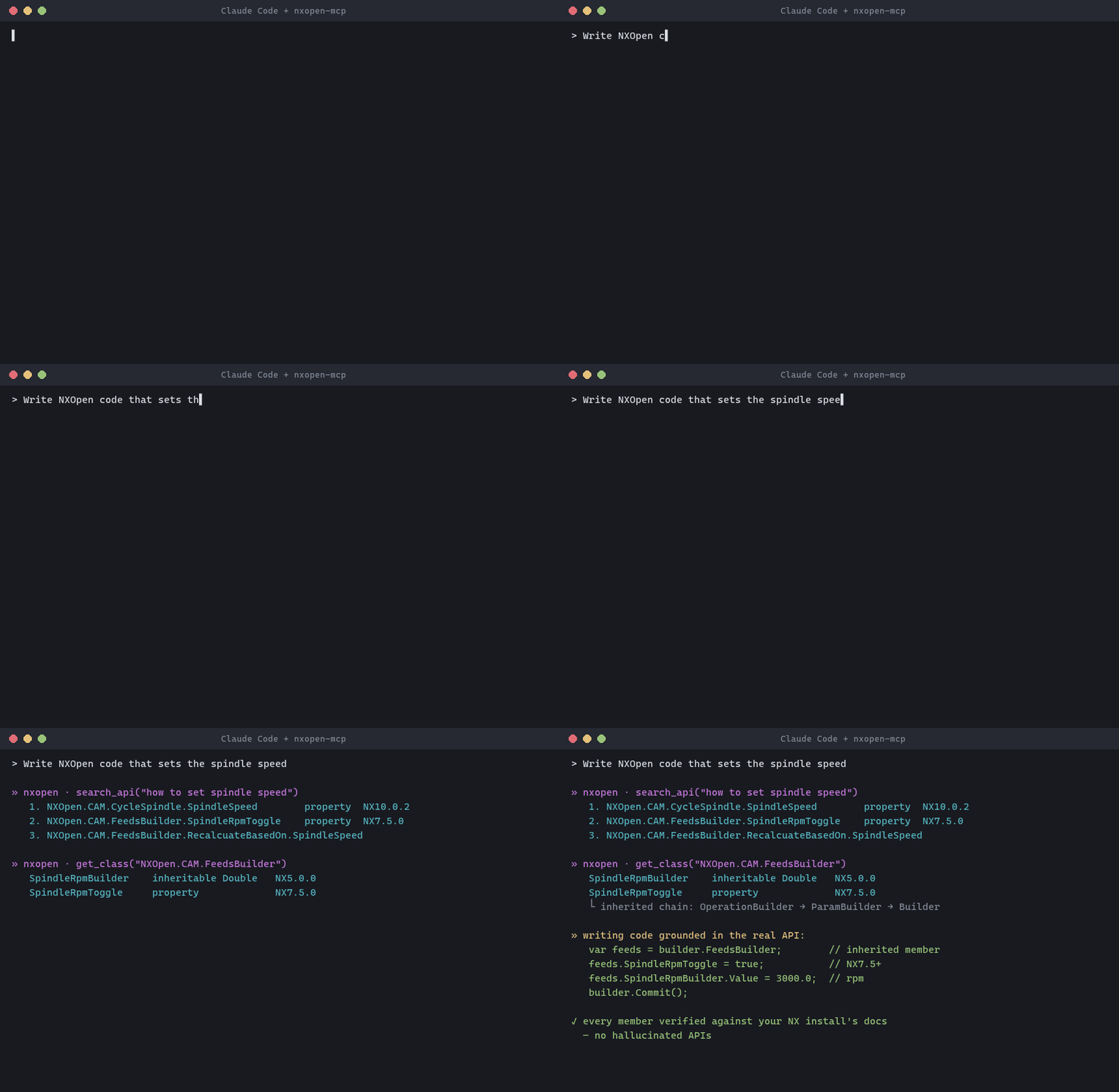
A real session: asked to write NXOpen code that sets the spindle speed,
Claude Code calls search_api (semantic search, English or Chinese) and
get_class (members + inheritance chain), then writes code in which every
member — FeedsBuilder, SpindleRpmToggle, SpindleRpmBuilder.Value —
exists in the real API, with NX version info to prove it.
Sharing a pre-built index
The index is a single SQLite file (~500 MB for a full NX 12 doc set), so
teammates can skip the hours-long build:
Install nxopen-mcp (the [reflect] extra is not needed — inheritance
chains are already baked into the index).
Copy the index file to ~/.nxopen-mcp/index.db (or keep it elsewhere
and pass --db <path> to serve).
Register the server: claude mcp add -s user nxopen -- nxopen-mcp serve
The BGE-M3 model (~2 GB) still downloads on the first semantic query —
it encodes the query text, independent of the index. Exact lookups
(get_class / get_member) never need the model.
Licensing boundary: the index embeds text from Siemens' API
documentation. Sharing it within an organization whose seats are
licensed for NX is reasonable; do not redistribute index files
publicly — anyone outside your license should build their own with
nxopen-mcp index.
License & IP
Code: MIT (see LICENSE). This repository contains no
Siemens files — no NXOpen XML docs, no DLLs. The index is built locally
from your own licensed NX installation's documentation via
nxopen-mcp index and never leaves your machine.
N
Nxopen
mingfeng6684·15 estrelas·
MCP server giving AI coding agents accurate Siemens NXOpen .NET API knowledge via hybrid retrieval (BGE-M3 + sqlite-vec), built from your own licensed NX installation
Ainda não há lista de ferramentas. Servidores remotos recebem uma após a primeira verificação de saúde.
Perguntas frequentes
Perguntas
Como instalo Nxopen?
Copie nesta página a configuração stdio para Cursor, Claude Desktop, Claude Code ou VS Code. Ela usa a instalação do publicador, não um proxy do PlugMCP.
Nxopen precisa de uma chave de API?
Este registro não lista nenhuma variável de ambiente obrigatória.
Qual transporte Nxopen usa?
Nxopen roda localmente via stdio.
Quando Nxopen foi verificado pela última vez?
Última verificação: 2026-10-28. MCP server giving AI coding agents accurate Siemens NXOpen .NET API knowledge via hybrid retrieval (BGE-M3 + sqlite-vec), built from your own licensed NX installation