Vibe Squad
One coordinator. Five model families. Seventy-one specialists, all written in Markdown you can read and edit.
Potencialize seu agente
Instalação do publicador. Não é um endpoint do PlugMCP.
Host a copy with our keys and logs.
Ainda não há uma versão empacotada no registro. Siga o README do repositório.
URL remota ou um comando na sua máquina? Como as duas instalações diferem
Rodar no PlugMCP
A new server you create. It is not this listing's official endpoint. Use the publisher install when you want their URL and their credentials.
AbrirDo publicador
One coordinator. Five model families. Seventy-one specialists, all written in Markdown you can read and edit.
Multi-model AI orchestration where behaviour is Markdown, not code. One coordinator routes scoped task packets to 71 role-based specialists across 5 model families (Codex / Claude / Gemini / Grok / Kimi) — each working in an isolated git worktree, each reviewed by a rival family before it lands. One tmux session, no server.
Seven specialists live at once across Claude and Codex — each card its own model, profile, elapsed clock and scoped surface — while the coordinator works in the pane beside them.
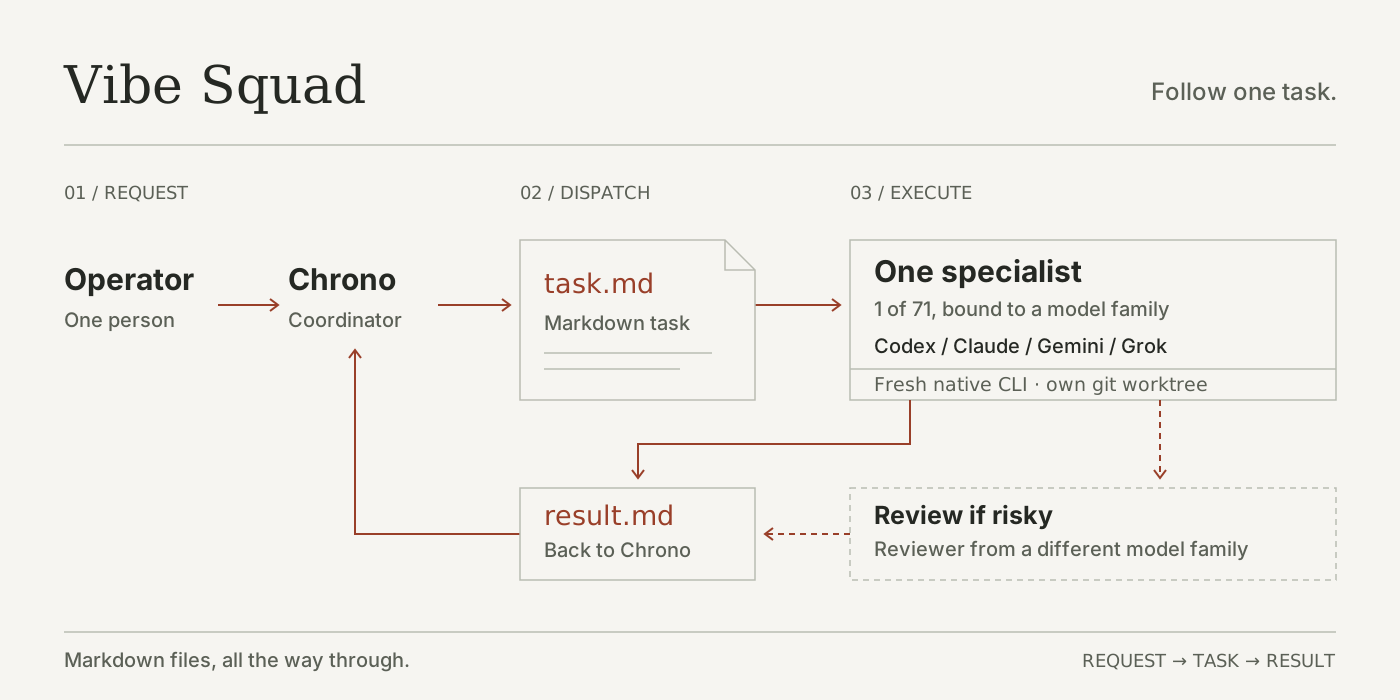
Vibe Squad is for people who like vibe coding but want more structure than one enormous chat. You talk to Chrono, the coordinator. Chrono turns your goal into a plan, picks the specialist and model that fit each part, runs workers in isolated git worktrees, and calls for independent review when the risk warrants it.
You can ask it to:
What's underneath
The product is the instruction layer, and it is Markdown all the way down. Modes, specialist briefs, capability cards, and skills are files you can open and change. Code handles only what must not be guessed: launching, worktree isolation, identity checks, atomic publication, admission control, and Git-integration boundaries. Judgment stays with the models.
macOS, for now. You need tmux, fswatch, jq, curl, Python 3.13, uv, and authenticated native CLIs for Claude, Codex, Gemini (agy), Kimi, and Grok.
Memory lives outside the public repository. Create a private vault once:
mkdir -p "$HOME/Obsidian-Chrono"
printf '%s\n' '{"vault_id":"my-private-vault","schema_version":1}' \
  > "$HOME/Obsidian-Chrono/.chrono-vault"
export CHRONO_VAULT_ROOT="$HOME/Obsidian-Chrono"
Then clone and launch:
git clone https://github.com/mtarcure/claude-vibe-squad.git
cd claude-vibe-squad
uv sync                                # create the pinned Python 3.13 environment
bash docs/install/install-pre-commit-hook.sh  # install the reviewed local leak guard
bin/squad doctor
bin/squad up
The installer copies the self-contained private-memory leak guard into Git's private hooks
directory. It does not point core.hooksPath at tracked files, so checking out another branch
cannot replace the code Git runs on your next commit. Repository-wide specialist, format, and
capability validation remains in CI. If an older clone has core.hooksPath=.githooks, migrate it
by running the installer. The installer clears the local value and refuses success if a global or
system value still overrides the private hooks directory, reporting the origin that must be
removed. See the install guide.
That is the whole required path. There is no background daemon to install first. bin/squad up runs on a fresh clone, notices once that the optional launchd daemon is absent, and continues.
Optional: the launchd routines. bash bin/install-routines.sh --daemon-only installs a background daemon; bash bin/install-routines.sh adds the optional routine agents too. The daemon buys exactly two things: the live ● daemon segment in the tmux status bar, and the documented POST /mcp/<server>/<tool> HTTP bridge. Without it the status bar reads ● daemon offline and that curl path is unavailable; the MCP servers themselves are unaffected. Dispatch, worktree isolation, review, memory, and the coordinator are untouched, because none of them talk to it. See the daemon guide.
Before you install them, know what they run. Each agent executes code from your
checkout on every launch, with no immutable snapshot — so checking out a branch you
have not reviewed (a fork's pull request above all) in a clone where they are loaded
runs that branch's code as your user, within about two minutes for the fastest agent.
The daemon and nightly agents source your shell secrets, and com.vibesquad.chrome
owns your authenticated browser, so that execution carries real authority. The
installer manages three of these agents, but two more — com.chrono.squad-monitor and
com.vibesquad.chrome — are installed by no repository command and never appear in
bin/install-routines.sh --status. Unload the agents before checking out an
unreviewed branch and reload afterwards; the daemon guide
lists every label and its exact launchctl commands. A fix separating the installed
code root from the live data root is planned.
bin/squad up opens a tmux control room with Chrono and a status window. Each specialist starts as a fresh native CLI process for its task; there are no permanent per-model panes. Detach with Ctrl-b d, return with bin/squad attach.
--safe is not a permission mode. It suppresses the first-run autonomy warning and skips the pre-flight doctor check, and that is all. The coordinator and board-spawned workers run with the same permissions either way, because worker launch flags are a fixed controller ABI the supervisor re-derives and refuses to launch on mismatch. Nothing in either path sandboxes later agent actions. A task's read_scope and write_scope are declarations: write_scope is enforced when committed changes are integrated, not while the worker acts, and read_scope is not an action-time read barrier. Review the isolated worktree, verification contract, and held-category policy before enabling broader autonomy.
See Getting started for provider authentication, vault setup, and your first request.
You ask in plain language. Chrono maps it into exactly one of two workflows.
Project and Bounty are the modes. Triage is a dispatch technique, not an extra mode; parallel work is just several independently dispatched single tasks, not a special "panel" or "swarm" transport.
flowchart LR
    OP([You]) --> CO[Chrono]
    CO --> PLAN[Markdown task<br/>and capability]
    PLAN --> RUN[Fresh native CLI<br/>in isolated worktree]
    RUN --> CHECK[Tests and<br/>independent review]
    CHECK --> RESULT[Atomic result<br/>back to Chrono]
    RESULT --> OP
A task is a Markdown file, and that file is the contract. Which specialist, which model, what it may read, what it may change, and what counts as done:
---
specialist:    security-analyst        # the role, chosen for the job
to_model:      gpt-codex               # the model bound to that role
mode:          project
write_scope:   [src/auth/**]           # the only files it may change
read_scope:    [src/**, docs/auth.md]
reviews:       none                    # or the task id this reviews
review_triggers: [blast_radius]        # what forces a second opinion
---

Audit the session-handling path and report anything exploitable.
Do not change behaviour; findings only.
Everything the worker may do is on that page. Workers never talk to each other or to you — each writes one result and Chrono integrates it.
Four things hold that together:
shared/specialist-runtime-map.tsv.Review is part of settling, not a separate ceremony. Every specialist has a route to a reviewer
from another model family, mandatory for security- and judgment-critical work and skipped for
ordinary low-risk work. The reviewer's job is to find a concrete reason the work is wrong; REJECT
is a useful result, not a failed run. The machine checks reviewer independence and evidence
identity — it does not vote on whether the work is any good. Which of those rules are actually under
test is written down in a tracked census that names the untested ones too.
The board carries work across conversations. Every run leaves its task file and receipt behind, so a failure is diagnosed from those rather than from a chat log, and something raised but not finished is picked up next session instead of dying with the thread.
Durable memory is private Markdown outside the repository. Chrono records what a run learned and recalls it before the next one, so a lesson paid for once is not paid for twice.
Each note carries where it came from and how sensitive it is. There is no automatic contradiction flag: recall does not mark a note "contested," and a newer note does not silently win. Conflicts are resolved by explicit supersession links and human curation, and recall ranks on recorded usage feedback and provenance. Obsidian is an optional way to read the same files by hand.
There is no graph database here, and no fashionable label applied for its own sake.
71 specialist briefs live under departments/ and shared/specialists/, each validated on every
push by CI. The installed local pre-commit hook separately blocks private-memory artifacts before
they enter history. A brief is prose: what the role is for, how it should think, what it must
refuse. Adding one means writing Markdown, not registering a class.
71 specialists          claude  ███████████████████████████████  31
                        codex   █████████████████████            21
                        gemini  ████████████████                 16
                        kimi    ██                                2
                        grok    █                                 1
The gemini row is a lane name, not a binary. That lane runs on the agy CLI, which fronts Gemini and Google's other products; the standalone gemini CLI is retired.
Around them sit 92 skills (methodology documents a specialist reads when the work calls for it — unique documents, with the per-runtime mirror copies collapsed), four catalogued plugins, and 8 MCP servers covering memory, research, recon, and media tooling, with a staged security stack you wire yourself.
The public plugins/ tree also includes security-mcp-stack, a configuration and validation
bundle without a marketplace manifest: five directories, four catalogued plugins.
chrono-dedup exists in the private source and is not distributed here because the
export path policy withholds its tree. Like the four
catalogued plugins, it declares AGPL-3.0-or-later separately from the root MIT licence; see
the plugin licence register. The licence alone is not the withholding rule.
This checkout supplies no download or installation source for it. Ask the maintainer for a
separately distributed source release, or build a replacement prior-art service against your own
corpus; neither is installed by cloning this repository.
References to chrono-dedup in workflow cards, specialist methods, tool recommendations, and
expected host-tool descriptions describe an optional private setup. Those steps require a
separately provisioned service; use manual searches of public disclosures and your own prior
findings when it is absent. The shipped capability source records it as needs-operator-install,
and the generated adapters do not advertise it as available. Even a private checkout must
explicitly configure and verify the service before changing that declaration locally.
All five families run through their providers' native CLIs — never swapped for an MCP relay or a
direct API fallback. Four authenticate on subscription or managed-login paths; the Grok board lane is
the exception and requires an xAI API key (model-lanes/lane-capabilities.tsv declares
xai-api-key-only). Utility services are separate.
One rule governs all of it: a configured tool is not a working tool until a live probe says so.
Declared, delivered, and actual are three different things, and only actual counts. That probe is
bin/canary.sh, which reports PASS, FAIL, or NOT MEASURED — it never
lets "did not run" pass for "works".
The rule earns its keep. A model id can be accepted by the CLI, self-report correctly, and still be served by a different model; only the usage record shows it. Findings like that are recorded as dated probes, each with the literal command and its literal result.
v1.1.9 is the current release; v1.1.1 was the first public one. It runs as the maintainer's daily driver rather than as a demo. CHANGELOG.md records what each release changed, including the parts that are still rough.
Start with the documentation index, the architecture, or how to add a specialist.
Contributions are welcome. Start with CONTRIBUTING.md. Keep generated state, mailbox traffic, credentials, private memory, and authorized-target evidence out of commits.
Except where a file or an accompanying third-party notice says otherwise, the original contents of this repository are Copyright (c) 2026 Matthew A. and licensed under the MIT License. See LICENSE and THIRD_PARTY.md.
Multi-model AI orchestration where behaviour is Markdown, not code. One coordinator routes scoped task packets to 71 role-based specialists across 5 model families (Codex / Claude / Gemini / Grok / Ki
Visão geral
Multi-model AI orchestration where behaviour is Markdown, not code. One coordinator routes scoped task packets to 71 role-based specialists across 5 model families (Codex / Claude / Gemini / Grok / Kimi) — each working in an isolated git worktree, each reviewed by a rival family before it lands. One tmux session, no server.
Ferramentas
Ainda não há lista de ferramentas. Servidores remotos recebem uma após a primeira verificação de saúde.
Perguntas frequentes
Copie nesta página a configuração stdio para Cursor, Claude Desktop, Claude Code ou VS Code. Ela usa a instalação do publicador, não um proxy do PlugMCP.
Este registro não lista nenhuma variável de ambiente obrigatória.
Claude Vibe Squad roda localmente via stdio.
Última verificação: 2026-10-28. Multi-model AI orchestration where behaviour is Markdown, not code. One coordinator routes scoped task packets to 71 role-based specialists across 5 model families (Codex / Claude / Gemini / Grok / Kimi) — each working in an isolated git worktree, each reviewed by a rival family before it lands. One tmux session, no server.
