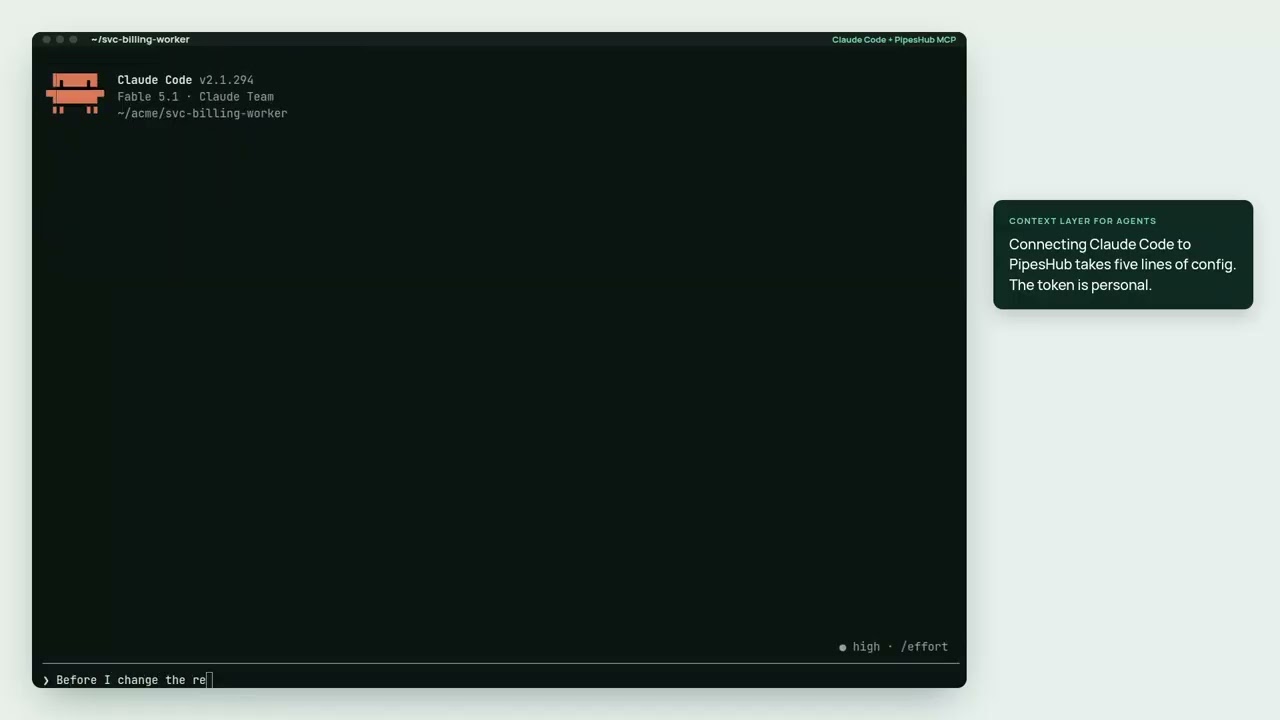
This guide covers how to connect PipesHub's remote MCP server to Cursor, Claude Code, Gemini CLI, Codex CLI, Claude.ai (Web), and LibreChat using static OAuth credentials or bearer tokens.
PipesHub exposes a remote MCP endpoint over at . MCP Clients connect to this endpoint directly -- no local npm packages or stdio processes needed.
This repository contains the packages that make up Pipeshub’s local MCP server
PIPESHUB_MCP_CHAT
Última verificação
2026-10-28
Estrelas
17
Ferramentas
—
Disponibilidade
—
Streamable HTTP
/mcp
▶ Watch the 2½-minute demo: Claude Code using this MCP server to answer from Jira, Slack, GitHub and Drive, with each person's own permissions.
Coding agent? Start at For coding agents. Install the skill into the user's repo with npx skills add pipeshub-ai/mcp-server (see skills/pipeshub) and append the AGENTS.md snippet on that page. Listed on the official MCP registry as io.github.pipeshub-ai/mcp and on Cursor Directory as PipesHub. The listing files (plugin.json, mcp.json) default MCP to http://localhost:3000/mcp (Docker). Change the URL for a company instance; they contain no secrets. Contributors working in this repository: read AGENTS.md.
Claude Code plugin:/plugin marketplace add pipeshub-ai/mcp-server, then /plugin install pipeshub@pipeshub, adds the MCP server, the skill, and the /pipeshub:ask and /pipeshub:setup commands. It connects to ${PIPESHUB_MCP_URL:-https://app.pipeshub.com/mcp} with Authorization: Bearer ${PIPESHUB_MCP_TOKEN}; export both in your shell (self-hosted: set the URL to https://<your-instance>/mcp), then restart Claude Code.
Looking for the tool reference? See TOOLS.md for descriptions, arguments, and a decision guide for each tool the MCP server exposes (pipeshub_chat, pipeshub_search, pipeshub_get_record_content, pipeshub_download_record, pipeshub_directory, pipeshub_sources, pipeshub_agents). Searching and reading records is the recommended default; pipeshub_chat is optional (see Leaving pipeshub_chat out).
Using QM? QM cannot attach a third-party MCP endpoint — it is an MCP server to its own harness, not a client. Follow Use PipesHub with QM. The deployment-layer bundle in qm/ gives agents a pipeshub command inside their sandbox; this package ships that command as a second bin.
Prerequisites
A running PipesHub instance: PipesHub Cloud or self-hosted. To self-host, the local Docker demo playbook covers install and first-run — do not scaffold LangChain. First-run (account + LLM) is still in the browser; search 500s until an LLM is configured.
Important: Grant your OAuth app every scope the discovery endpoint lists (see Customizing Default Scopes). Sign-in grants the requested scopes the app allows and drops the rest, so a scope missing from the app does not fail the login; the tools that need it are refused. If the app allows none of the requested scopes, or a requested scope name is unknown, sign-in fails with invalid_scope.
Save the app and copy the Client ID and Client Secret
Customizing Default Scopes
The /.well-known/oauth-protected-resource/mcp discovery endpoint lists the scopes the MCP tools use, so clients like Claude Code, which request every listed scope, ask only for what the tools need:
Scope
Used by
semantic:write
pipeshub_search
conversation:chat
pipeshub_chat
agent:read, agent:execute
pipeshub_agents, pipeshub_sources, pipeshub_chat with an agent
Discovery also lists offline_access. It is not a tool scope: it lets the client get a refresh token, so it stays signed in instead of signing in again when its access token expires.
The list is limited to the MCP_SCOPES environment variable on your PipesHub instance, which is also the upper limit on the scopes any personal access token or OAuth token can hold. Remove a scope from MCP_SCOPES to stop discovery listing it. Clients that set their own scopes, such as Cursor and LibreChat, still request it, but PipesHub does not grant a scope that MCP_SCOPES excludes. PipesHub servers older than this behavior list all of MCP_SCOPES.
Placeholders
Replace these in all configurations below:
Placeholder
Description
Example
PIPESHUB_INSTANCE_URL
Your PipesHub instance URL
https://app.pipeshub.com
YOUR_CLIENT_ID
OAuth app client ID
clid_abc123...
YOUR_CLIENT_SECRET
OAuth app client secret
clsec_xyz789...
The remote MCP endpoint URL is: PIPESHUB_INSTANCE_URL/mcp
Remote MCP Setup
Cursor supports static OAuth for remote MCP servers via the auth object in mcp.json.
Configuration
Open Cursor Settings > Tools and Integrations > New MCP Server, or edit your project's .cursor/mcp.json:
Cursor will auto-discover the authorization and token endpoints via PipesHub's /.well-known/oauth-protected-resource/mcp metadata.
Note: If the scopes field is omitted, Cursor fetches /.well-known/oauth-protected-resource/mcp and requests allscopes_supported listed there. To limit access, explicitly list only the scopes you need. You can also control which scopes are exposed server-side — see Customizing Default Scopes.
Using Environment Variables
Use Cursor's ${env:VAR} interpolation to keep secrets out of config files:
Cursor uses a fixed redirect URI for all MCP servers:
cursor://anysphere.cursor-mcp/oauth/callback
Register this as the allowed redirect URI when creating the OAuth app in PipesHub.
OAuth Login Troubleshooting
If Cursor's internal browser fails to load the OAuth login page, copy the authorization URL from the internal browser and paste it into your normal browser to complete the login flow.
Claude Code supports remote HTTP MCP servers with static OAuth credentials via --client-id, --client-secret, and --callback-port.
PipesHub exposes discovery at /.well-known/oauth-protected-resource/mcp, so Claude Code auto-discovers the authorization and token endpoints.
Important: Claude Code does not support configuring specific scopes. It fetches /.well-known/oauth-protected-resource/mcp, reads the scopes_supported list, and requests all of them. PipesHub lists only the scopes the MCP tools use. Give your OAuth app all of them: sign-in grants the ones the app allows, tools that need a missing scope are refused, and sign-in fails with invalid_scope if the app allows none of them. To see or limit the list, see Customizing Default Scopes.
Note: The client secret is stored in the system keychain, not in config files. You'll be prompted to enter it when you first authenticate via /mcp.
Authenticate
After adding the server, run /mcp inside Claude Code and follow the browser login flow. Tokens are stored securely and refreshed automatically.
Verify
claude mcp list
claude mcp get pipeshub
Gemini CLI supports remote MCP servers with OAuth via dynamic_discovery (the default), which auto-discovers authorization and token endpoints from PipesHub's /.well-known/oauth-protected-resource/mcp.
Then edit ~/.gemini/settings.json to add the oauth block as shown above.
Authenticate
Inside Gemini CLI, use the /mcp auth commands:
# List servers and their auth status
/mcp auth

# Authenticate with PipesHub (opens browser for login)
/mcp auth pipeshub

# Re-authenticate if tokens expire
/mcp auth pipeshub
On first connection, Gemini will automatically detect the 401 response, discover the OAuth endpoints, and open a browser for login. Tokens are stored securely in ~/.gemini/mcp-oauth-tokens.json and refreshed automatically.
Manage Servers
# List all configured servers
gemini mcp list

# Remove the server
gemini mcp remove pipeshub

# Temporarily disable/enable
gemini mcp disable pipeshub
gemini mcp enable pipeshub
Override authorization endpoint (auto-discovered by default)
tokenUrl
No
Override token endpoint (auto-discovered by default)
redirectUri
No
Override redirect URI (defaults to http://localhost:7777/oauth/callback)
Note: OAuth requires a local browser. It will not work in headless environments, remote SSH without X11 forwarding, or containers without browser access.
Codex CLI (OpenAI Codex) connects to remote MCP servers over Streamable HTTP, configured with a [mcp_servers.<name>] table in ~/.codex/config.toml (or .codex/config.toml in your project root to scope it per-project). Codex's HTTP transport authenticates with a bearer token read from an environment variable, so pass a PipesHub JWT bearer token.
--bearer-token-env-var takes the name of the environment variable holding the token, not the token value itself.
Verify
# List configured MCP servers
codex mcp list

# Inside the Codex TUI, view server status and available tools
/mcp
Claude.ai supports custom connectors via remote MCP servers. This lets you use PipesHub tools directly in the Claude.ai web interface without any local setup.
Note: This feature is currently in beta. Free plan users are limited to one custom connector.
For Individual Users (Pro / Max Plans)
Go to claude.ai and navigate to Settings > Connectors
Click Add custom connector at the bottom of the Connectors section
Enter the MCP server URL:
PIPESHUB_INSTANCE_URL/mcp
Click Advanced settings and enter your OAuth credentials:
OAuth Client ID: YOUR_CLIENT_ID
OAuth Client Secret: YOUR_CLIENT_SECRET
Click Add
You'll be redirected to PipesHub's login page to authenticate and grant permissions
After authenticating, the connector will be active and PipesHub tools will be available in your Claude.ai conversations
For Team / Enterprise Plans
Organization Owners must first add the connector:
Navigate to Organization settings > Connectors
Click Add custom connector
Enter the MCP server URL: PIPESHUB_INSTANCE_URL/mcp
Click Advanced settings and enter the OAuth Client ID and Client Secret
Click Add
Team members can then connect:
Go to Settings > Connectors
Find the PipesHub connector (marked with a "Custom" label)
Click Connect to authenticate via PipesHub's OAuth login
Redirect URI
Claude.ai uses the following redirect URI for OAuth:
https://claude.ai/api/mcp/auth_callback
Register this as an allowed redirect URI in your PipesHub OAuth app.
Security Notes
Only connect to trusted MCP servers
Review the permissions requested during the OAuth authentication flow
Claude.ai interacts with PipesHub on your behalf using the granted OAuth token — your password is never shared
LibreChat supports remote MCP servers with OAuth authentication via its custom connectors UI. This lets you connect PipesHub tools to any model available in your LibreChat instance.
Copy the Redirect URI and register it as an allowed redirect URI in your PipesHub OAuth app (see Step 1)
Return to the LibreChat connector and click Update to initiate the OAuth flow — you'll be redirected to PipesHub's login page to authenticate and grant permissions
Redirect URI
LibreChat generates the redirect URI after the connector is created. The URI follows this format:
Where <server-identifier> is the unique identifier assigned by LibreChat (visible at the top of the connector settings as "Unique Server Identifier"). You must copy this URI and add it to your PipesHub OAuth app's allowed redirect URIs before authenticating.
Note: If your LibreChat instance runs on a different host or port, the URI will reflect that (e.g., https://chat.example.com/api/mcp/pipeshub/oauth/callback).
Scopes
LibreChat allows you to specify the OAuth scopes in the Scope field. Use a space-separated list:
openid email
To request PipesHub-specific scopes, add them to the scope field:
Note: Sign-in grants only the requested scopes your OAuth app in PipesHub allows, so request the scopes the app was granted. See Customizing Default Scopes for details.
Local MCP Server (Stdio)
Instead of connecting to PipesHub's remote MCP endpoint, you can run the MCP server locally as a stdio process using the @pipeshub-ai/mcp npm package. This is useful when you prefer a local setup or need to work in environments where direct HTTP connections to the remote MCP endpoint aren't practical.
Prerequisites
Node.js 18+ installed
A PipesHub instance URL
A credential that acts as you, so results follow your permissions. Either:
No token in the config: run pipeshub login once (npm i -g @pipeshub-ai/mcp; --url <origin> when self-hosted). With no --bearer-auth, start uses that sign-in, refreshes it (on PipesHub versions that issue device-login refresh tokens; otherwise it lasts an hour), and defaults --server-url to the instance you signed in to. It also reads PIPESHUB_TOKEN from the environment, sent only to --server-url or PIPESHUB_BASE_URL.
A personal access token (phpat_…), minted in PipesHub under Developer Settings and passed as --bearer-auth, as in the examples below.
With pipeshub login, a Claude Desktop entry is just:
The local server (start and serve) retries a PipesHub request that is refused with 429, 502, 503 or 504. It waits for as long as the Retry-After header asks, or, without one, backs off for half a second and then a second. It stops after three tries in all and passes the last answer on. A Retry-After of more than 30 seconds is not waited out: that answer is passed on at once, and the tool's error says how long PipesHub asked to wait. Only requests that are safe to repeat are retried (GET, HEAD, OPTIONS, PUT, DELETE). Search and chat are POSTs and are never retried, because a repeat would be a second search or a second answer.
A request that gets no response within 60 seconds is abandoned. The limit covers the wait for PipesHub to start answering, not the whole answer, so a long chat response that is already streaming is not cut off.
Both are set with environment variables, in the MCP client's env block or with --env NAME=VALUE:
Variable
Default
Meaning
PIPESHUB_MCP_MAX_ATTEMPTS
3
Tries per request, the first one included, from 1 to 10. 1 turns retries off.
PIPESHUB_MCP_TIMEOUT_MS
60000
Milliseconds to wait for PipesHub to start answering. 0 turns the timeout off.
Read-only mode
Two tools write: pipeshub_create_collection and pipeshub_upload add collections and documents (they never delete or overwrite). They need the kb:write and kb:upload scopes. To serve read tools only from the local server, pass --scope read to start or serve. On the remote /mcp, a token without those scopes is not offered the write tools.
Leaving pipeshub_chat out
The server offers all eleven tools, and its instructions and tool descriptions tell the agent to answer with pipeshub_search and pipeshub_get_record_content first. pipeshub_chat runs PipesHub's own assistant and is optional: for an agent that can call tools, it adds cost and time without adding accuracy. In PipesHub's evaluation (100 questions, Claude Opus as the agent), search and read alone found 88% of the facts at $0.54 and 78 seconds median per answer; adding chat also found 88%, at about $0.73 and 97 seconds. See TOOLS.md for the full figures.
Nothing changes unless you choose to: by default every tool stays. To hold an agent to search and read, leave pipeshub_chat out, together with pipeshub_agents, which only picks an agent for chat:
Local stdio server: set PIPESHUB_MCP_CHAT=off in the server's env block in your MCP client config, or pass --env PIPESHUB_MCP_CHAT=off to start or serve. The server then mounts nine tools, and its instructions no longer mention chat or agents. Unset or on keeps today's behaviour; any other value stops the server with an error that says what it accepts.
"env": { "PIPESHUB_MCP_CHAT": "off" }
To pick tools one by one instead, list the ones to keep with --tool (for example --tool pipeshub_search --tool pipeshub_get_record_content). --tool does not change the instructions.
Remote endpoint (/mcp): turn the tool off in the client. In Claude Code, run claude --disallowedTools "mcp__pipeshub__pipeshub_chat,mcp__pipeshub__pipeshub_agents", where pipeshub is the name you gave the server, or put the same entries in the permissions.deny list of .claude/settings.json. In other clients, use the per-tool toggles in their MCP settings, where they offer them.
Keep pipeshub_chat when the client cannot run its own tool loop, when you want PipesHub's assistant to write the answer, to talk to a configured PipesHub agent, or to take an action through the user's connected tools.
How It Works
Architecture
AI Client (Cursor / Claude Code / Gemini CLI / Codex CLI / Claude.ai / LibreChat)
        │
        │  HTTP POST (JSON-RPC)
        │  Authorization: Bearer <token>
        ▼
  PIPESHUB_INSTANCE_URL/mcp
        │
        │  StreamableHTTP Transport
        │  (stateless, per-request MCP server)
        ▼
  PipesHub API (curated tool set — see TOOLS.md)
"Incompatible auth server: does not support dynamic client registration"
This means the client is trying dynamic registration instead of using your pre-configured credentials. Make sure you passed --client-id and --client-secret (Claude Code) or the auth object (Cursor) correctly.
Authentication fails / redirect error
Ensure the Redirect URI in your OAuth app matches exactly what the client uses:
Make sure the OAuth app is active (not suspended) in PipesHub
Cannot reach MCP endpoint
Verify the endpoint is accessible: curl -X POST PIPESHUB_INSTANCE_URL/mcp (should return 401, not connection error)
Check that your PipesHub instance has MCP enabled
Debugging with MCP Inspector
npx @modelcontextprotocol/inspector
Then connect to PIPESHUB_INSTANCE_URL/mcp with a Bearer token to test the endpoint directly.
FAQ
Update the MCP_SCOPES environment variable on your PipesHub instance so it includes the scopes you want clients to get. Discovery lists only the ones the MCP tools use.
Update the OAuth app scopes in PipesHub: go to Settings > Developer Settings > OAuth Apps, select your OAuth app, and add or remove scopes as needed.
Re-authenticate the client — existing tokens carry the old scopes, so you need to re-authenticate to get a new token with the updated scopes. For example:
Cursor: Remove and re-add the MCP server, or clear the cached OAuth token and reconnect.
Claude Code: Run /mcp and complete the browser login flow again.
Gemini CLI: Run /mcp auth pipeshub to re-authenticate.
Codex CLI: Update PIPESHUB_BEARER_TOKEN with a fresh token and restart Codex.
Claude.ai: Disconnect and reconnect the connector in Settings > Connectors.
P
Pipeshub Ai
pipeshub-ai·17 estrelas·
This repository contains the packages that make up Pipeshub’s local MCP server
Ainda não há lista de ferramentas. Servidores remotos recebem uma após a primeira verificação de saúde.
Perguntas frequentes
Perguntas
Como instalo Pipeshub Ai?
Copie nesta página a configuração http para Cursor, Claude Desktop, Claude Code ou VS Code. Ela usa a instalação do publicador, não um proxy do PlugMCP.
Pipeshub Ai precisa de uma chave de API?
O publicador lista estas variáveis de ambiente: PIPESHUB_MCP_CHAT.
Qual transporte Pipeshub Ai usa?
Pipeshub Ai é acessado por HTTP.
Quando Pipeshub Ai foi verificado pela última vez?
Última verificação: 2026-10-28. This repository contains the packages that make up Pipeshub’s local MCP server