Potencialize seu agente
Instalação do publicador. Não é um endpoint do PlugMCP.
Host a copy with our keys and logs.
Ainda não há uma versão empacotada no registro. Siga o README do repositório.
URL remota ou um comando na sua máquina? Como as duas instalações diferem
Rodar no PlugMCP
A new server you create. It is not this listing's official endpoint. Use the publisher install when you want their URL and their credentials.
AbrirAny brain, any agent. Package an AI agent's whole brain once — persona, MCP stack, skills,
memory, config — into one open, signed .uniqent file, and install it into whatever framework you
run (Claude Code, Hermes, OpenClaw) in one command.
Think n8n, but for whole agents: a visual builder to assemble the thing, and a portable artifact you can install anywhere. Uniqent is the builder + packager + translator + installer — it sits above the frameworks so one brain travels between all of them.
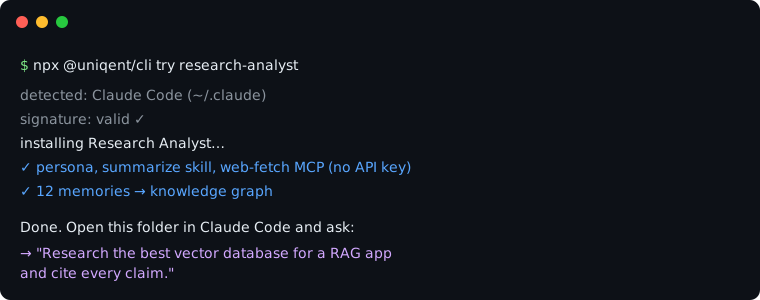
No clone, no config, no API key — install a complete research-analyst brain into your agent:
npx @uniqent/cli try research-analyst
It auto-detects your framework, installs the persona + skill + web-fetch MCP + a linked memory
graph, then tells you exactly what to ask. Run npx @uniqent/cli try --list to see the featured
brains.
Today an agent's "brain" is locked inside whatever framework you built it in — there's no portable
unit for "a whole agent." Uniqent makes that unit and the workflow around it: build → package →
share → install. You compose a brain in Uniqent Studio (a local-first visual builder) — or
capture one you already have — and export a single signed .uniqent bundle that carries no
secrets. Anyone installs it into the framework they run; a per-framework adapter translates
the brain into that framework's native layout and asks only for the recipient's own credentials.
🚀 Try a brain instantly — npx @uniqent/cli try <name> installs a featured, signed,
creds-free brain into your agent in one command.
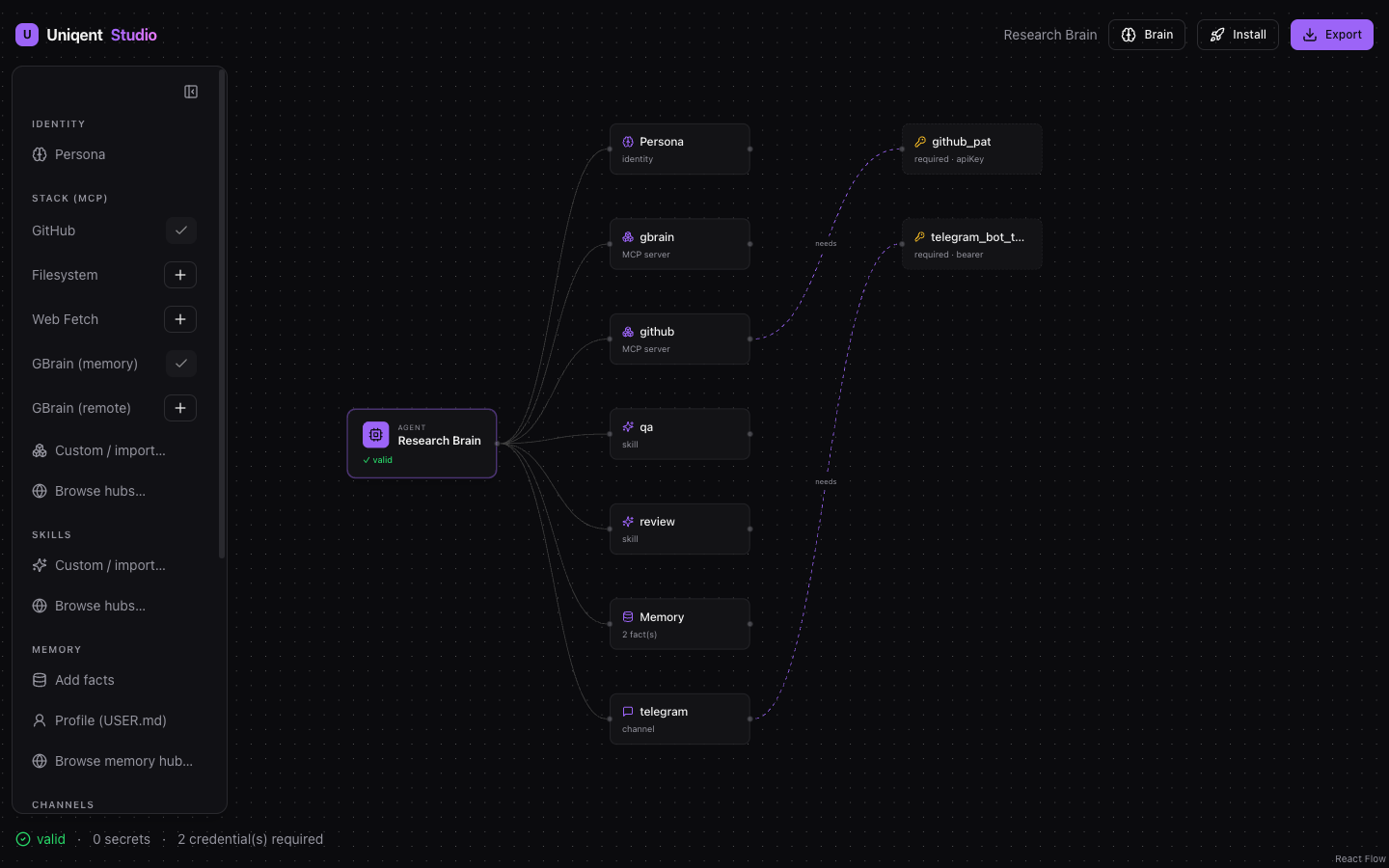
🧩 Build one visually — compose persona, MCP stack, skills, memory, channels, and flows on an
n8n-style canvas in Studio, with credentials wired as "needs" edges, then export one
.uniqent.
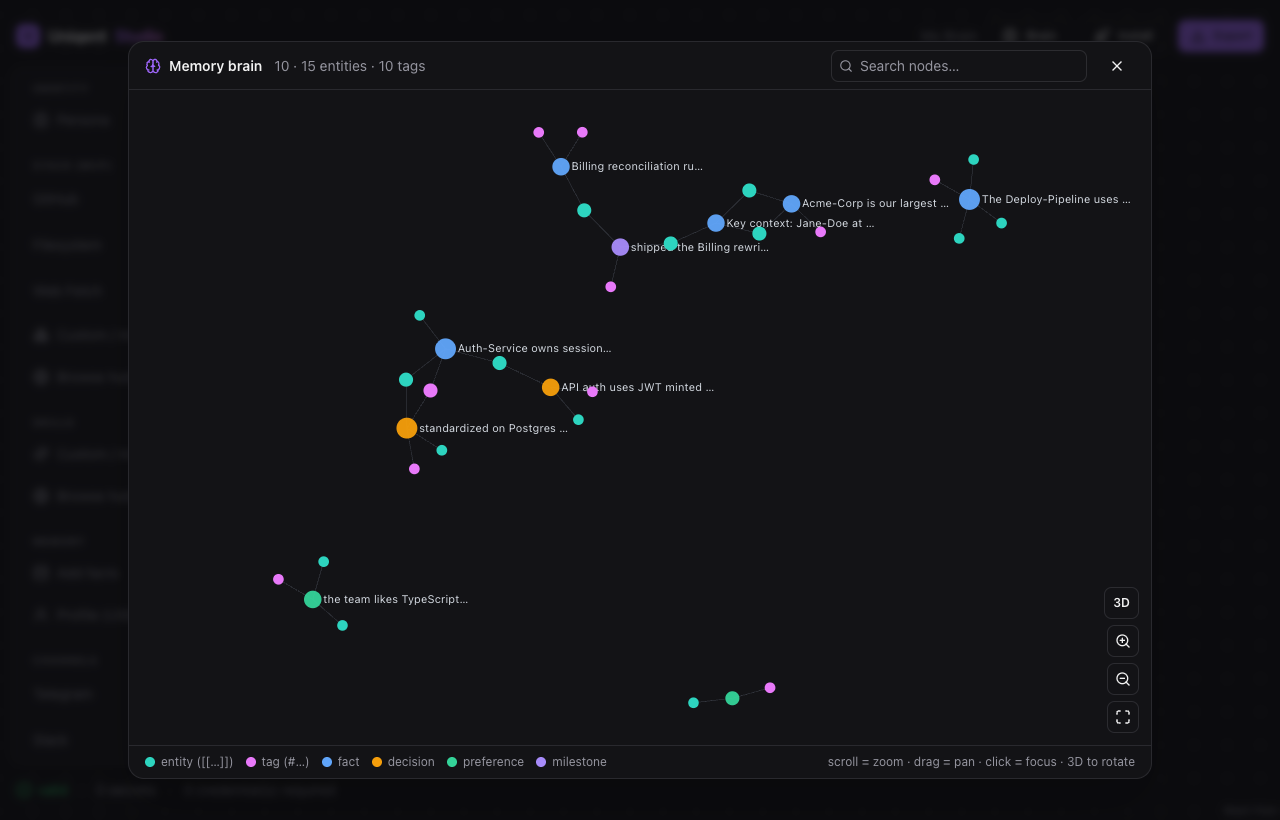
Memory isn't a flat list: write facts with Obsidian-style [[entities]] and #tags and Studio
parses them into an interactive memory brain — a force-directed graph (zoom / pan / drag, plus
a 3D mode) of how facts, people, and topics connect.
📥 Bring what you have — uniqent export captures a running agent; uniqent import-vault
turns an Obsidian / "second-brain" vault into a brain (SOUL.md → persona, USER.md → profile,
MEMORY.md + notes → memory, [[wikilinks]]/#tags preserved).
🔁 Install anywhere — the same bundle installs into Claude Code, Hermes, or OpenClaw; the adapter translates it and resolves your credentials locally.
Build → Pack → Share → Install — one open bundle, any framework:
.uniqent (Ed25519 signature over a content digest) — a fail-closed
secret-scan guarantees no API keys travel in the bundle.What makes it defensible — four things .dotagents-style sharing lacks:
npm i -g @uniqent/cli # or use npx @uniqent/cli <command>
A few real flows:
# Install a brain into your framework, resolving your own credentials locally:
uniqent install my-brain.uniqent --target claude-code --root .

# Install straight from a raw URL (no registry needed):
uniqent install https://example.com/dev-powerpack.uniqent --target openclaw --root ~/.openclaw

# Or by slug from any hosted index.json:
export UNIQENT_REGISTRY=https://raw.githubusercontent.com/RiggdAI/uniqent/main/registry/index.json
uniqent search coding && uniqent install dev-powerpack --target hermes --root ~/.hermes --cred github_pat=…
Studio runs as a native desktop app (Tauri). It needs a clone — see Build from source below.
pnpm --filter @uniqent/studio native:dev # native app with hot reload
Prerequisites
corepack enable provisions the exact pnpm pinned in
package.json.xcode-select --install). macOS is the supported desktop target
today.Build and test
git clone https://github.com/RiggdAI/uniqent.git && cd uniqent
corepack enable
pnpm install
pnpm build                       # all packages + Studio

pnpm test                        # every package's tests
pnpm typecheck && pnpm lint && pnpm format:check
(cd apps/studio/src-tauri && cargo test)   # native app's Rust tests
Run the CLI from source
node packages/cli/dist/bin.js --help
node packages/cli/dist/bin.js try research-analyst --target claude-code --root /tmp/demo --yes
Run Studio
pnpm --filter @uniqent/studio native:dev   # native app, dev mode (Vite hot reload + Rust backend)
pnpm --filter @uniqent/studio native:build # release build → Studio.app + .dmg
The release build lands in apps/studio/src-tauri/target/release/bundle/ (macos/Uniqent Studio.app
and dmg/*.dmg). Builds are unsigned for now: the first time, right-click the app → Open.
Regenerate generated files (only after changing their sources)
pnpm --filter @uniqent/spec gen             # JSON Schema + docs/SPEC.md, after editing packages/spec
pnpm --filter @uniqent/studio fixtures:ports # cross-language parity fixtures, after changing ported TS logic
.uniqent. ✅uniqent import-vault + uniqent export. ✅.uniqent installs into all three. ✅@uniqent/cli on npm; example brains in examples/; a file-based registry;
memory-pack publishing. ✅uniqent:// web "Install" handoff;
Codex/Cursor/Gemini adapters.LICENSE)LICENSE-SPEC) — any framework can implement an
adapter without asking permission.Contributions welcome — see docs/CONTRIBUTING.md and
docs/GOVERNANCE.md. Report security issues via
docs/SECURITY.md.
Any brain, any agent. Package an AI agent's brain — persona, MCP stack, skills, memory, config — into one open, signed bundle and install it into any framework (OpenClaw, Hermes, Claude Code) in one c
Visão geral
Any brain, any agent. Package an AI agent's brain — persona, MCP stack, skills, memory, config — into one open, signed bundle and install it into any framework (OpenClaw, Hermes, Claude Code) in one click.
Ferramentas
Ainda não há lista de ferramentas. Servidores remotos recebem uma após a primeira verificação de saúde.
Perguntas frequentes
Copie nesta página a configuração stdio para Cursor, Claude Desktop, Claude Code ou VS Code. Ela usa a instalação do publicador, não um proxy do PlugMCP.
Este registro não lista nenhuma variável de ambiente obrigatória.
Uniqent roda localmente via stdio.
Última verificação: 2026-10-28. Any brain, any agent. Package an AI agent's brain — persona, MCP stack, skills, memory, config — into one open, signed bundle and install it into any framework (OpenClaw, Hermes, Claude Code) in one click.