Potencialize seu agente
O comando do próprio publicador. Não é um endpoint do PlugMCP.
Host a copy with our keys and logs.
docker run -i --rm ghcr.io/sandbaseai/sandbase-harness-mcp:0.3.8O Claude Code não tem link de instalação para um comando local. Copie o comando abaixo e execute-o em um terminal.
MANAGED_AGENTS_URL=<value> MANAGED_AGENTS_API_KEY=<secret> claude mcp add sandbaseai-sandbase-harness -- docker run -i --rm ghcr.io/sandbaseai/sandbase-harness-mcp:0.3.8Execute em um terminal.
{ "mcpServers": { "sandbaseai-sandbase-harness": { "command": "docker", "args": [ "run", "-i", "--rm", "ghcr.io/sandbaseai/sandbase-harness-mcp:0.3.8" ], "env": { "MANAGED_AGENTS_URL": "<value>", "MANAGED_AGENTS_API_KEY": "<secret>" } } }}claude_desktop_config.json
URL remota ou um comando na sua máquina? Como as duas instalações diferem
Rodar no PlugMCP
A new server you create. It is not this listing's official endpoint. Use the publisher install when you want their URL and their credentials.
AbrirAI-readable project metadata: llms.txt · installation guide
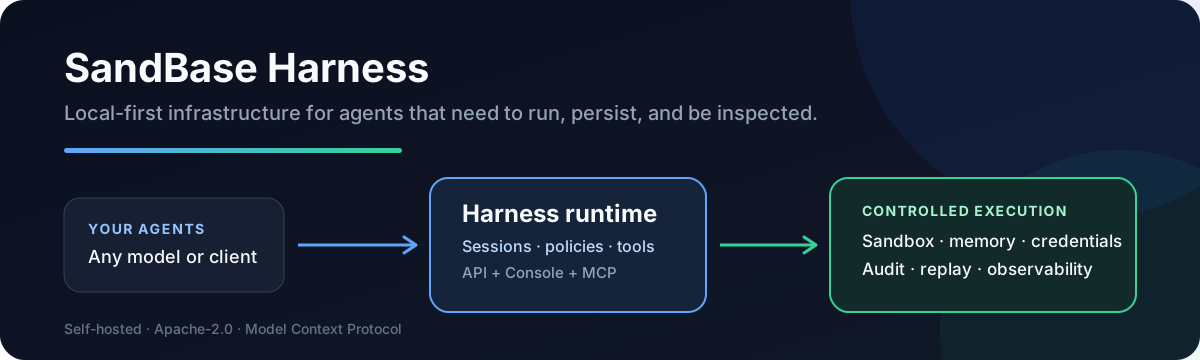
A local-first runtime for AI agents. Sessions, sandboxed tools, memory, credentials, audit trails, and a built-in Console — all running on your machine or in your own infrastructure.
Agent SDKs handle the model loop. Production agents need more: persistent
sessions, tool governance, sandbox boundaries, credential handling, memory,
auditability, and a UI for humans to inspect what happened. managed-agents
is that runtime layer — not a visual workflow builder and not another model SDK.
/v1 API and local Consolemanaged-agents/sdknpm run release:checkRequirements: Node.js 22+, npm 10+, and a model provider API key (OpenAI, Anthropic, MiniMax, or any OpenAI-compatible endpoint). Docker is optional and only needed for Docker-backed sandboxes.
git clone --branch v0.3.8 --depth 1 https://github.com/sandbaseai/sandbase-harness.git
cd sandbase-harness
npm ci
npm run build
mkdir ../my-agents && cd ../my-agents
node ../sandbase-harness/dist/index.js init
node ../sandbase-harness/dist/index.js start
init writes a workspace into the directory you run it from: an agent, a skills
folder, and config.yaml, whose provider reference is the ${OPENAI_API_KEY}
environment variable. start serves the API and the Console on
http://127.0.0.1:3000.
Two steps finish the setup, both on Settings > Setup at http://127.0.0.1:3000/dashboard:
start command again, or use the
restart button. A saved setting only takes effect at startup. If your provider
is not in the list, choose the OpenAI-compatible vendor and set its base URL.deepseek-chat for DeepSeek, for example. An agent carries
its own model ID, so the gpt-4o that init writes is not valid for every
provider, and a wrong ID fails the turn with model_not_found.Send the first message from the Console: open Sessions, create a session for the agent, and type into the composer. From a terminal it is one command:
node ../sandbase-harness/dist/index.js chat agent_assistant --message "hello" --tool-approval allow
chat sends that one message and exits once the turn settles; without
--message it keeps the session open and streams until you interrupt it.
--tool-approval allow
preauthorizes the tool calls the agent may make, which the init template
otherwise parks for approval and waits for a person to answer; see CLI.
The unscoped managed-agents name on npm is not this project. Until an
official scoped package is announced in this repository, install only from the
tagged GitHub source release shown above. Do not run npx managed-agents or
npm install managed-agents.
The included development container installs dependencies and builds the runtime. When the terminal is ready, start the server on the forwarded port:
node dist/index.js start --host 0.0.0.0
Open the forwarded SandBase Harness Console port, then configure a model in Settings > Setup. Codespaces usage may be billed by GitHub; the local quick start above remains free and keeps all runtime data on your machine.
| Console overview | Settings | API reference |
|---|---|---|
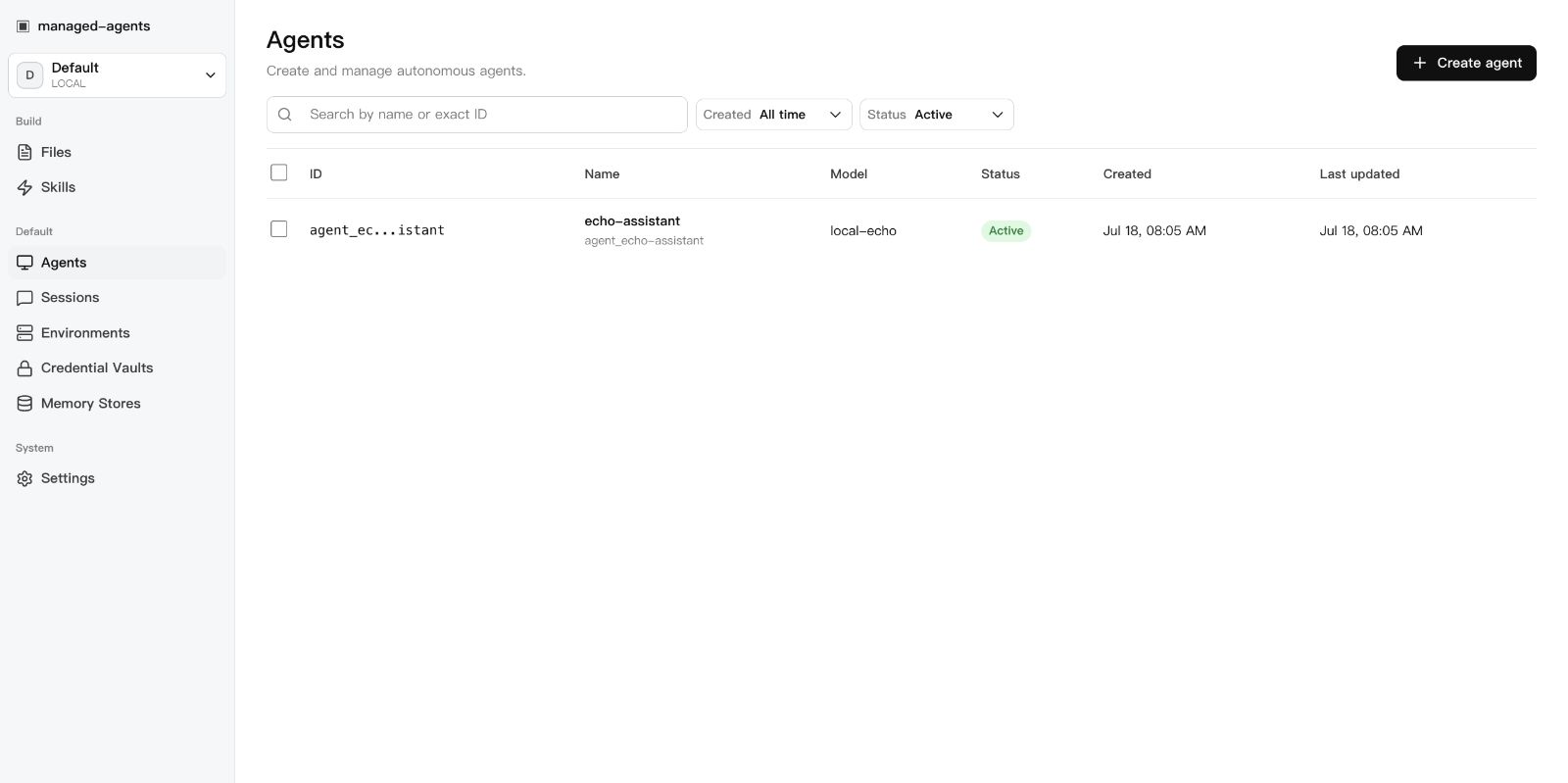 | 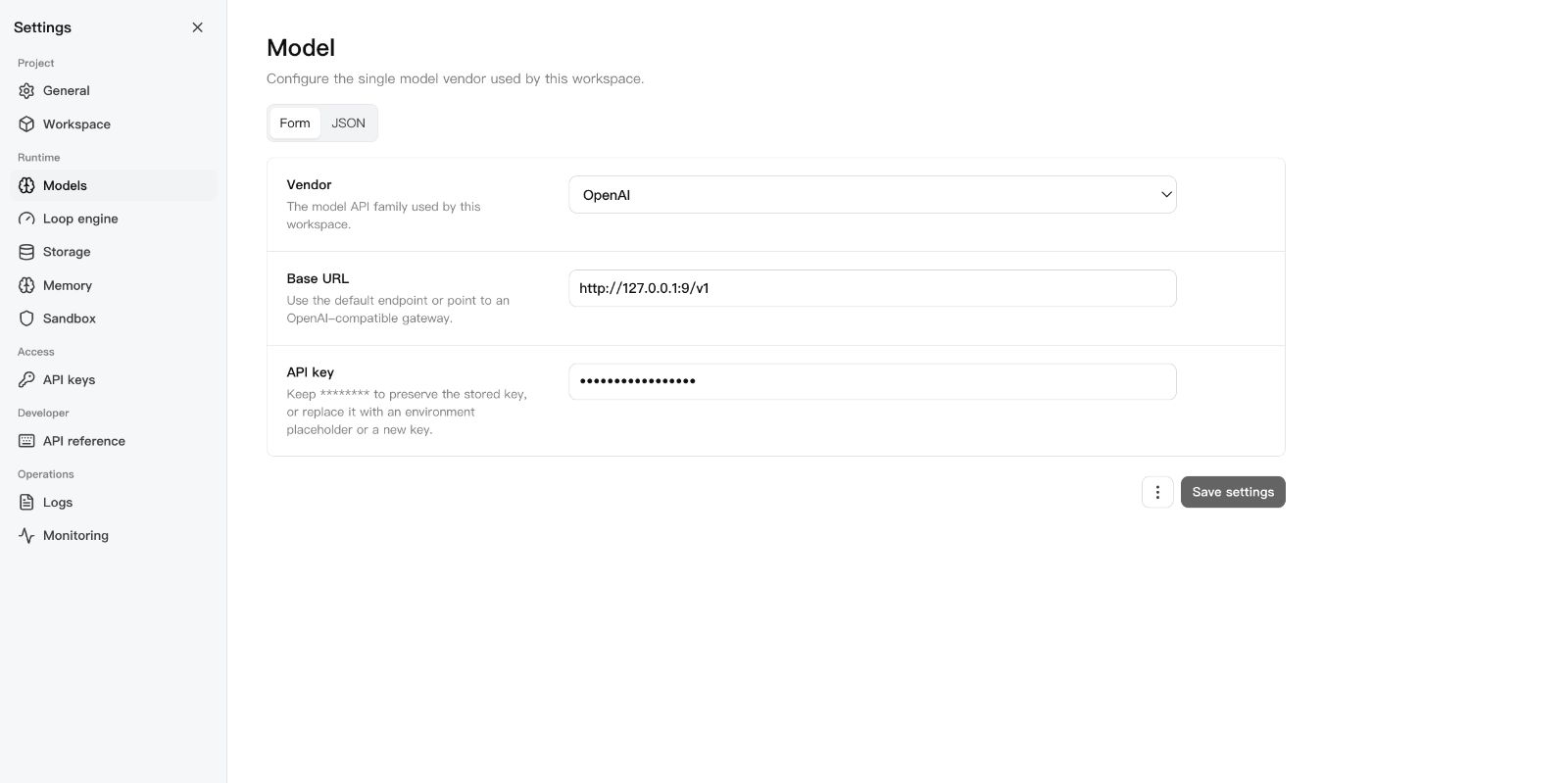 | 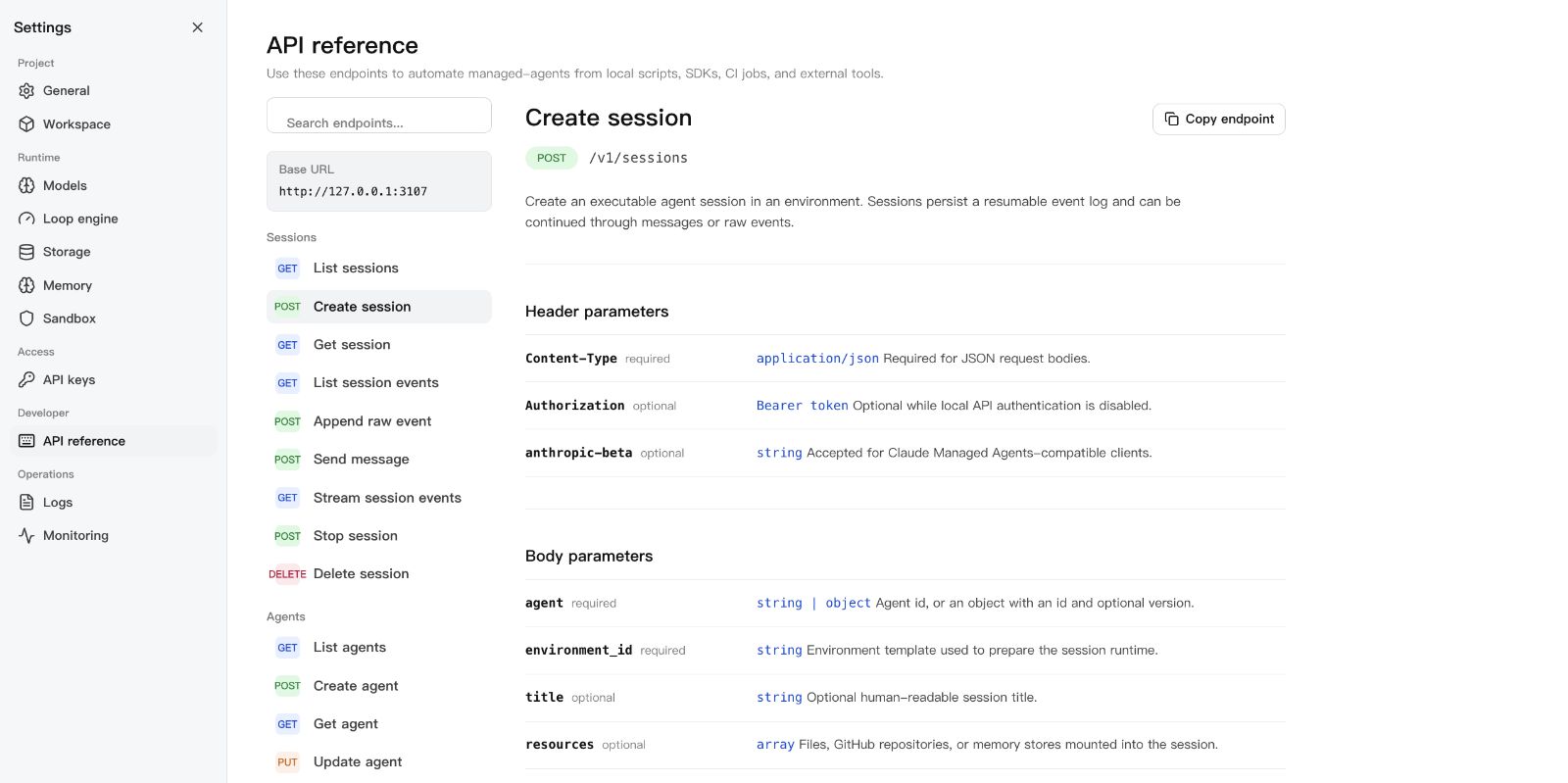 |
The runtime answers its own /v1 API on that same port, and an official
Anthropic TypeScript SDK client drives it unchanged: point the client's
baseURL at the runtime, give it the runtime API key, and the quickstart in
examples/official-sdk runs a whole turn —
message, tool call, tool result, final reply — against it. That example is
executed on every pull request by
tests/conformance/official-sdk-quickstart.test.ts, so the compatibility it
describes is compatibility that is tested rather than claimed.
The same surface is specified in docs/api.md, and this repository's own TypeScript SDK is documented under SDK below.
Coverage of the published Claude Managed Agents contract is declared entry by
entry in src/core/capabilities/matrix.ts:
of the official SDK's route surface (110 method/path pairs as of SDK
0.131.0), 90 routes are mounted and 20 refuse by name; no route is deferred.
Partial and Unsupported entries always name their reason.
The table below is generated by npm run docs:compat, and a contract-honesty
test fails when it drifts from the matrix.
managed-agents init
managed-agents start [--host 127.0.0.1] [--port 3000]
managed-agents apply <file...>   # create or update agents/environments/deployments from manifests
managed-agents list
managed-agents reload
managed-agents chat <agent-id> --message "hello" [--tool-approval ask|allow|deny]
managed-agents template list | install <name> | create <name>
apply is the declarative form of the same API: a Markdown file whose
frontmatter is the agent definition (the body below --- becomes the system
prompt), a .yaml environment document, or a Markdown deployment manifest
(frontmatter carries name, agent, environment, schedule; the body
becomes the initial user.message). The resolved ids land in
managed-agents-lock.json beside the files, so re-running apply after an
edit updates the same resource instead of creating a duplicate — commit the
lock file with the manifests. A later file may reference an earlier one by
name, so apply coding-assistant.md environment.yaml deployment.md wires the
deployment to the rows the first two files created.
A turn whose tool needs approval parks instead of failing, and chat asks before
running it, then lets the runtime continue the same turn. --tool-approval allow
decides every such call in advance, which is what a script or a CI job uses, and
deny refuses them. With no terminal to prompt, the default ask answers nothing
and exits non-zero with the calls that are waiting named, so a script states its
policy rather than inheriting one. A custom tool is the exception: only your own
client can produce its result, and chat says so and exits non-zero. See
usage.
import { ManagedAgentsClient } from 'managed-agents/sdk';

const client = new ManagedAgentsClient({
  baseUrl: 'http://127.0.0.1:3000',
});

const session = await client.sessions.create({
  agent: 'agent_...',
  environment_id: 'env_...',
});

for await (const event of client.sessions.chat(session.id, 'Hello')) {
  if (event.type === 'agent.message_chunk') {
    process.stdout.write(event.delta ?? '');
  }
}
The /v1 API follows Claude Managed Agents resource shapes, so you can also
point the Anthropic SDK at the local runtime:
import Anthropic from '@anthropic-ai/sdk';

const client = new Anthropic({
  apiKey: process.env.MANAGED_AGENTS_API_KEY ?? 'local-dev-key',
  baseURL: 'http://127.0.0.1:3000',
});

const session = await client.beta.sessions.create({
  agent: 'agent_...',
  environment_id: 'env_...',
});
Open by default. Authentication activates when at least one API key exists:
# Static key via environment
export MANAGED_AGENTS_API_KEY=sk-local-example

# Or create a managed key
curl -X POST http://127.0.0.1:3000/v1/api-keys \
  -H "Content-Type: application/json" \
  -d '{ "name": "Local Console" }'
Clients send Authorization: Bearer <key>.
examples/deepseek-harness. A DSH
project can also take a portable Skill from GitHub source —
npx --yes github:sandbaseai/sandbase-skills add multi-source-search
installs into .dsh/skills/multi-source-search.agent-plugin/PLUGIN.md.config.yaml, and the
workspace layout live in the usage guide; curl walkthroughs
for every resource are in docs/api.md.npm ci
npm run typecheck # src + tests + Console
npm test # vitest
npm run build # runtime + console + SDK
npm run release:check # full local release gate
release:check runs typecheck, tests, both builds, npm pack --dry-run, CLI
init smoke, and examples/basic startup smoke.
If this runtime solves a real agent-infrastructure problem for you, star the repository so other builders can find it.
Ecosystem directories, community guides, and related projects are in docs/ecosystem.md. Community use-case discussions: memory migration between Codex, Claude Code, and DSH, sandbox and filesystem protection for third-party plugins.
Local-first, self-hosted AI agent runtime and MCP bridge with sandboxed sessions, memory, credentials, audit/replay, and a local Console.
{ "mcpServers": { "sandbaseai-sandbase-harness": { "command": "docker", "args": [ "run", "-i", "--rm", "ghcr.io/sandbaseai/sandbase-harness-mcp:0.3.8" ], "env": { "MANAGED_AGENTS_URL": "<value>", "MANAGED_AGENTS_API_KEY": "<secret>" } } }}Ferramentas
Ainda não há lista de ferramentas. Servidores remotos recebem uma após a primeira verificação de saúde.
Perguntas frequentes
Copie nesta página a configuração stdio para Cursor, Claude Desktop, Claude Code ou VS Code. Ela usa a instalação do publicador, não um proxy do PlugMCP.
O publicador lista estas variáveis de ambiente: MANAGED_AGENTS_URL, MANAGED_AGENTS_API_KEY.
Sandbase Harness roda localmente via stdio.
Última verificação: 2026-11-12. Local-first, self-hosted AI agent runtime and MCP bridge with sandboxed sessions, memory, credentials, audit/replay, and a local Console.
