
Potencialize seu agente
Instalação do publicador. Não é um endpoint do PlugMCP.
Host a copy with our keys and logs.
Ainda não há uma versão empacotada no registro. Siga o README do repositório.
URL remota ou um comando na sua máquina? Como as duas instalações diferem
Rodar no PlugMCP
A new server you create. It is not this listing's official endpoint. Use the publisher install when you want their URL and their credentials.
AbrirShared, governed memory for your team's AI coding agents — on your own Postgres.
memnos is a self-hosted memory server for AI agents. Your conversations are captured, distilled into facts, and recalled in later sessions — across Claude Code, Cursor, Windsurf, Codex, or anything that speaks MCP, REST, or an OpenAI/Anthropic-compatible base URL. It runs on one PostgreSQL + pgvector database (no second vector store, no graph database), uses no LLM at query time, and ships with governance — token auth, namespace ACLs, audit log, and an encrypted secret vault — in the open-source build.
Apache-2.0 · self-hostable · single-org · local-first · uv tool install memnos
It doesn't just remember — it knows what's true now: when a new fact contradicts an old one, bi-temporal supersession closes the old fact out, and recall shows the transition.
CLAUDE.md, Cursor rules, native model memory — all genuinely useful, and all the same shape: local and per-developer. They sit on one machine, scoped to one repo or one person's chat history. The knowledge that actually gets lost is between developers: the decision a teammate made three sprints ago and why, the constraint nobody wrote down. That never reaches the next engineer's agent.
memnos is one shared, governed memory the whole team's agents read and write — so a fact one developer's agent learns is recallable by everyone else's, correctly attributed.
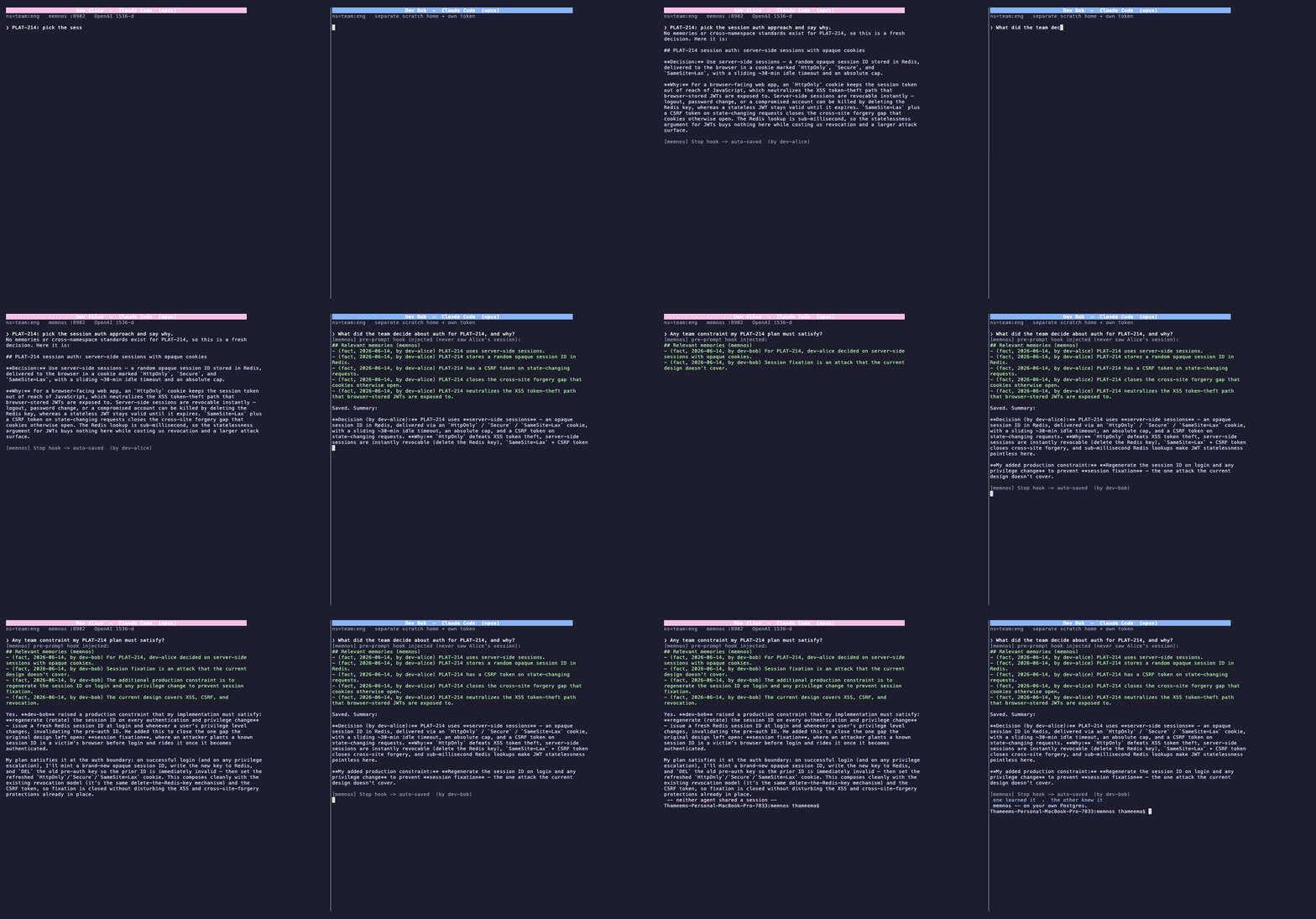
Two separate Claude Code agents — different processes, different tokens, same
namespace (ns=team:eng). Alice's agent decides an auth approach; Bob's fresh agent (which
never saw her session) recalls it attributed by dev-alice and adds a constraint;
Alice's next turn picks up Bob's constraint, attributed by dev-bob. Bidirectional
shared memory across two real agents — server-stamped authorship (clients can't spoof it),
on your own Postgres, no LLM at recall time.
The same proof at the CLI level, two memnos sessions on one namespace:
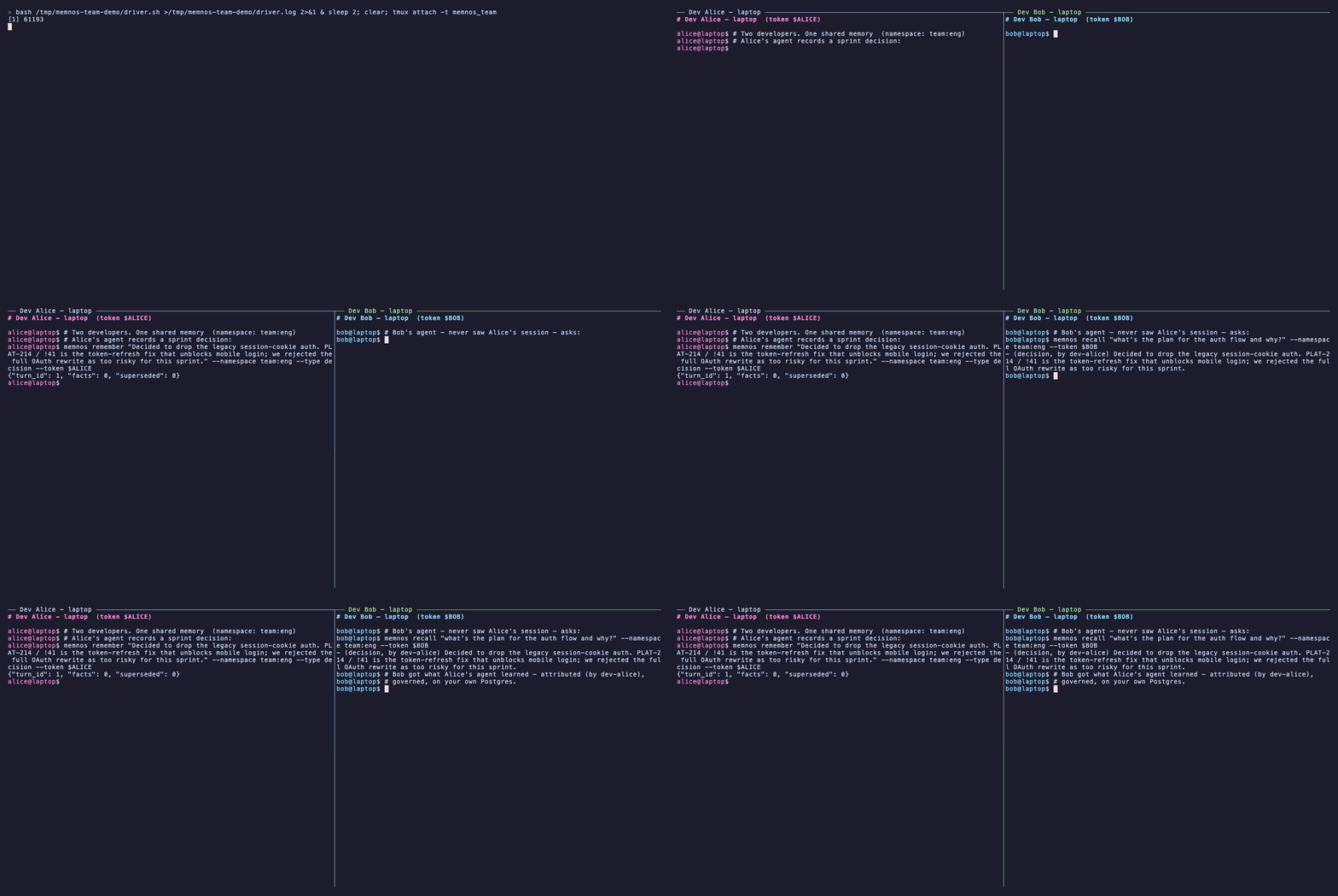
Dev Bob's recall returns the decision Dev Alice stored, attributed by dev-alice — one
governed namespace, attribution stamped by the server, not the payload.
How memory gets captured is honest about its limits: deterministic both-sides on Claude
Code (lifecycle hooks) and on any base-URL-configurable client via memnos proxy; MCP
capture is discretionary (the model chooses when to call the tools); ChatGPT and Claude
Desktop can't be cleanly auto-captured (no base-URL override, no cert MITM) — MCP is the
path there. Details in Integrations.
The concept (the gap, and why attribution must be server-stamped) is in
docs/team-memory.md; standing up one shared host with a scoped
token per developer is in docs/guides/team.md.
Install into an isolated environment (uv recommended; pipx works too — don't
pip install into your system Python):
uv tool install memnos        # no uv?  brew install uv   or
                              #         curl -LsSf https://astral.sh/uv/install.sh | sh

memnos setup                  # ← zero external dependencies by default: downloads embedded
                              #   PG + pgvector (~20-30 MB, macOS arm64 / Linux x86_64 /
                              #   Windows x86_64) — no Docker, no brew, no apt
                              # or: memnos setup --external (connect to YOUR existing Postgres)
                              # or: memnos setup --docker   (spin up a pgvector container)
memnos start                  # background server → open http://127.0.0.1:8900/admin
Bare memnos setup downloads a pre-built PostgreSQL 16 + pgvector binary into
~/.memnos/embedded_pg/ on first run (same as the explicit memnos setup --embedded —
the flag still works, it's just the default now). No Docker, no brew, no apt — just
uv tool install and you're done. memnos start auto-restarts the embedded PG on every boot.
On a platform without an embedded build (anything other than the three above), it falls
back to the original interactive wizard automatically — --docker/--external always work
everywhere regardless.
Operate it like any daemon: memnos status / stop / restart; memnos serve runs in
the foreground for systemd/launchd/Docker; memnos upgrade updates in place;
memnos autostart installs a login service so the server survives reboots.
During setup you're asked for an optional OpenAI key (stored AES-256-GCM encrypted,
never in plaintext): with one, you get 1536-d embeddings + bi-temporal fact extraction;
without one, memnos runs in free local 384-d mode — nothing leaves your machine.
For extraction without OpenAI, set MEMNOS_EXTRACT_BASE_URL to any OpenAI-compatible
endpoint (Ollama / vLLM / LM Studio) — embeddings stay local-384 and free, only fact
extraction calls that local LLM. memnos migrate-embeddings converts between embedding
modes losslessly if you change your mind.
Extraction depends on who is speaking. Every turn is stored verbatim and stays searchable.
From your own messages, memnos extracts decisions, preferences, rules, plans and personal
facts. From the assistant's replies, it keeps only decisions, concrete outcomes,
identifiers (PR/issue numbers, versions, SHAs, hosts) and explicit state changes, capped
per reply by MEMNOS_ASSISTANT_FACT_CAP (default 6). A fact the assistant repeats is not
counted as corroboration. To store facts about you under your name rather than a generic
"user", set MEMNOS_USER_NAME, for example MEMNOS_USER_NAME="Ada Lovelace".
Full walkthrough: QUICKSTART.md · Windows:
docs/guides/windows.md · everything else: memnos --help.
lives_in, works_at) supersede on contradiction —
by rule, not by asking an LLM — so "where do I live?" returns the current answer, with
the old one closed out, dated, and still auditable.memnos is a governed memory engine, not an agent runtime. A detailed, version-pinned comparison with other memory systems lives at memnos.net/compare.
One command wires memnos into your agent — no manual config editing:
memnos agent-setup claude-code     # Claude Code: MCP + hooks (auto recall/save) + /memnos
memnos agent-setup claude-desktop  # Claude Desktop
memnos agent-setup codex           # Codex CLI
memnos agent-setup cursor          # Cursor
memnos agent-setup windsurf        # Windsurf
memnos agent-setup openclaw        # OpenClaw
memnos agent-setup hermes          # Hermes Agent (Nous Research)
memnos agent-setup omnigent --agent-dir <path>   # Omnigent (Databricks) — wires whatever
                                    #   harness Omnigent runs (Claude, Codex, Cursor, ...)
Each mints a scoped token, is idempotent, and backs up any file it edits.
Omnigent server-wide capture — a separate, additive command wires memnos into an
Omnigent server's own --config YAML (not a single agent) as a native type: function
policy, so every agent that server runs gets its assistant responses captured
automatically, with zero Omnigent source changes:
memnos server-setup omnigent --config <path-to-omnigent-server-config.yaml> --mode embedded # or --mode central
Write-only (captures responses; does not recall/inject) and fails open (never blocks or denies the live conversation). Full guide, coverage caveats, and the embedded/central config split →
Honest capture tiers — clients differ in how reliably memory gets captured, and we'd rather tell you than pretend otherwise:
~/.memnos/offline_queue/)
and replayed automatically on next session start — no turns lost to transient downtime.memnos proxy: point any OpenAI- or
Anthropic-compatible client at the proxy
(ANTHROPIC_BASE_URL=http://127.0.0.1:8910). It relays every request untouched
(streaming included, keys forwarded, never stored) and captures both sides of each
completed exchange, with agent-loop noise filtered out.
Guide + capability matrix.memnos server-setup omnigent
captures every covered agent's assistant response automatically — no model discretion,
no per-agent wiring. One-directional (no recall/injection — Omnigent has no
turn-boundary hook for that) and narrower than "every response" for one class of
session; see the honest coverage caveats.recall, recall_wide, remember,
reconcile_claim, …) — called when the model decides to. Useful, but not guaranteed.Also: REST (POST /remember, POST /recall — Bearer token, namespace-scoped),
CLI (memnos remember/recall), and an SDK (uv pip install memnos-sdk) with
LangChain / LangGraph / LlamaIndex adapters. Client guides:
docs/guides/clients/.
REST, MCP, hooks, and the benchmark all run the same engine — there is one codebase, not a benchmarked copy and a shipped copy.
A zero-build web console ships in the open-source build at /admin: create
namespaces, mint/revoke tokens, manage grants, view the dashboard, store secrets. Every
call is token-authenticated, namespace-ACL'd, and audited.
memnos admin # bootstrap an admin token → paste into /admin
LongMemEval: 78.4% on the full 500-question benchmark (gpt-4o answer + judge), run on MemoryBench — a competitor's own open harness. By category: single-session assistant facts 98.2%, user facts 92.9%, knowledge-update tracking 78.2% (with 99% retrieval Hit@10 — the engine found the answer; the answering model missed it), temporal reasoning 77.4%, multi-session 70.7%. The weak spot, disclosed: single-session preferences 46.7% (n=30) — preference statements aren't fact-shaped, and extraction underserves them today.
LoCoMo: 64–65% under the gpt-4o judge on the full benchmark (10 conversations,
1,542 QA), reproduced across three independent from-scratch ingests (the small spread
is non-deterministic extraction, not the engine). Every prediction file is published
under benchmarks/results/.
We care more about credibility than a big headline:
Reproduce: python benchmarks/locomo_eval.py --sample-ids 0,1,2,3,4,5,6,7,8,9
(see benchmarks/).
Every number above is reproducible from this repo — judge, rubric, and per-question predictions all included.
Claude Code ─┐
Cursor       ├─ MCP (stdio) ─┐
Windsurf     ─┘              │
hooks / proxy ──────────────┼─► memnos server ──► PostgreSQL + pgvector  (ONE engine)
REST / CLI ─────────────────┘     ├─ hybrid retrieve: pgvector (HNSW) + BM25 (tsvector) → RRF
                                   │   → cross-encoder rerank → quota + timeline + entity arms
                                   │   (NO LLM at query time)
                                   ├─ bi-temporal facts + belief-change supersession
                                   ├─ governance: token auth · namespace ACL · audit · usage
                                   └─ encrypted secret vault (AES-256-GCM) + ingest redaction
Write (LLM at ingest only): a message becomes a verbatim raw turn and structured
bi-temporal SPO facts. Near-duplicate facts are deduplicated on the write path.
Single-valued attributes supersede on change; multi-valued ones (did, visited)
accumulate. Memories can be typed, and memories typed constraint are pinned —
injected into every recall in their namespace. Secrets are redacted before storage. An
offline "sleep" pass consolidates facts into entity dossiers, and reconcile re-runs
contradiction close-out across an existing namespace.
Read (no LLM): hybrid retrieval (pgvector HNSW + BM25, RRF-fused), cross-encoder rerank, quota guarantees for raw-turn + fact coverage. Temporal questions add a guaranteed entity timeline; entity questions add an entity-guarantee arm so list/aggregation answers are complete. Recall is grounded: results carry their source namespace, and provenance links trace facts back to the turns they came from.
secret://name), key rotation. Resolvable
over HTTP via POST /secret/resolve, authorized per-secret through a pseudo-namespace
grant (secret:name) — see docs/api.md.memnos health turns metrics into actionable findings.Local-first: the server binds
127.0.0.1. Put a TLS reverse proxy in front for remote use.
memnos is early (0.1.x) and changing. Honest scope, so you don't find out the hard way:
127.0.0.1 by default; remote access is your reverse proxy's job.MEMNOS_EXTRACT_BASE_URL at any OpenAI-compatible endpoint (Ollama / vLLM / LM Studio)
to run extraction locally and free, while embeddings stay on the private local-384 path.
With nothing set, local mode still gives you embeddings + hybrid recall over verbatim
turns — but no fact extraction, so no supersession or timelines.Apache-2.0. The open-source build is the engine + single-org self-host + the basic management console. SSO/advanced RBAC, encrypted-vault key management (KMS/HSM, rotation policies), the multi-tenant control plane, the richer enterprise UI, and managed cloud are the commercial layer.
Namespace-scoped, token-authenticated shared memory for AI coding agents. Self-hosted on Postgres (embedded by default). MCP server, REST API & Python SDK.
Ferramentas
Ainda não há lista de ferramentas. Servidores remotos recebem uma após a primeira verificação de saúde.
Perguntas frequentes
Copie nesta página a configuração stdio para Cursor, Claude Desktop, Claude Code ou VS Code. Ela usa a instalação do publicador, não um proxy do PlugMCP.
Este registro não lista nenhuma variável de ambiente obrigatória.
Memnos roda localmente via stdio.
Última verificação: 2026-11-15. Namespace-scoped, token-authenticated shared memory for AI coding agents. Self-hosted on Postgres (embedded by default). MCP server, REST API & Python SDK.