 |
Potencialize seu agente
Instalação do publicador. Não é um endpoint do PlugMCP.
Host a copy with our keys and logs.
Ainda não há uma versão empacotada no registro. Siga o README do repositório.
URL remota ou um comando na sua máquina? Como as duas instalações diferem
Rodar no PlugMCP
A new server you create. It is not this listing's official endpoint. Use the publisher install when you want their URL and their credentials.
AbrirDo publicador
|
Production-ready MongoDB backup & disaster recovery: stream mongodump to S3, web dashboard, PITR, age encryption & MCP server. Single Go binary.
|
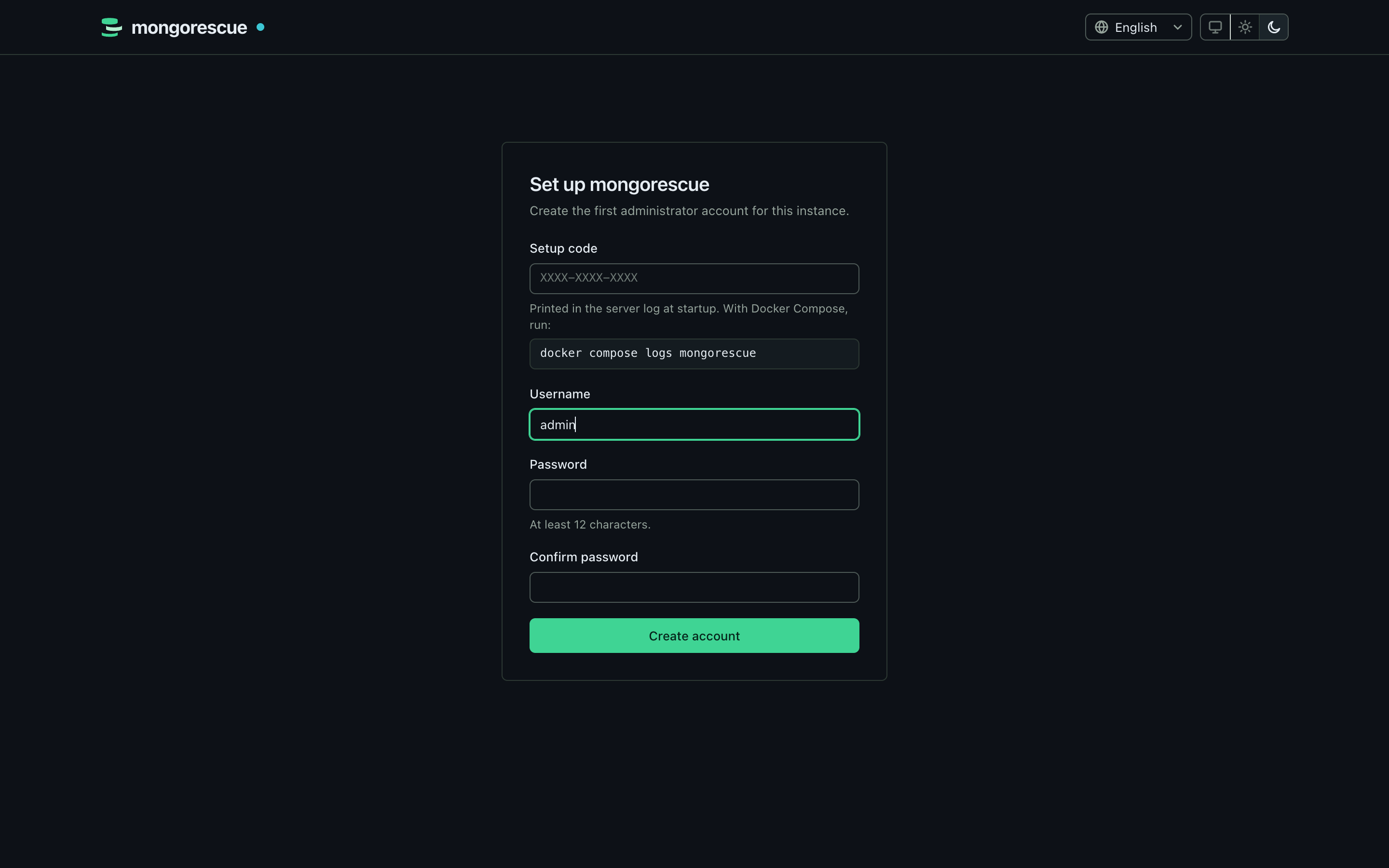
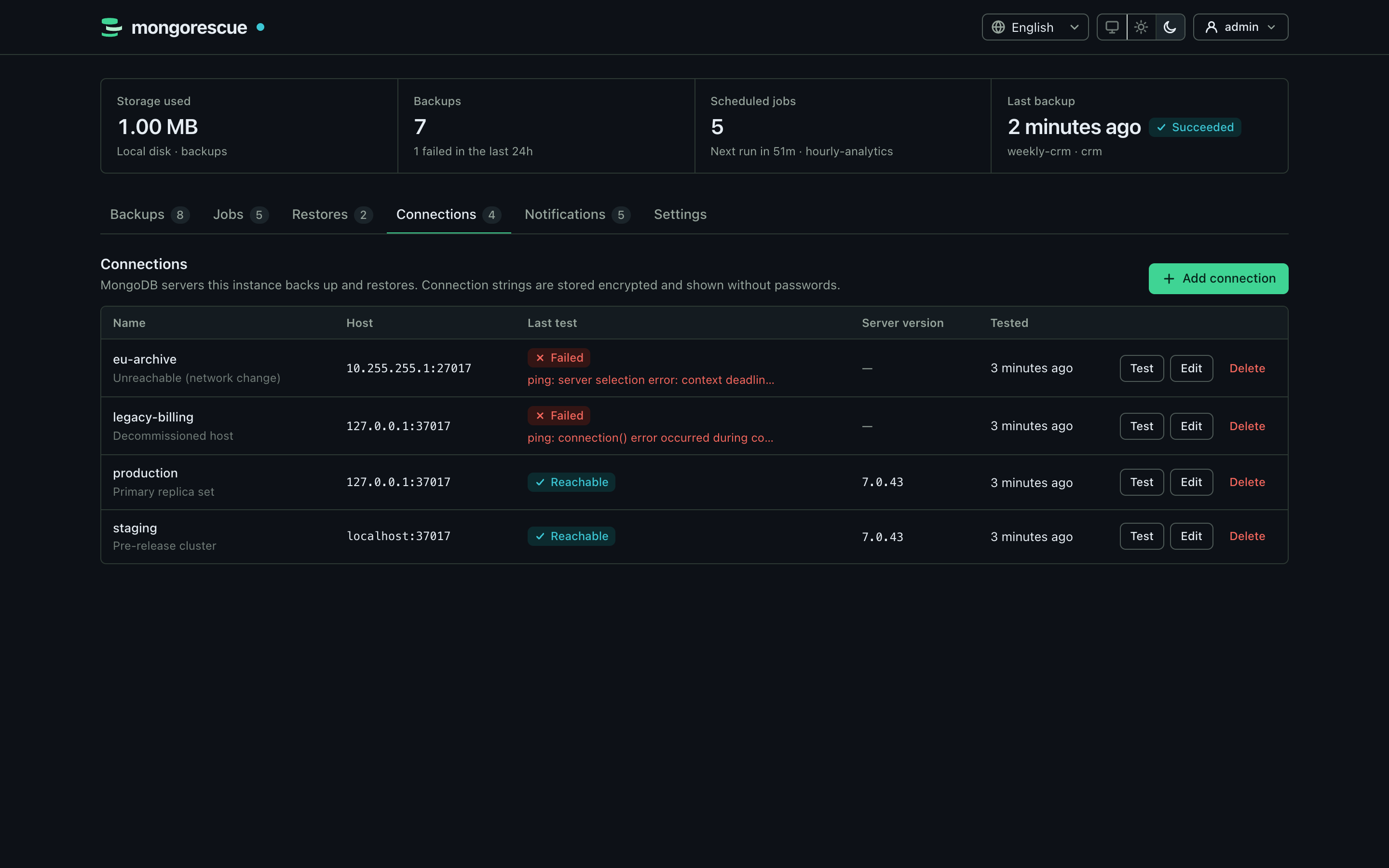
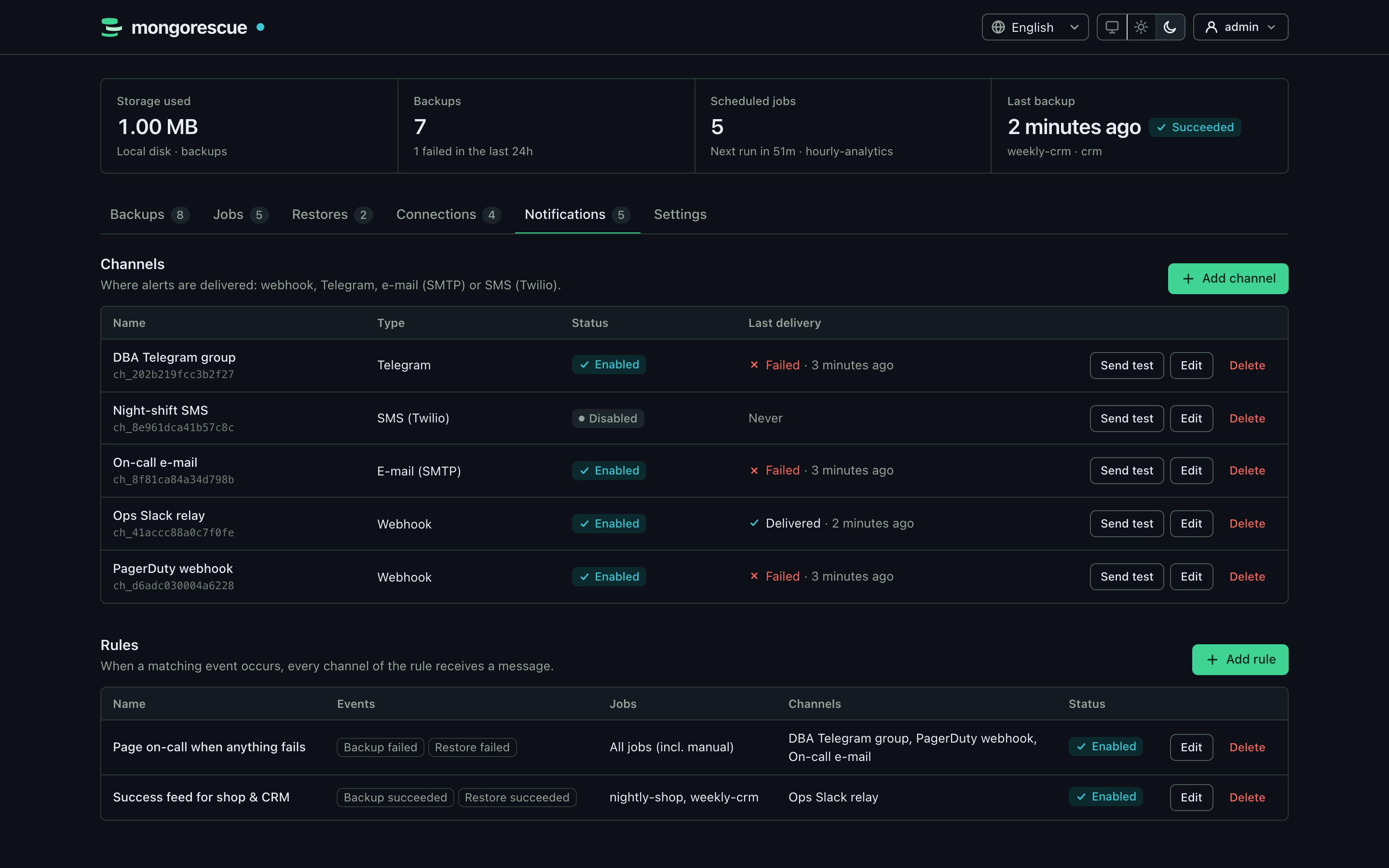
| First-run setup | MongoDB connections |
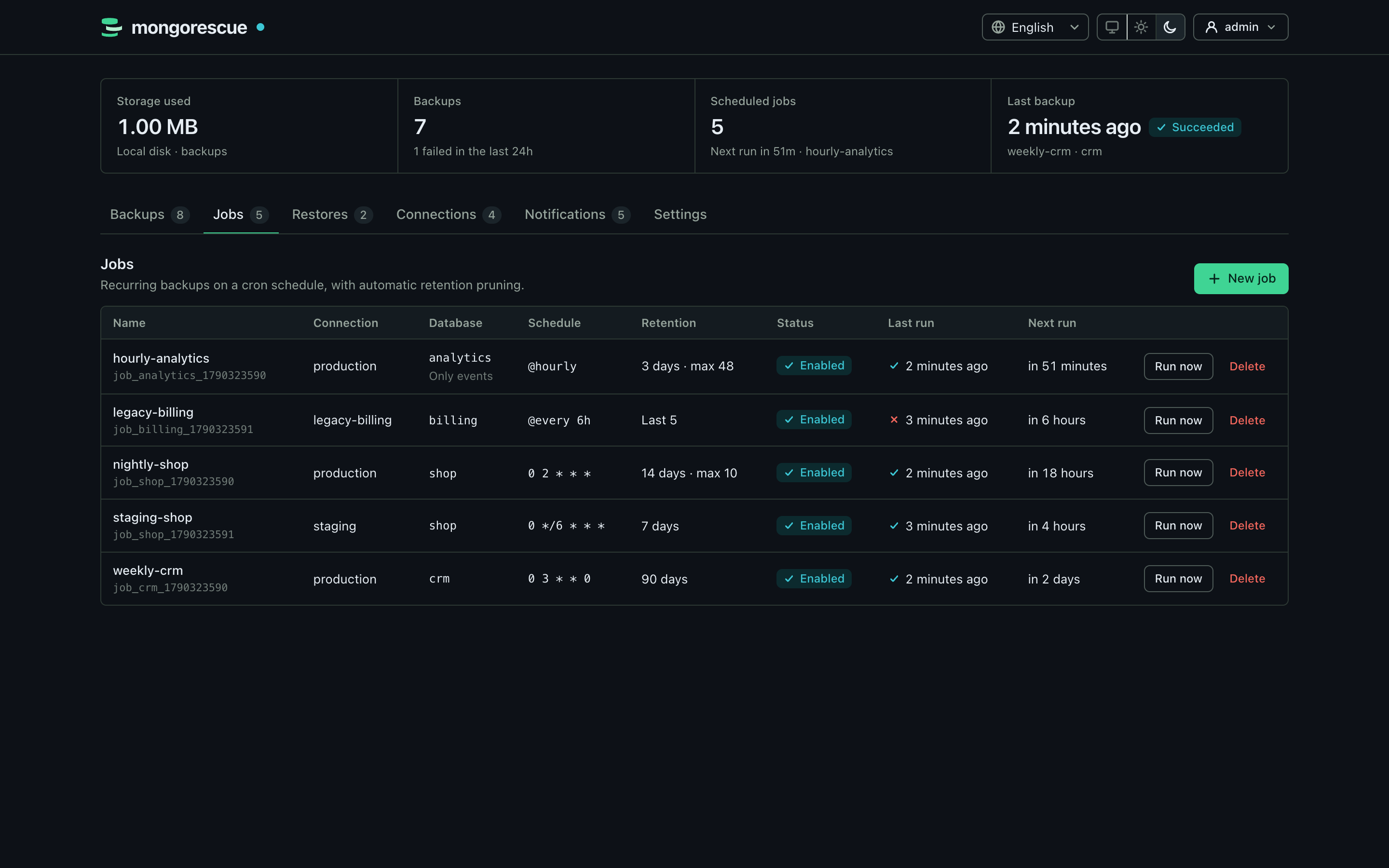 | 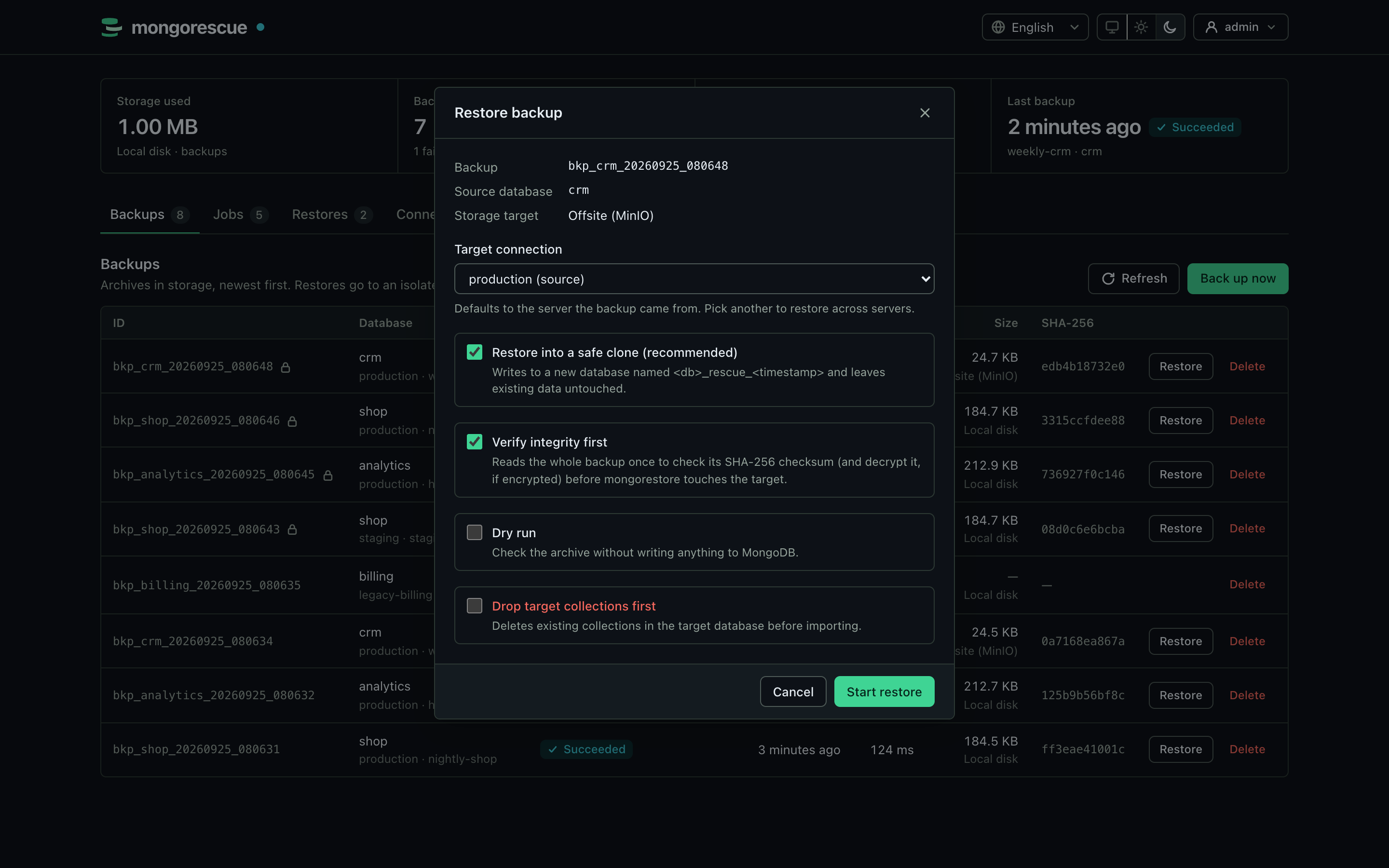 |
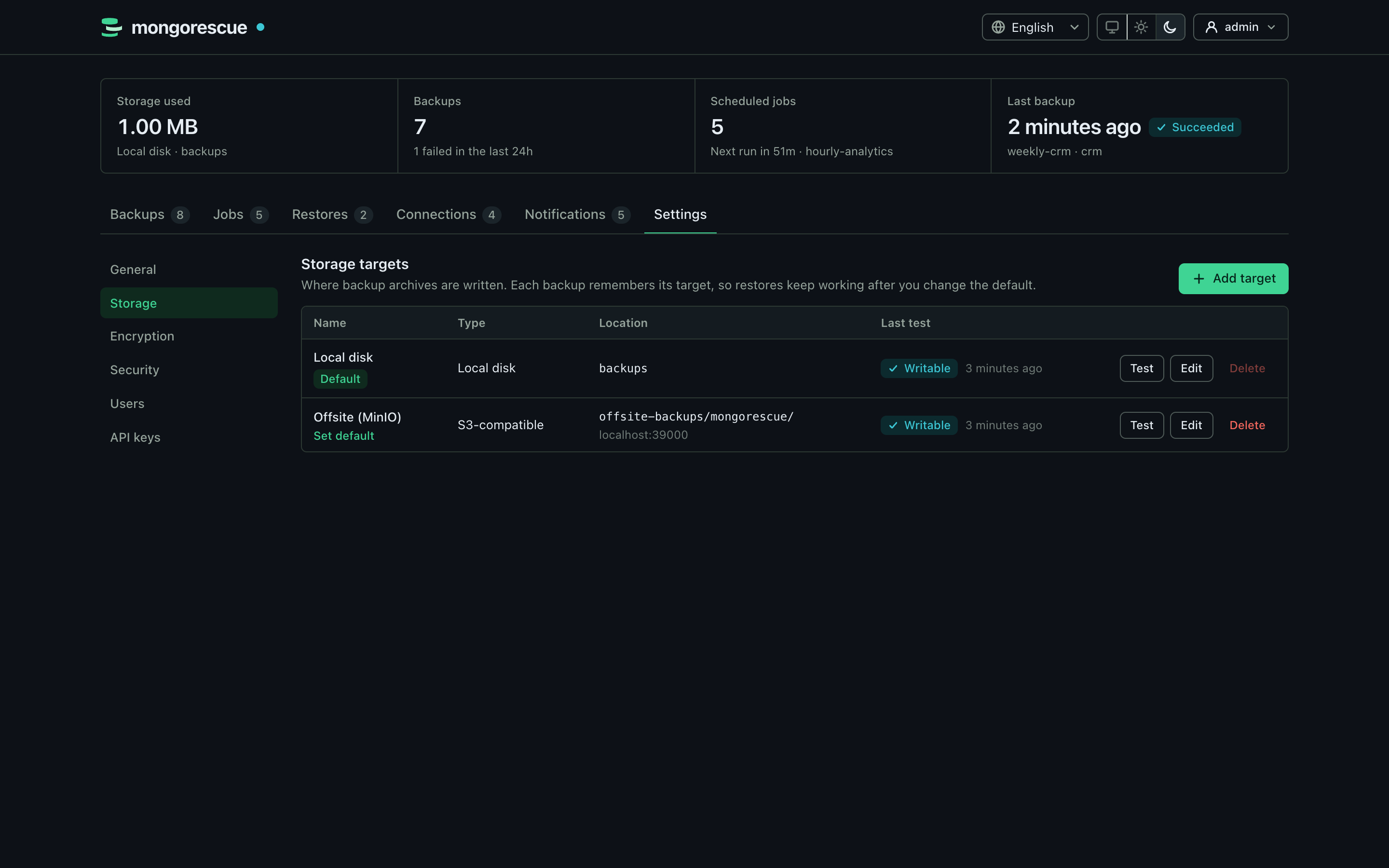
| Scheduled jobs | Restore into a safe clone |
 |  |
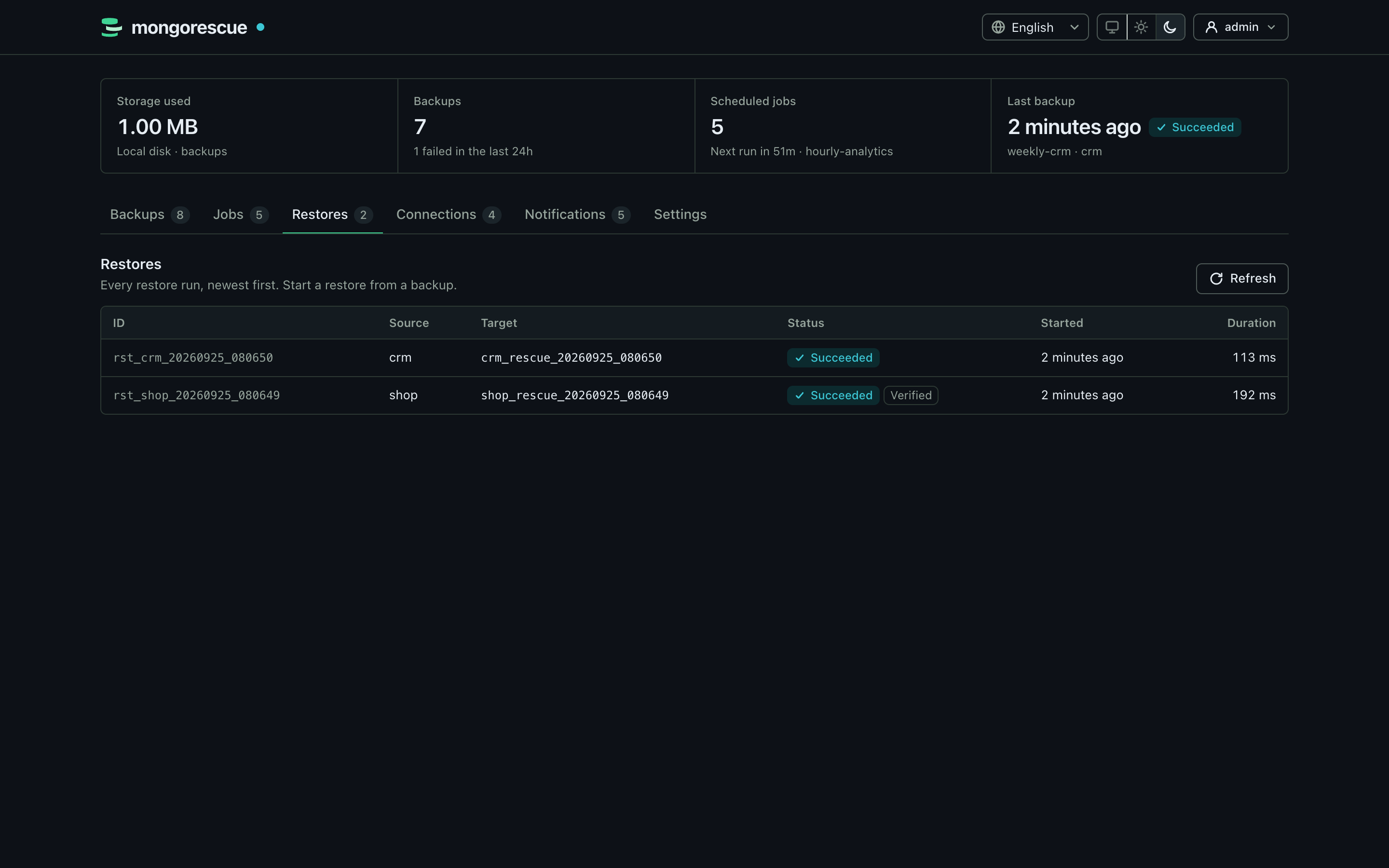
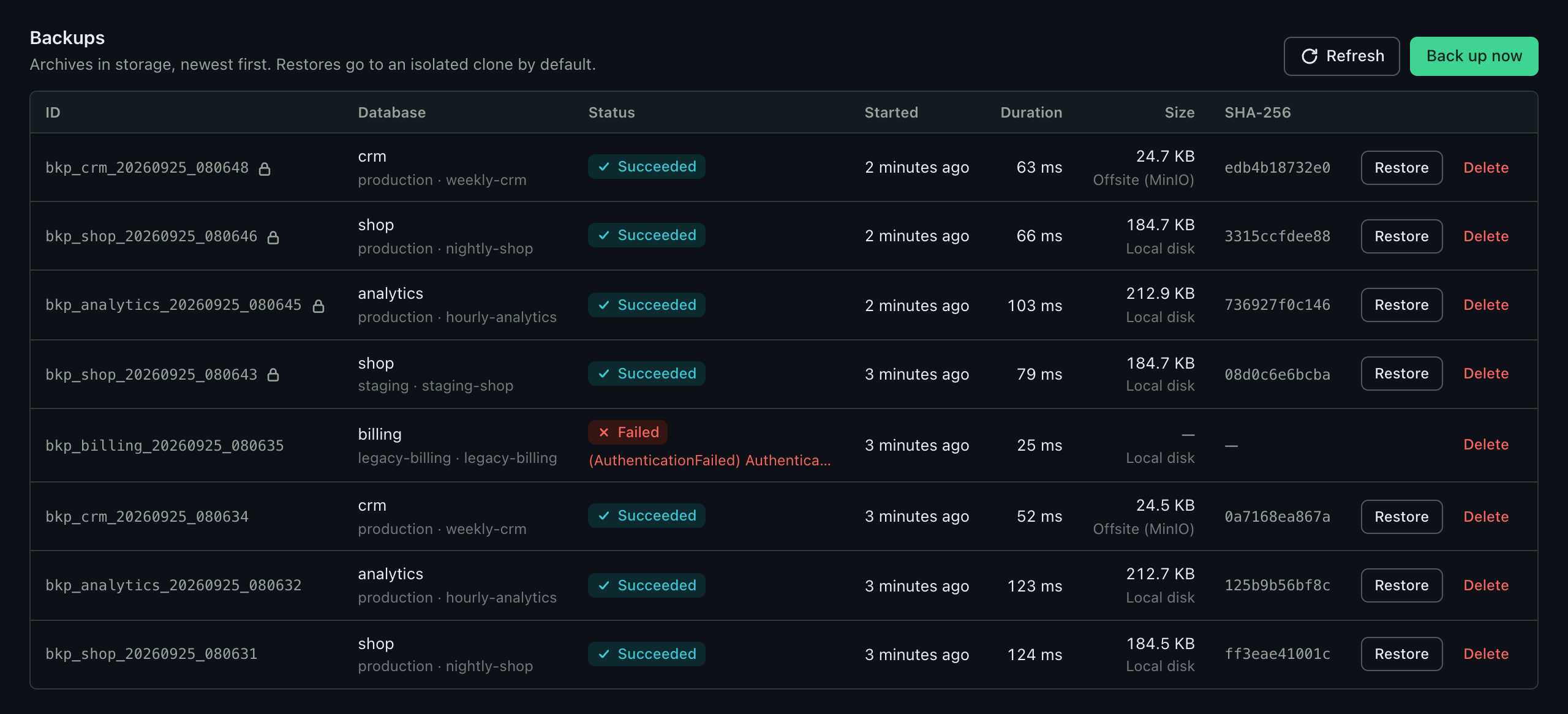
| Storage targets | Notifications |
 |  |
| Restore history | Backups |
MongoRescue runs mongodump on a schedule, streams the archive to local disk or any S3-compatible bucket, and brings it back with mongorestore when you need it. The dump is piped straight through, so memory use stays flat no matter how large the database is.
Restores go into a separate copy of the database (<db>_rescue_<timestamp>_<id>) unless you explicitly ask to overwrite the original. Nothing touches production by accident.
prod_*, each database into its own backup, with a live preview, optional automatic inclusion of new databases, collections chosen per database in a tree (Selected and All) and one notification per run (jobs with several databases, collection filters per database)secret.key, the age keys and the storage credentials (runbook)#/backups/<id>)promtool/start, success, /fail), so a crashed instance or a hung scheduler raises an alert toomongorescue backup, restore, list, verify, status) with --wait, JSON output and stable exit codesdocker run -d --name mongorescue -p 8080:8080 \
-v mongorescue-data:/data -v mongorescue-backups:/backups \
ghcr.io/yigitcittan/mongorescue:latest
Or, with Docker Compose, run docker compose up -d in a clone of this repository (or next to a downloaded docker-compose.yml).
docker logs mongorescue or docker compose logs mongorescue) and create the admin account.The image includes the MongoDB Database Tools. It is the only distribution that serves the dashboard over HTTP.
Desktop app. On a workstation, download the desktop app from Releases (Windows installer, macOS .app, Linux binary) and start it; mongodump and mongorestore are bundled. It shows the same dashboard in a native window, without opening a network port, fills in the setup code on first start and updates itself from GitHub Releases. See docs/desktop.md.
Kubernetes. A Helm chart in deploy/helm/mongorescue runs the image as a one-replica StatefulSet with probes, a restricted security context and a graceful shutdown that waits for running backups. See docs/kubernetes.md.
Server binary. For headless use (REST API, MCP, metrics), download mongorescue from Releases, put the tools on your PATH and run ./mongorescue. It serves no dashboard unless you pass -dashboard (or set MONGORESCUE_DASHBOARD=true); the setup code is printed in its log.
MongoRescue serves plain HTTP. Before you expose the port to a network, put a TLS-terminating reverse proxy in front of it; see docs/production.md. No MongoDB to try it with? examples/with-mongodb.yml adds a demo instance to the Compose setup.
Everything the dashboard does is available over HTTP. In the dashboard, open Settings → API keys, create a key and copy it (it is shown only once). Then use it as a bearer token, for example to back up a database on one of your connections:
KEY='mr_...'   # the key you just created

curl -X POST http://localhost:8080/api/v1/backups \
  -H "Authorization: Bearer $KEY" \
  -d '{"connection_id": "conn_1a2b3c4d5e6f7a8b", "database": "shop"}'
Restore it into a safe clone on the same server, or pass "target_connection_id" to restore it into another one (that needs an admin key or a session):
curl -X POST http://localhost:8080/api/v1/restore \
  -H "Authorization: Bearer $KEY" \
  -d '{"backup_id": "bkp_shop_20260924_030000_3f9a1c2e"}'
A job backs up one database or several. This one backs up every database whose name starts with prod_ each night, one after another, and reports databases created later instead of silently adding them (an admin key is needed to create jobs):
curl -X POST http://localhost:8080/api/v1/jobs \
  -H "Authorization: Bearer $ADMIN_KEY" \
  -d '{"name": "all prod", "cron_expression": "0 2 * * *", "connection_id": "conn_1a2b3c4d5e6f7a8b",
       "database_selection": {"mode": "pattern", "include": ["prod_*"], "auto_include_new": false}}'
GET /api/v1/jobs/{id}/databases/preview shows what it would back up right now, and GET /api/v1/jobs/{id}/runs lists its runs with the outcome of every database. In the dashboard the job form offers the same choice as Single / Selected / All / Pattern.
To restore only some collections, list what the backup holds with GET /api/v1/backups/{id}/collections (read from the archive header, without downloading the backup) and pass "selected_collections": ["orders", "customers"]; the dashboard's restore dialog offers the same list. To restore over the original database, send "safe_clone": false together with "confirm_in_place": true (with an admin key). The full endpoint list is in docs/api.md.
Every key has a scope: read (the default) can only look, operator can also start backups, run jobs and restore into safe clones, and admin can do everything. The examples above need an operator key.
The same binary is a client of a running instance, for scripts and CI. It talks to the REST API with an API key read from a file (or MONGORESCUE_CLI_API_KEY) and never opens a data directory:
export MONGORESCUE_URL=https://backup.example.com
export MONGORESCUE_CLI_API_KEY_FILE=~/.config/mongorescue/key

mongorescue status
mongorescue backup --job job_shop_nightly --wait --timeout 30m
mongorescue list backups --status failed --json
mongorescue restore bkp_shop_20260924_030000_3f9a1c2e --wait --verify-restore
Restores go into a safe clone unless you pass both --in-place and --confirm; the CLI never prompts. Exit codes are stable (0 ok, 1 failed, 2 usage, 3 unauthorized, 4 not found, 5 conflict, 6 wait timed out, 7 unreachable), so a CI step fails when the backup does. See docs/cli.md.
MongoRescue speaks the Model Context Protocol, so Claude, GitHub Copilot in VS Code, Cursor or your own agents can check your backups, diagnose failures, start backups and rehearse restores for you. Create an API key (a read key to look, an operator key to act) and add the server to your assistant, for example in Claude Code:
claude mcp add --transport http mongorescue http://127.0.0.1:8080/mcp \
  --header "Authorization: Bearer $MONGORESCUE_MCP_API_KEY"
or, for clients that start a local command (Claude Desktop), mongorescue mcp bridges stdio to a running instance, with the key in MONGORESCUE_MCP_API_KEY. Assistants can never delete anything or restore in place: restores through MCP always go into a new <db>_rescue_<timestamp>_<id> database, and every call is audited and rate limited. Configurations for Claude Desktop, Claude Code, VS Code and Cursor, the tool list and the security model are in docs/mcp.md.
Everything is configured in the dashboard. Storage targets (local directories and S3-compatible buckets), backup encryption, security options and limits live under Settings, next to users and API keys; MongoDB connections, jobs and notifications have their own tabs. All of it is stored in the data volume (/data), together with the key that encrypts stored credentials; back that volume up. Changes apply immediately, without a restart. Backups go to the Local disk target (the /backups volume) until you add another one.
Only a few bootstrap options are read at startup:
There is no configuration file. Environment variables of earlier builds are imported into the database once and then ignored; see docs/configuration.md for every setting and the upgrade notes.
You need Go 1.26 or newer.
make build        # build ./bin/mongorescue
make test-race    # unit tests
make test-integration-docker   # integration tests against MongoDB, MinIO and LocalStack in Docker
make test-chaos-docker         # fault-injection suite (Toxiproxy, SIGKILL, full disk, clock steps)
make test-load-docker          # load test: scheduler, memory, API p95 and primary impact at scale
make desktop      # desktop app for this OS (needs the Wails CLI and CGO, see docs/desktop.md)
See CONTRIBUTING.md for the full testing setup and how to send a pull request, and docs/testing.md for what the suites guarantee.
MongoRescue holds the credentials of your databases and your storage, so it is built to limit what one stolen credential can do. Deletes through MongoRescue are soft and wait out a grace period, lowered protections wait too, and an optional two-person rule needs a second administrator for destructive actions (delete protection). S3 targets can lock every object in compliance mode, so not even the bucket's credentials can delete an archive early (Object Lock). Users and API keys get a role (viewer, operator, admin) and can be limited to some connections (roles, per-connection access); every action lands in a hash-chained audit log; connections to MongoDB can use TLS and x509. What this does and does not protect against is in the threat model.
Security: the threat model covers every component (STRIDE, with the code behind each mitigation and the open items); release archives, checksums, SBOMs, desktop assets and container images are signed with Sigstore cosign and carry SLSA provenance (how to verify them); the parsers of untrusted input are fuzzed continuously with ClusterFuzzLite.
As of v0.28.0. Run through the production checklist before you rely on MongoRescue.
mongorescue.db) whose data directory is locked by one process. Active-passive high availability adds a standby (it serves no data and accepts no sign-in) that takes over when the active instance dies, but there is no active-active mode and no shared metadata store: the standby receives the metadata through snapshots, so changes made in the last snapshot interval before a crash can be lost. Without HA, scheduled metadata snapshots and the recovery kit make a rebuild possible, and the heartbeat tells you when the instance is down.secret.key is the root of trust; credentials are not read from Vault (#62). Stored credentials and encryption keys are sealed with one key: losing it makes them unrecoverable, and whoever reads it together with mongorescue.db holds every credential. It can be wrapped by a KMS (AWS KMS, Google Cloud KMS, Azure Key Vault, Vault Transit), so that the data directory holds no plaintext key, but a running instance keeps it in memory, and deleting the KMS key loses it too. Keep the recovery kit offline. Keys can be rotated; a key set by MONGORESCUE_SECRET_KEY is rotated by hand.mongos are not tested and not consistent across shards; point-in-time recovery needs a replica set.The full list of production gaps is tracked with the production-gap label.
The plan to production readiness, from provable recovery (self-backup, a recovery kit, users and roles, restore preflight and verification, RPO/RTO, a full audit log) through roles and single sign-on to point-in-time recovery and immutable storage, is in docs/roadmap.md.
Ideas and help are welcome in issues.
Windows releases are signed with free code signing provided by SignPath.io, certificate by SignPath Foundation.
Only artifacts built by the release workflow from a tagged commit of this repository are signed.
MongoRescue does not collect telemetry or send data about you or your databases anywhere except to the MongoDB servers, storage targets and notification channels you configure. The desktop app checks GitHub Releases for updates. See docs/privacy.md, which also covers what each backup artefact holds, how long it is kept, and erasure requests (such as GDPR Article 17) against backups.
GNU Affero General Public License v3.0 (AGPL-3.0). See LICENSE for details. Security issues: please report them privately, as described in SECURITY.md.
Production-ready MongoDB backup & disaster recovery: stream mongodump to S3, web dashboard, PITR, age encryption & MCP server. Single Go binary.
Ferramentas
Ainda não há lista de ferramentas. Servidores remotos recebem uma após a primeira verificação de saúde.
Perguntas frequentes
Copie nesta página a configuração stdio para Cursor, Claude Desktop, Claude Code ou VS Code. Ela usa a instalação do publicador, não um proxy do PlugMCP.
Este registro não lista nenhuma variável de ambiente obrigatória.
Mongorescue roda localmente via stdio.
Última verificação: 2026-10-28. Production-ready MongoDB backup & disaster recovery: stream mongodump to S3, web dashboard, PITR, age encryption & MCP server. Single Go binary.