Dunetrace

Runtime reliability for AI agents. Structural and semantic detection, runtime prevention, native root cause, and one-click fixes.
Усильте агента
Установка от издателя. Не эндпоинт PlugMCP.
Host a copy with our keys and logs.
В реестре пока нет пакетного релиза. Следуйте README репозитория.
Удалённый URL или команда на вашем компьютере? Чем различаются два способа установки
Запустить на PlugMCP
A new server you create. It is not this listing's official endpoint. Use the publisher install when you want their URL and their credentials.
Запуск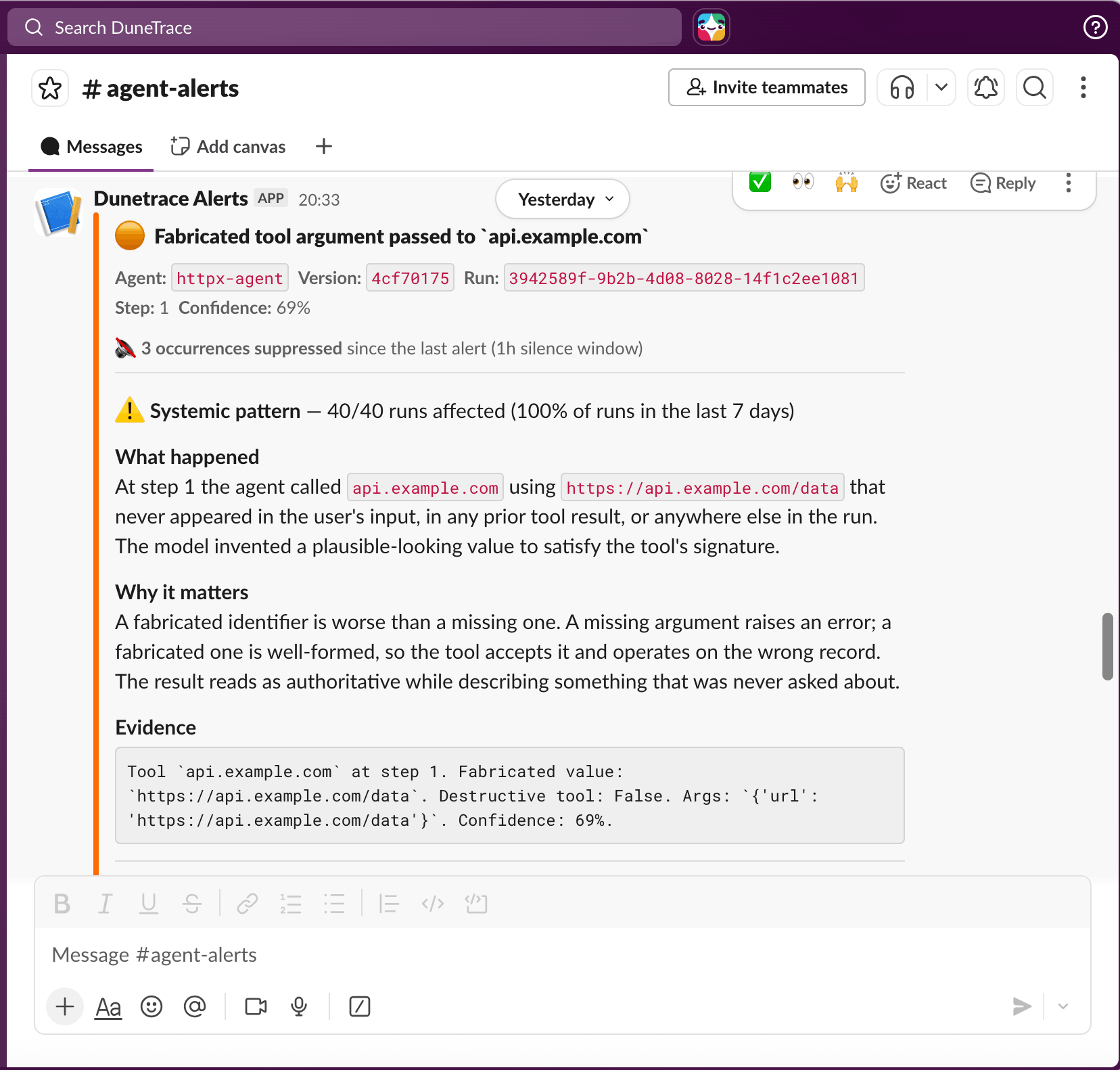
If Dunetrace helps you, consider giving it a ⭐ on top right, it helps others find the project.
AI agents fail silently:
Tracers answer "what happened?" i.e. after you already know it broke. Dunetrace answers "is something breaking right now?" with deterministic, zero-LLM checks on every run, and in the request path, where a policy can block the action before it executes.
Dunetrace covers the full agent reliability lifecycle, not just one slice of it:
1. Start the backend
git clone https://github.com/dunetrace/dunetrace
cd dunetrace && cp .env.example .env
docker compose -f docker-compose.ghcr.yml up -d   # localhost, auth off — see docs/operations.md to deploy
curl -s localhost:8001/ready && curl -s localhost:8002/ready   # both {"status":"ok",...}
2. Install the SDK
pip install dunetrace                       # Python
npm install dunetrace                       # Node.js / TypeScript

# Or skip steps 2-3 entirely: the skill installs the SDK and instruments your
# code. Run /dunetrace-setup (Claude Code, Cursor) or $dunetrace-setup (Codex).
npx skills add dunetrace/dunetrace-skills --skill dunetrace-setup
3. Instrument your agent
Python
from dunetrace import Dunetrace
import openai

dt = Dunetrace()
dt.init(agent_id="support-agent")   # auto-instruments installed clients (OpenAI, Anthropic, Mistral, Bedrock, LangChain, CrewAI, httpx, requests)

@dt.agent("support-agent", model="gpt-4o")
def my_agent(question: str) -> str:
    resp = openai.chat.completions.create(
        model="gpt-4o",
        messages=[{"role": "user", "content": question}],
    )
    return resp.choices[0].message.content   # LLM + tool calls tracked automatically, no manual hooks
TypeScript / Node.js
import { Dunetrace, autoInstrument } from "dunetrace";
import OpenAI from "openai";

const dt = new Dunetrace();
autoInstrument({ openai: OpenAI });   // patches OpenAI + outbound fetch; add `anthropic:` / `mistral:` too, or wrap one client with dt.wrapOpenAI()

const openai = new OpenAI();          // constructed after the patch — still tracked

await dt.run("support-agent", { model: "gpt-4o" }, async (run) => {
  await openai.chat.completions.create({ model: "gpt-4o", messages });
  run.finalAnswer();                  // LLM + tool calls tracked automatically, streaming included
});
Try the built-in failure scenarios
cd packages/sdk-py                                      # Python
python examples/basic_agent.py                          # No LLM calls, no API key
SCENARIO=tool_loop python examples/langchain_agent.py   # TOOL_LOOP via LangChain — needs OPENAI_API_KEY
SCENARIO=failures python examples/decorator_agent.py    # TOOL_LOOP, RETRY_STORM, RAG_EMPTY_RETRIEVAL

cd ../sdk-ts && npm install                             # TypeScript — needs Node 22+
ollama pull llama3.2                                    # and Ollama, so no API key is needed
npm run example:vercel-ai                               # Happy path
npm run example:vercel-ai:loop                          # TOOL_LOOP → detect → explain, end to end
More, including approvals, policies, agent memory and voice → examples index
Open the dashboard: http://localhost:3000
34 detectors run on every completed run — no configuration, no LLM. A few of the main ones:
Each alert carries what fired, why it matters, a concrete fix, and rate context (first occurrence / recurring / systemic). → docs/detectors.md for all 34
dt.run() calls auto-link into a delegation graph that DELEGATION_LOOP and HANDOFF_CONTEXT_LOSS read → docs/multi-agent.mdMEMORY_POISONING flags adversarial content persisted into them → docs/memory.mdOpt-in LLM judgment for what structural checks can't see — seven DeepEval-backed evaluators (hallucination, task completion, task-understanding failure, off-topic drift, user frustration, confusion loops, sycophancy). Post-hoc and sampling-based, never in your agent's request path. Its own container, off by default:
SEMANTIC_WORKER_ENABLED=true
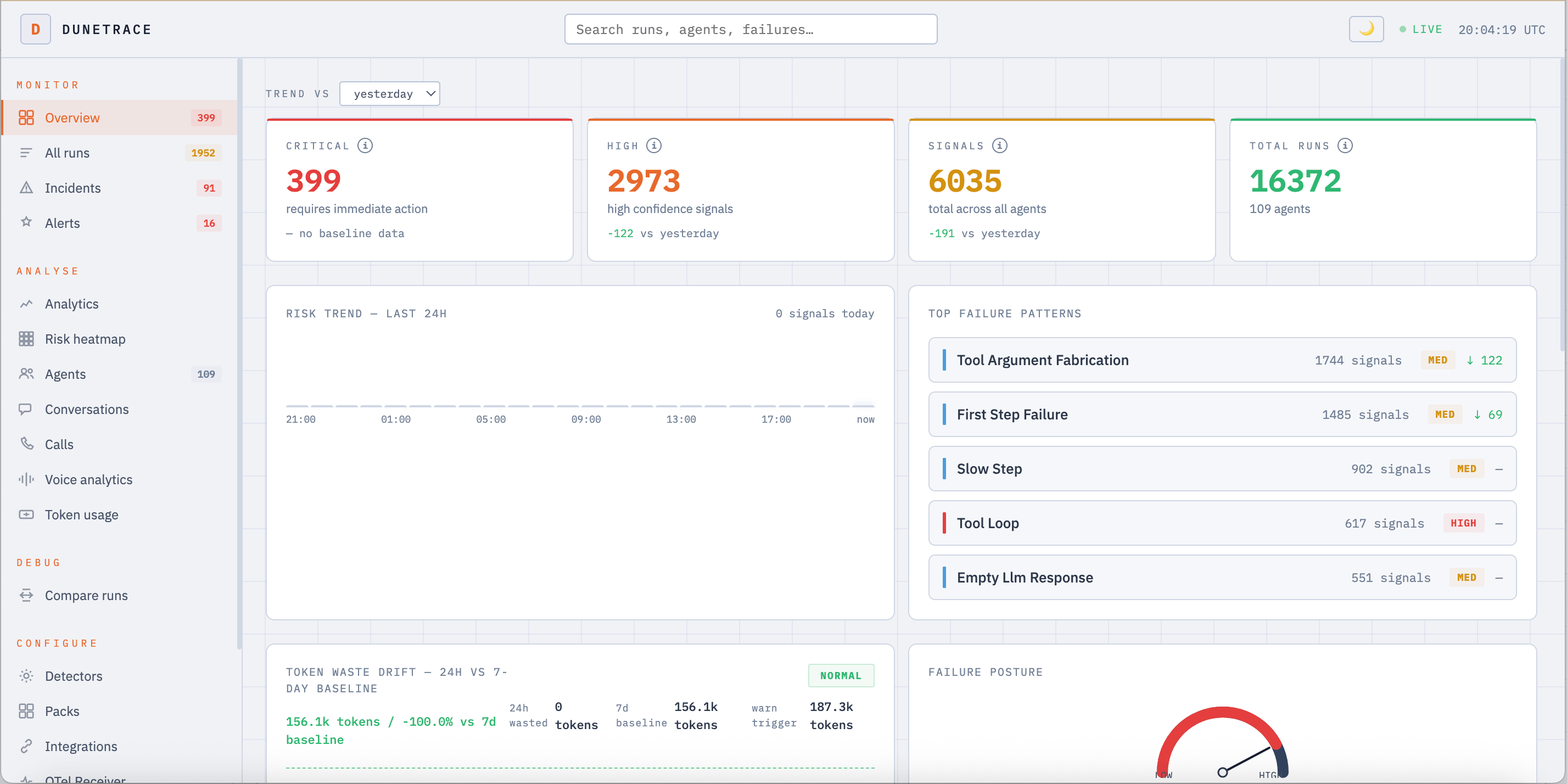
Live at http://localhost:3000. Auto-refreshes every 15s.
Slack and generic webhook (PagerDuty, Linear, custom).
SLACK_WEBHOOK_URL=https://hooks.slack.com/services/...
SLACK_MIN_SEVERITY=LOW   # LOW | MEDIUM | HIGH | CRITICAL
DIGEST_ENABLED=true      # weekly digest of top failure types, Monday 9am UTC
Click Explain + on any alert: Dunetrace analyzes the run's own stored events (no third-party tracer) and returns a cause plus a fix — either a runtime policy it applies itself (tool loops, retry storms, runaway step counts) or a prompt/code diff you copy in or open as a draft PR. Fix effectiveness is tracked automatically.
Runtime guardrails that fire mid-run — before a failure propagates. Defined in code or in the dashboard (the SDK refetches every 60s).
dt.add_policy(                                  # stop, switch_model, escalate, inject, ...
    name="cap tool calls",
    condition={"trigger": "tool_call_count", "operator": "gt", "value": 5},
    action={"type": "stop"},
)
dt.add_policy(                                  # human-in-the-loop: blocks the call until
    name="approve-wires",                       # someone approves in Slack or the dashboard,
    condition={"trigger": "before_tool_call", "operator": "eq", "value": "wire_money"},
    action={"type": "require_approval", "params": {"timeout_s": 300}},   # fail-closed on timeout
)
Query agent signals from Claude Code, Cursor, or Codex — "what failed in the last 24 hours?" — without leaving your editor.
pip install dunetrace-mcp
31 tools covering agents, runs, signals, fixes, issues, policies, custom detectors and voice calls. Claude Code registers the server automatically in ~/.claude.json (restart to load); Cursor and Codex need one config block.
Services share one Postgres and no message broker: the SDK ships events to the ingest API, and each worker polls for what it needs next. The core pipeline runs with no LLM key; three workers are opt-in.
→ docs/architecture.md — services, data flow, detection paths, schema · docs/operations.md — deploying, probes and metrics, retention, redaction, rate limiting
Model providers — OpenAI, Anthropic, Mistral and AWS Bedrock, auto-instrumented with no call-site changes.
Evaluation & tracing
Fix & workflow
Voice
Fork, branch, change, make test, PR — open an issue first for new integrations or architecture changes. Requires Python 3.11+, Node.js 22+, Docker + Docker Compose.
→ CONTRIBUTING.md (setup and workflow) · good first issues · adding a detector
Dunetrace UG (haftungsbeschränkt) · Kolonnenstr. 8, 10827 Berlin, Germany · [email protected]
The runtime reliability layer for AI agents.
Инструменты
Списка инструментов пока нет. У удалённых серверов он появляется после первой проверки состояния.
FAQ
Скопируйте на этой странице конфигурацию stdio для Cursor, Claude Desktop, Claude Code или VS Code. Она использует установку издателя, а не прокси PlugMCP.
В этой записи не указано обязательных переменных окружения.
Dunetrace работает локально через stdio.
Последняя проверка: 2026-11-15. The runtime reliability layer for AI agents.