Knossos
The labyrinth mapped once: on screen beside Claude Code, and in the notes your agent reads while it works.
Power your agent
การติดตั้งจากผู้เผยแพร่ ไม่ใช่เอนด์พอยต์ของ PlugMCP
URL แบบรีโมตหรือคำสั่งบนเครื่องของคุณ? การติดตั้งสองแบบต่างกันอย่างไร
รันบน PlugMCP
A new server you create. It is not this listing's official endpoint. Use the publisher install when you want their URL and their credentials.
เปิดจากผู้เผยแพร่
The labyrinth mapped once: on screen beside Claude Code, and in the notes your agent reads while it works.
A live architecture map of your codebase, on screen beside Claude Code and in the notes your agent reads while it works. Evidence-backed graph with file and line proof, served over MCP and a CLI.
Knossos (Κνωσός) is the Bronze Age palace at the heart of Minoan Crete, a complex so sprawling that Greek myth remembered it as the Labyrinth: the maze Daedalus built for the Minotaur, which no one could navigate without a thread to follow back out. Ariadne handed Theseus that thread.
TL;DR: Knossos scans a repository into a local graph of its components and the
relationships between them, each with the file and line that proves it. In Claude Code,
/knossos opens that graph as a live pane beside your session, and the agent gets a short note
at the moment it reads, edits or commits a file that matters: how much depends on it, which
rules bind it, and which tests reach it. The same graph answers 37 MCP tools and a CLI, for
Claude Code, Codex or any MCP client.
Facts that static analysis cannot prove are labelled with their confidence and origin. Nothing in the scan installs dependencies, imports a module or boots a framework.
Status: pre-release. Knossos is not yet published to Packagist or any container registry. The source is public on GitHub, so install from a checkout (see Installation). Image names such as
knossos:devare built locally by you; there is nodocker pullto fetch them yet.
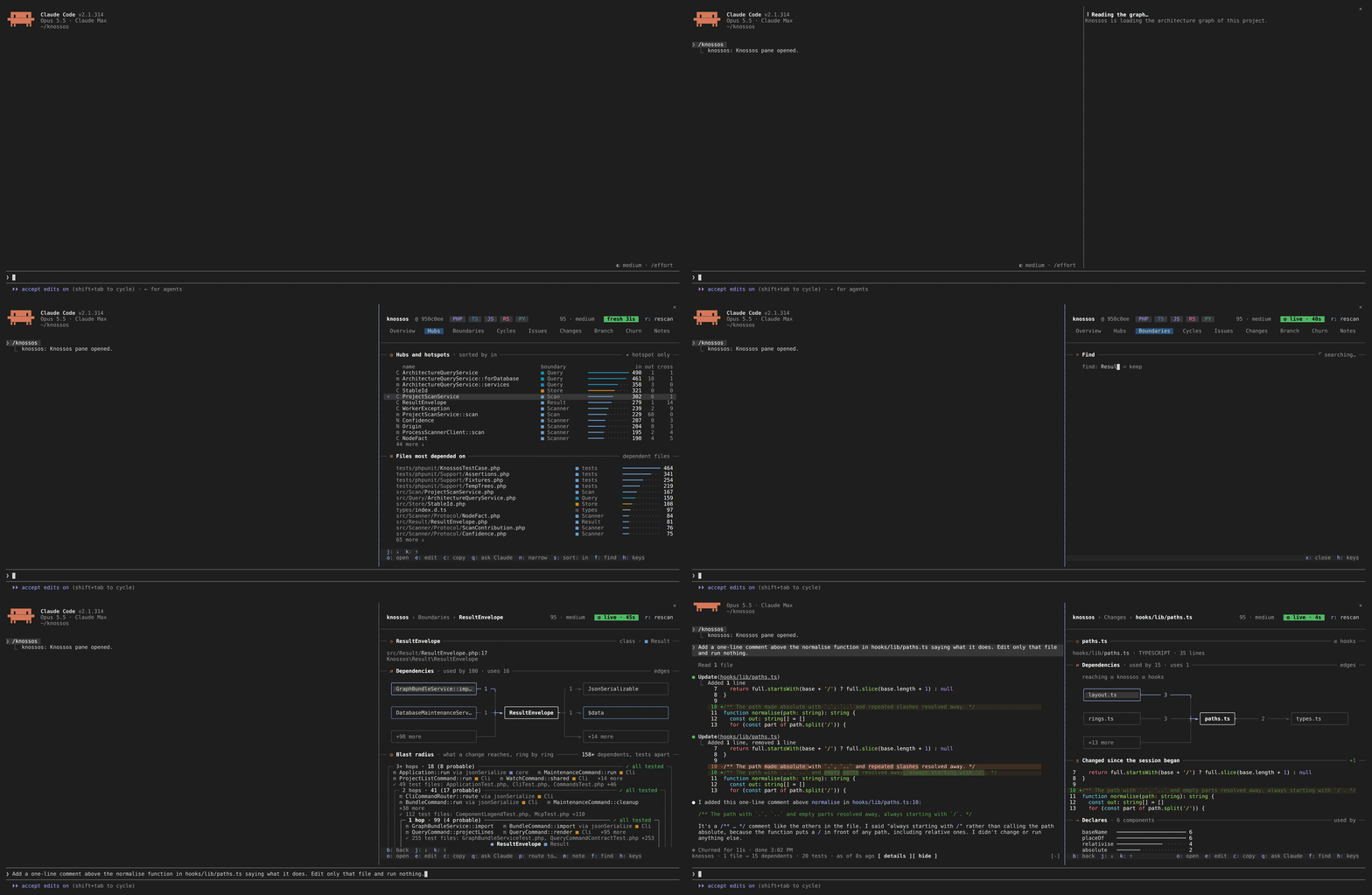
A Claude Code session: /knossos opening the pane, a walk through its
tabs and a search, then an edit, the band summing up the change, and its diff in Changes.
/knossos opens the project's architecture beside your session on nine tabs
(Overview, Hubs, Boundaries, Cycles, Issues, Changes, Branch, Churn and Notes), with a detail
for every component and file, its blast radius as rings, and the route between any two
componentsknossos web opens the same architecture workspace in your browser,
with keyboard navigation, search, diffs and notes, without a Claude Code sessionserver_info has an equivalent CLI commandYou need PHP 8.3 or newer with JSON, PDO and PDO SQLite, Node 24 or newer, Python 3.11 or newer, Composer 2 and Git. Cargo 1.82 or newer is optional and adds Rust scanning.
Clone the repository, then run the installer from the project you want to scan first:
git clone https://github.com/AraneaDev/knossos.git /absolute/path/to/knossos
cd /absolute/path/to/your-project
/absolute/path/to/knossos/tools/install
It installs the worker dependencies, creates the data directory ~/.knossos with a roots file
that allows this project, scans it, and registers the MCP server with Claude Code at user scope.
Re-run it from another project to add that one.
Then install the plugin, which carries the pane, the messages, the session brief and the routing
skill. Its hooks run the knossos of the checkout that installed the plugin (falling back to
the one on your path), and must read the data directory your server uses:
ln -s /absolute/path/to/knossos/bin/knossos ~/.local/bin/knossos
knossos install-agent-plugin                                        # preview
knossos install-agent-plugin --data-dir="$HOME/.knossos" --execute
Start a new session. The brief appears at its start, and /knossos opens the pane.
The installer scanned your project. To scan another, allow it and scan it with the same data directory the server uses:
export KNOSSOS_DATA_DIR="$HOME/.knossos"
knossos allow-root /absolute/path/to/project --execute
knossos scan /absolute/path/to/project
In a Claude Code session in that project, type /knossos to open the pane, then ask the agent a
structural question, such as "what breaks if I change UserRepository, and which tests would
tell me?". The routing skill sends it to the graph. A first scan with real output is in
first scan.
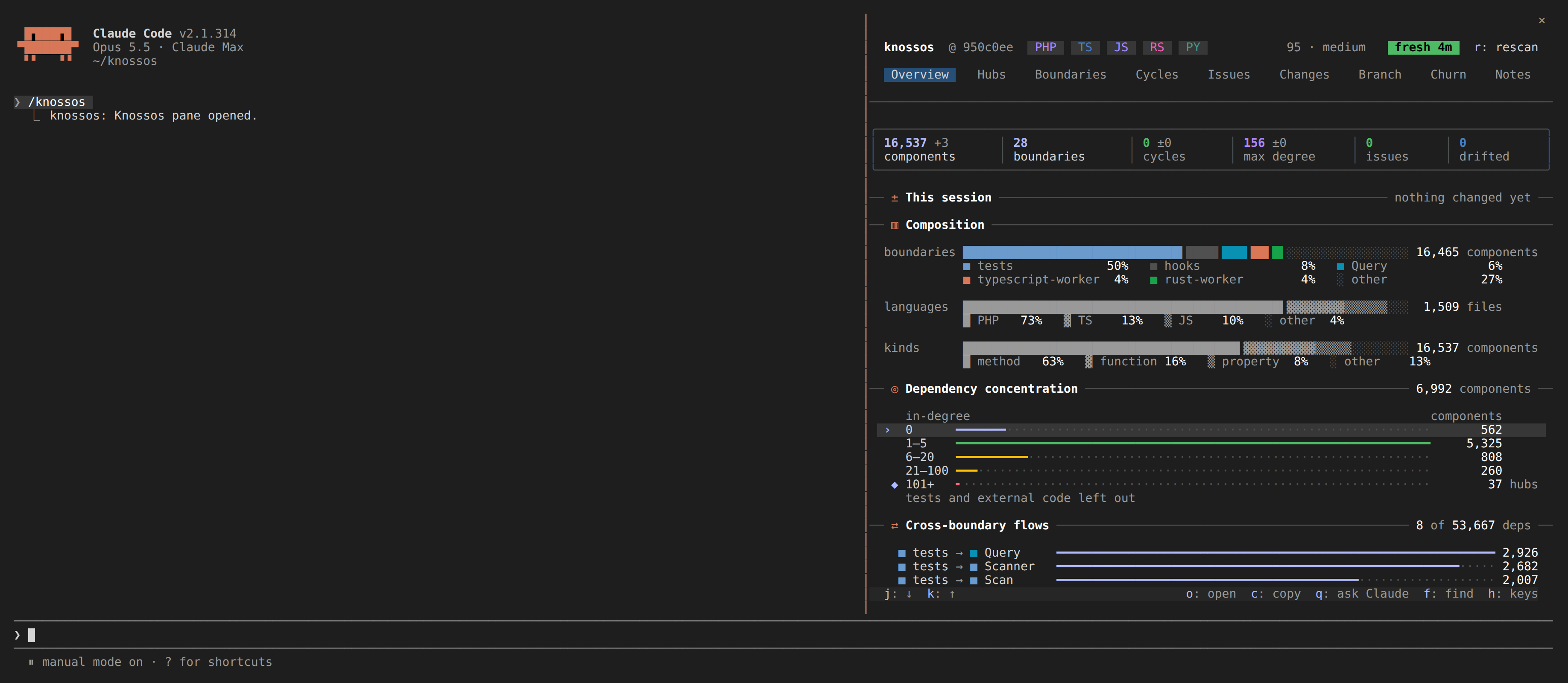
Overview: what moved since the last scan, what this session touched, and how dependencies concentrate.
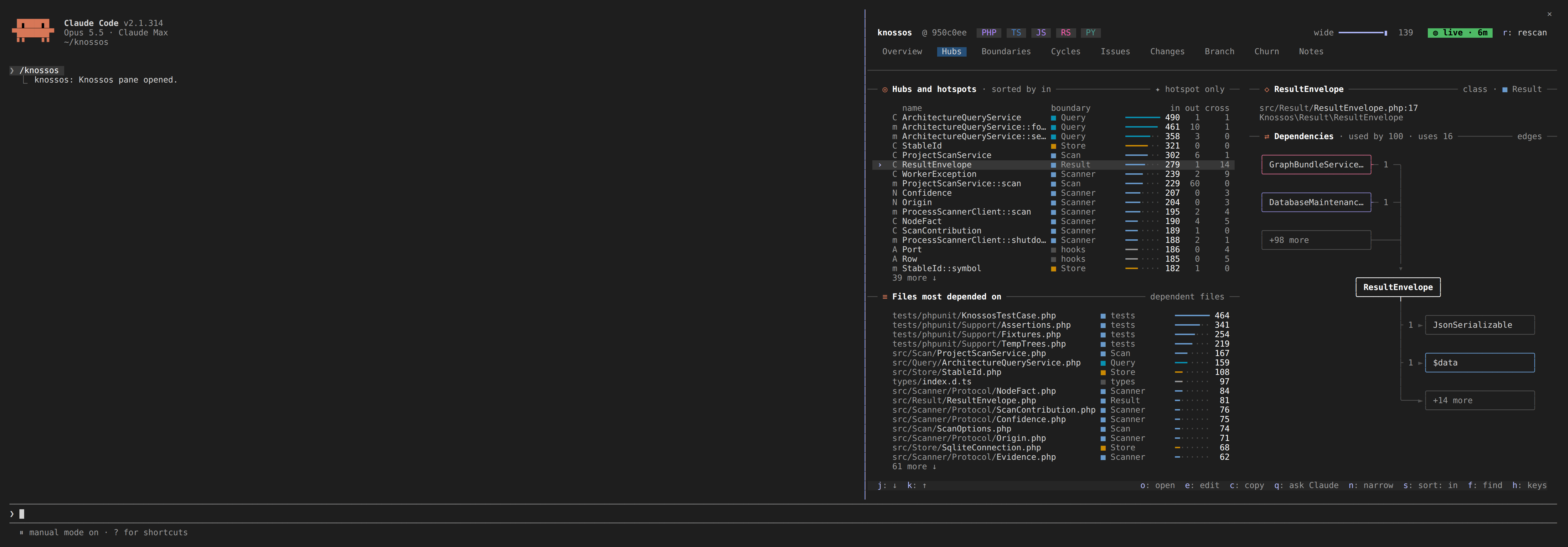
Hubs: the most depended-on components, with the marked one's neighbourhood beside the list.
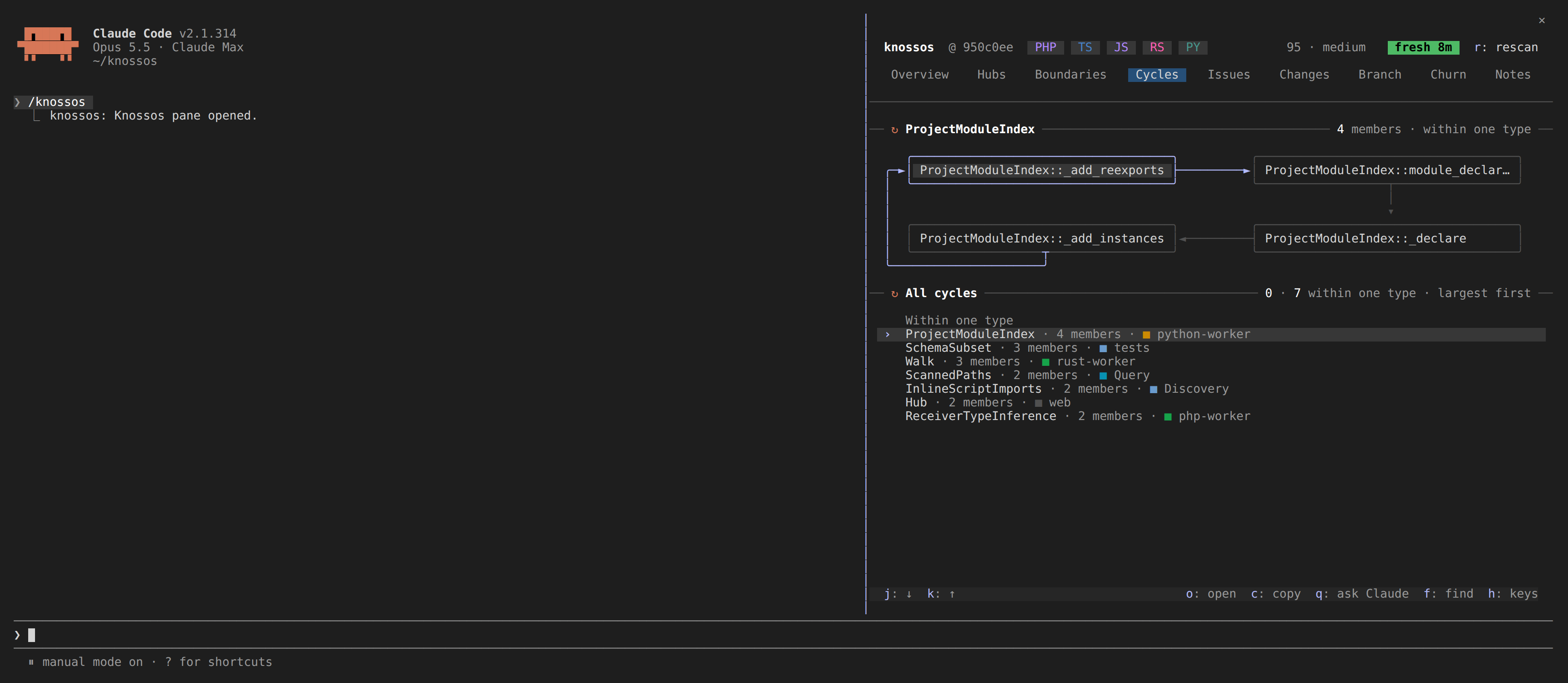
Cycles: each dependency cycle drawn as boxes, from its first member back to the start.
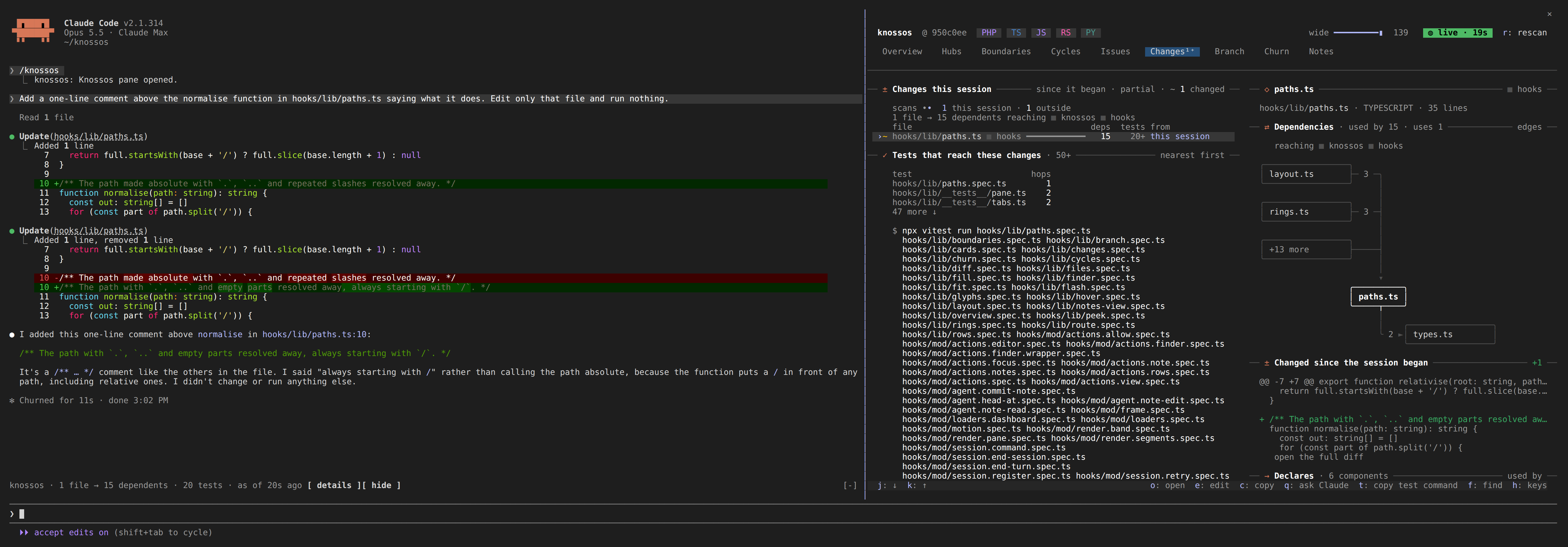
Changes: every file changed since the session began, its dependents, the tests that reach it, and its diff.
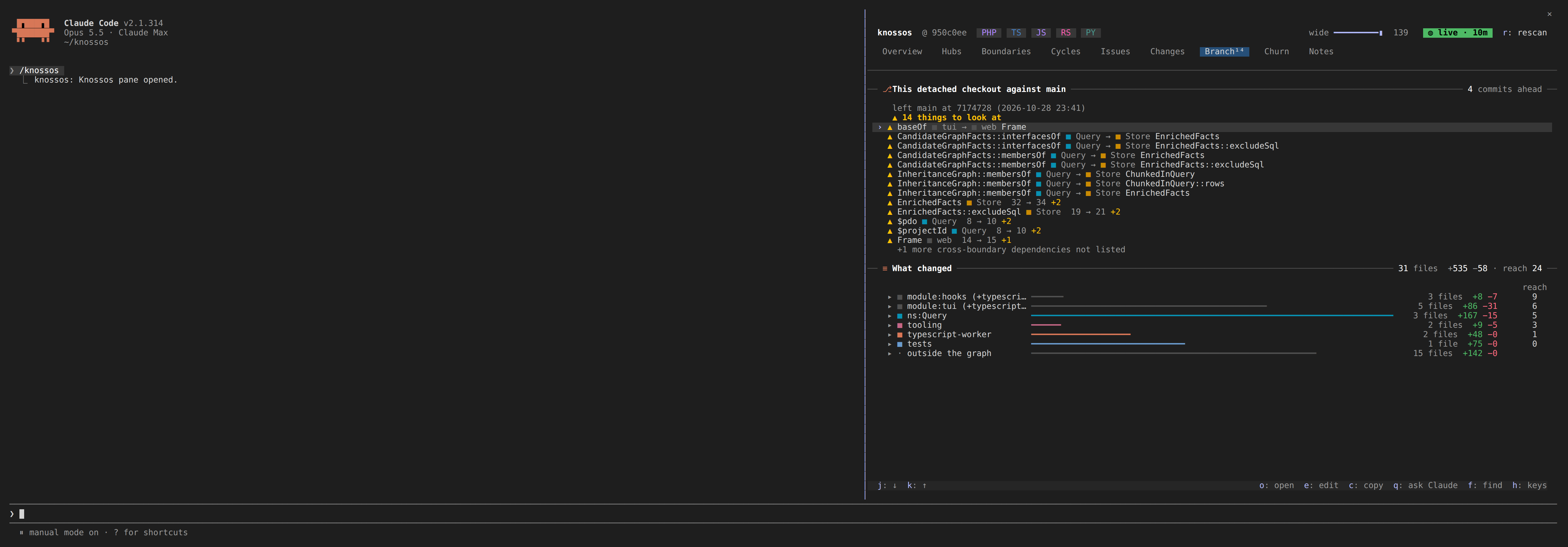
Branch: whether this branch broke anything against main, then what it changed by boundary.
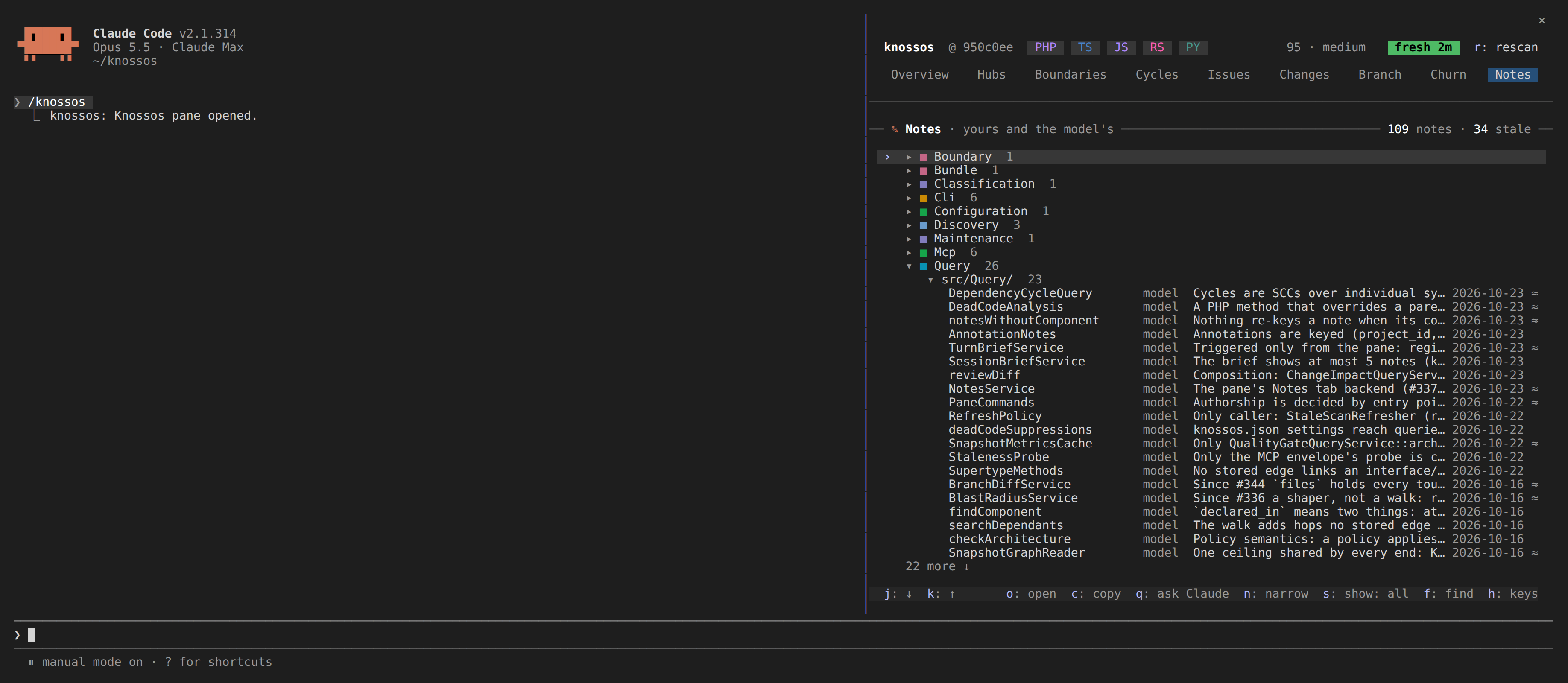
Notes: every note on the project, yours and the agent's, by where it lives.
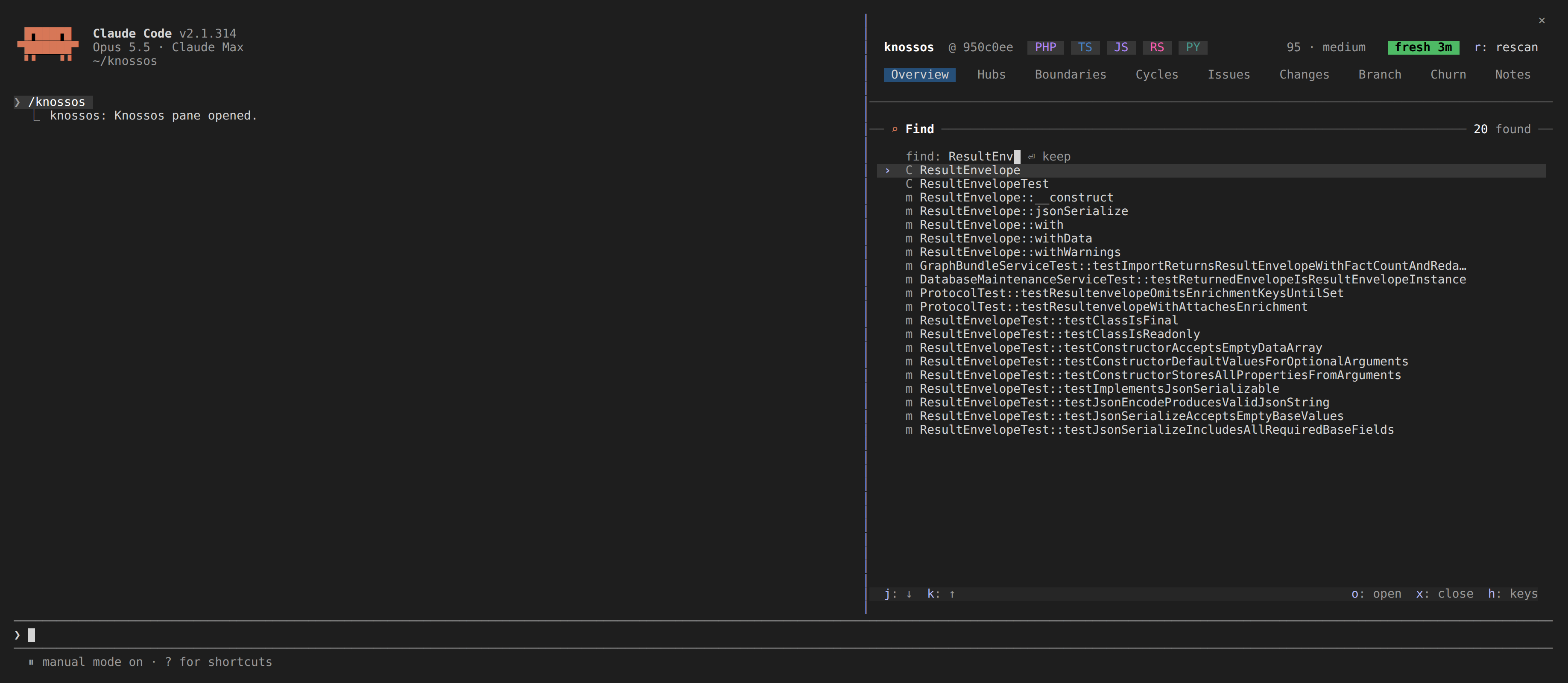
The finder: f, a few letters of a name, and Enter opens that component.
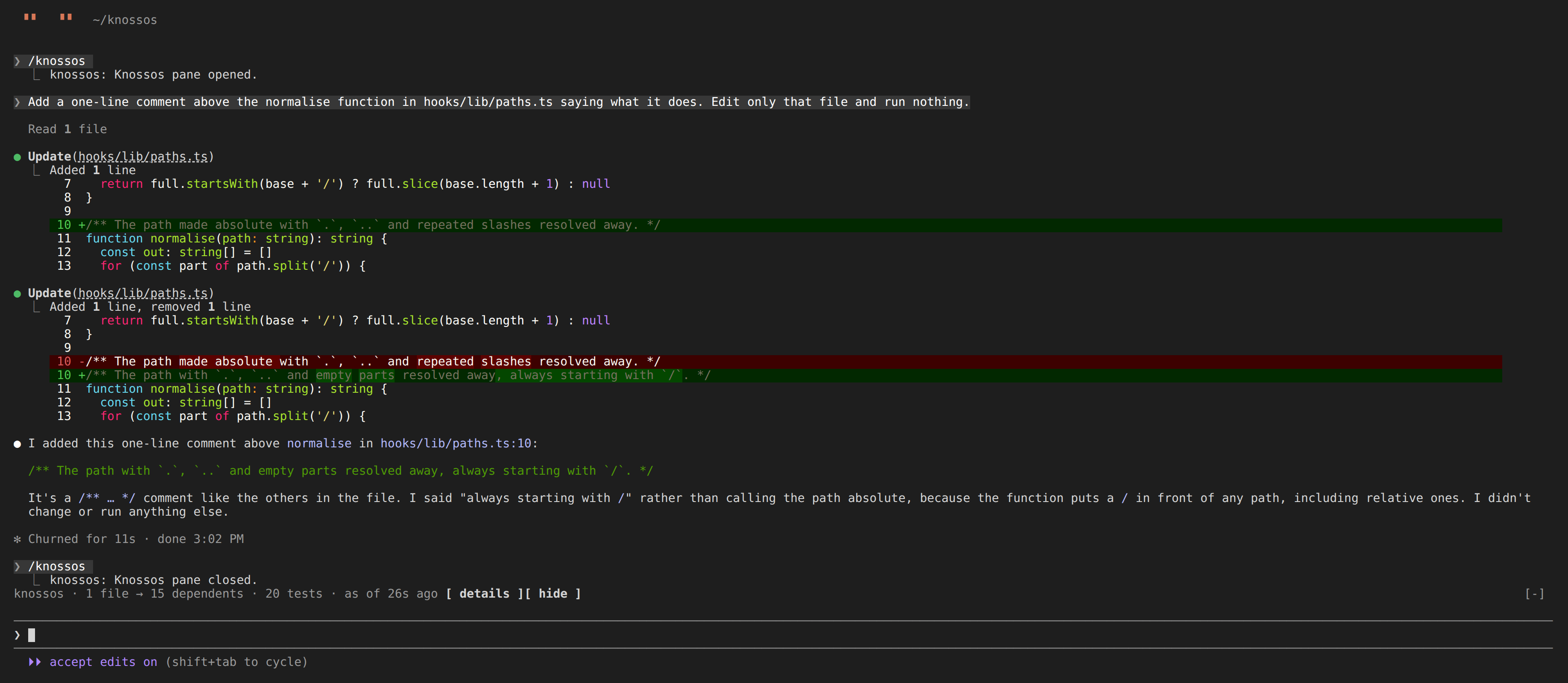
The band: after a turn that edited files, how far the change reaches, with the pane shut.
Every tab, key and setting is in the pane guide.
Browse your project's architecture in a browser while working in Codex, another editor, or outside an agent session:
cd /path/to/your-project
knossos web
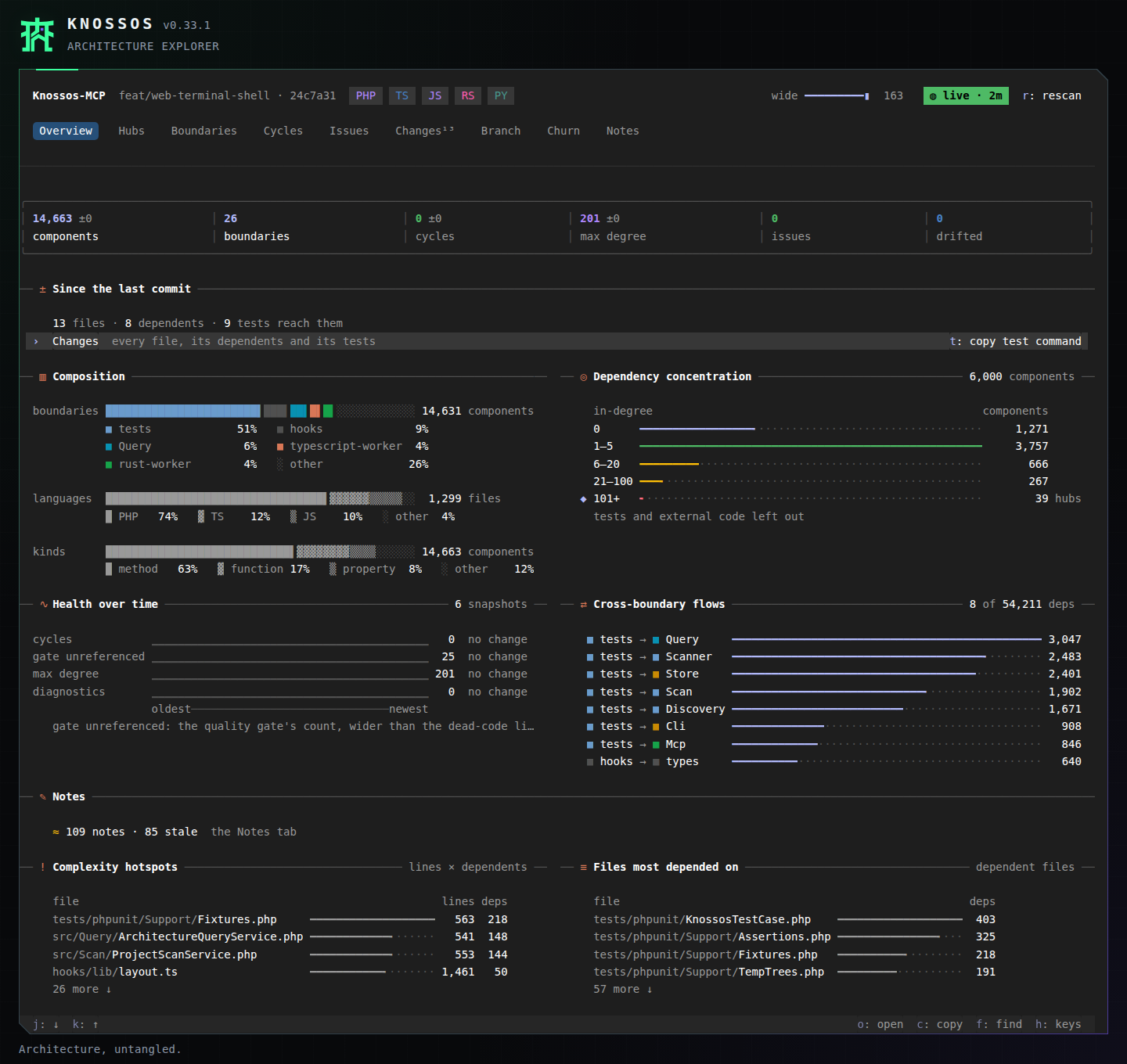
The local server opens your browser with the same nine tabs, finder, component and file
details, blast radius, diffs and notes as the native pane. Click a tab or use its number;
press f to find a component. The Changes tab follows uncommitted work against the last
commit, without needing a Claude Code session.
Keep the command running while you use the client; Ctrl-C stops it. To name another project
or choose a port without opening a browser automatically:
knossos web /path/to/your-project --port=8123 --no-open
Use the printed address, including its token. See the web client guide for editor integration, keyboard controls, bookmarks, installing it as an app, and the differences from the Claude Code pane.
Four messages, each one line, each said once at the moment it helps: after a Read of a heavily depended-on or policed file, after an edit of one the Read missed, at the end of a turn that edited files (the boundary violations it introduced and the tests that reach its changes), and after a commit, on what the session's changes leave behind:
knossos: this session's changes carry 1 changed file no test reaches (src/Kernel.php); 1 dependency cycle new since the session began (Router → Kernel). Check them before you push.
Before an edit, file_context gives one file's boundary and the rules that bind it, its
dependents, the tests that reach it and its latest commits, in one call instead of a grep for
its callers. Every message and its limits are in messages for the model.
Over MCP, in any client, the 37 tools answer questions such as:
UserRepository?ScannerClient::scan?Each group of tools has its own guide, linked from the docs index, and every schema is in the MCP tool reference.
Every query is also a CLI command, with --json for scripts. A project is named by a path
inside it or by its ID, and the CLI reads the same graph as the server (~/.knossos after
tools/install):
knossos impact-analysis . 'App\Billing\Invoice'
knossos review-diff . --base-ref=main --policies=architecture-policies.json
knossos quality-gate . <baseline-snapshot> --budgets=knossos-budgets.json --sarif --json
knossos dead-code .
knossos diagnostics . --severity=error
knossos check-architecture .
knossos watch /absolute/path/to/project
Exit code 0 means every evaluated gate passed, 1 that a gate failed, and 2 that the result
could not be evaluated. See CI and editor integration,
rules and budgets, watch mode
and the CLI reference.
Mixed repositories reconcile into one graph. Other scanners plug in as isolated worker processes through the scanner SDK.
serve refuses to start without a root, and Knossos
never writes the roots file during normal operation: only tools/install and
knossos allow-root --execute do, so widening it stays a deliberate act on disk.git with repository-controlled hooks, pagers and drivers forced off.One versioned quality profile runs locally, in Git hooks and in CI:
tools/quality-container fast
tools/quality-container full
fast covers linting, static analysis, formatting and the whole test suite. full adds
security audits, coverage floors, performance budgets, mutation score and supply-chain checks.
See quality gates, how the mod is built
and CONTRIBUTING.md for the workflow, the Conventional Commit prefixes that
drive releases, and how to add a language scanner.
MIT.
Built by Tim Schipper and released as open source under Aranea Development.
A live architecture map of your codebase, on screen beside Claude Code and in the notes your agent reads while it works. Evidence-backed graph with file and line proof, served over MCP and a CLI.
เครื่องมือ
ยังไม่มีรายการเครื่องมือ เซิร์ฟเวอร์แบบรีโมตจะได้รายการหลังการตรวจสอบสถานะครั้งแรก
FAQ
คัดลอกคอนฟิก stdio สำหรับ Cursor, Claude Desktop, Claude Code หรือ VS Code ได้ในหน้านี้ คอนฟิกนี้ใช้การติดตั้งของผู้เผยแพร่ ไม่ใช่พร็อกซีของ PlugMCP
ระเบียนนี้ไม่ได้ระบุตัวแปรสภาพแวดล้อมที่จำเป็น
Knossos ทำงานแบบโลคัลผ่าน stdio
ตรวจสอบล่าสุดเมื่อ 2026-11-05 A live architecture map of your codebase, on screen beside Claude Code and in the notes your agent reads while it works. Evidence-backed graph with file and line proof, served over MCP and a CLI.