Python ADK as MCP Client using Gemini 2 LLM as flight search assistant
Python ADK + MCP Gemini
A practical implementation demonstrating ADK (Agent Development Kit) as an MCP (Model Context Protocol) client for flight search capabilities. This project showcases asynchronous integration between ADK's LlmAgent and an external MCP server, featuring dynamic tool discovery, stateful session management, and structured function calling. Powered by Google's Gemini model, it implements proper resource handling and event-driven architecture for a robust, extensible assistant.
Demo of ADK (Agent Development Kit) as an MCP (Model Context Protocol) client for flight search capabilities.
This project showcases the integration of two powerful Google technologies:
Agent Development Kit (ADK): An open-source, code-first Python toolkit for building intelligent AI agents
Model Context Protocol (MCP): A standardized protocol for AI models to interact with external tools
In this implementation, ADK acts as the MCP Client, connecting to an MCP Server that provides flight search capabilities.
🏗️ Architecture
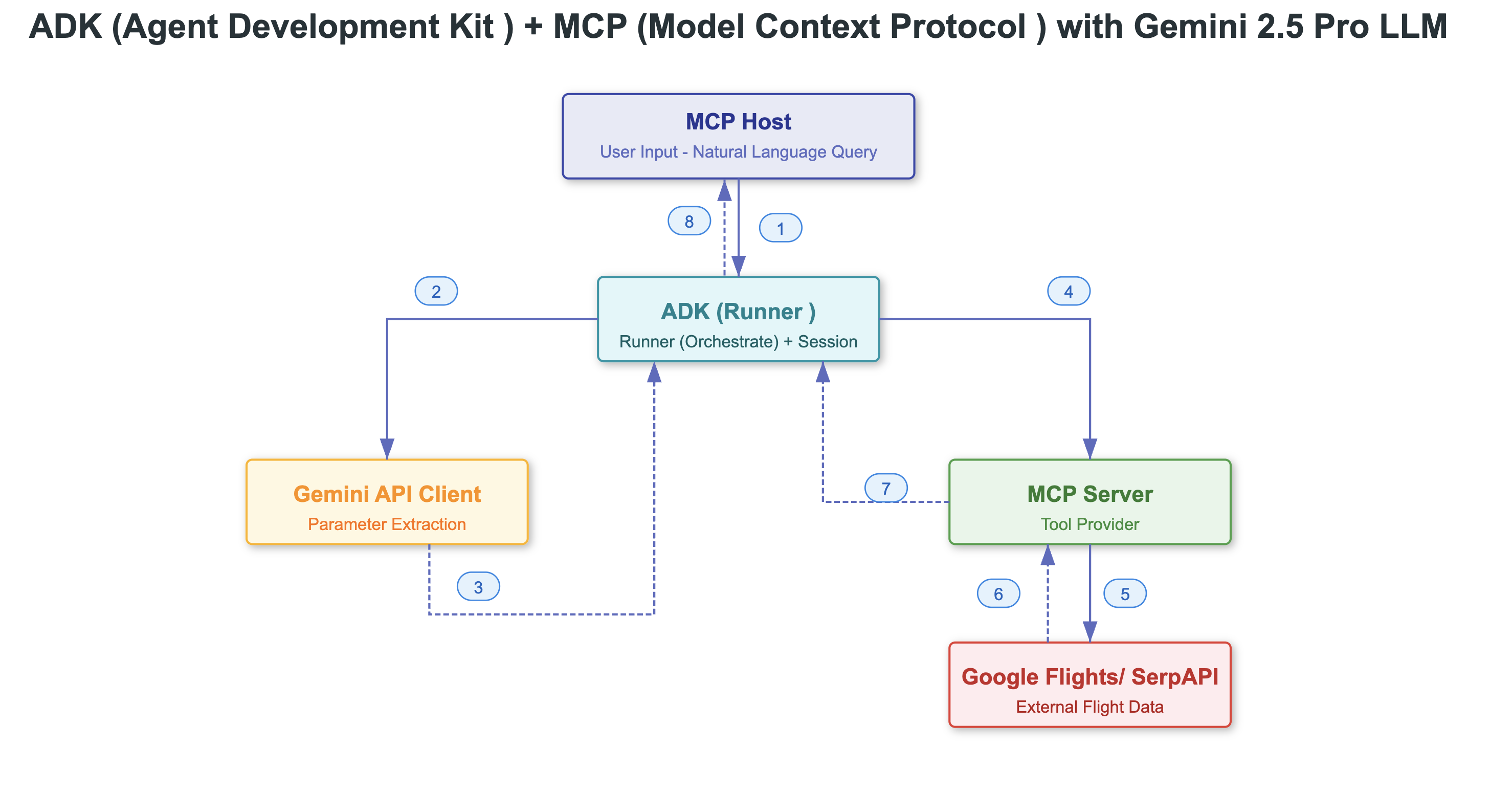
The Flight Search Assistant follows a streamlined request flow that combines the power of Google Gemini, ADK, and MCP to process user queries and provide intelligent responses.
🧩 Core Components
Google Gemini 2 as LLM
Agent Development Kit (ADK) as Agent
Model Context Protocol (MCP)
SerpAPI for Search
Python 3.8+
✨ Technology Highlights
Google Gemini 2
Powers conversational AI and context-aware interactions.
Agent Development Kit (ADK)
Manages conversation flow and tool orchestration.
Model Context Protocol (MCP)
Handles secure tool operations and external API calls.
SerpAPI
Provides access to real-time flight data.
🚀 Features
ADK as MCP Client Integration - Seamless connection between ADK agent and MCP server using MCPToolset
Dynamic Tool Discovery - Automatic detection and integration of MCP server capabilities
Asynchronous Event Processing - Event-driven architecture with ADK's Runner for non-blocking operations
Stateful Sessions - Conversation context management with InMemorySessionService
Structured Tool Invocation - Type-safe function calling through MCP protocol
Agent Development Kit (ADK) is an open-source, code-first Python toolkit for building, evaluating, and deploying intelligent AI agents. ADK enables developers to create agentic workflows — from simple single-agent tasks to complex multi-agent orchestration — all within a modular and extensible framework.
Agents in ADK
An Agent is an autonomous, self-contained execution unit designed to achieve specific goals. Agents can:
Perform tasks
Interact with users
Leverage external tools
Collaborate with other agents to complete complex workflows
Enable custom logic, specialized workflows, or unique tool integrations
Perfect for advanced, tailor-made solutions
In this project, we're using LLM Agents with MCPTools.
Tools in ADK
A Tool represents a specific capability granted to an AI agent, allowing it to perform actions and interact with the external world beyond basic text generation and reasoning. A tool is usually a modular code component — such as a Python function, class method, or even another agent — designed to carry out a defined task.
How Agents Use Tools
Agents dynamically leverage tools through function-calling mechanisms, where the LLM:
Reasons over context
Selects and invokes the appropriate tool with generated inputs
Observes the result
Integrates the output into its next action or response
Tool Types in ADK
ADK supports several types of tools:
Function Tools: Custom tools built specifically for your application's unique logic
Functions/Methods: Standard synchronous Python functions or class methods
Agents-as-Tools: Specialized agents as callable tools within a parent agent
Long-Running Function Tools: Tools for asynchronous or time-intensive operations
Built-in Tools: Predefined tools included in the framework (web search, code execution, RAG)
Third-Party Tools: Integrations from popular ecosystems like LangChain or CrewAI
MCP Client Integration
In this project, ADK serves as an MCP Client that connects to an MCP Server (mcp-flight-search). This connection allows the ADK agent to discover and use tools exposed by the MCP server to search for flights.
🛠️ Implementation Steps
Prerequisites
Python 3.8+ installed
Google Gemini Generative AI access via API key
A valid SerpAPI key (used to fetch live flight data)
To enable Gemini to interact with real-world APIs, we use an MCP-compliant server. For this project, we use mcp-flight-search — a lightweight MCP Server built using FastMCP which exposes a tool that searches real-time flight data using SerpAPI.
Verify that the MCP server is properly installed:
pip show mcp-flight-search
Step 3: Connecting to MCP Server
# --- Step 1: Get tools from MCP server ---
async def get_tools_async():
    """Gets tools from the Flight Search MCP Server."""
    print("Attempting to connect to MCP Flight Search server...")
    server_params = StdioServerParameters(
        command="mcp-flight-search",
        args=["--connection_type", "stdio"],
        env={"SERP_API_KEY": os.getenv("SERP_API_KEY")},
    )

    tools, exit_stack = await MCPToolset.from_server(
        connection_params=server_params
    )
    print("MCP Toolset created successfully.")
    return tools, exit_stack
Step 4: Agent Creation
# --- Step 2: Define ADK Agent Creation ---
async def get_agent_async():
    """Creates an ADK Agent equipped with tools from the MCP Server."""
    tools, exit_stack = await get_tools_async()
    print(f"Fetched {len(tools)} tools from MCP server.")

    # Create the LlmAgent
    root_agent = LlmAgent(
        model=os.getenv("GEMINI_MODEL", "gemini-2.5-pro-preview-03-25"),
        name='flight_search_assistant',
        instruction='Help user to search for flights using available tools based on prompt. If return date not specified, use an empty string for one-way trips.',
        tools=tools,
    )

    return root_agent, exit_stack
Step 5: Integration and Session Management
async def async_main():
    # Create services
    session_service = InMemorySessionService()

    # Create a session
    session = session_service.create_session(
        state={}, app_name='flight_search_app', user_id='user_flights'
    )

    # Define the user prompt
    query = "Find flights from Atlanta to Las Vegas 2025-05-05"
    print(f"User Query: '{query}'")

    # Format input as types.Content
    content = types.Content(role='user', parts=[types.Part(text=query)])

    # Get agent and exit_stack
    root_agent, exit_stack = await get_agent_async()

    # Create Runner
    runner = Runner(
        app_name='flight_search_app',
        agent=root_agent,
        session_service=session_service,
    )
Step 6: Execution
    print("Running agent...")
    events_async = runner.run_async(
        session_id=session.id,
        user_id=session.user_id,
        new_message=content
    )

    # Process events
    async for event in events_async:
        print(f"Event received: {event}")

    # Always clean up resources
    print("Closing MCP server connection...")
    await exit_stack.aclose()
    print("Cleanup complete.")
Step 7: Demo
Example user query:
"Find flights from Atlanta to Las Vegas 2025-05-05"
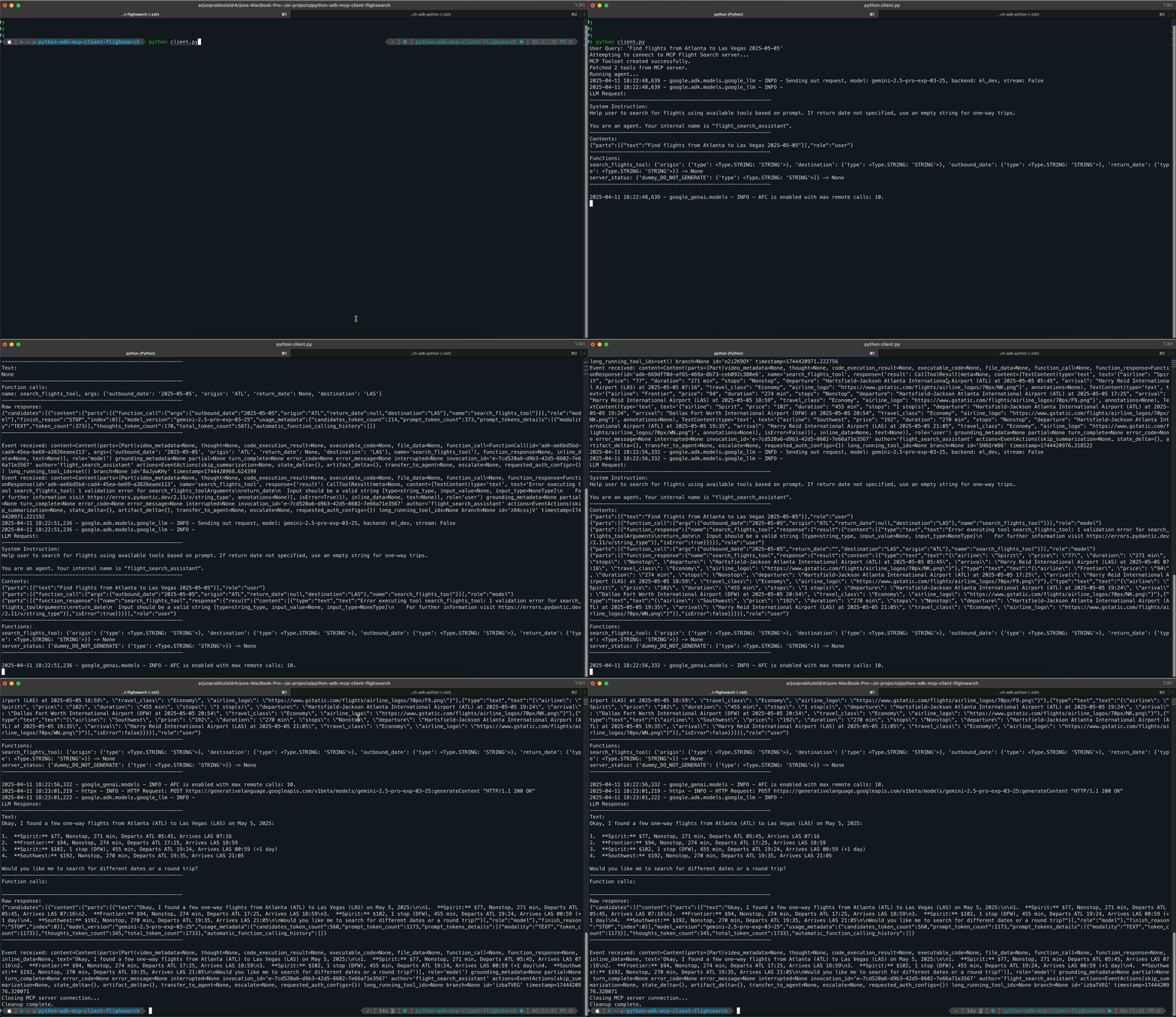
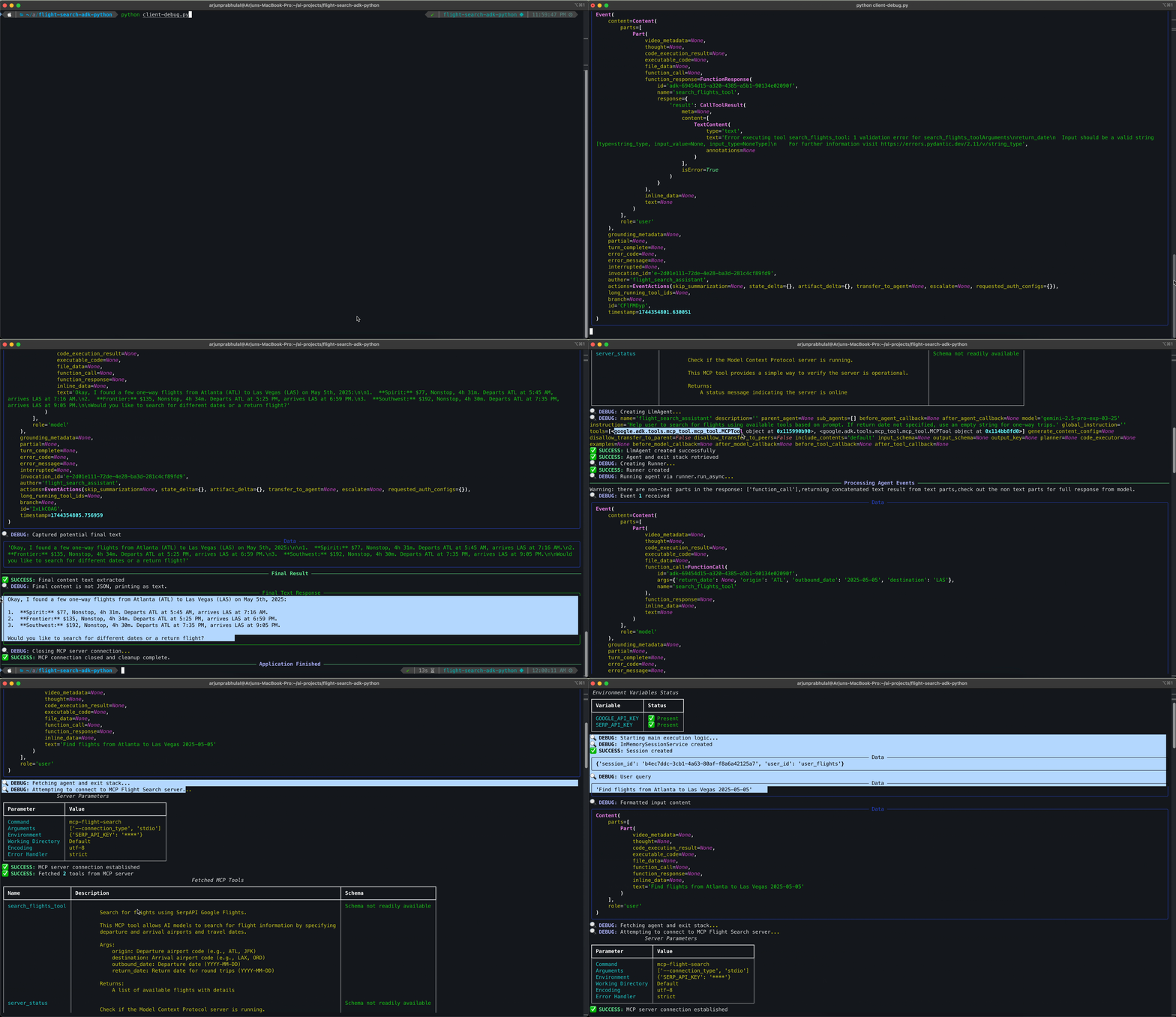
Here's a demonstration of the flight search assistant in action:
Standard Logging Mode
Debug Mode
🚦 Getting Started Guide
Installation Steps
1. Clone Repository
git clone https://github.com/arjunprabhulal/adk-python-mcp-client.git
cd adk-python-mcp-client
2. Environment Setup
Set up a Python virtual environment and install dependencies:
# Setup virtual environment (Mac or Unix)
python -m venv venv
source venv/bin/activate  # On Windows: venv\Scripts\activate

# Install all dependencies from requirements.txt
pip install -r requirements.txt
3. Configuration
Create and configure your environment variables:
# Copy the example environment file
cp .env.example .env

# Edit the .env file with your actual API keys
# Replace placeholders with your actual keys:
# GOOGLE_API_KEY=your-actual-google-api-key
# SERP_API_KEY=your-actual-serpapi-key
4. Start Services
Run the client script to start the application:
python client.py
The application will:
Connect to the MCP Flight Search server
Initialize the ADK agent with your Gemini API key
Process the default flight query or your custom query
MCP is an open protocol that standardizes how AI models interact with external tools and data sources
ADK is a Python-based framework for building and deploying AI agents
MCPToolset bridges MCP and ADK by enabling ADK agents to consume tools exposed by MCP servers
Tool Types and Integration
ADK Tools: Python objects designed for direct use within ADK agents
MCP Tools: Capabilities exposed by MCP servers, adapted by MCPToolset for use within ADK agents
Third-Party Tools: Libraries like LangChain and CrewAI offer tools that can be integrated
Asynchronous Architecture
Both ADK and the MCP Python library are built on Python's asyncio framework
Tool implementations and server handlers should be asynchronous (async def) to ensure non-blocking operations
Stateful Sessions in MCP
MCP establishes persistent, stateful connections between clients and servers
This statefulness allows for context retention across interactions but requires careful session management
Deployment Considerations
The persistent nature of MCP connections can pose challenges for scaling and deployment
Infrastructure considerations include load balancing and session affinity
Managing MCP Connections in ADK
MCPToolset manages the lifecycle of MCP connections within ADK
Using an exit_stack ensures connections are properly terminated when execution completes
⚠️ Troubleshooting
API Key Issues:
ADK expects GOOGLE_API_KEY instead of GEMINI_API_KEY
If you encounter ValueError: Missing key inputs argument!, check that you're using the correct environment variable
Error message: ValueError: Missing key inputs argument! To use the Google AI API, provide (api_key) arguments. To use the Google Cloud API, provide (vertexai, project & location) arguments.
Rate Limiting:
You may encounter 429 rate-limit errors: google.genai.errors.ClientError: 429 RESOURCE_EXHAUSTED
Consider implementing retries with exponential backoff
MCP Connection Issues:
Ensure the MCP server is properly installed and accessible
Check that your SerpAPI key is correctly configured
Internal Server Errors:
You may occasionally see 500 internal server errors from the Gemini API
These can often be resolved by retrying the request after a short delay
📚 Official Documentation References
For more detailed information about ADK and MCP, refer to the official documentation: