
Power your agent
การติดตั้งจากผู้เผยแพร่ ไม่ใช่เอนด์พอยต์ของ PlugMCP
URL แบบรีโมตหรือคำสั่งบนเครื่องของคุณ? การติดตั้งสองแบบต่างกันอย่างไร
รันบน PlugMCP
A new server you create. It is not this listing's official endpoint. Use the publisher install when you want their URL and their credentials.
เปิดeShopLite is a set of reference .NET applications implementing an eCommerce site with features like Semantic Search, Model Context Protocol (MCP), Reasoning models, vector databases, and more.
- ☁️ Scenarios use .NET and Aspire, with a stable .NET 10 baseline and an isolated .NET 11 RC2 scenario for experimental Blazor AI components. See the dependency baseline below for compatibility exceptions.
- 🌟 Don't forget to star (🌟) this repo to find it easier later.
- ➡️ Get your own copy by Forking this repo and find it next in your own repositories.
- ❓ Have a question? Besides creating issues or pull requests, the best option for questions is to join the Azure AI Discord channel, where a team of AI experts can help you.
This project framework provides the following features:
The project includes several scenarios demonstrating different capabilities:
New to Scenario 18? Start with its three-step quick start, then explore the screenshots and blog-to-code walkthrough.
global.jsondotnet tool install -g Aspire.Cli --version 13.6.1 (used for setting local secrets via aspire secret set)The October 14, 2026 refresh updates the 17 existing scenarios other than 14-MAFDevUI
to Aspire 13.6.1 and the latest compatible NuGet releases. The root SDK stays on stable
.NET 10; Scenario 18 overrides it with .NET 11 RC2
for the experimental Blazor components. Install both SDKs to work on all scenarios.
The refresh includes Microsoft.Extensions.AI 10.11.0, OpenTelemetry 1.19, Microsoft Agent Framework 1.24.0, MCP 2.2.0, and A2A 1.0.0-preview3 where used. Existing prerelease dependencies remain prerelease where no stable replacement provides the required functionality. MCP SSE transports and A2A text parts have been migrated to the current APIs rather than merely changing package versions.
Scenarios 08 and 12 deliberately retain the latest EF Core 9 servicing release, 9.0.21:
their EFCore.SqlServer.VectorSearch 9.0.0 provider requires that EF major. The other
EF-backed scenarios use 10.0.13. Local dotnet-ef tool manifests follow the matching
EF major. Upgrading the SQL vector provider to native EF 10 requires a separate vector
entity/query migration, not mixing EF 9 relational assemblies with EF 10 tests.
Direct PKCS references select patched 10.0.13 instead of vulnerable transitive versions.
14-MAFDevUI has not been refreshed: its local instructions require an Azure
best-practices tool that is unavailable in this session. Its existing dependency versions
are retained until that prerequisite is supplied. Builds and existing tests passed for
the other 17 existing scenario solutions (80 existing tests), and Scenario 18 has 29
passing tests. Scenario 18 was also validated locally with SQL Server 2025, real Foundry
embeddings, and gpt-6-luna via Responses: streamed catalog cards, cart rejection/approval,
missing product specifications, and restart against existing data. These checks do not
establish cloud deployability or validate every other scenario against real models.
See CHANGELOG.md for the new scenario, dependency migrations, setup scripts, and known upgrade boundaries.
Each scenario has its own aspire.config.json, so Aspire selects that scenario's AppHost
instead of inheriting the repository-root selection:
cd .\scenarios\18-BlazorAgenticUI
aspire start
Use aspire run for a foreground session, and aspire stop to stop the selected app.
Install the SDK requested by that scenario's nearest global.json: .NET 10.0.402 for
stable scenarios, or .NET 11 RC2 for Scenario 18. A .NET 11 installation does not satisfy
the stable .NET 10 pin. AppHost selection does not install SDKs or configure credentials.
To verify every scenario's local selection without starting services:
pwsh .\scripts\Tests\Test-ScenarioAppHosts.ps1
Clone the repository:
git clone https://github.com/Azure-Samples/eShopLite.git
Navigate to the scenario directory of interest:
cd eShopLite/scenarios/[scenario-folder]
Login to Azure:
azd auth login
Provision and deploy all the resources:
azd up
It will prompt you to provide an azd environment name (like "eShopLite"), select a subscription from your Azure account, and select a location where the necessary models, like gpt-4.1-mini and ADA-002 are available, a sample region can be "eastus2".
Use PowerShell 7 and sign in with az login. The new setup script creates or reuses an
AIServices account, deploys the common chat and embedding models, then configures local
AppHost user-secrets through the Aspire CLI. Supply your own subscription, resource group,
globally unique account name, and region:
pwsh .\scripts\Initialize-FoundryModels.ps1 `
  -SubscriptionId '<subscription-id>' `
  -ResourceGroupName 'rg-eshoplite' `
  -AccountName '<globally-unique-account-name>' `
  -Location 'eastus2' `
  -DryRun
Remove -DryRun to provision resources and write secrets. This can incur Azure charges.
-DryRun and -WhatIf make no Azure calls and do not establish model availability.
The default chat model and deployment name are gpt-6-luna; embeddings use
text-embedding-3-small. The script resolves model versions from the regional catalog
and checks SKU support and quota before provisioning. It stops if the requested model is
unavailable, with no automatic substitution. Override model/version, deployment name, SKU,
or capacity with the corresponding -Chat* and -Embeddings* parameters.
It reuses matching deployments and refuses to overwrite conflicting deployments or enable
key authentication on an account that disables it.
This provisions common model dependencies for local development, not every scenario's
infrastructure. SQL/containers remain managed by each AppHost; Azure AI Search, realtime
audio, DeepSeek, GitHub Models, and other specialized dependencies still need their
scenario-specific setup. It does not change model declarations used by azd up.
Secret setup requires the SDK selected by each AppHost's nearest global.json.
The script checks SDK availability before requesting a key. If using a nonstandard SDK
installation, pass -DotNetRoot "<SDK installation directory>"; the override applies
only to child commands. An Aspire exit code 7 can indicate a missing SDK, not an Azure
authentication problem. Scenario 18 specifically requires .NET 11 RC2.
The existing scripts\Set-AzureOpenAISecrets.ps1 configures secrets only, without creating
Azure resources. It discovers every eShopAppHost.csproj, including layouts without src,
and automatically includes future scenarios. Scenario 18 (18-BlazorAgenticUI) has its own
AppHost and independent user-secrets store, and is included automatically. Directories
without an AppHost are reported as skipped. Run from the repo root:
pwsh .\scripts\Set-AzureOpenAISecrets.ps1
The script interactively prompts for four values:
Use -DryRun to preview the commands without executing them:
pwsh .\scripts\Set-AzureOpenAISecrets.ps1 -DryRun
For a preview without prompts or an API key:
pwsh .\scripts\Set-AzureOpenAISecrets.ps1 `
  -Endpoint 'https://<your-resource>.openai.azure.com/' -NonInteractive -DryRun
Non-interactive writes additionally require -ApiKey as a SecureString, supplied from a
masked prompt or a secure credential source, not a plaintext key in command history.
Local .NET user-secrets are not an encrypted production secret store.
Internally, the script calls the Aspire CLI (aspire secret set) for each AppHost it discovers. To set a single value manually, use the same command directly:
aspire secret set Parameters:AzureOpenAIEndpoint "https://<your-resource>.openai.azure.com/" \
  --apphost scenarios/01-SemanticSearch/src/eShopAppHost/eShopAppHost.csproj
Note: Scenario-specific extra parameters (e.g.,
Parameters:AzureOpenAIRealtimeDeploymentNamein 03-RealtimeAudio,Parameters:DeepSeekEndpointin 05-deepseek,Parameters:GitHubModelsTokenin 11-GitHubModels) must still be set manually. See each scenario's README for details.
scenarios/01-SemanticSearch/)dotnet run in the appropriate host project folderTo run the demo, follow these steps:
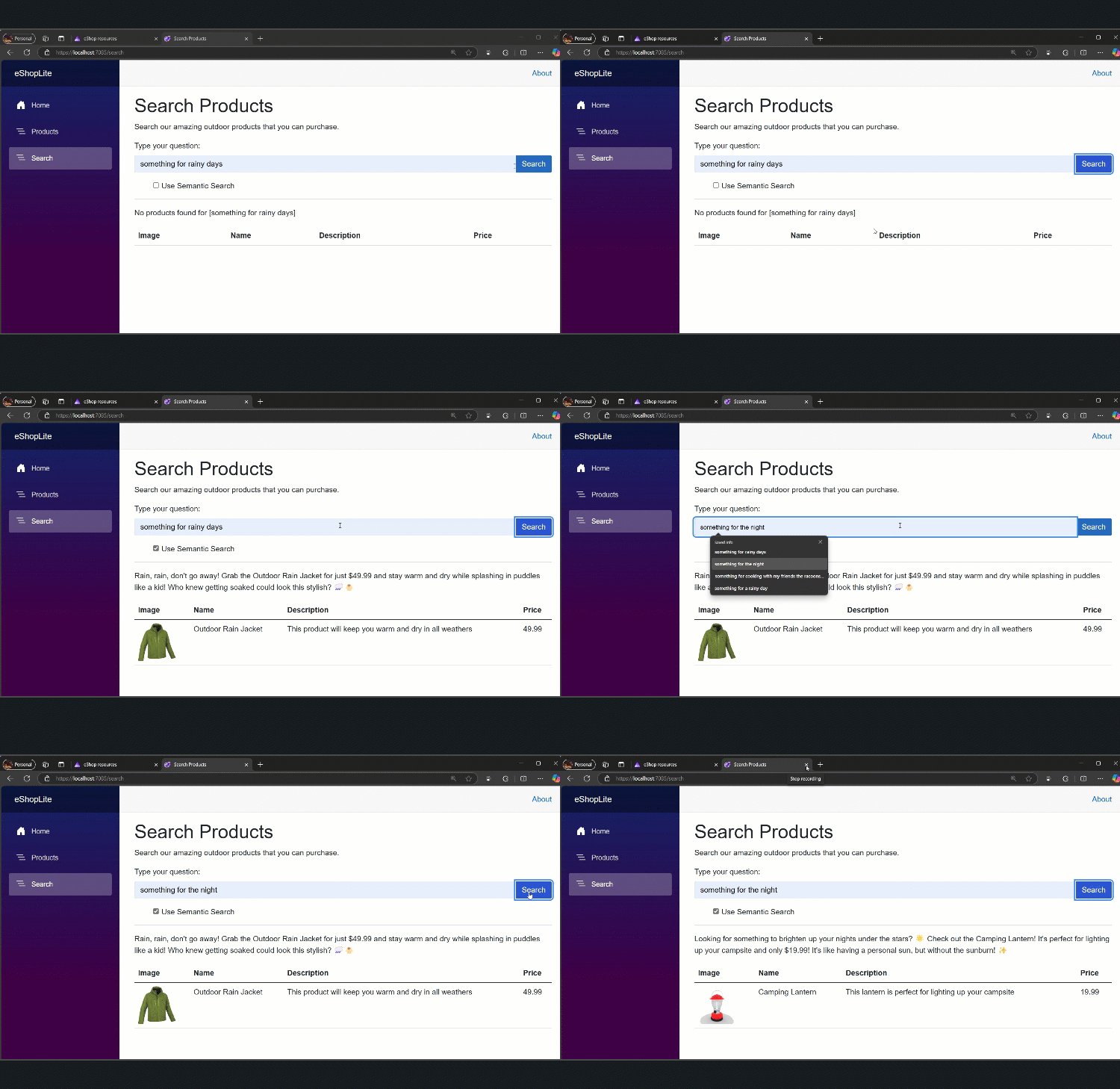
This is the eShopLite Aplication running, performing a Keyword Search:
This is the eShopLite Aplication running, performing a Semantic Search:
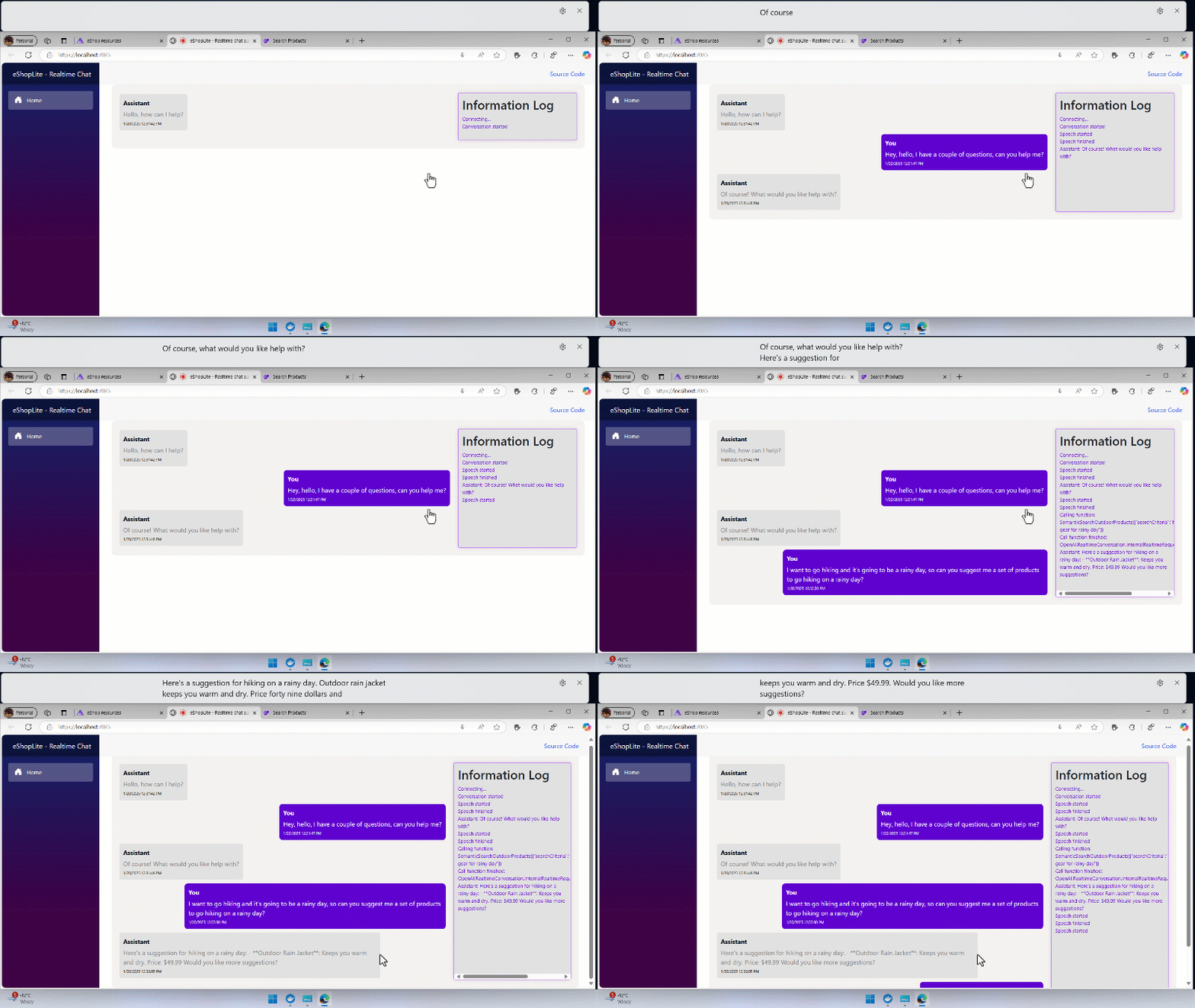
This is the eShopLite Application running the Realtime Audio feature:
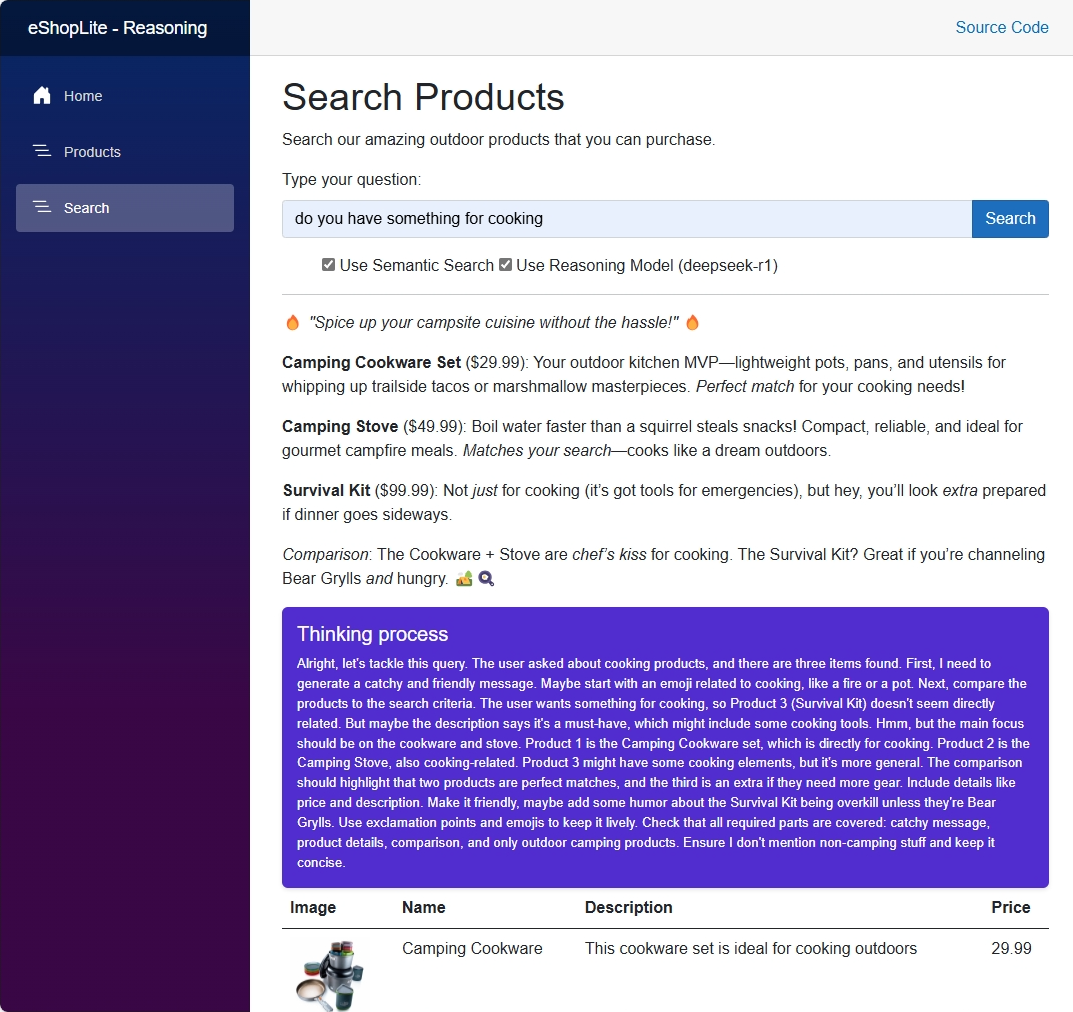
This is the eShopLite Application using the DeepSeek-R1 Reasoning Model:
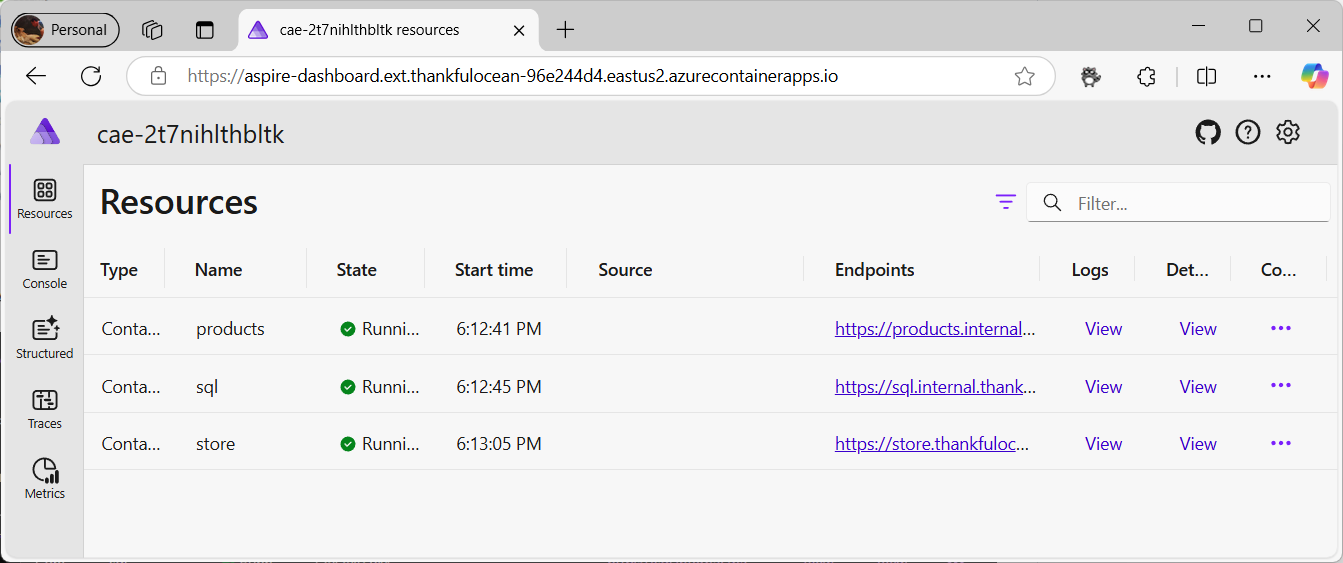
The Aspire Dashboard to check the running services:
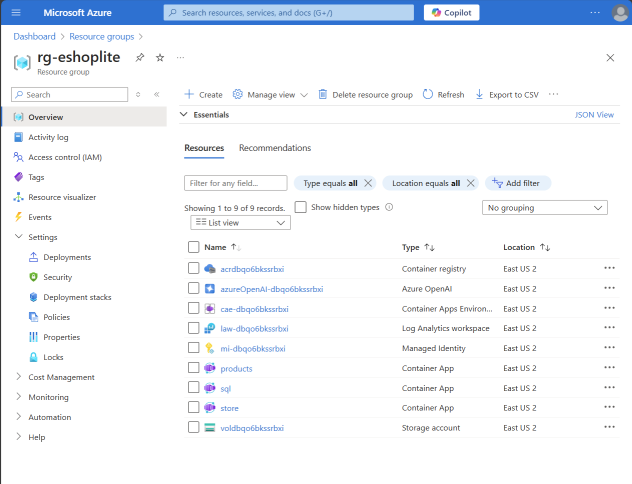
The Azure Resource Group with all the deployed services:
If you get stuck or have questions about building AI apps, join:
If you have product feedback or errors while building, visit:
eShopLite is a set of reference .NET applications implementing an eCommerce site with features like Semantic Search, MCP, Reasoning models and more.
เครื่องมือ
ยังไม่มีรายการเครื่องมือ เซิร์ฟเวอร์แบบรีโมตจะได้รายการหลังการตรวจสอบสถานะครั้งแรก
FAQ
คัดลอกคอนฟิก stdio สำหรับ Cursor, Claude Desktop, Claude Code หรือ VS Code ได้ในหน้านี้ คอนฟิกนี้ใช้การติดตั้งของผู้เผยแพร่ ไม่ใช่พร็อกซีของ PlugMCP
ระเบียนนี้ไม่ได้ระบุตัวแปรสภาพแวดล้อมที่จำเป็น
EShopLite ทำงานแบบโลคัลผ่าน stdio
ตรวจสอบล่าสุดเมื่อ 2026-10-26 eShopLite is a set of reference .NET applications implementing an eCommerce site with features like Semantic Search, MCP, Reasoning models and more.