Power your agent
คำสั่งของผู้เผยแพร่เอง ไม่ใช่เอนด์พอยต์ของ PlugMCP
Host a copy with our keys and logs.
npx -y @event4u/[email protected]Claude Code ไม่มีลิงก์ติดตั้งสำหรับคำสั่งแบบโลคัล ให้คัดลอกคำสั่งด้านล่างแล้วรันในเทอร์มินัล
claude mcp add event4u-agent-config -- npx -y @event4u/agent-config@20.4.0รันในเทอร์มินัล
{ "mcpServers": { "event4u-agent-config": { "command": "npx", "args": [ "-y", "@event4u/[email protected]" ] } }}claude_desktop_config.json
URL แบบรีโมตหรือคำสั่งบนเครื่องของคุณ? การติดตั้งสองแบบต่างกันอย่างไร
รันบน PlugMCP
A new server you create. It is not this listing's official endpoint. Use the publisher install when you want their URL and their credentials.
เปิดHow these are counted — one canonical counter, agent-config → update_counts --check, re-derives all six from the tree and fails CI when one is off by one. Two bases are not what the linked directory shows, so they are stated here rather than left to be inferred: Commands 211 counts every command file recursively (the linked directory holds 62 at its top level) and Rules 122 counts the source rules while the linked projection holds 121 — one rule is dormant and is not projected. Personas 29 excludes the directory README. Counts are of files and directories: none of them measures quality, activation or adoption.
Try it in 30 seconds — one read-only subagent checks "done" in any repo, nothing else installed: the wedge ↓. Start at the proof, not the catalog: event4u-app.github.io/agent-config/proof/.
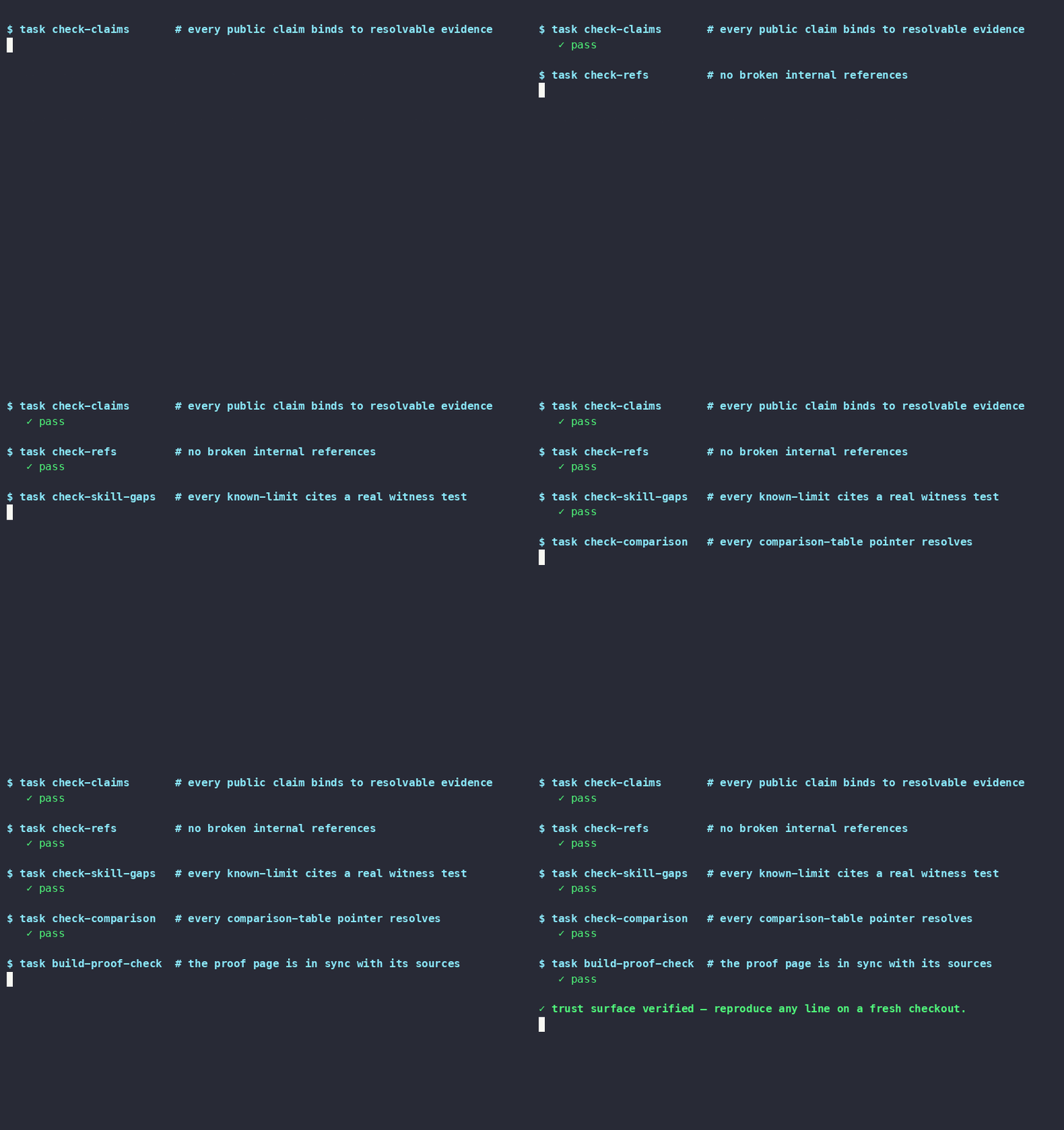
Every public claim in this README is machine-checked — verify it yourself. In a market that runs on unbacked headline numbers, this one binds each claim to resolvable evidence or fails its own build.
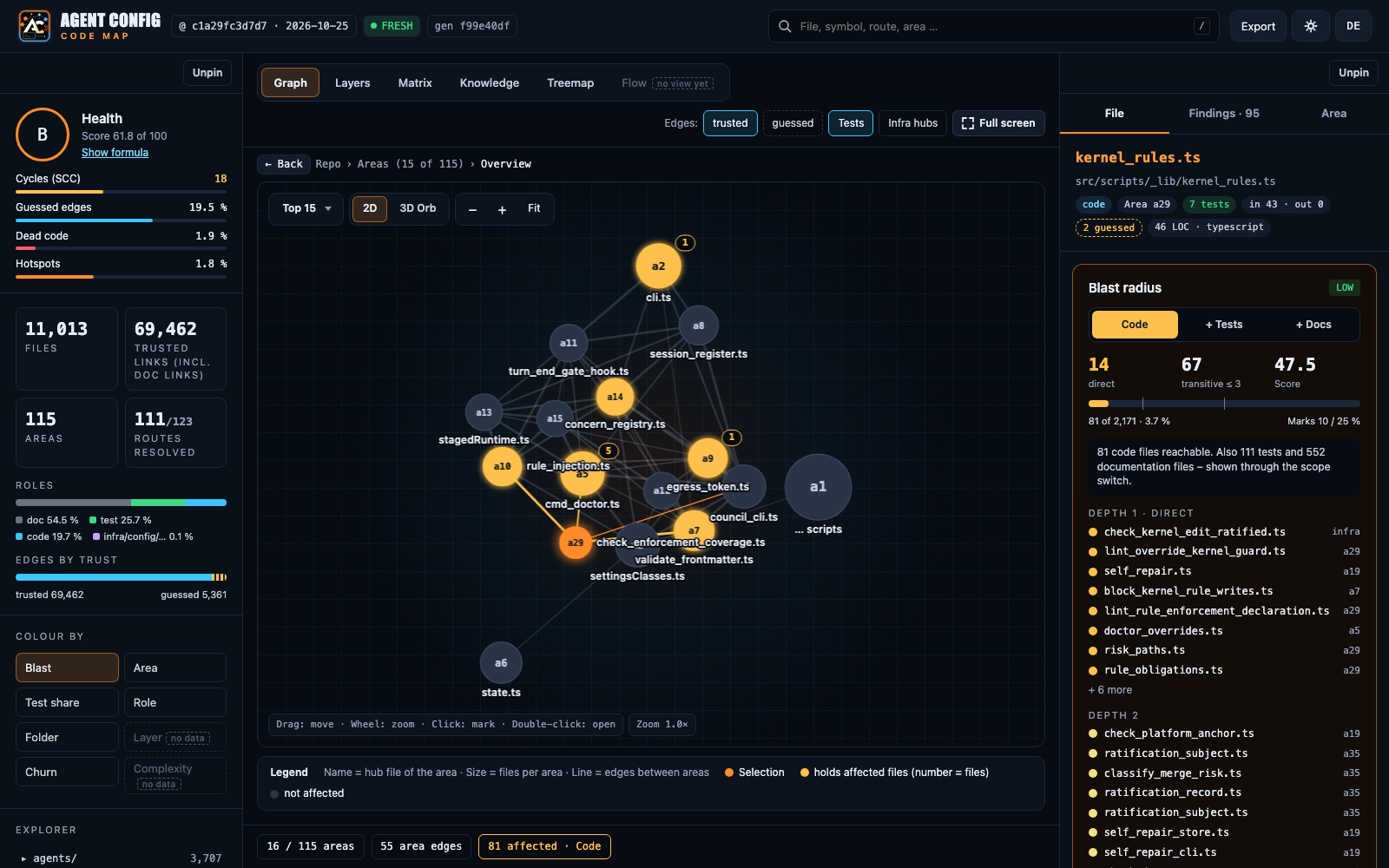
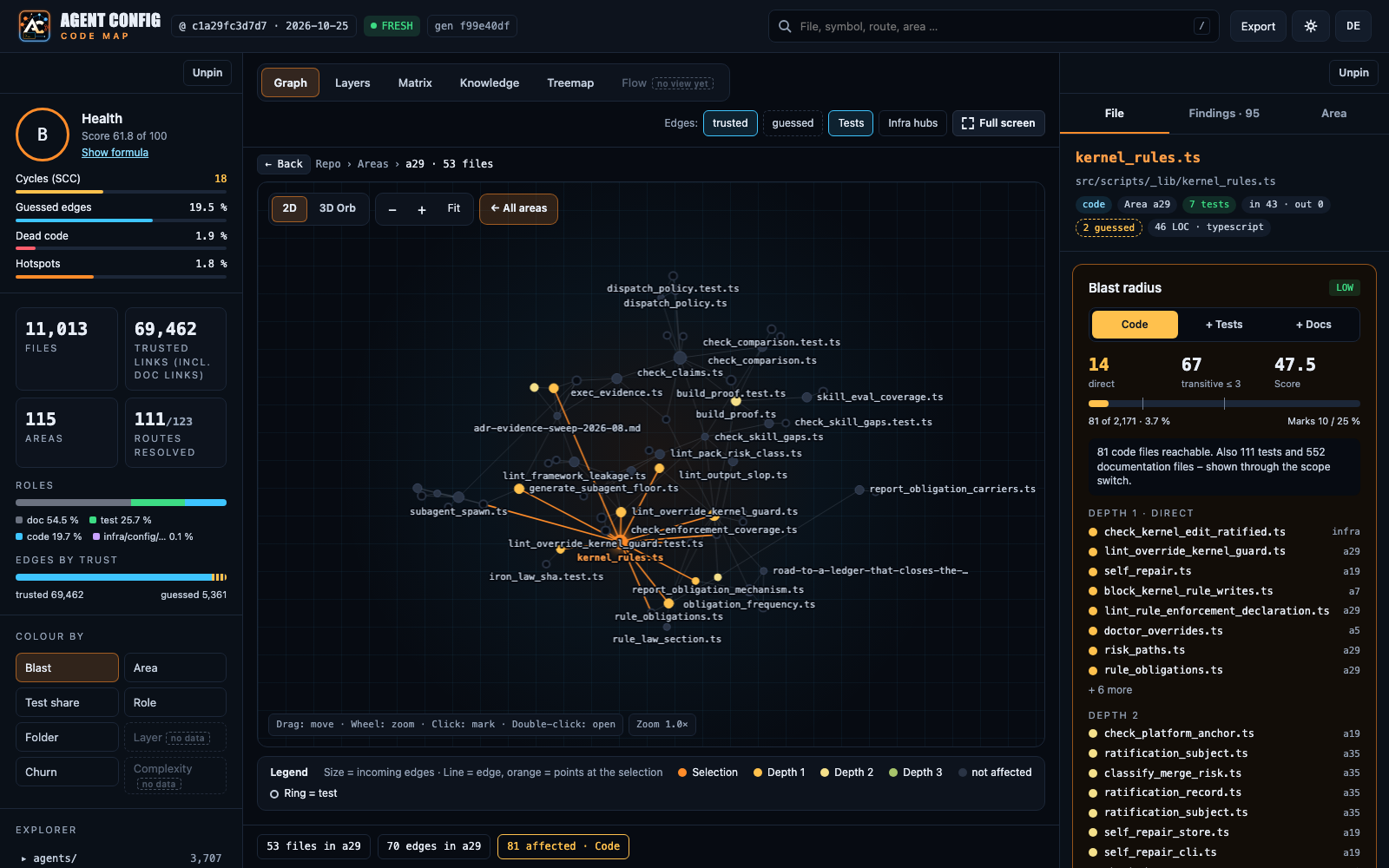
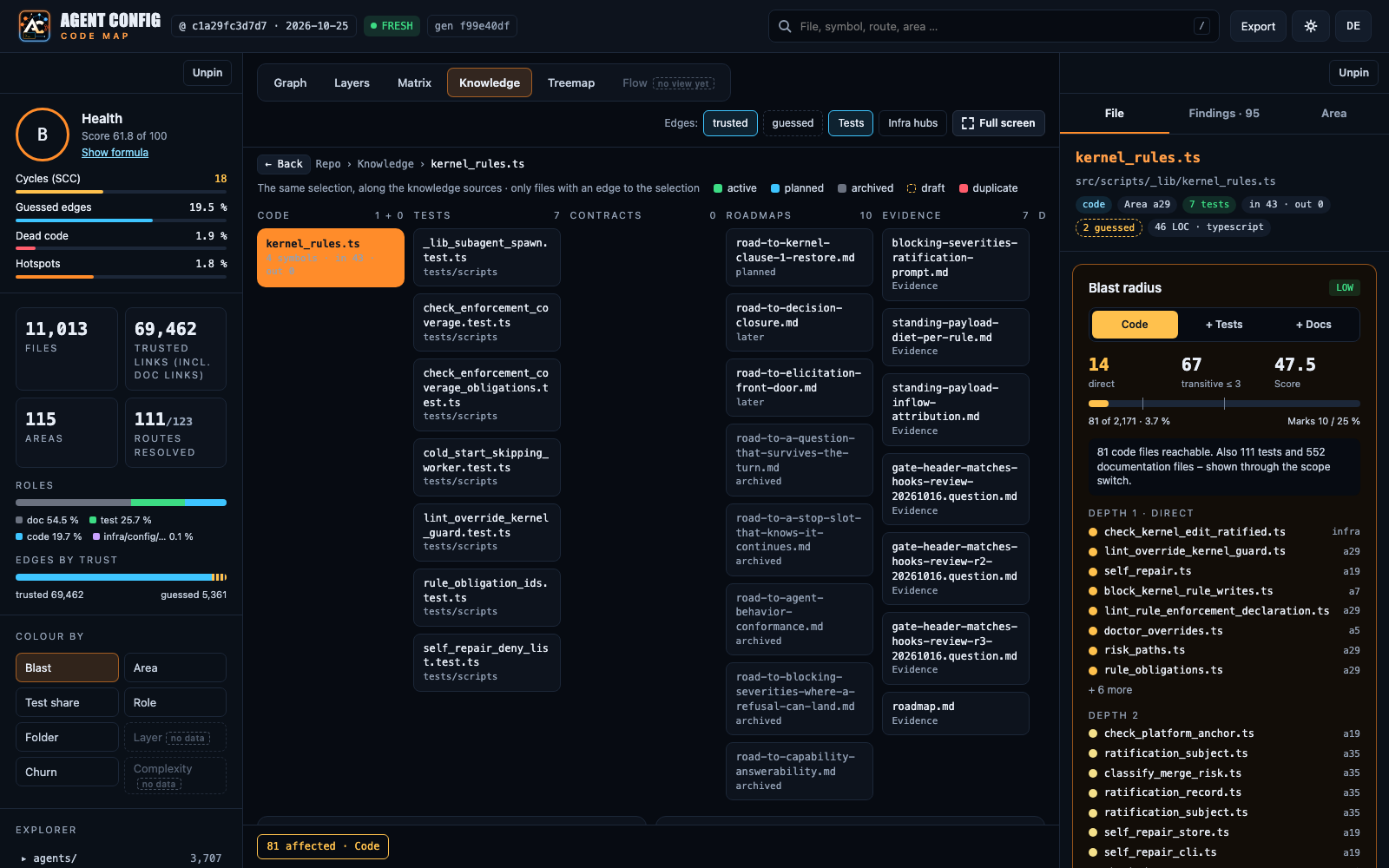
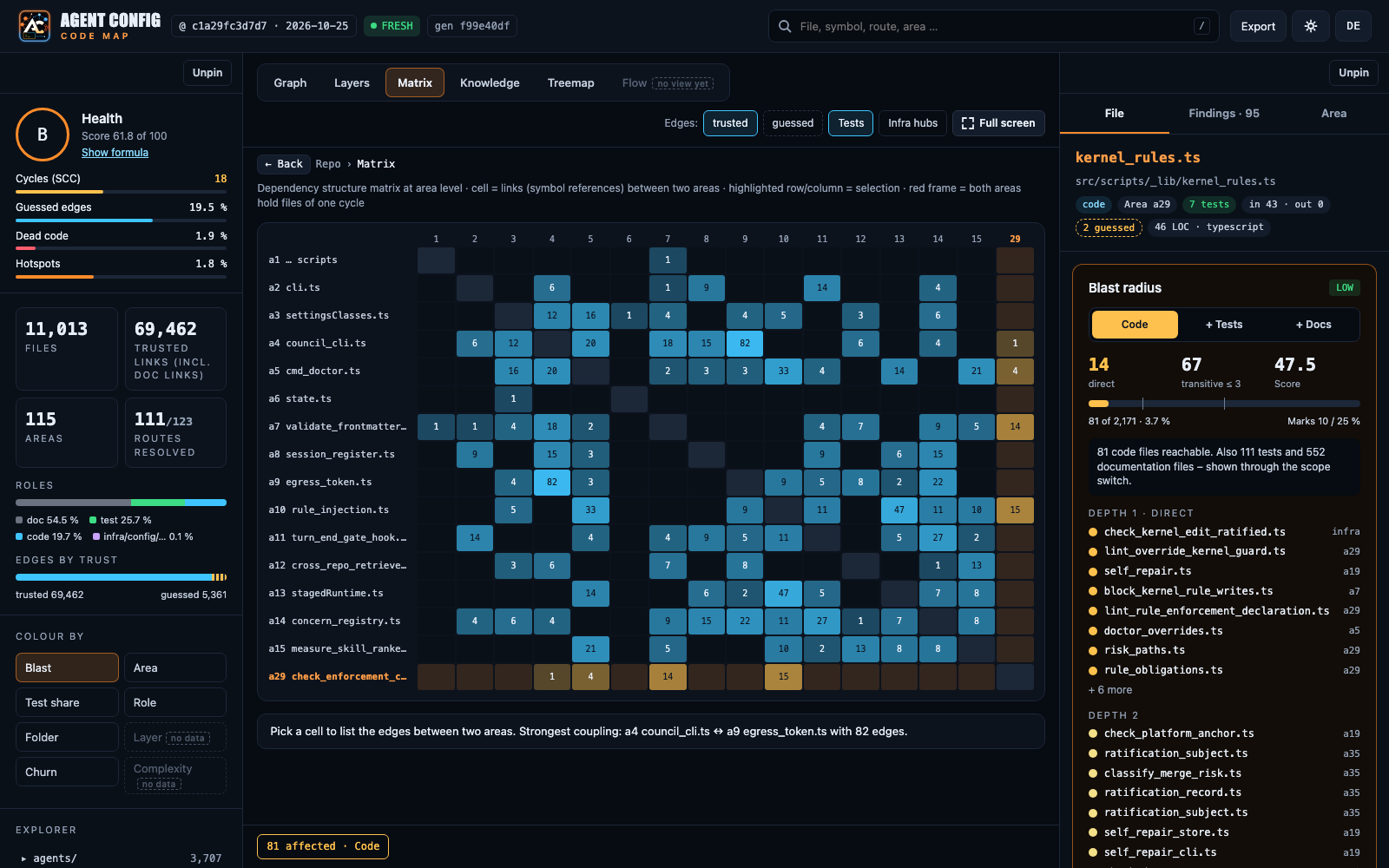
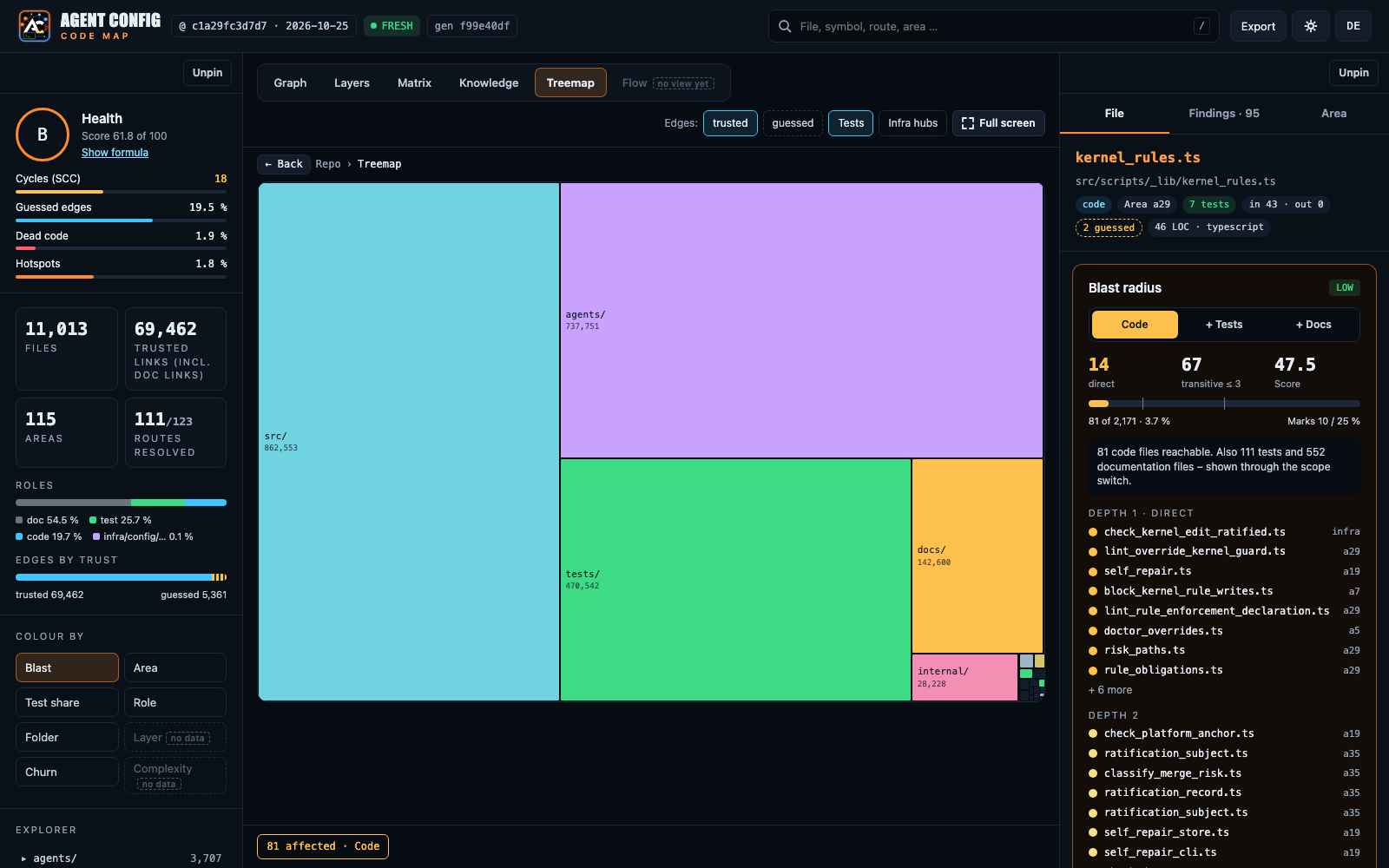
agent-config code-graph map draws an offline map into agents/map/: code, data, systems, interfaces, runtime, delivery, history, domains. Facts keep file:line, re-read before acting. Pick a file: every reached area lights up.
 |  |
|---|---|
 |  |
Choose your experience — developer · founder · content · agency · finance · ops. Add packs. Get a focused command set, not a 500-artefact dump. Bring your own AI provider.
A deep library of skills, commands and governed rules — plus a capability router that loads the right skill on intent and multi-agent orchestration with consensus review. The whole layer is compiled into 20 host agents — of 23 detected, 3 being export-only (Claude Code, Cursor, Augment, Cline, Windsurf, Copilot, Gemini CLI, Codex, Continue, Zed, JetBrains, Aider and more). Resident processes are permitted only under the supervision policy this repository adopted on 2026-08-27 — a rule, not a description of anything running today. Six role-shaped entry paths sit on top, so any host becomes a reliable team member — without locking you to a single model or vendor.
# 1. Install — on a terminal with a display, the browser wizard launches
#    automatically; the same TypeScript installer runs the real install behind it.
npx -y @event4u/agent-config init

# 2. Pick your profile + tools in the wizard, click Finish.
#    (Writes ~/.event4u/agent-config/, ~/.claude/, ~/.cursor/, …)

# 3. First real task — agent refines, plans, verifies.
/work "your first real task"
Or try one subagent first, on your own repo:
mkdir -p .claude/agents
curl -fsSL https://raw.githubusercontent.com/event4u-app/agent-config/main/docs/wedge/production-validator/production-validator.md \
  -o .claude/agents/production-validator.md
# then in Claude Code:  @production-validator check this branch is actually done
production-validator is read-only: it hunts mocks and stubs on the shipped path
and demands real-system evidence (what it does).
The full suite is one command — Quickstart ↓.
Deep and disciplined and honest about what it deliberately is not:
--purge, only files it recorded, never the anchor.What it deliberately is not — the core is a governance layer with optional, individually opt-in embedded engines (code intelligence, gated reach, the setup GUI, the bench lab — the embedded-engine doctrine): no mandatory or always-on daemon, no separate state database, no self-rewriting memory, no auto-build pipeline. Engines are never mandatory, never default-on without measured lift and terminate with the command that invoked them. The host agent runs the loop; every learned change is human-reviewed; the same layer stays portable across tools. Capability without a process to babysit.
Where this comes from (honest provenance). The skills, rules and personas are distilled from real production work on TypeScript and PHP codebases. The governance mechanics are stack-agnostic, but the domain heuristics are richest where they were forged — treat coverage on other stacks as promising, not proven and tell us where it falls short.
See exactly what works on which host or jump to things you can do in a minute.
agent-config setup writes profile.id to .agent-settings.yml and sends you
to that profile's first screen. Each experience page carries the full detail —
who it's for, first commands and skills, packs and flows — and what is
deliberately not loaded.
Not sure which one? The wizard asks a single 8-option role question and maps
to the closest profile. Source-of-truth
src/agent-src/profiles/ · schema
docs/contracts/profile-system.md · beyond
software user-types/ (galabau · metalworking ·
truck — see Beyond software).
You don't memorize commands — you run a work journey. Four flows span the developer story end-to-end:
docs/flows.md.Creative Pack — cinematic AI video. script → character-locked image → motion+audio prompt → provider render → stitched clip, with
AIV_DRYRUN=trueas the cost-safety default. A first-class capability inside the content / creator experience — no longer the package's headline. See/video:from-script.
Legal Pack — not legal advice. The EU/DE legal pack (contract/NDA/DPA review, triage) is a research-and-drafting aid only — it does not provide legal advice, does not replace a qualified lawyer and must not be relied on for any concrete matter. It produces general information and general templates, never individual-case examination. Read
LEGAL_NOTICE.mdbefore use.
Full catalog — every skill, rule, command, guideline:
docs/catalog.md. The headline is the experience (profile + packs) and the depth behind it.
Run from a consumer repo — bootstrap via npx, the agent picks up
your stack and you ship work end-to-end. New install? Start with the
Quickstart. Already installed? Supported tools
shows the wired AIs; docs/featured-commands.md
lists the end-to-end workflows (/implement-ticket, /work,
/commit, /pr:create). Deeper tour: 2-minute demo.
Install scope. Pick one scope per machine — project-local (default, recommended for application repos) or user-global (recommended for tooling repos / dotfiles). The installer refuses a second, conflicting scope via the scope_guard pre-flight. Details: docs/contracts/install-scopes.md. Cleanup when needed: bash src/scripts/cleanup_other_scope.sh --confirm.
Don't take the claims on trust — verify them. docs/proof.md
is generated from source: a claim→evidence table (every public claim binds to a
resolvable pointer or CI fails), honest-null benchmarks including the runs where
the package changed nothing and a "verify it yourself" block you run on a fresh
checkout. It fails CI if it drifts from its sources — reproducibility is the
proof. Read it at
event4u-app.github.io/agent-config/proof/,
with the comparison frame at docs/us-vs-the-category.md.
Freshest measured row: in one post-fix session, advisory context injection cut language-mirror violations 555 → 19 while the two blocking guards went 8 → 0 and 1 → 0 — advisory reduced massively, only blocking eliminated. One session and a post-hoc reading, so a recorded prior rather than a law.
Maintaining a skills catalog yourself? The anti-reskin gate that blocks
find-replace re-skin PRs here runs on yours too — docs/anti-reskin-gate.md.
Audit-disciplined — decision keys land in agents/runtime/state/; the replay
journal is opt-in (hooks.runtime_journal.enabled).
Core principles names the four invariants.
Working on the package itself? Development covers the
task ci pipeline, Requirements the toolchain,
Maintainer telemetry the
opt-in measurement loop. Source-of-truth tree is
src/ (src/skills, src/rules, src/agent-src/); never hand-edit .augment/ or dist/agent-src/.
Security. Disclosure policy: SECURITY.md. Threat model: docs/threat-model.md.
One command. Detection-driven — your installed AI tools are found and pre-selected. Nothing is written until you click Finish. No YAML by hand.
Those four are structural — properties of the code path, not of your machine.
How long it takes is not: that is dominated by network and registry latency.
CI measures the install → doctor wall-clock on every umbrella run and
publishes it with its conditions, as evidence rather than as a promise.
The one command is above ↑.
Headless / CI: init skips the GUI on CI, a non-TTY, a headless host or any CLI-mode flag; it runs the non-interactive installer instead. The GUI and the CLI share one installer (src/scripts/install.ts), so both produce identical results. Flags, the full opt-out set and --dry-run: docs/wizard.md · gui-wizard § When the GUI is skipped.
Pick specific AIs: --tools=claude-code,cursor,augment,… (any subset). --gui forces the loopback-bound, CSRF-gated picker past the TTY and headless checks; it does not override CI, AGENT_CONFIG_NO_UI or a CLI-mode flag; combining it with one of those exits non-zero rather than quietly running the CLI install.
Verify hook coverage: npx @event4u/agent-config hooks:status (--strict for CI, --format json for tooling).
Scope (v2.5+):
initwrites global only —~/.event4u/agent-config/,~/.claude/,~/.cursor/, …. The project tree getsagents/overrides/only.--projectis maintainer-only behindAGENT_CONFIG_DEV_MODE=1(ADR-020, dev-mode).
Migrating from v1.x? npx @event4u/agent-config migrate — docs/migration/v1-to-v2.md.
agent-config is — and what it isn'tA content layer — skills, rules, commands, guidelines, personas — distributed via npm and projected into every supported AI tool's native config format. Skills use SKILL.md with package-specific frontmatter keys.
It is not an agent runtime. The agent loop, the LLM dispatcher and tool orchestration stay with the host tool (Claude Code, Augment, Cursor, Cline, Windsurf, Gemini CLI, Copilot). Think of it as a playbook and style guide for those tools — not a replacement.
/implement-ticketThe flagship command. Drives a ticket end-to-end through a fixed linear flow — and blocks on ambiguity instead of guessing.
/implement-ticket PROJ-123
The agent runs this sequence:
refine → memory → analyze → plan → implement → test → verify → report
minimal-safe-diff + scope-control — no drive-by edits./commit and /pr:create are suggestions, never auto-run.Any ambiguity halts the flow with numbered options — never a silent guess. Persona comes from .agent-settings.yml (roles.active_role): senior-engineer (default), qa or advisory (plan-only).
/work (free-form prompt)Same engine, no ticket required:
/work add a CSV export endpoint to the audit-log controller
The first pass scores the prompt on five dimensions and routes on the band:
After the band gate, the flow is identical to /implement-ticket. Free-form goal → /work; ticket payload → /implement-ticket.
After the run: agent-config explain last reconstructs the trace (route · memory · council · halts · provider) — read-only, PII-scrubbed, offline. Docs
UI-shaped work routes to one of three directive sets — ui (full audit→design→apply→review→polish→report), ui-trivial (≤ 1 file, ≤ 5 lines: apply→test→report), mixed (backend + UI: contract→ui→stitch). Existing-UI audit is a hard gate (ui-audit-gate); polish has a 2-round ceiling with a11y precedence. Stack detection → blade-livewire-flux / react-shadcn / vue / plain.
→ Mental model (1 page) · Flow contract
Safety floor (non-destructive defaults · ask-before-guessing · mirror-the-user's-language) ships in every profile, as a guardrail, not a security boundary. Profiles add coaching.
Under the hood: kernel-only · kernel + tier-1 · kernel + tier-1 + tier-2. Details: rule-router · kernel-membership · Configure →.
Stability:
STABILITY.mdfor the full matrix. Work Engine (/work+/implement-ticket): beta. Runtime Dispatcher: stable. Tool Adapters: experimental (fullprofile only).
.agent-user.md and Ghostwriter — voice primitivesCreate the user file interactively: /agents user init (schema). Ghostwriter cluster: /ghostwriter:fetch <url-or-name> runs an attestation gate; private individuals rejected; paywalled / leaked / DM content banned at the schema level.
Skills, commands, rules and guidelines can be served as an MCP endpoint from your own Cloudflare Worker, reachable over HTTP by any MCP client. Two auth modes: public (default) and bearer-auth (operator opt-in, MCP-Token Wrangler secret).
task mcp:cloud:login         # one-time, opens browser
task mcp:cloud:setup         # check → r2-create → r2-verify → whoami
task mcp:cloud:secret-put    # opt in to bearer-auth (recommended for private deploys)
→ Operator walkthrough: mcp-cloud-setup · Per-client config: mcp-client-config · Endpoints: mcp-cloud-endpoints.
Scope — Lite, not Full. The Worker serves read-only governance (skills · commands · rules · guidelines · contexts) as MCP prompts and resources, plus small read-only tools (
memory_lookup,chat_history_read,list_*). It does not execute the repository's local scripts (linters, audits,task ci, work-engine hooks) — those require local install per Quickstart.
The built-in local stdio server is listed in the Glama MCP Registry — it requires a local checkout, not a turnkey install (ADR-067).
Organization-mode features (SSO, central policy, OAuth connectors, team-context) stay cancelled by design until a recruited customer and a funded security audit lift them; the small-team recipe is the supported path meanwhile. Each is a stable cancellation row in team-deployment-posture.
Three classes of install/runtime behaviour look like package bugs and are host-harness behaviour the package cannot control: sibling-plugin namespaces, deferred tools surfaced via ToolSearch and cross-scope skill drift. Diagnostics and the package's response: docs/contracts/harness-expectations.md. When a skill appears twice, start with task probe:skills.
npx)✅ native ☑️ text reference (in AGENTS.md, not invokable as native slash-command) 📌 marker only — not available
Team reproducibility: every tool you
initis recorded inagents/installed-tools.lock(committed, machine-managed). New team members runnpx @event4u/agent-config syncafter cloning; CI gates drift withagent-config validate. Schema:installed-tools-manifest.
Claude Code: the marketplace plugin is deprecated (single-surface model). The npx/npm file projection now carries content and the deterministic hooks (registered in a managed
~/.claude/settings.jsonblock byagent-config global/upgrade), so the plugin only duplicates skill/command listings while its git-SHA snapshot rots silently. Existing installs:claude plugin uninstall agent-config@event4u-agent-config—agent-config doctorflags the duplicate surface.
Keep the global install current with agent-config upgrade (latest) or
agent-config refresh --global (same-version re-install); agent-config doctor
flags a missing-from-PATH binary or broken hook wiring. See
getting-started § Keeping current ·
Troubleshooting.
For platforms where the package's scripts cannot run, artefacts are built for paste-in or upload:
dist/linear/{workspace,team,personal}.mddist/cloud/<skill>.zipagent-switch is the companion
CLI for running several agent accounts on one machine: it isolates each account
in its own profile (CLAUDE_CONFIG_DIR per profile), so switching accounts
never means logging out and back in. The two compose — agent-switch isolates
the accounts, agent-config governs what the agents do inside them. When
agent-config runs under an agent-switch profile it says so in the settings hub,
warns before writes that would land in a shared (cross-profile) tree and
accepts a host-supplied config root so its own settings stay profile-scoped.
A stack-agnostic governance core (orchestration · role modes · command clusters · quality gates · audit discipline), plus stack-specific skill sets:
The same orchestration core drives non-software trades via user-types/: galabau-field-crew · metalworking-shop · truck-driver. Contribute your own — 5-minute scaffold.
Three domain-safety rules (domain-safety-pii, domain-safety-disclaimer, domain-safety-retention) act as per-domain output floors across ~12 areas — PII redaction (support / finance / recruiting / marketing), advice disclaimers (legal / financial / medical / consulting), retention guidance (finance / support), ops floors (logging / export). Full surface → rule → floor matrix: docs/safety.md. Beta contracts: memory-visibility-v1 · decision-trace-v1.
Every diff is checked against a license policy derived from the target repo's own detected license (precedence-ordered; sources disagree → escalate, never guess) and a strict linter over our borrow ledger (provenance/borrows.jsonl → docs/THIRD-PARTY-NOTICES.md) that fails a deny-class or unknown license, a missing transformation note or a rename-only-phrased one — wired into ci/ci-strict. license-compliance-audit runs a similarity scan on demand, invoked by a human and never by a pipeline. This is provenance-governed borrow discipline with an audited trail — not a copy detector.
docs/CLAIMS.md. It ships in no form in CI, not even advisory — only as the on-demand skill above.Reduces and documents risk — never eliminates it.
Local-only log of skills, rules and commands consulted in /implement-ticket / /work. Enable via telemetry.artifact_engagement.enabled: true; JSONL in the project, nothing uploaded. Reports: npx @event4u/agent-config telemetry:report.
A prompt matching a command's purpose ("setze ticket ABC-123 um" → /implement-ticket) surfaces it as a numbered option — nothing auto-executes. Per-conversation off: /command-suggestion-off. Settings: commands.suggestion.{enabled,blocklist,confidence_floor} in .agent-settings.yml.
Browse content: all commands · skills catalog · full catalog · llms.txt.
First stop for any install problem: agent-config doctor — it flags a
missing-from-PATH binary, binary↔plugin version drift, stale orphans and
manifest issues, each with a one-line fix hint.
For "why didn't rule/hook X fire?" questions: agent-config routing:doctor
— a read-only, live diagnosis that reports every session-start gate as
ACTIVE/INACTIVE with the concern's own reason (e.g.
session-canary: ACTIVE for "Alex" vs INACTIVE — no name on any settings layer), the platform's concern chain, host hook registration and router +
projection freshness. Deeper hook internals (fail-open/closed posture, last
dispatcher feedback per concern): agent-config hooks:doctor.
Upgrade and staleness symptoms — a command or skill missing after an upgrade,
skills appearing twice, an interrupted upgrade, command not found, stale
project files: docs/troubleshooting.md § Upgrade and staleness.
Working on the package itself? Edit src/ (the source of truth — src/skills, src/rules, src/agent-src/), regenerate trees:
task sync             # regenerate dist/agent-src/ and .augment/
task generate-tools   # regenerate .claude/, .cursor/, .clinerules/, .windsurfrules
task ci               # full pipeline — green before PR
task test             # unit + integration tests
task dev:setup        # boot the onboarding wizard against the working tree
Invoking the CLI from a source checkout: ./agent-config <command> (the maintainer shim at the repo root → scripts/agent-config → dist/cli/agent-config.js). npx @event4u/agent-config doesn't resolve in the source repo without a prior npm link, since there's no node_modules/.bin/agent-config symlink — use ./agent-config instead. Build the TS binary with npm run build:cli if dist/cli/agent-config.js is missing.
→ Full project structure and commands: docs/development.md · CONTRIBUTING.md. Stack: TypeScript throughout — CLI, UI and the build / lint scripts. MCP registry payloads render under dist/mcp/ (submission checklist).
npx @event4u/agent-config init is the canonical install path. No Python anywhere on the install path (the Python installer retired with the TypeScript migration)..augment/ also need Task.Native PowerShell / cmd is not supported for the file install — use WSL2 for the full installed tree. The supported native-Windows surface is the MCP stdio server: point any MCP client at
npx -y @event4u/agent-config mcp-server
and the governance content (prompts, resources, tools) is available without
the file install. Porting the bash dispatcher to native Windows is
demand-gated: a named Windows adopter who cannot use WSL2 or the MCP
path reopens it (see agents/roadmaps/ — road-to-credible-install Phase 3).
The package is free, MIT and stays that way — no paid tier, no dual licensing. If it saves you time and you want to chip in, the GitHub Sponsor button at the top of the repo is the whole mechanism. If you would rather not, use it anyway; nothing here is gated on it.
MIT.
mcp-name: io.github.event4u-app/agent-config
Skills, rules, slash commands and subagents for Claude Code, Cursor, Copilot, Codex and more AI coding tools — teach your AI coding agents to check their work before they say done.
{ "mcpServers": { "event4u-agent-config": { "command": "npx", "args": [ "-y", "@event4u/[email protected]" ] } }}เครื่องมือ
ยังไม่มีรายการเครื่องมือ เซิร์ฟเวอร์แบบรีโมตจะได้รายการหลังการตรวจสอบสถานะครั้งแรก
FAQ
คัดลอกคอนฟิก stdio สำหรับ Cursor, Claude Desktop, Claude Code หรือ VS Code ได้ในหน้านี้ คอนฟิกนี้ใช้การติดตั้งของผู้เผยแพร่ ไม่ใช่พร็อกซีของ PlugMCP
ระเบียนนี้ไม่ได้ระบุตัวแปรสภาพแวดล้อมที่จำเป็น
@event4u/agent Config ทำงานแบบโลคัลผ่าน stdio
ตรวจสอบล่าสุดเมื่อ 2026-11-15 Skills, rules, slash commands and subagents for Claude Code, Cursor, Copilot, Codex and more AI coding tools — teach your AI coding agents to check their work before they say done.