Boundra · Payment approval gateway for AI agents
Boundra (boundra.io) — Boundaries for agent payments. The boundary layer for agent payments: before any money moves, answer "should this payment happen at all?"
Our thesis:
Power your agent
คำสั่งของผู้เผยแพร่เอง ไม่ใช่เอนด์พอยต์ของ PlugMCP
Host a copy with our keys and logs.
uvx boundra-mcp==0.1.0Claude Code ไม่มีลิงก์ติดตั้งสำหรับคำสั่งแบบโลคัล ให้คัดลอกคำสั่งด้านล่างแล้วรันในเทอร์มินัล
claude mcp add io.github.gobeyondfj-cmd-boundra -- uvx boundra-mcp==0.1.0รันในเทอร์มินัล
{ "mcpServers": { "io.github.gobeyondfj-cmd-boundra": { "command": "uvx", "args": [ "boundra-mcp==0.1.0" ] } }}claude_desktop_config.json
URL แบบรีโมตหรือคำสั่งบนเครื่องของคุณ? การติดตั้งสองแบบต่างกันอย่างไร
รันบน PlugMCP
A new server you create. It is not this listing's official endpoint. Use the publisher install when you want their URL and their credentials.
เปิดจากผู้เผยแพร่
One natural-language rule → compiled into a policy → every payment the agent attempts is genuinely evaluated → allow / ask a human / veto, with a full audit trail.
Two run modes:
demo.py): stdlib only, self-contained mock merchant
and wallets, zero dependencies, zero networkdemo/demo_real.py): standard MCP server + real x402 SDK +
Base Sepolia testnet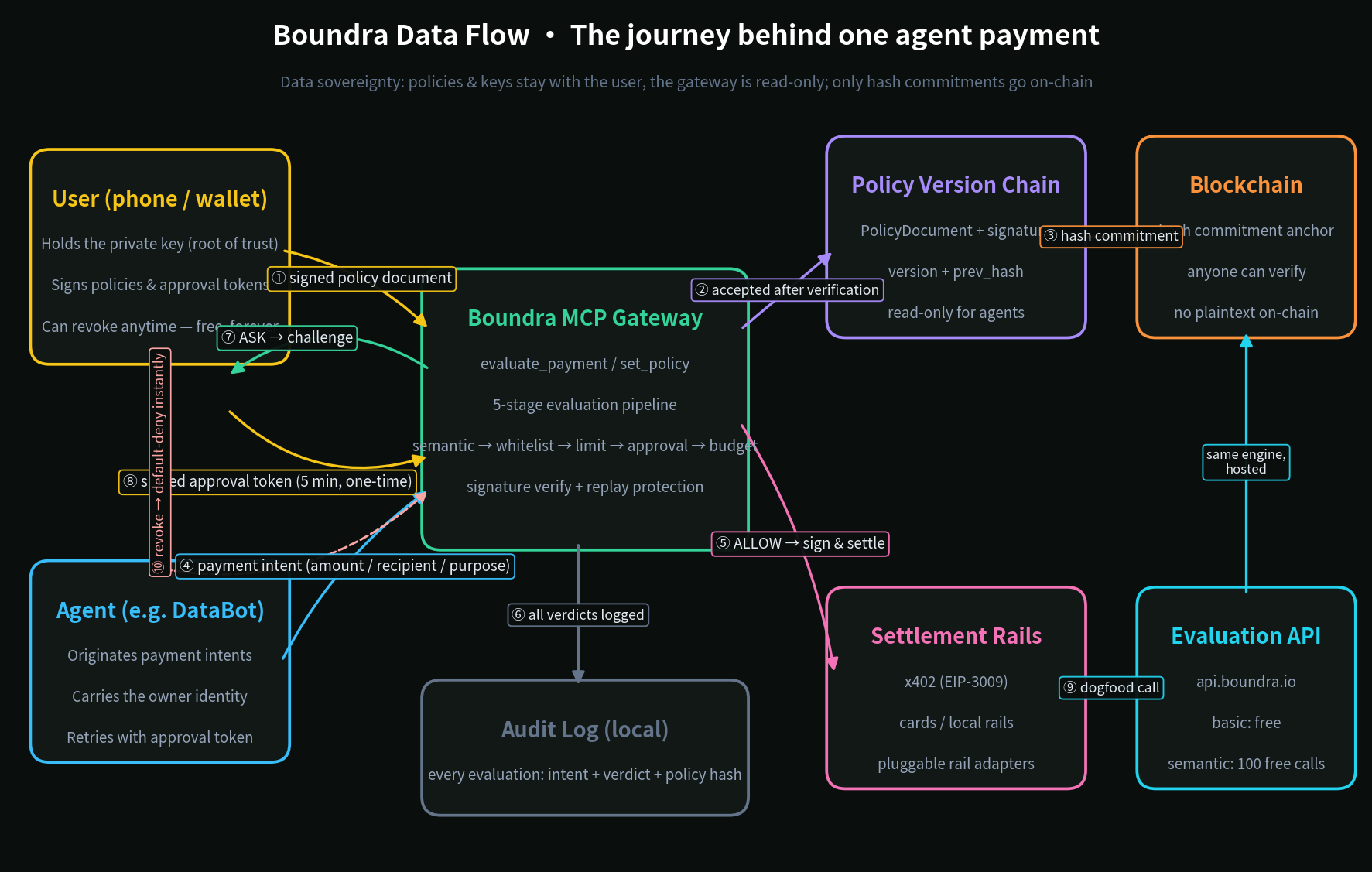
Policies and keys stay with the user; the gateway is read-only; only hash commitments go on-chain. Revocation is free — forever, no exceptions.
Integrating Boundra into your agent? See docs/INTEGRATION.md — hosted API, x402 SDK hook, and MCP paths with tested code.
# 1. Hit the hosted evaluation API — a real, public x402 merchant
curl -X POST https://api.boundra.io/evaluate/basic \
  -H 'Content-Type: application/json' \
  -d '{"intent":{"amount":0.01,"recipient":"api.weather.com","purpose":"weather data"}}'
# → {"decision":"ALLOW",...}  ·  semantic layer: 100 free calls per agent,
#   then $0.003 via x402 — settled for real on Base mainnet (USDC)

# 2. Local end-to-end simulation — a data-procurement agent's day
.venv/bin/python demo/simulate_agent.py
# signed policy publish → ALLOW / DENY (limit) / ASK → user-signed approval token
# → prompt-injection blocked → audit trail, plus a dogfood call to api.boundra.io

# 3. One-line MCP install + 2-minute policy wizard
uvx --from git+https://github.com/gobeyondfj-cmd/boundra boundra-mcp     # stdio server
uvx --from git+https://github.com/gobeyondfj-cmd/boundra boundra-init    # wallet → template → sign → anchor
uvx --from git+https://github.com/gobeyondfj-cmd/boundra boundra-approve # sign an ASK challenge
Zero to a signed, enforced policy in ~10 minutes. No accounts, no dashboards — your wallet key is your identity.
0 · Try the hosted API (30 seconds, nothing to install)
curl -X POST https://api.boundra.io/evaluate/basic \
  -H 'Content-Type: application/json' \
  -d '{"intent":{"amount":0.01,"recipient":"api.weather.com","purpose":"weather data"}}'
1 · Bind your identity — the wallet is the account
uvx --from git+https://github.com/gobeyondfj-cmd/boundra boundra-init
Creates or imports a Base wallet. No signup, no email — the private key never leaves your device, and your address is your identity everywhere in the system.
2 · Set your policy
The wizard offers templates (personal assistant / travel / dev API / procurement) or lets you write your own rule in plain English, then compiles it and shows you exactly what will be enforced — before anything is signed.
3 · Sign & publish
You sign the policy document with your wallet key (EIP-191). It is published as a versioned document and a hash commitment is anchored on-chain. From this moment the gateway is read-only for every agent — changing the policy without your key is impossible.
4 · Mount the MCP server into your agent
Hosted (zero install, multi-tenant, default-deny until you publish a signed policy):
{ "mcpServers": { "boundra": { "url": "https://api.boundra.io/mcp" } } }
Or self-hosted:
{ "mcpServers": { "boundra": { "command": "uvx",
  "args": ["--from", "git+https://github.com/gobeyondfj-cmd/boundra", "boundra-mcp"] } } }
5 · Every payment gets a verdict before signing
Your agent calls evaluate_payment; the 5-stage pipeline answers
ALLOW (sign & settle) / DENY (aborted pre-signature, zero on-chain
trace) / ASK (a challenge bound to this exact payment).
6 · When the agent asks, you decide
uvx --from git+https://github.com/gobeyondfj-cmd/boundra boundra-approve
Paste the ASK challenge, sign it on your device — the agent retries with the signed approval token. Forged, rebound, or replayed tokens are rejected.
7 · Watch, update, revoke
get_spend_report / get_audit_trail / get_policy_versions keep you in
control day to day. Every policy change is a new signed version
(set_policy); revoke_policy is instant default-deny and free forever.
cd boundra

# Mode 1: offline simulation (run this first — the full flow in 30 seconds)
python demo/demo.py

# Mode 2: real x402 + MCP
python -m venv .venv && .venv/bin/pip install \
    "x402[evm,httpx]" mcp eth-account fastapi uvicorn
.venv/bin/python tests/test_mcp_client.py    # MCP protocol-level tests
.venv/bin/python demo/setup_wallets.py       # generate Base Sepolia test wallets + faucet guide
.venv/bin/python demo/demo_real.py           # real protocol end-to-end (settles on-chain after funding)
Agent framework (Claude / custom)
   │  MCP protocol (stdio)
   ▼
mcp_server.py  ──→  policy.py 5-stage evaluation pipeline
(policy decision     semantic → whitelist → limit → approval → budget
 point)
   ▲
   │ on_before_payment_creation hook (x402 SDK v2 native interception point)
x402_buyer.py ──sign (EIP-3009)──→ x402 server ──→ facilitator ──→ Base Sepolia
Key finding: x402 SDK v2 natively provides the on_before_payment_creation
hook plus register_policy / set_spend_controls — the policy layer is not a
bolt-on; it is the slot the official protocol stack reserves. This validates
the wedge.
boundra/
├── policy.py                 intent compilation (NL→Policy, bilingual CN/EN) + 5-stage pipeline + platform red lines
├── signed_policy.py          ★ signed policy documents + version chain + revocation (keccak)
├── approval.py               ★ signed approval tokens (challenge → user signs → gateway verifies)
├── mandate.py                ★ task Mandates: single-use authorization, burned after use (pipeline layer 4)
├── templates.py              ★ policy template library (personal assistant / travel / dev API / procurement)
├── chain_anchor.py           ★ anchor backends: local simulation + real Base Sepolia (web3)
├── gateway.py                gateway core v3: 4-layer stacking + token verification + Mandate + revocation
├── rail_adapters.py          ★ rail adapter layer: evaluation core decoupled from settlement rails (x402 first)
├── mcp_server.py             ★ standard MCP server (11 tools, stdio)
├── boundra_cli.py            ★ boundra-init (policy wizard) + boundra-approve (challenge signer)
├── contracts/
│   └── PolicyAnchor.sol      ★ on-chain commitment contract (owner-write, anyone-read)
├── demo/
│   ├── simulate_agent.py     ★ end-to-end user journey simulation (MCP + hosted API dogfood)
│   ├── demo_policy.py        signed-policy demo (impersonation / unsigned / tampering attacks all blocked)
│   ├── demo_real.py          real-protocol end-to-end orchestration
│   ├── x402_resource_server.py  real x402 paywall server (FastAPI middleware)
│   ├── x402_buyer.py         real x402 buyer, evaluated by the MCP gateway before signing
│   ├── setup_wallets.py      Base Sepolia test wallet generation
│   └── demo.py / merchant.py / agent.py   offline simulation (zero dependencies)
├── tests/
│   ├── test_product.py       ★ product tests (22 assertions)
│   └── test_mcp_client.py    MCP protocol-level tests
├── docs/
│   ├── dataflow.png          data-flow diagram (English)
│   └── render_*.py           diagram renderers (architecture / flow / use-case / data flow)
└── state/audit.jsonl         audit trail (generated at runtime, gitignored)
A policy is a document signed by the user's wallet, not a row in the gateway's configuration:
user private key signature ──→ PolicyDocument (NL rule + compiled artifact + prev_hash + version)
                      │  three checks: signer == owner, versions sequential, prev_hash unbroken
                      ▼
              PolicyStore (version chain) ──→ LocalAnchor (simulated commitment; production writes to contract)
                      │
                      ▼  check_integrity before every evaluation (signature + anchor)
              5-stage pipeline; audit records cite policy version + hash
set_policy always
fails — impersonation, unsigned, and tampered submissions are all blocked
(seven scenarios in demo/demo_policy.py)Run: .venv/bin/python demo/demo_policy.py
Every evaluate_payment response carries a credential — a
boundra.verdict/v1 receipt signed by the platform key (EIP-191). It answers
"who can prove this ALLOW / DENY / ASK actually happened, under this policy,
for this exact payment intent?"
intent_hash = sha256 over the canonical
{amount, recipient, purpose} — a credential cannot be re-attached to a
different paymentpolicy_refs lists the policy version hashes used,
comparable against on-chain anchorsaudit_id links to the server-side audit entryproof, canonicalize the payload
(sorted keys, compact separators), recover the EIP-191 signer — it must
equal issuer and the platform address
0xF30955B6Be768370Da13fca237A5f252F6081d1C (the same address that receives
x402 revenue — one identity for signing and settlement). Published at
GET https://api.boundra.io/verdict-key.from verdict_credential import verify_credential
ok, why = verify_credential(verdict["credential"]) # offline, no API call
Self-hosted gateways attach no credential unless BOUNDRA_VERDICT_KEY is set —
unsigned mode stays fully backward compatible.
One line — uvx resolves dependencies and starts the server:
{
  "mcpServers": {
    "boundra": {
      "command": "uvx",
      "args": ["--from", "git+https://github.com/gobeyondfj-cmd/boundra", "boundra-mcp"]
    }
  }
}
On first run, use the boundra-init wizard (same package): create/import a
wallet → pick a policy template → sign → publish via MCP, about 2 minutes.
When your agent hits ASK, run boundra-approve and paste the challenge to
produce a signed approval token.
human_approved self-attested by the agentapprove(legacy-deprecated).demo/demo_real.py; the hook fires inside the SDK,
before signing). Endgame: compile the deterministic parts of policy into a
smart-contract wallet module, enforced at the settlement layer.contracts/PolicyAnchor.sol) and web3 client (chain_anchor.BaseSepoliaAnchor)
are ready; set chain_config.json to switch to the real chain (deploy via
Remix with test ETH).Tiered pricing:
Open core: the client, evaluation engine, and demos in this repo are
Apache-2.0. The hosted evaluation service (tiered pricing, free-quota
accounting, revenue ledger) runs from the private boundra-ops repo.
Verified (all of test_product.py 22 assertions + test_mcp_client.py pass):
4-layer policy stacking (platform red lines × user × agent × Mandate) with
strictest-wins; signed approval tokens (valid passes, forged rejected,
intent-rebinding rejected, replay rejected); Mandate single-use; revocation
defaults to deny and a signed v2 restores; template render+compile; all MCP
tools over the wire; gateway blocks an injection attack inside the real x402
402 round-trip before the SDK signs; the full tiered-pricing loop — first
proven on Base Sepolia (2026-10-16), then on Base mainnet (2026-10-21):
free tier passes, paid tier settles $0.003 USDC for real (buyer 1.010 → 1.007,
platform address credited 0.003), dogfood hook self-evaluates, semantic layer
blocks the injection, /revenue ledger entry.
The mainnet settlement tx is publicly verifiable: 0xf04d3497…4eac7e5
— the live API now settles on Base mainnet via Coinbase's CDP facilitator.
Earlier testnet proof: 0x5ad8ef4b…c474bbe
(the hosted service code is closed by design — the chain is the receipt).
Not yet verified: real on-chain anchoring (contract ready, needs test ETH to deploy); real user demand; semantic layer false-positive rate under real LLM behavior distributions.
Policy decision point for agent payments — allow, ask, or veto before signing
{ "mcpServers": { "io.github.gobeyondfj-cmd-boundra": { "command": "uvx", "args": [ "boundra-mcp==0.1.0" ] } }}เครื่องมือ
ยังไม่มีรายการเครื่องมือ เซิร์ฟเวอร์แบบรีโมตจะได้รายการหลังการตรวจสอบสถานะครั้งแรก
FAQ
คัดลอกคอนฟิก stdio สำหรับ Cursor, Claude Desktop, Claude Code หรือ VS Code ได้ในหน้านี้ คอนฟิกนี้ใช้การติดตั้งของผู้เผยแพร่ ไม่ใช่พร็อกซีของ PlugMCP
ระเบียนนี้ไม่ได้ระบุตัวแปรสภาพแวดล้อมที่จำเป็น
Boundra — Payment Approval Gateway For AI Agents ทำงานแบบโลคัลผ่าน stdio
ตรวจสอบล่าสุดเมื่อ 2026-11-09 Policy decision point for agent payments — allow, ask, or veto before signing
