ProofFlow makes AI-generated work reviewable, traceable, and reversible by
recording the full chain from work contract to proof packet: contract first,
record the algorithm decision, declare the cost budget, snapshot the code state,
bind claims to evidence, evaluate done criteria, then export an auditable
packet.
Audit infrastructure for AI coding agents with evidence-backed review and policy gates.
Demo asset (deferred): The end-to-end dogfood Demo_Asset GIF and the
VSCode_Channel inline audit / Approve Gate screenshots for the v0.1.x
dogfood-and-channel-polish milestone are deferred to the next dogfood cycle
(no capturable VS Code window in this milestone). Tracked in
PLANS.md#vscode-channel-screenshots-deferred-from-v0-1-x-dogfood.
ProofFlow is not only a PR review helper. It is a local-first ledger for AI
coding work. A Ledger Case captures the workflow before, during, and after an
agent changes code:
Work Contract - record the objective, repo path, allowed scope,
forbidden actions, required tests, done criteria, evidence requirements,
algorithm requirements, and cost budget.
Algorithm Decision - record the selected approach, rationale,
alternatives, invariants, and forbidden approaches before implementation.
Cost Budget - declare token, API, GPU, CPU, runtime, or iteration limits
before expensive work begins.
Snapshot - capture the git diff, changed files, HEAD SHA, base ref, and
diff hash so reviewers know exactly what code state was examined.
Evidence - store command output, test output, diffs, notes, screenshots,
or other artifacts as searchable evidence.
Claim - require every agent claim to bind to evidence before it is
trusted.
Proof Packet - export the contract, algorithm decision, cost budget,
timeline, snapshots, claims, evidence, evaluation, decisions, and remaining
risks into markdown.
Main chain: Work Contract -> Algorithm Decision -> Cost Budget -> Snapshot ->
Evidence -> Claim -> Evaluation -> Proof Packet. This keeps the core product
invariant sharp: no Case, no workflow; no Evidence, no trusted Claim; no done
criteria evaluation, no quiet success.
Risk Hints extend the evidence flow without turning ProofFlow into an automatic
algorithm judge. They tell the maintainer when the recorded route may be wrong
or too expensive, such as regeneration where mapping was required, budget
overrun metadata, or tests that prove output but not method.
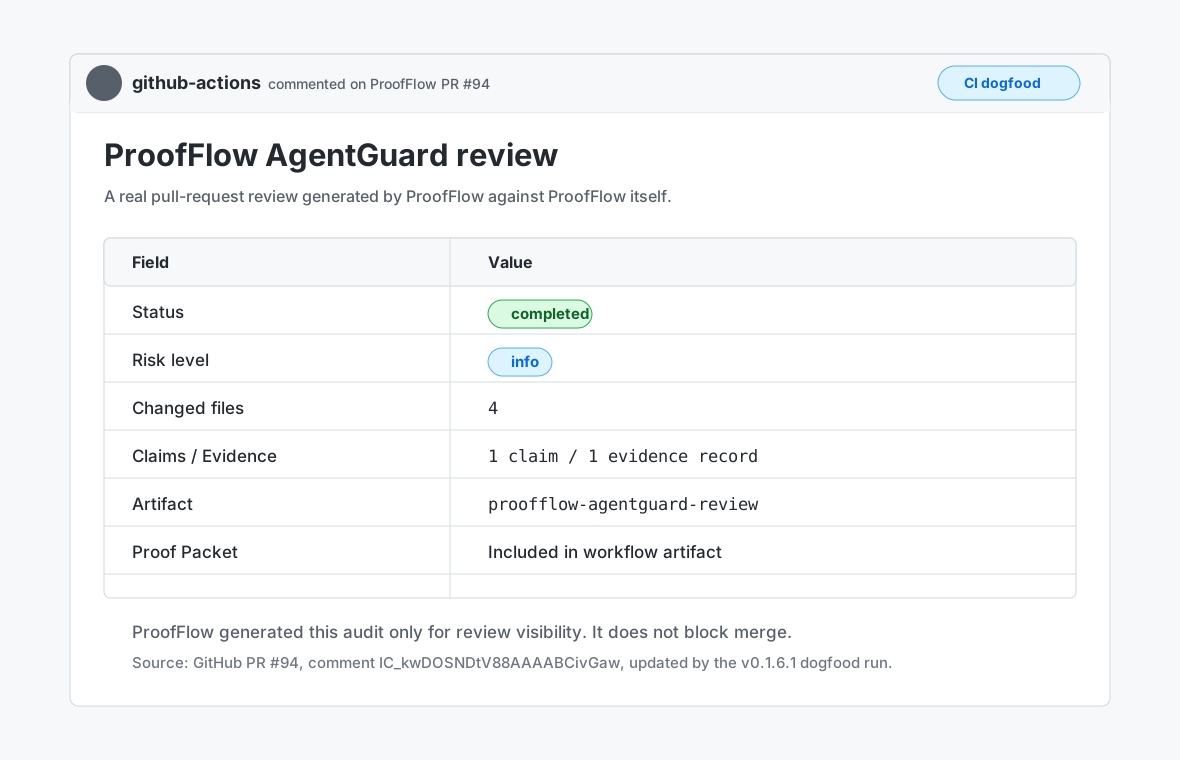
ProofFlow v0.1.6 was dogfooded on a real repository PR. The GitHub Actions
workflow ran AgentGuard, posted a stable PR summary comment, uploaded
summary.json, and exported a downloadable Proof Packet.
Result: one stable comment updated across pushes, one artifact containing the
Proof Packet and summary.json, no merge blocking.
Problem
AI coding agents (Claude Code, Codex, Copilot Workspace) can modify files, run commands, and make decisions autonomously. But there's no standard way to:
Audit what an agent did and why
Gate high-risk actions before they execute
Prove that a code review actually checked what it claims
Undo agent-initiated changes with confidence
ProofFlow solves this by sitting between the agent and the filesystem, creating an evidence graph that links every action to its justification.
Quickstart
Docker (recommended)
Run from the parent directory of the freshly cloned repo. The
Push-Location / Pop-Location pair keeps the working directory at the
repository root for the docker compose up command and restores it after the
block, so this snippet is copy-paste safe in a single PowerShell session.
git clone https://github.com/Hyperion-GPU/ProofFlow-v0.1.git
Push-Location ProofFlow-v0.1
docker compose up
Pop-Location
Docker publishes both ports on 127.0.0.1 by default to preserve ProofFlow's
localhost trust boundary. For stronger local protection, set an API key before
starting:
PROOFFLOW_API_KEY=change-me docker compose up
If you enable backend auth for the Docker frontend, use the same
PROOFFLOW_API_KEY value at build time so Vite can embed
VITE_PROOFFLOW_API_KEY in the static frontend bundle. AgentGuard
test_command execution is disabled by default; set
PROOFFLOW_ENABLE_TEST_COMMANDS=true only when you intentionally want the
backend to run local test commands during review.
Manual
Start each component from the repository root in a single PowerShell session.
Push-Location / Pop-Location keeps the working directory predictable across
the backend and frontend blocks; the backend port is fixed to 8787 to match
the make dev-backend baseline. npm run dev is a long-running process - run
the frontend block in a second PowerShell session if you want to keep the
backend uvicorn process visible in the first.
# Backend
Push-Location backend
pip install -r requirements.txt
python -m uvicorn proofflow.main:app --port 8787
Pop-Location

# Frontend (long-running; recommended in a second PowerShell session)
Push-Location frontend
npm ci
npm run dev
Pop-Location
Now your AI agent can keep an Agent Work Ledger, scan files, review code,
triage issues, suggest actions, and export audit reports - all with enforced
safety gates.
Codex Maintainer Plugin
ProofFlow also includes a repo-local Codex plugin at
plugins/proofflow-maintainer. It provides
starter prompts and a maintainer-focused skill for:
reviewing the current diff with ProofFlow,
creating a Proof Packet for a PR,
triaging issue text into a ProofFlow Case,
keeping an Agent Work Ledger for complex code tasks.
The plugin uses the same local proofflow-mcp server and keeps the backend
trust boundary at http://127.0.0.1:8787.
See the public-safe
Agent Work Ledger example
for the expected handoff shape.
Records complex AI coding work as a first-class Case. The main flow is Work
Contract -> Algorithm Decision -> Cost Budget -> Snapshot -> Evidence -> Claim
-> Evaluation -> Proof Packet, so maintainers can see what the agent promised,
what approach it chose, what cost limits it accepted, what changed, what
evidence backs its claims, whether the done criteria were satisfied, and which
Risk Hints deserve human review.
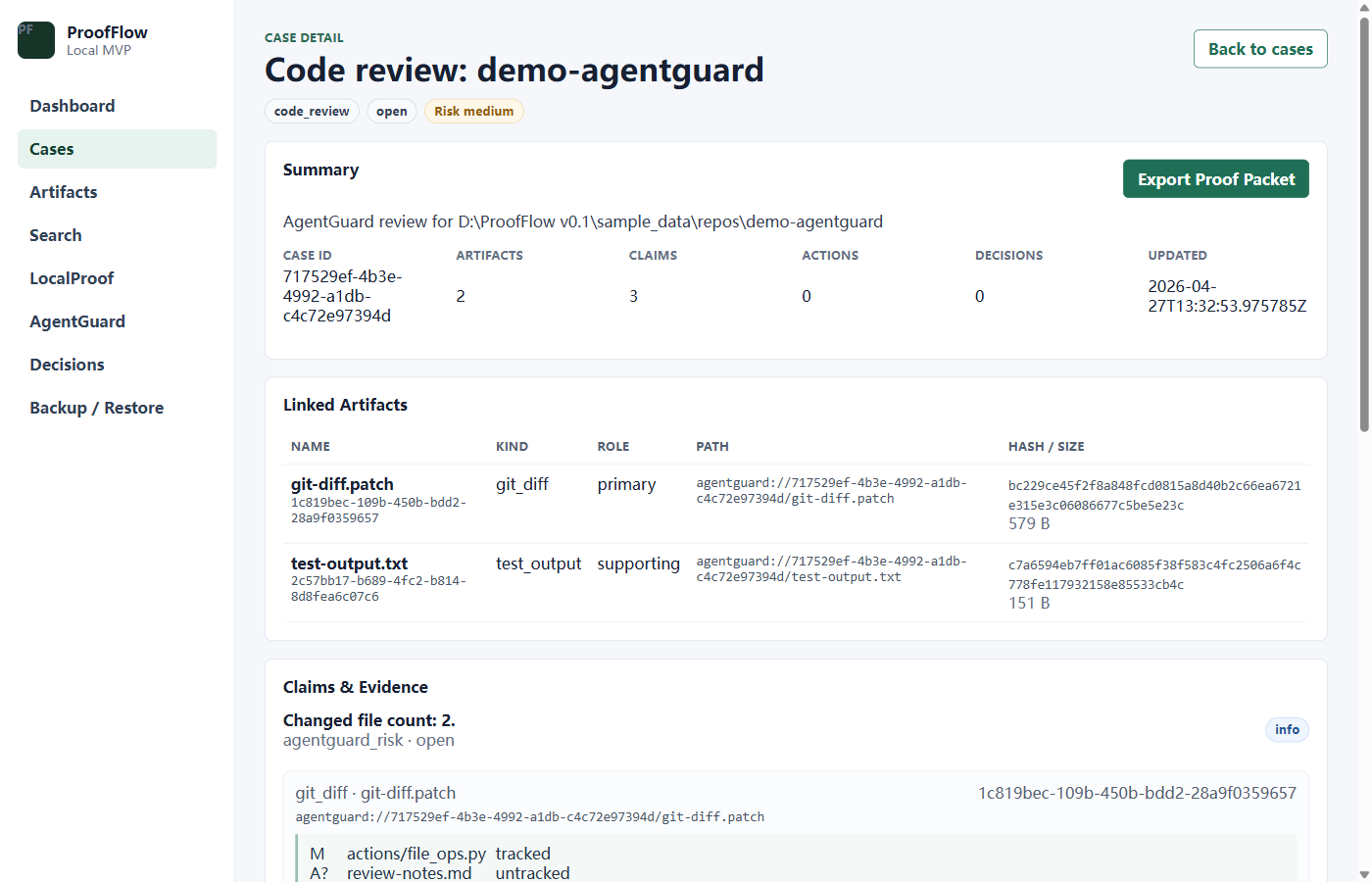
Evidence-Backed Code Review (AgentGuard)
Analyzes git diffs, generates risk-scored claims, and links each claim to specific evidence (changed lines, test results). No claim exists without supporting evidence.
File Audit & Organization (LocalProof)
Scans directories, indexes files with SHA-256 hashes, extracts text for full-text search, and suggests organization actions — all tracked in an auditable Case.
Issue Triage
Captures issue text as a first-class Case with source Artifact, deterministic triage Claims, component inference, label suggestions, and Proof Packet export.
Policy Gate Enforcement
High-risk filesystem actions (moves to system paths, bulk operations) are automatically paused at pending_decision status. Requires explicit owner approval before execution.
Safety Invariants
No Contract, no Ledger - AI coding work starts with explicit scope and done criteria
No Algorithm Decision, no trusted strategy - important approaches must be recorded before implementation
No Cost Budget, no expensive workflow - costly operations need declared limits first
No Final Snapshot, no Finish - finished ledgers must prove the reviewed repo state
No Preview, no Action — destructive operations require two-phase confirmation
No Evidence, no Claim — every assertion links to verifiable data
No Ready Evaluation, no Quiet Success - failed ledgers finish as finished_with_risks
No Undo, no Destructive Action — executed actions carry rollback metadata
No Case, no Workflow — all work is tracked in auditable containers
Run from the repository root in a single PowerShell session. Each
Push-Location / Pop-Location block restores the working directory back to
the repository root, so the python scripts/... smoke tests and
scripts/demo_workflow.py below can be pasted in the same session.
Local backend data defaults to backend/data/. For dogfood runs that should not
touch repository-local state, set PROOFFLOW_DB_PATH and PROOFFLOW_DATA_DIR
to a temporary directory before starting the backend.
Contributing
We welcome contributions! Please see CONTRIBUTING.md for guidelines.