Zero-G Reverse Engineering Anything & Sandboxed Closed-Loop Rust Parity Verifier for Gemini 4 Argon + Google Antigravity 2.0
REA-Argonaut (package: rea-argonaut, CLI: , MCP server: ) is a cross-platform (, , ) reverse-engineering and verified Rust reconstruction suite, engineered as a first-class and server.
Built as a full superset of morluto/rea (Reverse Engineer Anything), REA-Argonaut preserves all 35 original REA reverse-engineering domains (187 tools) while introducing the ArgonZeroG architecture and 7 new high-throughput forensic, recon-kit & verification tools (194 total MCP tools across 39 contract domains) designed for long-context frontier reasoning models.
[!IMPORTANT]
Active Development & Rolling Updates:REA-Argonaut is continuously updated with new forensic capabilities, architectural refinements, and parity harness enhancements. Check Discussions Announcements or click Watch in the top-right corner for the latest drops.
[!TIP]
New to Reverse Engineering or Vibe Coding? Start with the Visual User Guide:
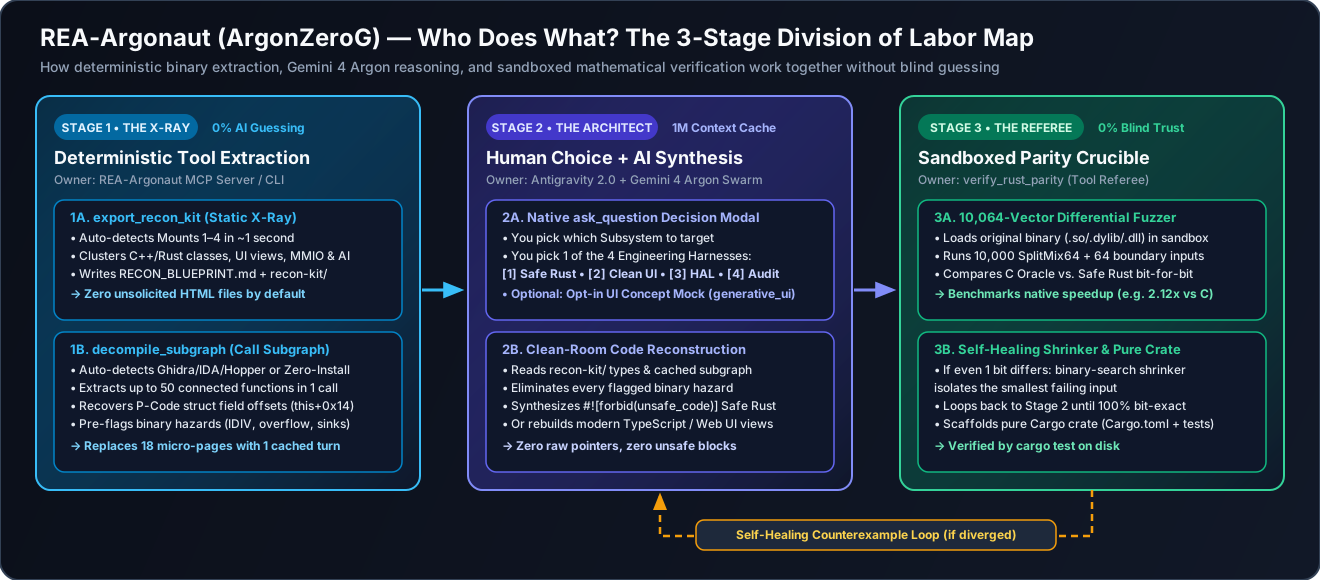
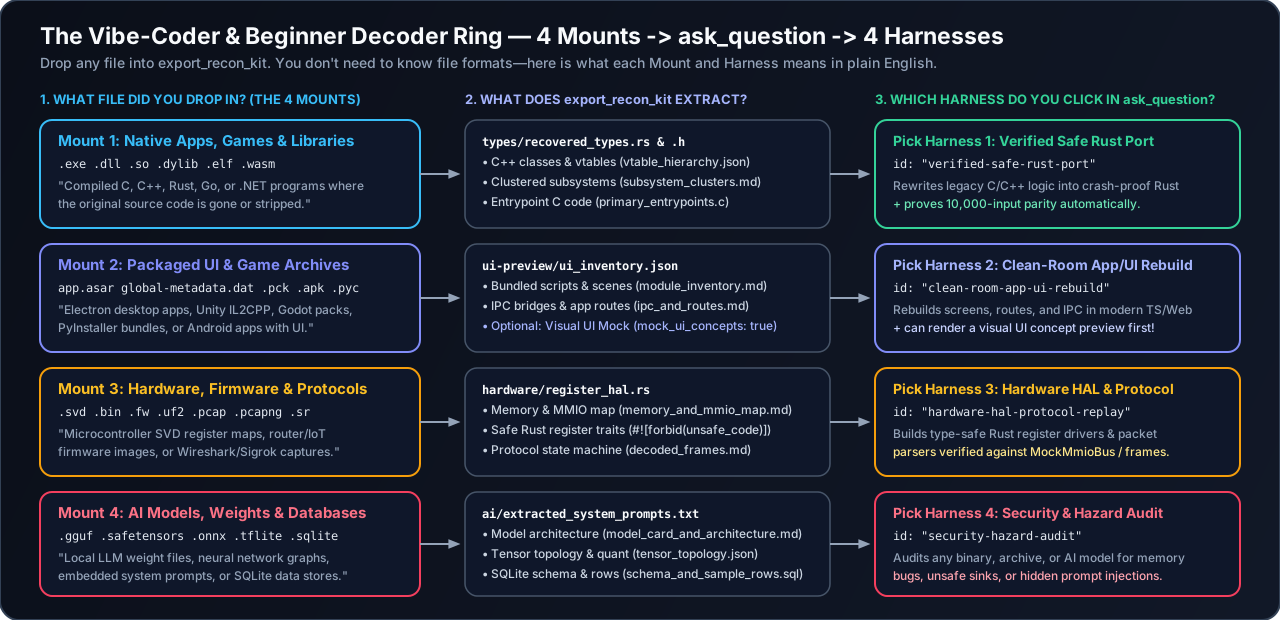
Read USER_GUIDE.md — The Zero-to-Hero Visual Field Manual & Decoder Ring for a plain-English walkthrough of the 3-Stage Division of Labor, what each of the 4 Mounts extracts, how to choose between the 4 Engineering Harnesses when Antigravity prompts you via ask_question, and copy-paste starter prompts.
Why REA-Argonaut? (ArgonZeroG Architecture)
Legacy MCP reverse-engineering servers were architected for small-context models, enforcing tiny pagination limits (64-character string previews, 50-line pseudocode slices, 20-row table pages) that force frontier agents into hundreds of sequential RPC round-trips and destroy KV context-cache reuse.
REA-Argonaut eliminates token-scarcity bottlenecks across six architectural pillars:
Single-Call Call-Graph Extraction: Traverses a target binary's call graph (BFS or DFS, cycle-safe up to max_depth: 5 and max_nodes: 256) and returns an entire subsystem's decompiled C pseudocode, disassembly, cross-references (XREFs), referenced string literals (2048-char previews), P-Code inferred struct field offsets (inferred_struct_offsets), and latent binary hazards (latent_hazards) in one deterministic JSON payload.
95%+ Context-Cache Reuse: Emits a topologically ordered, immutable subgraph representation so multi-turn agent reasoning and Rust reconstruction reuse cached KV prefixes instead of fragmenting context across dozens of micro-paginated tool calls.
Raised ArgonZeroG Limits Across Canonical Tools:
search_strings: max_preview_length raised to 2048 (default: 512), limit raised to 2000 (default: 250).
procedure_pseudocode / analyze_function: max_lines raised to 5000 (default: 1000, detail: "full" by default).
procedure_disassembly: max_instructions raised to 5000 (default: 1000).
4-Phase Recon-to-Argon Handoff: Materializes RECON_BLUEPRINT.md and the structured 4-Mount recon-kit/ workspace directory (Mount 1: native-binary, Mount 2: packaged-ui-archive, Mount 3: hardware-firmware-protocol, Mount 4: ai-model-data) in a single execution-free pass (mock_ui_concepts: false by default, producing zero unsolicited HTML files).
Native ask_question Harness Routing: Pairs with Antigravity's native ask_question decision control so users choose which subsystem and which of the 4 Harnesses (verified-safe-rust-port, clean-room-app-ui-rebuild, hardware-hal-protocol-replay, security-hazard-audit) to execute.
Tier 1 (Deep Decompiler Engine — Auto-Detected via provider: "auto"): Works directly with standard desktop installations of Ghidra (11.x and 12.x), IDA Pro (idat / idalib), Hopper Disassembler, and JEB. By default, REA-Argonaut drives their built-in headless runners in the background so the AI agent never blocks on GUI dialogs—while also exporting standard C headers (recon-kit/types/recovered_types.h) that you can import into your interactive Ghidra or IDA Pro desktop GUI (File -> Parse C Source) for side-by-side visual analysis.
Tier 2 (ZeroInstallNativeProvider Zero-Install Fallback): Out-of-the-box binary layout, symbol/section discovery, stripped C++ RTTI/VTable slot seeding (ClassName__vslot_N_<addr>), call-graph extraction, and disassembly when Ghidra/Hopper/IDA are not installed:
Linux (ELF): GNU binutils (objdump, readelf, nm) + native ELF header parser.
Windows (PE/COFF):llvm-objdump, dumpbin + native PE/COFF header/import/export parser.
Python Layout & Crash Bridge (bridge/pwntools/layout_impl.py & recorded_crash_impl.py): Dual-path backend supporting pwntools when installed and a 100% Python stdlib fallback on clean hosts.
4. 100% Vanilla REA Superset (187 Retained Tools) + 7ArgonZeroG Forensic Verticals (194 Total MCP Tools Across 39 Domains)
In addition to every original REA capability (JavaScript/Web bundles, Source Maps, Chrome DevTools/CDP, Frida, GDB/LLDB/WinDbg, Android APK/DEX, iOS IPA, JVM/JAR, .NET CIL, WebAssembly, Electron ASAR, Mach-O/ELF/PE, Hermes/React Native, Lua, Flash SWF, Archives, PCAP/HAR, EVM/Solidity, Firmware, Symbolic Execution, YARA/Capa), REA-Argonaut adds purpose-built forensic verticals:
inspect_rust_cpp_binary — Stripped Rust & Modern C++ Binary Forensics:
Recovers crate names and exact versions from .cargo/registry/src/... paths and core::panicking::Location tuples even in strip --strip-all binaries.
Native TypeScript Rust _RNv v0 and legacy _ZN symbol demangler + Itanium (_Z) and MSVC (?) C++ demangler.
Reconstructs C++ VTables and RTTI (typeinfo) across ELF (SHT_RELA PIE relocation resolution), Mach-O, and PE binaries without launching a heavy decompiler session.
Automated Differential FFI Harness: Compiles a C reference implementation (or loads an existing .so / .dylib / .dll via dlopen/dlsym) alongside a candidate #![forbid(unsafe_code)] Rust reconstruction (rustc --crate-type cdylib) and runs 10,000+ SplitMix64 randomized + boundary test vectors (0, 1, -1, MIN, MAX, powers of two, bitmasks) in-process.
Deterministic Counterexample Shrinking: Automatically binary-searches any diverging input down to the minimal failing argument tuple (counterexample.shrunk_inputs, bit_diff_summary) so the agent can self-heal its Rust port in a closed loop.
Clean Cargo Crate Scaffolding (scaffold_output_dir): Scaffolds a 100% pure #![forbid(unsafe_code)] Rust Cargo crate (Cargo.toml, src/lib.rs, tests/parity_regression.rs) with zero HTML clutter by default (html_report_path / --html-report is strictly opt-in).
OS-Native Sandboxed Execution: Runs compiled harnesses inside isolated OS sandboxes:
Dynamically inspects os.availableParallelism() and os.totalmem() at startup (src/config/AdaptiveResourceProfile.ts) to scale JavaScript AST worker pools, Headless Ghidra JVM heap (-XX:ActiveProcessorCount, -Xmx), and concurrent subprocess budgets across laptops, CI containers, and 128-core workstations with zero hardcoded CPU limits.
Quickstart
1. Install & Build
npm install
npm run build
2. Run the End-to-End ArgonZeroG Showcase
Compile a multi-function C cryptographic/compression pipeline (argon_cipher_pipeline), strip all symbols, extract the whole call-graph in one decompile_subgraph call, inspect stripped Rust/C++ panics & VTables, stream-inspect a GGUF AI model header, and prove bit-exact C-to-Rust parity across 10,000 FFI test inputs:
REA-Argonaut gratefully acknowledges and builds upon morluto/rea (Reverse Engineer Anything, Copyright (c) 2026 morluto, MIT License), preserving its complete multi-domain reverse-engineering architecture, process supervision, and decompiler bridges while extending it with the ArgonZeroG subgraph engine, zero-install cross-platform fallback, specialized forensic inspectors, and sandboxed Rust parity verifier. See LICENSE and THIRD_PARTY_NOTICES.md for full details.
R
REA Argonaut
PNWcoastie·12 ดาว·
Zero-G Reverse Engineering Anything & Verified Safe Rust Reconstruction for Gemini 4 Argon + Google Antigravity 2.0 (4-Mount Recon Kits, Whole-Subgraph Extraction, 10,000-Vector Differential Parity Re