Boundra · Payment approval gateway for AI agents
Boundra (boundra.io) — Boundaries for agent payments. The boundary layer for agent payments: before any money moves, answer "should this payment happen at all?"
Our thesis:
Power your agent
Yayıncının kendi URL'si. PlugMCP uç noktası değildir.
Host a copy with our keys and logs.
https://api.boundra.io/mcpYukarıdaki Claude düğmesi, ad ve URL doldurulmuş olarak Claude'u açar. Onayı yine orada siz verirsiniz.
claude mcp add --transport http io.boundra-boundra https://api.boundra.io/mcpRun in a terminal.
{ "mcpServers": { "io.boundra-boundra": { "command": "npx", "args": [ "-y", "mcp-remote", "https://api.boundra.io/mcp" ] } }}claude_desktop_config.json
Uzak URL mi, yoksa makinenizde bir komut mu? İki kurulum arasındaki fark
PlugMCP’de çalıştır
A new server you create. It is not this listing's official endpoint. Use the publisher install when you want their URL and their credentials.
BaşlatYayıncıdan
Boundra (boundra.io) — Boundaries for agent payments. The boundary layer for agent payments: before any money moves, answer "should this payment happen at all?"
Our thesis:
Allow, ask, or veto — a policy decision point your agent consults before signing any payment
One natural-language rule → compiled into a policy → every payment the agent attempts is genuinely evaluated → allow / ask a human / veto, with a full audit trail.
Two run modes:
demo.py): stdlib only, self-contained mock merchant
and wallets, zero dependencies, zero networkdemo/demo_real.py): standard MCP server + real x402 SDK +
Base Sepolia testnet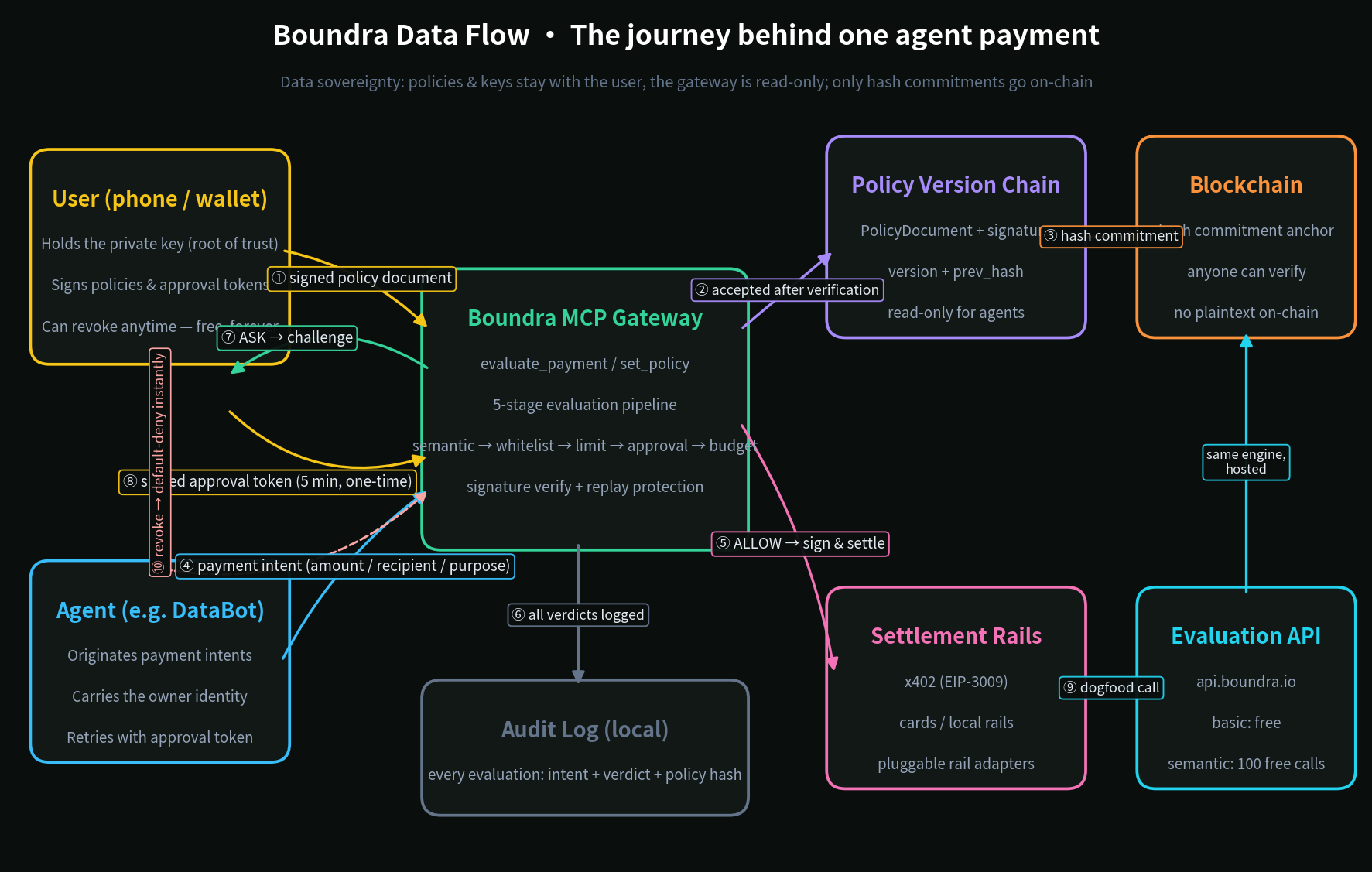
Policies and keys stay with the user; the gateway is read-only; only hash commitments go on-chain. Revocation is free — forever, no exceptions.
Integrating Boundra into your agent? See docs/INTEGRATION.md — hosted API, x402 SDK hook, and MCP paths with tested code.
# 1. Hit the hosted evaluation API — a real, public x402 merchant
curl -X POST https://api.boundra.io/evaluate/basic \
  -H 'Content-Type: application/json' \
  -d '{"intent":{"amount":0.01,"recipient":"api.weather.com","purpose":"weather data"}}'
# → {"decision":"ALLOW",...}  ·  semantic layer: 100 free calls per agent,
#   then $0.003 via x402 — settled for real on Base mainnet (USDC)

# 2. Local end-to-end simulation — a data-procurement agent's day
.venv/bin/python demo/simulate_agent.py
# signed policy publish → ALLOW / DENY (limit) / ASK → user-signed approval token
# → prompt-injection blocked → audit trail, plus a dogfood call to api.boundra.io

# 3. One-line MCP install + 2-minute policy wizard
uvx --from git+https://github.com/gobeyondfj-cmd/boundra boundra-mcp     # stdio server
uvx --from git+https://github.com/gobeyondfj-cmd/boundra boundra-init    # wallet → template → sign → anchor
uvx --from git+https://github.com/gobeyondfj-cmd/boundra boundra-approve # sign an ASK challenge
Zero to a signed, enforced policy in ~10 minutes. No accounts, no dashboards — your wallet key is your identity.
0 · Try the hosted API (30 seconds, nothing to install)
curl -X POST https://api.boundra.io/evaluate/basic \
  -H 'Content-Type: application/json' \
  -d '{"intent":{"amount":0.01,"recipient":"api.weather.com","purpose":"weather data"}}'
1 · Bind your identity — the wallet is the account
uvx --from git+https://github.com/gobeyondfj-cmd/boundra boundra-init
Creates or imports a Base wallet. No signup, no email — the private key never leaves your device, and your address is your identity everywhere in the system.
2 · Set your policy
The wizard offers templates (personal assistant / travel / dev API / procurement) or lets you write your own rule in plain English, then compiles it and shows you exactly what will be enforced — before anything is signed.
3 · Sign & publish
You sign the policy document with your wallet key (EIP-191). It is published as a versioned document and a hash commitment is anchored on-chain. From this moment the gateway is read-only for every agent — changing the policy without your key is impossible.
4 · Mount the MCP server into your agent
Hosted (zero install, multi-tenant, default-deny until you publish a signed policy):
{ "mcpServers": { "boundra": { "url": "https://api.boundra.io/mcp" } } }
Or self-hosted:
{ "mcpServers": { "boundra": { "command": "uvx",
  "args": ["--from", "git+https://github.com/gobeyondfj-cmd/boundra", "boundra-mcp"] } } }
5 · Every payment gets a verdict before signing
Your agent calls evaluate_payment; the 5-stage pipeline answers
ALLOW (sign & settle) / DENY (aborted pre-signature, zero on-chain
trace) / ASK (a challenge bound to this exact payment).
6 · When the agent asks, you decide
uvx --from git+https://github.com/gobeyondfj-cmd/boundra boundra-approve
Paste the ASK challenge, sign it on your device — the agent retries with the signed approval token. Forged, rebound, or replayed tokens are rejected.
7 · Watch, update, revoke
get_spend_report / get_audit_trail / get_policy_versions keep you in
control day to day. Every policy change is a new signed version
(set_policy); revoke_policy is instant default-deny and free forever.
cd boundra

# Mode 1: offline simulation (run this first — the full flow in 30 seconds)
python demo/demo.py

# Mode 2: real x402 + MCP
python -m venv .venv && .venv/bin/pip install \
    "x402[evm,httpx]" mcp eth-account fastapi uvicorn
.venv/bin/python tests/test_mcp_client.py    # MCP protocol-level tests
.venv/bin/python demo/setup_wallets.py       # generate Base Sepolia test wallets + faucet guide
.venv/bin/python demo/demo_real.py           # real protocol end-to-end (settles on-chain after funding)
Agent framework (Claude / custom)
   │  MCP protocol (stdio)
   ▼
mcp_server.py  ──→  policy.py 5-stage evaluation pipeline
(policy decision     semantic → whitelist → limit → approval → budget
 point)
   ▲
   │ on_before_payment_creation hook (x402 SDK v2 native interception point)
x402_buyer.py ──sign (EIP-3009)──→ x402 server ──→ facilitator ──→ Base Sepolia
Key finding: x402 SDK v2 natively provides the on_before_payment_creation
hook plus register_policy / set_spend_controls — the policy layer is not a
bolt-on; it is the slot the official protocol stack reserves. This validates
the wedge.
boundra/
├── policy.py                 intent compilation (NL→Policy, bilingual CN/EN) + 5-stage pipeline + platform red lines
├── signed_policy.py          ★ signed policy documents + version chain + revocation (keccak)
├── approval.py               ★ signed approval tokens (challenge → user signs → gateway verifies)
├── mandate.py                ★ task Mandates: single-use authorization, burned after use (pipeline layer 4)
├── templates.py              ★ policy template library (personal assistant / travel / dev API / procurement)
├── chain_anchor.py           ★ anchor backends: local simulation + real Base Sepolia (web3)
├── gateway.py                gateway core v3: 4-layer stacking + token verification + Mandate + revocation
├── rail_adapters.py          ★ rail adapter layer: evaluation core decoupled from settlement rails (x402 first)
├── mcp_server.py             ★ standard MCP server (11 tools, stdio)
├── boundra_cli.py            ★ boundra-init (policy wizard) + boundra-approve (challenge signer)
├── contracts/
│   └── PolicyAnchor.sol      ★ on-chain commitment contract (owner-write, anyone-read)
├── demo/
│   ├── simulate_agent.py     ★ end-to-end user journey simulation (MCP + hosted API dogfood)
│   ├── demo_policy.py        signed-policy demo (impersonation / unsigned / tampering attacks all blocked)
│   ├── demo_real.py          real-protocol end-to-end orchestration
│   ├── x402_resource_server.py  real x402 paywall server (FastAPI middleware)
│   ├── x402_buyer.py         real x402 buyer, evaluated by the MCP gateway before signing
│   ├── setup_wallets.py      Base Sepolia test wallet generation
│   └── demo.py / merchant.py / agent.py   offline simulation (zero dependencies)
├── tests/
│   ├── test_product.py       ★ product tests (22 assertions)
│   └── test_mcp_client.py    MCP protocol-level tests
├── docs/
│   ├── dataflow.png          data-flow diagram (English)
│   └── render_*.py           diagram renderers (architecture / flow / use-case / data flow)
└── state/audit.jsonl         audit trail (generated at runtime, gitignored)
A policy is a document signed by the user's wallet, not a row in the gateway's configuration:
user private key signature ──→ PolicyDocument (NL rule + compiled artifact + prev_hash + version)
                      │  three checks: signer == owner, versions sequential, prev_hash unbroken
                      ▼
              PolicyStore (version chain) ──→ LocalAnchor (simulated commitment; production writes to contract)
                      │
                      ▼  check_integrity before every evaluation (signature + anchor)
              5-stage pipeline; audit records cite policy version + hash
set_policy always
fails — impersonation, unsigned, and tampered submissions are all blocked
(seven scenarios in demo/demo_policy.py)Run: .venv/bin/python demo/demo_policy.py
Every evaluate_payment response carries a credential — a
boundra.verdict/v1 receipt signed by the platform key (EIP-191). It answers
"who can prove this ALLOW / DENY / ASK actually happened, under this policy,
for this exact payment intent?"
intent_hash = sha256 over the canonical
{amount, recipient, purpose} — a credential cannot be re-attached to a
different paymentpolicy_refs lists the policy version hashes used,
comparable against on-chain anchorsaudit_id links to the server-side audit entryproof, canonicalize the payload
(sorted keys, compact separators), recover the EIP-191 signer — it must
equal issuer and the platform address
0xF30955B6Be768370Da13fca237A5f252F6081d1C (the same address that receives
x402 revenue — one identity for signing and settlement). Published at
GET https://api.boundra.io/verdict-key.from verdict_credential import verify_credential
ok, why = verify_credential(verdict["credential"]) # offline, no API call
Self-hosted gateways attach no credential unless BOUNDRA_VERDICT_KEY is set —
unsigned mode stays fully backward compatible.
One line — uvx resolves dependencies and starts the server:
{
  "mcpServers": {
    "boundra": {
      "command": "uvx",
      "args": ["--from", "git+https://github.com/gobeyondfj-cmd/boundra", "boundra-mcp"]
    }
  }
}
On first run, use the boundra-init wizard (same package): create/import a
wallet → pick a policy template → sign → publish via MCP, about 2 minutes.
When your agent hits ASK, run boundra-approve and paste the challenge to
produce a signed approval token.
human_approved self-attested by the agentapprove(legacy-deprecated).demo/demo_real.py; the hook fires inside the SDK,
before signing). Endgame: compile the deterministic parts of policy into a
smart-contract wallet module, enforced at the settlement layer.contracts/PolicyAnchor.sol) and web3 client (chain_anchor.BaseSepoliaAnchor)
are ready; set chain_config.json to switch to the real chain (deploy via
Remix with test ETH).Tiered pricing:
Open core: the client, evaluation engine, and demos in this repo are
Apache-2.0. The hosted evaluation service (tiered pricing, free-quota
accounting, revenue ledger) runs from the private boundra-ops repo.
Verified (all of test_product.py 22 assertions + test_mcp_client.py pass):
4-layer policy stacking (platform red lines × user × agent × Mandate) with
strictest-wins; signed approval tokens (valid passes, forged rejected,
intent-rebinding rejected, replay rejected); Mandate single-use; revocation
defaults to deny and a signed v2 restores; template render+compile; all MCP
tools over the wire; gateway blocks an injection attack inside the real x402
402 round-trip before the SDK signs; the full tiered-pricing loop — first
proven on Base Sepolia (2026-10-16), then on Base mainnet (2026-10-21):
free tier passes, paid tier settles $0.003 USDC for real (buyer 1.010 → 1.007,
platform address credited 0.003), dogfood hook self-evaluates, semantic layer
blocks the injection, /revenue ledger entry.
The mainnet settlement tx is publicly verifiable: 0xf04d3497…4eac7e5
— the live API now settles on Base mainnet via Coinbase's CDP facilitator.
Earlier testnet proof: 0x5ad8ef4b…c474bbe
(the hosted service code is closed by design — the chain is the receipt).
Not yet verified: real on-chain anchoring (contract ready, needs test ETH to deploy); real user demand; semantic layer false-positive rate under real LLM behavior distributions.
Allow, ask, or veto — a policy decision point your agent consults before signing any payment
{ "mcpServers": { "io.boundra-boundra": { "url": "https://api.boundra.io/mcp", "headers": {} } }}Araçlar
Henüz araç listesi yok. Uzak sunucular ilk sağlık kontrolünden sonra bir liste alır.
SSS
Bu sayfadan Cursor, Claude Desktop, Claude Code veya VS Code için http yapılandırmasını kopyalayın. PlugMCP proxy'sini değil, yayıncının kurulumunu kullanır.
Bu kayıtta gerekli bir ortam değişkeni listelenmiyor.
Boundra — Payment Approval Gateway For AI Agents sunucusuna HTTP üzerinden ulaşılır.
Son kontrol: 2026-11-17. Allow, ask, or veto — a policy decision point your agent consults before signing any payment