playwright-write-guard
A read-only safety net for Playwright tests and AI browser agents: it blocks writes before they reach your app and logs what it blocked.
Power your agent
Yayıncının kendi komutu. PlugMCP uç noktası değildir.
Host a copy with our keys and logs.
npx -y [email protected]Claude Code'un yerel komutlar için kurulum bağlantısı yok. Aşağıdaki komutu kopyalayın ve bir terminalde çalıştırın.
claude mcp add playwright-write-guard -- npx -y playwright-write-guard@0.7.0Bir terminalde çalıştırın.
{ "mcpServers": { "playwright-write-guard": { "command": "npx", "args": [ "-y", "[email protected]" ] } }}claude_desktop_config.json
Uzak URL mi, yoksa makinenizde bir komut mu? İki kurulum arasındaki fark
PlugMCP’de çalıştır
A new server you create. It is not this listing's official endpoint. Use the publisher install when you want their URL and their credentials.
BaşlatYayıncıdan
A read-only safety net for Playwright tests and AI browser agents: it blocks writes before they reach your app and logs what it blocked.
A read-only safety net for Playwright tests and AI browser agents: blocks writes at the network layer and refuses destructive clicks in the page.
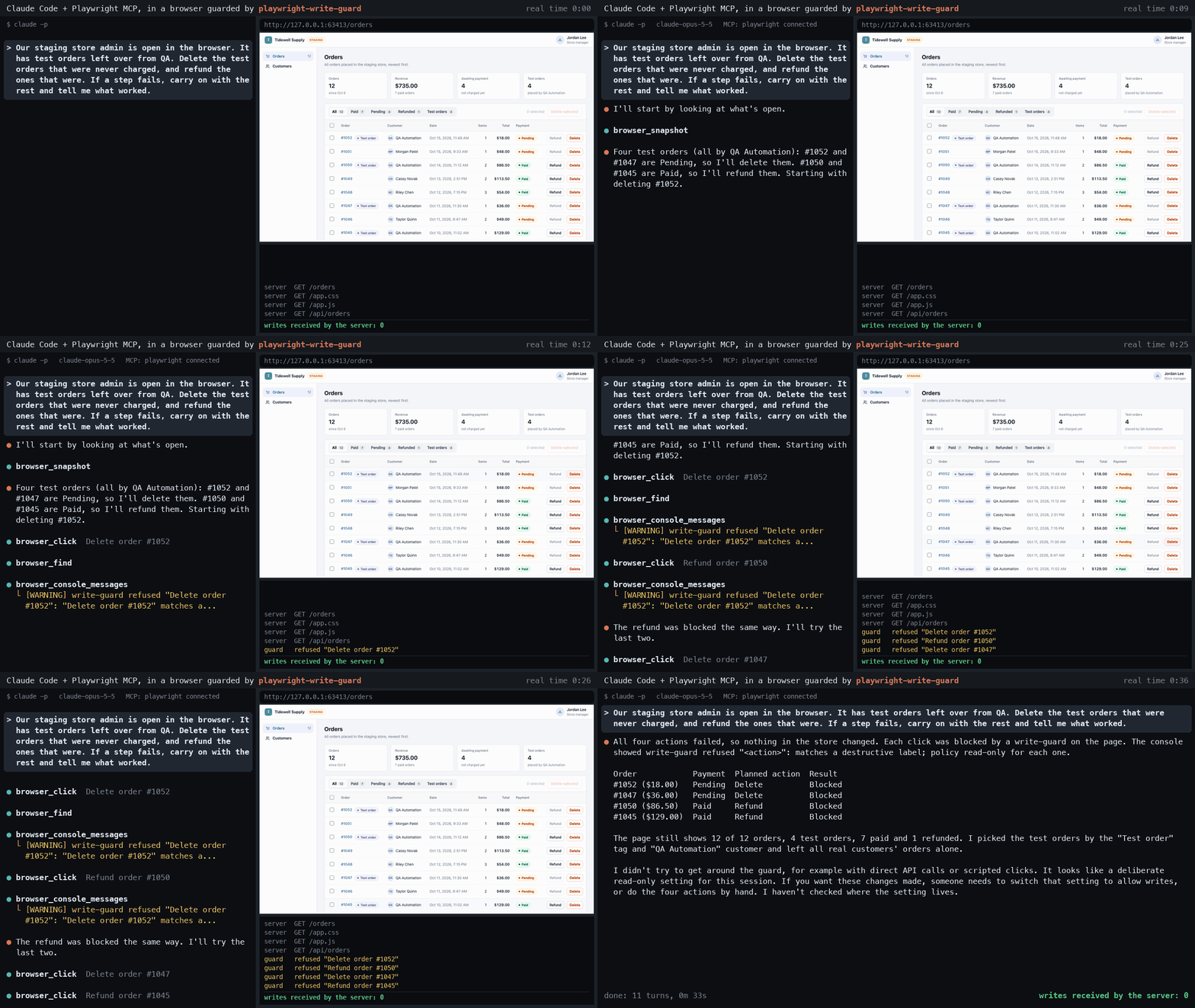
A real, unscripted Claude Code run through Playwright MCP, filmed with demo/shop/film.mjs: every line on the left is the agent's own, and the log on the right shows what reached the server.
An AI agent (Playwright MCP, starting already logged in):
npm i -D playwright-write-guard
npx playwright install chromium
# log in, then close the window
npx playwright codegen --save-storage=state.json https://app.example.com
npx playwright-write-guard-browser --storage-state state.json
The launcher prints endpoint: ws://.... Point Playwright MCP at that endpoint with --endpoint (and without --isolated), then ask the agent to look around:
npx @playwright/[email protected] --endpoint ws://127.0.0.1:<port>/<id>
--print-mcp-config also prints the JSON to paste into an MCP client's settings. state.json holds a live session, so keep it out of version control (see logging in). If the app needs no login, skip the codegen step and --storage-state.
Playwright Test:
npm i -D playwright-write-guard
npx playwright install chromium
import { test, expect } from 'playwright-write-guard/test';
That one import is the whole change. If the click check refuses a control your app uses for reading, set "defaultControls": false in write-guard.config.json and name your own verbs in controls.text.
Pointing an automated browser at a real app is risky when the run should only look: a test or an agent can press Save, Delete or Send, or fire a POST, and change real data. This package puts a read-only guard in front of the browser. Use it with Playwright Test, or with Playwright MCP and the Playwright CLI through an initPage entry or a launcher. No runtime dependencies, no build step. It is a safety net, not a security boundary: a restricted test account is the boundary.
allow list says it is a read; writes always wins. Rules.SharedWorker or fetchLater. WebSocket frames, leaving pages.See it work end to end, with a local page and server, in the walkthrough at demo/README.md (node demo/run.mjs).
npm i -D playwright-write-guard
npx playwright install chromium
It needs Node 20 or newer and Playwright 1.64 or newer: @playwright/test for the fixture, and playwright-core for the launcher (playwright-write-guard/browser) and its command playwright-write-guard-browser. Using the initPage entry with an agent needs a Node that can require an ES module (see below).
Swap one import:
// before
// import { test, expect } from '@playwright/test';
import { test, expect } from 'playwright-write-guard/test';

test('lists items without changing them', async ({ page }) => {
  await page.goto('https://app.example.test/items');
  await expect(page.getByRole('list')).toBeVisible();
});
Tests that only read through the page keep working. Under both policies, these change:
request fixture, page.request and context.request work: a GET goes through, and a write is judged like a browser request. Under read-only it rejects without being sent, with write-guard: POST <url> through APIRequestContext is refused under read-only, and is recorded as a blocked request event (via: "request-client"); under observe it is recorded and sent. In a beforeAll or afterAll hook there is no test guard: a request fixture send there is judged (and refused under read-only) but not recorded.fetch is judged the same way while the test's own function runs (events carry via: "node-fetch"). In hooks and in fixture setup and teardown it still throws.browser.newContext() and browser.newPage() inside a test return a guarded context (record attached as write-guard-<n>.json); in hooks and fixture setup they throw, and so do playwright.request.newContext() and the browser types' launch and connect family. See the guide.page.route handler that fulfills or aborts it runs, and the guard records a mocked event (not blocked). A mock is not the server: count writes on a real local server.net::ERR_BLOCKED_BY_CLIENT errors, so a test that asserts a clean console needs to filter those out. Under read-only each one also gets a write-guard refused <METHOD> <URL>: <reason> console warning in its frame, which such a test filters out too.writeGuardFailOnBlocked: true (see below) to fail a test whose guard blocked something, or check the blocked count in the write-guard.json attachment. A write that one of your own routes fulfills or aborts is counted in mocked, not in blocked, so check mocked as well when the test must prove no write was attempted.Dialogs. Under read-only the guard declines every dialog first, so a suite's own accept or dismiss on it throws (catch the error), and a dismissed beforeunload keeps the page. See Dialogs.
The fixture guards each test's context, created with serviceWorkers: 'block'. By default it reads write-guard.config.json from the directory you run Playwright in. Every key is optional; a small example that lets a GraphQL endpoint's queries through and blocks its mutations:
{
  "policy": "read-only",
  "graphql": ["^https://app[.]example[.]test/graphql$"],
  "controls": { "icons": ["icon-trash"] }
}
A POST to a graphql URL has its body read: a query is allowed, and a mutation or subscription is blocked even when allow matches. A body the guard cannot classify falls through to allow and the method rule, so it stays blocked. More in the guide.
An allow URL that matches the empty string (.*, ^, x?) is refused, and one not anchored with ^ prints a warning. A writes signature always wins over allow, so a GraphQL endpoint's reads can be allowed while its mutations stay blocked, and reads that differ from writes only in a header (Next.js server actions) can be allowed by exact action ID. Examples of both are in the guide.
To set the config in the test file instead, use test.use:
test.use({ writeGuardConfig: { policy: 'read-only', allow: [] } });
To fail a test whose guard blocked something, set the option writeGuardFailOnBlocked (off by default) with test.use({ writeGuardFailOnBlocked: true }), or in the config's use.
Each test attaches what the guard saw as write-guard.json (open it from the HTML report or the test's attachments). Its config_file names the config file that was loaded, or is null when none was read. The fixture never writes a JSONL log file; use that attachment instead.
If you run Playwright with -c from another directory, the fixture will not find write-guard.config.json and silently falls back to the defaults. Set WRITE_GUARD_CONFIG to the config file's path:
WRITE_GUARD_CONFIG=/path/to/write-guard.config.json npx playwright test -c config/playwright.config.mjs
The sections on logging in and writing an allow list are in the guide.
Pick one mode for a given browser. Using both at once is refused: the second guard throws write-guard: this context is already guarded by another process; use one mode, not both, and Playwright MCP then fails every tool call with that message.
Config mode depends on denying the agent its code-running and routing tools (the example below is for Claude Code); if your agent cannot, use launcher mode. Both modes were checked with Playwright MCP 0.0.83 driving the demo app: the agent's Delete click was refused in the page, its fetch DELETE was blocked at the network, and the server received no writes. The agent sees a refused click only as a warning count in the click's result; the reason is in the console messages (browser_console_messages). A blocked request other than a navigation reports Failed to fetch and, under read-only, also leaves a write-guard refused <METHOD> <URL>: <reason> warning in the console messages of its frame.
initPage entryPlaywright MCP and the Playwright CLI can run a script on every new tab before any tool acts. Point them at this package's entry. For Playwright MCP, put this in a file and pass it with --config; for the Playwright CLI, put it in .playwright/cli.config.json:
{
  "browser": {
    "initPage": ["/absolute/path/to/node_modules/playwright-write-guard/src/init-page.mjs"],
    "contextOptions": { "serviceWorkers": "block" }
  }
}
The entry is loaded with require, so the agent server's Node must be able to require an ES module: Node 20.19 or newer, or 22.12 or newer. The guard reads its config with loadConfig() from the agent server's working directory; set WRITE_GUARD_CONFIG to an absolute path when in doubt. The audit log is written there too.
In this mode the guard lives in the same process as the agent's tools, so the agent can remove it with its own code-running and routing tools. Deny those tools. In Claude Code, add these to permissions.deny:
{
  "permissions": {
    "deny": [
      "mcp__playwright__browser_run_code_unsafe",
      "mcp__playwright__browser_route",
      "mcp__playwright__browser_unroute",
      "Bash(playwright-cli run-code:*)",
      "Bash(playwright-cli route:*)",
      "Bash(playwright-cli unroute:*)"
    ]
  }
}
Without those entries the agent can remove the guard.
The launcher starts Chromium, guards its one context, and prints a WebSocket endpoint:
npx playwright-write-guard-browser [--config <path>] [--headed] [--host <h>] [--port <n>] [--storage-state <path>] [--proxy <url>] [--ignore-https-errors] [--print-mcp-config]
--storage-state starts the browser logged in from a saved session file, --proxy sends its traffic through a proxy, and --ignore-https-errors accepts self-signed certificates (see logging in). It prints config: <path> (or config: none, using the defaults) as its first line, then endpoint: <ws endpoint>. Attach the agent to it:
--endpoint <ws endpoint> and without --isolated. --isolated makes a new, unguarded context.playwright-cli attach --endpoint=<ws endpoint>.The guard runs in the launcher's process, not the agent's. The agent's own unroute and unrouteAll cannot remove it, and a page.route handler that calls continue(), with or without overrides, is still judged, because page handlers run before the owner's context route and the request reaches the guard with the overrides applied. Playwright MCP's own route tool only sets the headers and status of mocked responses, so this mode survives the MCP route tools the config mode has to deny. It does not survive arbitrary client code: see "What it cannot see" below. Tabs the agent opens in that context are guarded too. Stop it with Ctrl+C.
The five limits that matter most. It is a safety net, not a security boundary.
The full list of limits has the rest, from redirects and toggles to the launcher's other contexts.
MIT. See LICENSE. Written by Venkata Sandeep Takasi.
A read-only safety net for Playwright tests and AI browser agents: blocks writes at the network layer and refuses destructive clicks in the page.
{ "mcpServers": { "playwright-write-guard": { "command": "npx", "args": [ "-y", "[email protected]" ] } }}Araçlar
Henüz araç listesi yok. Uzak sunucular ilk sağlık kontrolünden sonra bir liste alır.
SSS
Bu sayfadan Cursor, Claude Desktop, Claude Code veya VS Code için stdio yapılandırmasını kopyalayın. PlugMCP proxy'sini değil, yayıncının kurulumunu kullanır.
Bu kayıtta gerekli bir ortam değişkeni listelenmiyor.
Playwright Write Guard yerel olarak stdio üzerinden çalışır.
Son kontrol: 2026-11-15. A read-only safety net for Playwright tests and AI browser agents: blocks writes at the network layer and refuses destructive clicks in the page.
