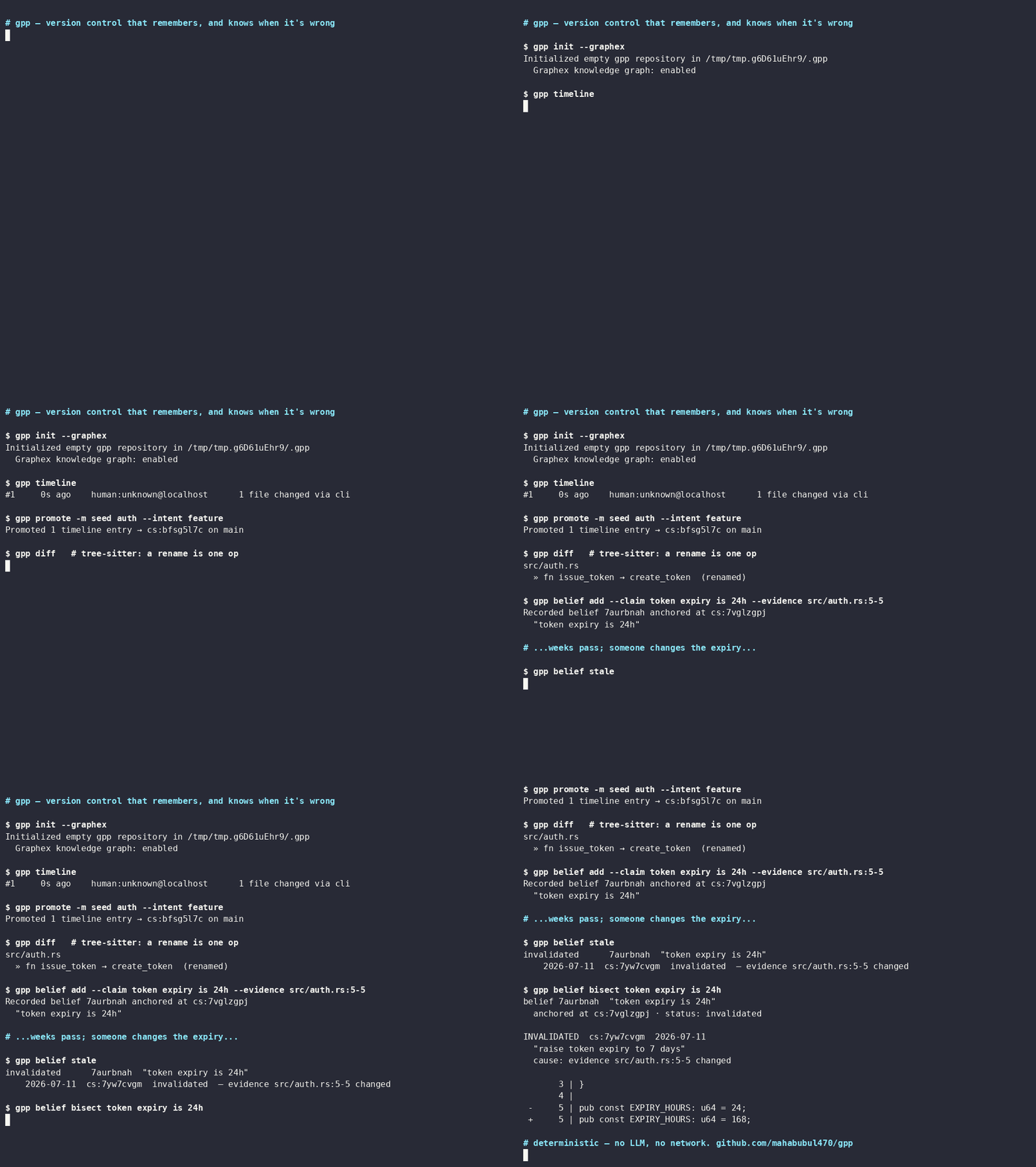
AI agents change code continuously, then lose the work that happened
between commits — and the notes they keep about your codebase
(, memory banks, knowledge files) go stale silently when the
code moves on. gpp is a version control system built for that reality: it
, promotes curated changesets with
intent and provenance, and hosts project knowledge — so when a commit invalidates something you believed about the
code, gpp can name that commit.
Deterministic — diff intersection and blob hashes, zero LLM or network
calls. (For scale: asked to judge whether a stored memory has been
invalidated, the best frontier model manages 55.2% accuracy on the
STALE benchmark — here it's a
history query, not a judgment.) Validated on real history across five
repos in four languages — axum 0.6→0.7, flask 1.1→2.0, clap 3→4, zod
3→4, go-redis 8→9 — where every invalidated belief bisects to a pinned,
documented culprit commit and the control beliefs survive: see
demos/belief-bisect/ for the full matrix.
What makes it different
Continuous capture. A high-frequency timeline records every file
change (SQLite WAL, debounced watcher); curated changesets are
promoted from it with an explicit intent, author kind (human/agent),
and cost record. Nothing is lost between commits.
Graphex: versioned, encrypted project knowledge. Architecture,
conventions, decisions, and beliefs live in an encrypted knowledge
graph inside the repo, tier-gated per agent trust level, audited on
every read — and staleness-checked against the history it rides on.
Agent governance. First-class agent identity with reputation
scoring, compliance-as-code policies enforced at capture/promote/sync,
anomaly detection, and per-changeset token/cost attribution.
Everything else — P2P sync over Noise, replay, review/RBAC, a relay node,
a TUI — is the platform underneath: see
docs/ARCHITECTURE.md.
Git is the substrate, not the competition. The bridge
(gpp git-import / git-export / git-bridge) round-trips real Git
commits, so GitHub and existing workflows keep working — gpp's knowledge,
provenance, and governance layers ride alongside. The axum demo above
runs entirely on history imported through this bridge.
Connect Claude Code (or any MCP client)
gpp ships an MCP server; agents query the knowledge graph (every belief
with a freshness envelope — anchor, commits since, and the changeset that
staled it), write their own evidence-anchored beliefs with
propose_belief (human-approved, then policed by history), propose
changesets, and report costs. Drop this in .mcp.json at your repo root:
Full client setup (Claude Desktop, generic stdio) and the exposed tool
list: docs/MCP.md.
Status
All 9 roadmap phases (0–8) implemented. See
docs/ROADMAP.md for per-phase deliverables and
documented deviations, docs/TODO.md for the prioritized
backlog, and docs/WORKLOG.md for the running
engineering log.
Verified 2026-08-23: 184 workspace tests pass, cargo clippy and
cargo fmt clean, full workspace builds. No stub crates remain — every
crate has a working implementation. Coverage is measured in CI
(cargo llvm-cov; 65.7% line at baseline, being raised).
Test depth is still uneven: foundational layers are well covered
(gpp-core, gpp-graphex, gpp-diff, gpp-tui ≥ 80% line; the CLI has
end-to-end suites for policy enforcement, cost reporting, reviewer
assignment and belief bisect), while several integration crates remain at
smoke-level (gpp-sdk, gpp-notify, gpp-rbac, gpp-replay).
"Implemented" here means built and tested against its milestone, not
exhaustively hardened everywhere. Closing that gap is the top item in
docs/TODO.md.
The full layer table
Layer
Crate
What's implemented
Storage
gpp-core
Content-addressed store (BLAKE3 + zstd), Blob/Tree, raw verified frame transfer
Documented follow-ups (recorded in the ROADMAP/TODO, not silently
skipped): registry/license APIs for deps, native PyO3/napi bindings,
outbound platform-review sync, apt/dpkg packages.
Install / build
cargo install gpp-cli                    # the `gpp` binary (crates.io)
cargo install gpp-relay                  # relay node (optional)

# or from a clone
cargo build --release
cargo test --workspace
cargo bench -p gpp-core -p gpp-diff      # criterion perf suite
Prebuilt binaries for Linux, macOS (ARM + Intel), and Windows are
attached to each release;
cargo install --git https://github.com/mahabubul470/gpp gpp-cli tracks
unreleased development.
More to try
# Governance
gpp policy template secrets-scan
gpp trust show
gpp audit --include-cost --include-graphex

# Decentralized: sync two repos over Noise
gpp sync serve 127.0.0.1:9473             # on peer A
gpp sync add a 127.0.0.1:9473 && gpp sync # on peer B

# GitHub-compatible
gpp remote setup --platform github --repository acme/webapp
gpp remote pr-create --base main
See CLAUDE.md for project context, docs/ for the
full specification (architecture, data model, CLI, protocols, roadmap),
and docs/book/ for the user guide + tutorials.
Chưa có danh sách công cụ. Máy chủ từ xa sẽ có danh sách sau lần kiểm tra tình trạng đầu tiên.
Câu hỏi thường gặp
Câu hỏi
Làm thế nào để cài đặt Gpp?
Sao chép cấu hình stdio cho Cursor, Claude Desktop, Claude Code hoặc VS Code trên trang này. Cấu hình dùng bản cài đặt của nhà phát hành, không phải proxy của PlugMCP.
Gpp có cần khóa API không?
Bản ghi này không liệt kê biến môi trường bắt buộc nào.
Gpp dùng giao thức truyền tải nào?
Gpp chạy cục bộ qua stdio.
Gpp được kiểm tra lần cuối khi nào?
Kiểm tra lần cuối: 2026-11-09. Project knowledge graph with history-checked belief staleness, changeset proposals, cost reporting