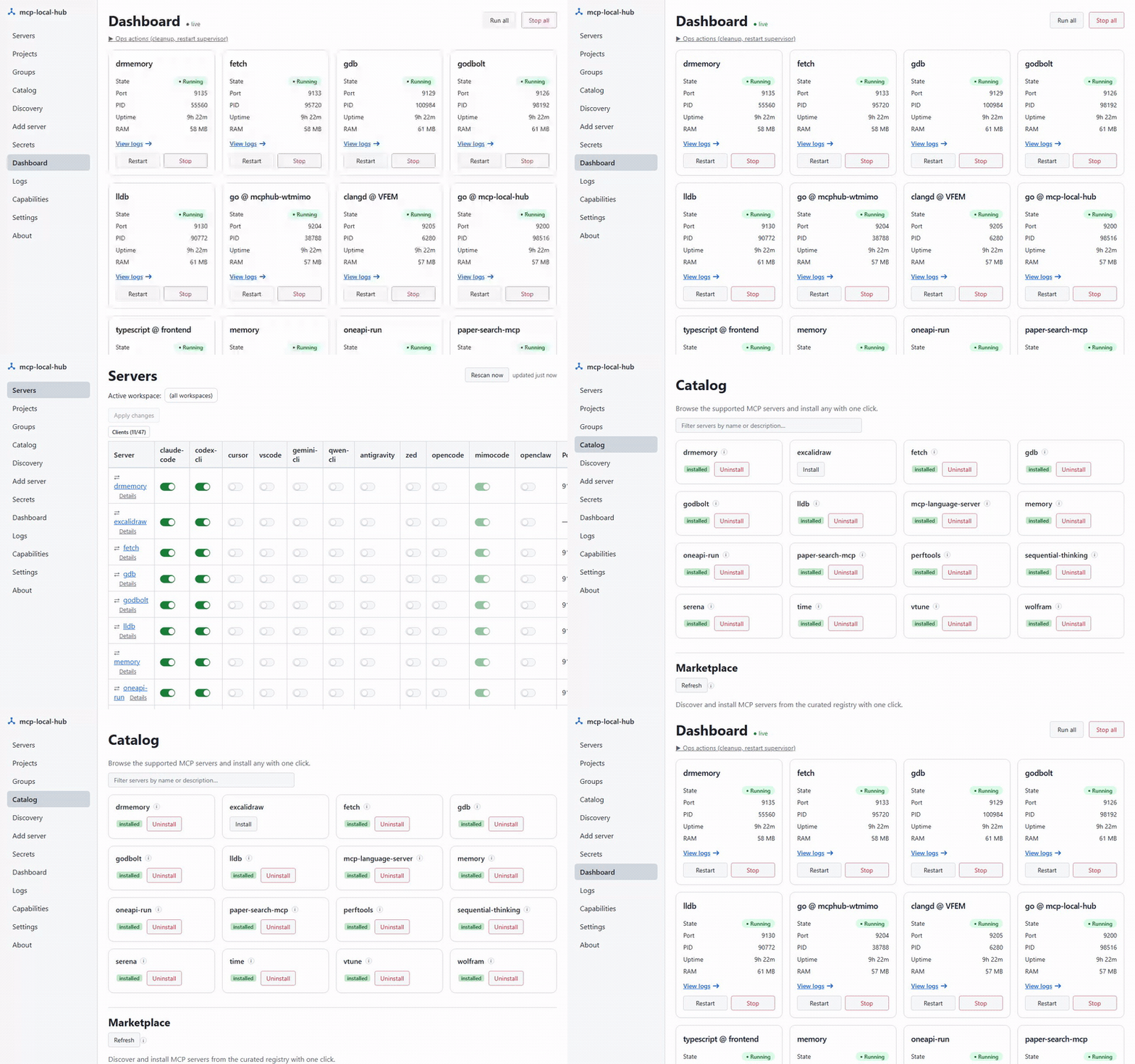
One managed local hub for every MCP server you use — N duplicate processes per server collapse to 1 shared daemon.
Run one copy of each Model Context Protocol server on your workstation, shared across every MCP client that needs it — instead of each client spawning its own redundant stdio process. Install the binary () once with , point your clients at the hub, and stop paying for the same server times.
Run one shared MCP server daemon per workstation — instead of each client (Claude Code, Codex CLI, Gemini CLI, Cursor, ...) spawning its own redundant stdio process. Windows-first hub with systray GUI, Task Scheduler integration, per-language LSP workspaces, and streamable HTTP routing.
星數
2
工具
—
可用率
—
mcphub
npm
N
[!WARNING]
Preview version: mcp-local-hub is actively under development. Interfaces,
manifests, GUI flows, install/migration behavior, and supported-client wiring
may still change. Windows 11 is the primary tested path, but not every
feature, server, client combination, or platform path is fully tested yet; use
dry-runs and backups before applying changes to important MCP client configs.
Install (npm)
For version 0.4.37, the npm distribution targets Windows x64 only; other
platforms are deferred and the 0.4.37 shim will reject them. The npm
package is mcp-local-hub; the command it installs is mcphub.
# 1. Install globally (npm places the `mcphub` command on PATH)
npm install -g [email protected]

# 2. Open the GUI — install servers with one click, see every daemon's health
mcphub gui
npm launches its native Product directly from the installed package. mcphub setup
is optional for explicit local testing/install mode, not an npm prerequisite.
The meta package ships no postinstall download script (the top npm
supply-chain attack vector) — npm installs the Windows x64 binary via an
optional dependency, and a tiny Node shim execs it. Building from source is
still supported for dev iteration — see
Building from source below.
Detailed setup, per-client behaviour, and troubleshooting in INSTALL.md.
Why mcphub — the problem and the cure
The problem. Every modern coding assistant (Claude Code, Codex CLI, Cursor, VS Code, Gemini CLI, Qwen Code CLI, Antigravity, Continue, ...) speaks MCP, and each client independently execs whatever stdio servers you configure — uvx serena, npx @modelcontextprotocol/server-memory, mcp-language-server, and so on. Run three assistants side-by-side on the same project and you get three Serena processes, three gopls subprocesses, three separate memory stores. Scale that across the editors, agents, and CLIs a working developer keeps open and you get dozens of duplicate node/python processes — each per-session spawn re-downloads dependencies, re-indexes your code, and eats RAM, all to do the same work the process next to it is already doing.
The cure.mcp-local-hub is one managed local hub: install once, and every client routes through it. Each MCP server runs once per OS user, supervised, restarted on failure, and shared — so the process tail compresses from N duplicate procs → 1 managed daemon each.
What this tool does
mcp-local-hub runs each MCP server once per OS user, exposes it as a local HTTP endpoint via Streamable HTTP transport, and writes the correct client-config entry into each managed MCP client. Clients see a shared daemon instead of their own child process.
Each MCP server runs once per OS user; every client shares the same
daemon over loopback HTTP instead of spawning its own copy. See
docs/supervisor-architecture.md for the
full lifecycle, state-file layout, migration, and per-OS behavior.
Stdio-only MCP servers (memory, time, sequential-thinking, wolfram, gdb, paper-search-mcp) run behind a native Go stdio-host (internal/daemon/host.go): one subprocess per daemon, multiplexed across concurrent HTTP clients via JSON-RPC id rewriting and a cached initialize response. Four servers (godbolt, lldb-bridge, perftools, vcpkg) ship as Go code embedded directly in the mcphub binary — no npm/pip dependency, starts instantly.
Antigravity's Cascade agent rejects loopback-HTTP MCP entries, so mcp-local-hub bridges it via a stdio relay subprocess: mcphub relay translates between stdio JSON-RPC and the shared HTTP daemon. Cascade sees a normal stdio command; the daemon stays shared.
Building from source
The npm install above is the fastest path. To build from source instead — for
dev iteration or to embed your own version metadata:
# 1. Build the admitted Windows product payload
pwsh ./build.ps1

# 2. Install to ~/.local/bin and register on user PATH (idempotent)
.\bin\mcphub.exe setup
build.sh remains the repository automation entry for supported non-Windows
build environments. On Windows, build.ps1 is the only product-payload route;
plain go build is a compile check whose output is not installable or
promotable.
Windows source builds produce one native file: bin/mcphub.exe as
WINDOWS_GUI (PE subsystem 2), plus the non-executable admitted identity
bin/windows-product-identity.json. The repository-only validator reads the
PE and version resource without executing it; no validator or launcher helper
is shipped.
The Windows platform subpackage deliberately has no npm bin mapping. The
meta package alone generates the public mcphub Node shim, which synchronously
relays arguments, standard streams, and exit status to mcphub.exe. GUI,
Explorer, shortcut, background, and explicit command modes all use that same
native product image.
--debug-console remains accepted as an exact first argument for compatibility:
mcphub --debug-console [command ...]
--debug-console must be the exact first argument. It affects only that
mcphub process, preserves redirected standard input/output/error, and is not
available through an environment variable, config key, subcommand flag, or
implicit gui, --foreground, --no-tray, supervise, or restart mode.
Background children remain console-free. GUI editor launches require a Windows
GUI-subsystem executable.
Whether you installed via npm or built from source, the rest is identical — use
the CLI to install the servers you want shared and verify they connect:
# Install the MCP servers you want shared
mcphub install --server serena       # default clients: Claude/Codex/Cursor
mcphub install --all                 # all 17 global servers, default clients

# Materialize one server in supervisor intent without touching client configs
mcphub install --server fetch --no-client-config

# Optional client targeting
mcphub install --server serena --clients qwen-cli,vscode
mcphub install --server serena --all-clients

# Verify
mcphub status
claude mcp get serena    # shows: Status: ✓ Connected, Type: http
Thirteen highlighted servers
The binary embeds 18 manifests. mcphub install --all installs the 17 global
servers; mcp-language-server is workspace-scoped and is materialized through
mcphub register. The table below highlights 13 commonly used servers rather
than claiming to enumerate the complete embedded catalog.
Server
Port
Transport
Notes
serena (×2 daemons)
9121 / 9122
native-http (uvx)
Flagship: per-client daemons (claude / codex) for context isolation
memory
9123
stdio-bridge (npx)
Shared JSONL write-serialized across all clients
sequential-thinking
9124
stdio-bridge (npx)
Stateless reasoning helper
wolfram
9132
stdio-bridge (node)
Requires wolfram_app_id secret
godbolt
9126
embedded Go
Compiler Explorer — compile/execute/disasm via godbolt.org + optimization remarks, llvm-mca, pahole
paper-search-mcp
9127
stdio-bridge (uvx)
Requires unpaywall_email secret
time
9128
stdio-bridge (npx)
Trivial stateless
gdb
9129
stdio-bridge (uv run)
Multi-debugger with session management
lldb
9130
embedded Go bridge
Auto-spawns lldb.exe, HTTP-multiplexes concurrent clients onto single TCP connection
perftools
9131
embedded Go
clang-tidy + llvm-objdump + include-what-you-use over real projects; hyperfine is opt-in only (RCE surface — set MCP_LOCAL_HUB_ENABLE_UNSAFE_HYPERFINE=1, see INSTALL)
vcpkg
9138
embedded Go
vcpkg/CMake diagnostics — build-failure triage across nested builds, overlay-port precedence, pin auditing, static patch-apply order, CMake include graph. Read-only: never starts a build. Every tool answers ok|failed|unknown(reason); see servers/vcpkg/README.md for how to read the verdicts
hfss
9139
stdio-bridge (uvx)
Ansys HFSS — cancellable solves, validated volume meshes, and generalized plus renormalized Touchstone
cst
9140
stdio-bridge (uvx)
CST Studio Suite — cancellable solves, documented mesh export, portable results, and port-mode progression
Plus context7 as a direct HTTPS entry (no daemon, no scheduler task).
Embedded vs external servers
Four servers (godbolt, lldb-bridge, perftools, vcpkg) are implemented as Go packages inside internal/<name>/ and run as subcommands of the mcphub binary itself — no external runtime dependency. The first three also ship as independent standalone binaries via go build ./cmd/<name> for users who want just that one server without the full hub. vcpkg intentionally follows the hub-only in-binary pattern and has no standalone cmd/vcpkg executable.
Performance-review workflow combining multiple servers in one chat:
# audit real project for perf antipatterns
perftools.clang_tidy(files=["src/hot.cpp"], checks="performance-*")

# sanity-check asm on godbolt with optimization remarks
godbolt.compile_code(source=..., filters={optOutput: true, intel: true})

# statistical bench (requires opt-in: MCP_LOCAL_HUB_ENABLE_UNSAFE_HYPERFINE=1 on
# the perftools daemon — see INSTALL.md "Opting into hyperfine")
perftools.hyperfine(commands=["./old_bin", "./new_bin"], warmup=3)

# verify the LTO-linked final binary keeps the vectorization
perftools.llvm_objdump(binary="./new_bin", project_root=".", function="hot_loop")
Supported clients
Default install targets are claude-code and codex-cli.
cursor, vscode, gemini-cli, qwen-cli, antigravity, zed, kiro, windsurf,
cline, kilocode, opencode, hermes, and openclaw are opt-in via
--clients ... or --all-clients, so install does not silently mutate every
assistant installed on the workstation.
Client
Install mode
Version/status
Config path
Transport
Claude Code CLI
Default
2.1.112 tested
~/.claude.json
HTTP (type: "http")
Codex CLI
Default
0.121.0 tested
~/.codex/config.toml
HTTP (streamable_http)
Cursor
Opt-in
Preview; live smoke pending
~/.cursor/mcp.json
HTTP (type: "http")
VS Code
Opt-in
Preview; live smoke pending
user-profile mcp.json
HTTP (type: "http")
Gemini CLI
Opt-in
0.38.1 tested
~/.gemini/settings.json
HTTP (type: "http")
Qwen Code CLI
Opt-in
Preview; live smoke pending
~/.qwen/settings.json
HTTP (httpUrl)
Antigravity IDE
Opt-in
v0.x tested
~/.gemini/antigravity/mcp_config.json
stdio relay -> HTTP
Zed
Opt-in
Preview; built from upstream docs, live smoke pending
~/.config/zed/settings.json (%APPDATA%\Zed\settings.json on Windows)
stdio relay -> HTTP (context_servers)
Kiro
Opt-in
Preview; built from upstream docs, live smoke pending
~/.kiro/settings/mcp.json
HTTP
Windsurf
Opt-in
Preview; built from upstream docs, live smoke pending
~/.codeium/windsurf/mcp_config.json
HTTP (serverUrl)
Cline
Opt-in
Preview; built from upstream docs, live smoke pending
VS Code globalStorage …/saoudrizwan.claude-dev/settings/cline_mcp_settings.json
HTTP (type: "streamableHttp")
Kilo Code
Opt-in
Preview; built from upstream docs, live smoke pending
VS Code globalStorage …/kilo-code.kilo-code/settings/mcp_settings.json
HTTP
OpenCode
Opt-in
Preview; built from upstream docs, live smoke pending
~/.config/opencode/opencode.json
HTTP
Hermes
Opt-in
Preview; built from upstream docs, live smoke pending
~/.hermes/config.yaml
HTTP
OpenClaw
Opt-in
Preview; built from upstream docs, live smoke pending
~/.openclaw/openclaw.json
HTTP
Antigravity note: Cascade rejects loopback-HTTP MCP entries, so mcp-local-hub writes a stdio relay entry instead — mcphub.exe relay --server <name> --daemon <d>. Cascade spawns the relay as a normal stdio subprocess; the relay forwards JSON-RPC to the shared HTTP daemon. No extra server process per Antigravity session.
CLI surface
The commands you reach for day to day:
Command
What it does
mcphub setup
Optional explicit local install/testing mode: install to ~/.local/bin and register on user PATH
Materialize only that server's daemon/supervisor intent; do not read or write MCP client configs
mcphub install --all
Bulk install every manifest under servers/ into default clients
mcphub status
Show state of every mcp-local-hub-* task (Running / Scheduled / Stopped) with PID, RAM, uptime, next-run
mcphub restart --server <n> / --all
Stop + re-launch one or all daemons
mcphub scan
Classify every MCP entry across managed clients (via-hub, can-migrate, unknown, per-session, not-installed)
mcphub migrate --server <n>
Rewrite stdio client entries to hub HTTP for a given server
mcphub secrets {init,set,get,list,…}
Age-encrypted vault for API keys
mcphub rollback
Restore the latest client-config backup for every client
mcphub version
Print version, commit, build metadata
The full command surface — install flags, discovery/migration, logs/backups/recovery,
scheduler/secrets, and the hidden transport shims — is in
docs/cli-reference.md.
Architecture highlights
One admitted Windows Product image — the public npm command is a Node shim
that launches the native executable in the npm package. Generated background
launches use that admitted image, retaining an authenticated active Product owner.
~/.local/bin remains the optional explicit-local install and fixed storage policy;
production npm use requires no promotion or executable copy there.
First-run onboarding — mcphub setup --trusted-root blesses LSP trusted roots up front; the GUI shows a dismissable welcome banner until the first server is installed.
go:embed manifests — all 18 server manifests are baked into the binary, so the binary runs without a sibling servers/ directory. install --all targets the 17 global manifests; the remaining manifest is workspace-scoped.
Embedded entry patterns — godbolt, lldb-bridge, and perftools expose a NewCommand() factory imported by both a standalone binary and the hub subcommand. vcpkg exposes the same factory only to the hub subcommand because it is deliberately hub-only.
Native Go stdio-host with child-exit detection — one subprocess per daemon, multiplexed across concurrent HTTP clients, with child-exit detection feeding Task Scheduler's restart policy.
A single long-lived mcphub supervise process per user owns every MCP daemon,
restarts it on failure, and shares it across clients. Full design — new commands
(supervise, strict-mode, autostart, install --upgrade), state-file
layout, v0.4.x migration flow, and per-OS behavior matrix — is in
docs/supervisor-architecture.md.
Current status
Preview / Phase 3B-II hardening — the core CLI, daemon layer, Windows GUI,
tray, secrets, settings, backup, migration, and workspace-scoped LSP surfaces
are in the tree. Phase 3A and Phase 3B-I are closed; Phase 3B-II has delivered
multiple follow-up slices, but still needs the live/manual smoke matrix and
backlog reconciliation before a release-ready claim.
Delivered and documented:
17 built-in global servers (incl. HFSS, CST, and the gdb/lldb/godbolt/perftools/drmemory/vtune/oneapi-run debug+profile suite) plus a 52-row curated catalog (one-click install across engineering/CAD, music, data/BI, creative, science, PKM, office) and the direct HTTPS context7 entry.
22 user-facing CLI commands across install, migration, logs, backups,
scheduler, secrets, settings, cleanup, and version surfaces.
Go rewrites of godbolt and lldb, embedded as dual-entry servers.
Perftools wrapping clang-tidy, opt-in hyperfine, llvm-objdump, and iwyu.
PATH-based install model with mcphub setup.
go:embed manifests for filesystem-independent binaries.
Native stdio-host, child-exit detection, and Task Scheduler restart policy.
Local-loopback GUI, SSE event bus, dashboard, logs, migration matrix,
secrets/settings/about screens, Windows tray subprocess, and Playwright/E2E
infrastructure.
Workspace-scoped LSP lazy proxies and a Phase 3B-II live/manual smoke
checklist for tray, console, reboot, daemon kill, and multi-language LSP
validation.
Phase 3B-II release hardening — execute the D2/D3 live/manual smoke matrix and reconcile the remaining backlog before tagging.
Phase 3C+ candidate work — optional unified MCP endpoint and VS Code workspace/JSON5 import compatibility. (Richer health/capability status, the curated marketplace + one-click install, and remote-server http manifests have since SHIPPED — see the matrix below.)
Phase 4+ — Linux/macOS scheduler backends (systemd user units + launchd agents).
Feature & readiness matrix
A surface-by-surface map of what this project actually does today, with explicit honesty about preview-state coverage. See CONTRIBUTING.md for the promotion rules a row follows.
✅ Stable — fresh automated test coverage OR a recent live-smoke pass for the exact user-visible surface, AND no open critical caveat. Not "production-ready"; "works as advertised in this preview, with evidence."
⚠ Preview — feature is shipped and reachable, but live-smoke coverage is partial, an open caveat exists in work-items/bugs/ or the backlog, OR the surface may change in incompatible ways. Backups and dry-run before applying.
🚧 Roadmap — feature is acknowledged in the backlog but not yet shipped, OR currently exists only as a cross-compile path with no runtime evidence.
Surface
Status
Notes
Run on Windows
✅ Stable
Tested on Windows 11 (10.0.26100); primary platform
Run on Linux
🚧 Roadmap
Ubuntu CI builds/tests; install/scheduler not implemented
Run on macOS
🚧 Roadmap
darwin cross-build only; scheduler + force-kill probe stubbed
Auto-start on logon — Windows
✅ Stable
Task Scheduler with restart-on-failure
Auto-start on logon — Linux
⚠ Beta
systemd user units (F2) + loginctl enable-linger (F3) both implemented — mcphub autostart enable writes the --user unit, runs systemctl --user enable --now, then best-effort enable-linger so the supervisor survives logout; live-verify on a real systemd host pending
Auto-start on logon — macOS
🚧 Roadmap
launchd auto-start is not currently tracked in the backlog F-tier; manual launch only
Default client install
⚠ Preview
Claude Code, Codex CLI
Opt-in client install
⚠ Preview
Cursor (live-smoke pending), VS Code, Gemini-CLI, Qwen-CLI, Antigravity (stdio-relay), Zed (stdio-relay), Kiro, Windsurf, Cline, Kilo Code, OpenCode, Hermes, OpenClaw; built from upstream config docs, live smoke pending
Mozilla Public License Version 2.0 (MPL-2.0) — see LICENSE.
Commercial licenses and commercial versions are available by separate agreement
for teams that need different licensing terms, private distribution, support,
warranty, indemnity, integration, packaging, or proprietary deployment terms.
To discuss a commercial version or commercial license, contact Dmitry Denisenko
through GitHub at @applicate2628.
Unless and until a separate commercial agreement is signed, use, modification,
and distribution of this repository remain governed by MPL-2.0. A commercial
offer does not reduce the rights granted for the public source code under
MPL-2.0.
CLI: Command-Line Interface; commands such as mcphub install and
mcphub status.
Commercial license: separate private agreement for different licensing,
support, distribution, warranty, indemnity, integration, packaging, or
deployment terms.
Cursor: Cursor editor/agent client; an opt-in MCP client target
(--clients cursor) in this preview.
GUI: Graphical User Interface; the embedded local web interface and tray
surface.
MCP: Model Context Protocol; the protocol used by managed clients and
servers.
MPL-2.0: Mozilla Public License Version 2.0; the open-source license used
by this repository.
SSE: Server-Sent Events; the HTTP event stream used by the GUI.
VS Code: Visual Studio Code; opt-in MCP client target and future
workspace-import surface.
M
MCP Local Hub
applicate2628·2 顆星·
Run one shared MCP server daemon per workstation — instead of each client (Claude Code, Codex CLI, Gemini CLI, Cursor, ...) spawning its own redundant stdio process. Windows-first hub with systray GUI
Run one shared MCP server daemon per workstation — instead of each client (Claude Code, Codex CLI, Gemini CLI, Cursor, ...) spawning its own redundant stdio process. Windows-first hub with systray GUI, Task Scheduler integration, per-language LSP workspaces, and streamable HTTP routing.
上次檢查時間:2026-11-05。 Run one shared MCP server daemon per workstation — instead of each client (Claude Code, Codex CLI, Gemini CLI, Cursor, ...) spawning its own redundant stdio process. Windows-first hub with systray GUI, Task Scheduler integration, per-language LSP workspaces, and streamable HTTP routing.