接入你的智能体
從發布者安裝。不是 PlugMCP 端點。
遠端 URL 還是本機指令? 兩種安裝方式的差異
來自發布者
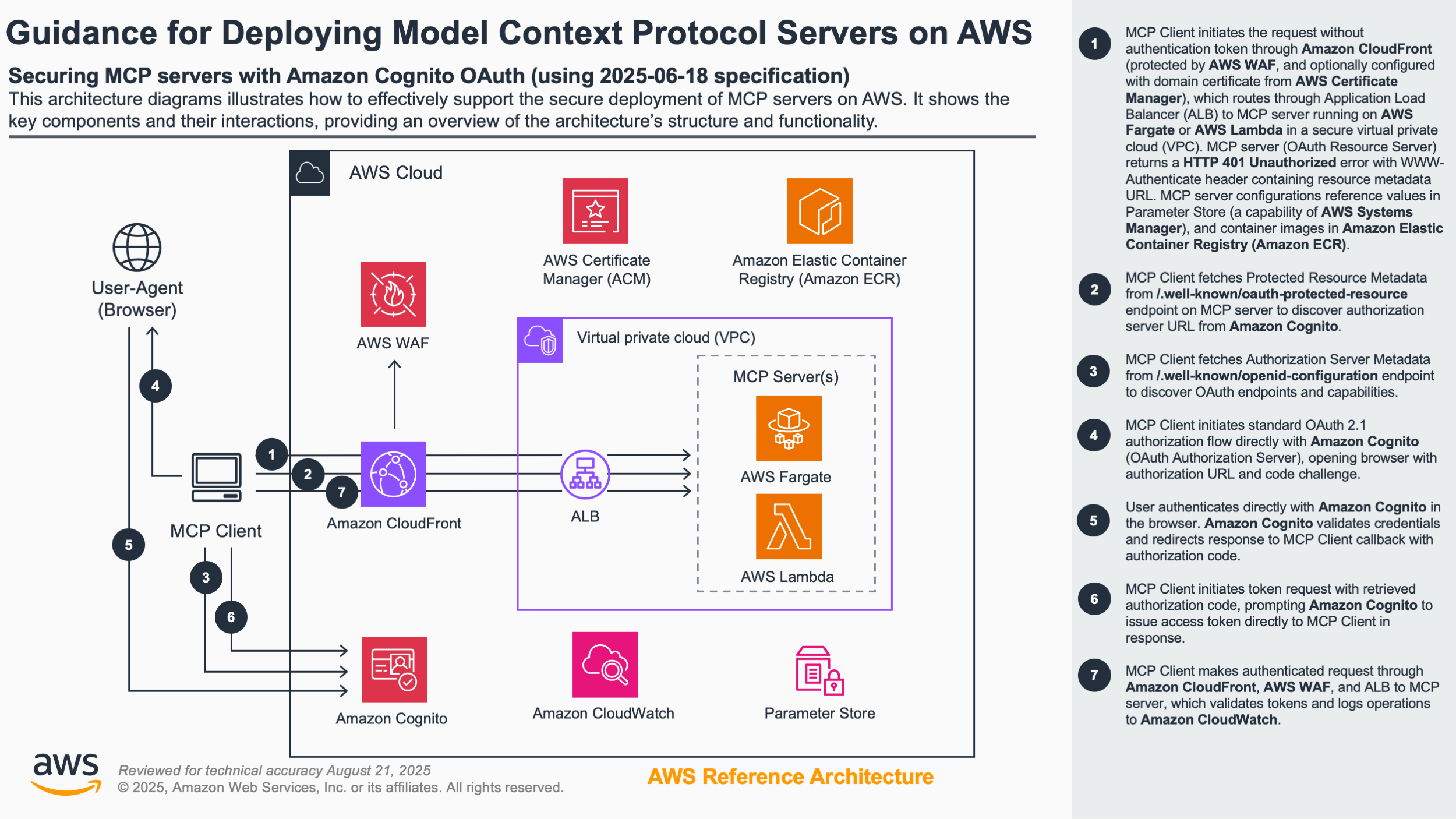
This Guidance demonstrates how to securely run Model Context Protocol (MCP) servers on the AWS Cloud using containerized architecture. It helps organizations implement industry-standard OAuth 2.0 authentication while protecting server deployments with multiple security layers, including content delivery networks and web application firewalls.
This guidance demonstrates how to deploy Model Context Protocol (MCP) servers on AWS with secure authentication using Amazon Cognito, implementing the 2025-06-18 MCP specification with OAuth 2.0 Protected Resource Metadata (RFC9728). It enables you to host MCP servers that can be accessed remotely while maintaining security through standards-compliant OAuth 2.0 authentication flows.
The solution addresses several key challenges:
The architecture implements:
You are responsible for the cost of the AWS services used while running this Guidance. As of August 2025, the cost for running this Guidance with the default settings in the US East (N. Virginia) Region is approximately $194.18 per month for processing moderate traffic levels.
We recommend creating a Budget through AWS Cost Explorer to help manage costs. Prices are subject to change. For full details, refer to the pricing webpage for each AWS service used in this Guidance.
The following table provides a sample cost breakdown for deploying this Guidance with the default parameters in the US East (N. Virginia) Region for one month.
These deployment instructions are optimized to work on Amazon Linux 2 AMI. Deployment in another OS may require additional steps.
If you're using AWS CDK for the first time, bootstrap your account:
cdk bootstrap
Clone the repository:
git clone <repository-url>
cd guidance-for-deploying-model-context-protocol-servers-on-aws
cd source/cdk/ecs-and-lambda
Install dependencies:
npm install
Login to public ECR:
aws ecr-public get-login-password --region us-east-1 | docker login --username AWS --password-stdin public.ecr.aws
Deploy the stacks:
Without domain configuration:
cdk deploy --all
Or with domain configuration (single region - us-east-1):
cdk deploy --all --context cdnCertificateArn=arn:aws:acm:us-east-1:123456789012:certificate/abc123 --context albCertificateArn=arn:aws:acm:us-east-1:123456789012:certificate/abc123 --context customDomain=mcp-server.example.com
Or with multi-region certificate configuration:
cdk deploy --all --context cdnCertificateArn=arn:aws:acm:us-east-1:123456789012:certificate/abc123 --context albCertificateArn=arn:aws:acm:eu-west-1:123456789012:certificate/def456 --context customDomain=mcp-server.example.com
Or with CloudFront HTTPS only (ALB stays HTTP):
cdk deploy --all --context cdnCertificateArn=arn:aws:acm:us-east-1:123456789012:certificate/abc123 --context customDomain=mcp-server.example.com
Update MCP servers:
Without domain configuration:
cdk deploy MCP-Server
Or with domain configuration:
cdk deploy MCP-Server --context cdnCertificateArn=arn:aws:acm:us-east-1:123456789012:certificate/abc123 --context albCertificateArn=arn:aws:acm:us-east-1:123456789012:certificate/abc123 --context customDomain=mcp-server.example.com
Verify CloudFormation stack status:
Validate Cognito setup:
Verify infrastructure:
For development and testing environments only, you can quickly create and manage users with AWS CLI:
# Create test user
aws cognito-idp admin-create-user --user-pool-id YOUR_USER_POOL_ID --username [email protected]

# Set permanent password (bypass temporary)
aws cognito-idp admin-set-user-password --user-pool-id YOUR_USER_POOL_ID --username [email protected] --password "TestPass123!" --permanent
The deployment includes a sample Python MCP client that demonstrates OAuth 2.0 Protected Resource authentication with the deployed servers. This client implements the 2025-06-18 MCP specification with StreamableHTTP transport.
Note: This client is a modified version of the simple-auth-client example from the official MCP Python SDK.
The included Python client (source/sample-clients/simple-auth-client-python/) demonstrates:
Important: This implementation does not support Dynamic Client Registration (DCR). Client credentials must be pre-configured in AWS Cognito and provided via environment variables.
Navigate to the client directory:
cd source/sample-clients/simple-auth-client-python
Install dependencies with uv:
pip install uv
uv sync --reinstall
Set environment variables:
export MCP_SERVER_URL="https://<your-cloudfront-endpoint>/weather-nodejs/mcp"
export OAUTH_CLIENT_ID="<your-cognito-client-id>"
export OAUTH_CLIENT_SECRET="<your-cognito-client-secret>"
Run the client:
uv run python -m mcp_simple_auth_client.main
Test available endpoints:
https://<your-cloudfront-endpoint>/weather-nodejs/mcphttps://<your-cloudfront-endpoint>/weather-nodejs-lambda/mcpThe client will automatically handle the OAuth flow, open a browser for authentication, and provide an interactive CLI to test the MCP tools.
Implement additional MCP servers:
Optimize costs:
Enhance security:
Remove deployed resources:
cdk destroy --all
Manual cleanup steps:
For detailed information, refer to these additional documentation files:
cdnCertificateArn) must be in us-east-1albCertificateArn) must be in the deployment regionFor any feedback, questions, or suggestions, please use the issues tab under this repo.
source/cdk/ecs-and-lambda/ for better organizationCustomers are responsible for making their own independent assessment of the information in this Guidance. This Guidance: (a) is for informational purposes only, (b) represents AWS current product offerings and practices, which are subject to change without notice, and (c) does not create any commitments or assurances from AWS and its affiliates, suppliers or licensors. AWS products or services are provided "as is" without warranties, representations, or conditions of any kind, whether express or implied. AWS responsibilities and liabilities to its customers are controlled by AWS agreements, and this Guidance is not part of, nor does it modify, any agreement between AWS and its customers.
This Guidance demonstrates how to securely run Model Context Protocol (MCP) servers on the AWS Cloud using containerized architecture. It helps organizations implement industry-standard OAuth 2.0 auth
總覽
This Guidance demonstrates how to securely run Model Context Protocol (MCP) servers on the AWS Cloud using containerized architecture. It helps organizations implement industry-standard OAuth 2.0 authentication while protecting server deployments with multiple security layers, including content delivery networks and web application firewalls.
工具
尚無工具清單。遠端伺服器會在首次健康檢查後取得工具清單。
常見問題
在本頁複製適用於 Cursor、Claude Desktop、Claude Code 或 VS Code 的 stdio 設定。它使用發布者的安裝方式,而不是 PlugMCP 代理伺服器。
這筆記錄未列出必要的環境變數。
Guidance For Deploying Model Context Protocol Servers On Aws 透過 stdio 在本機執行。
上次檢查時間:2026-10-28。 This Guidance demonstrates how to securely run Model Context Protocol (MCP) servers on the AWS Cloud using containerized architecture. It helps organizations implement industry-standard OAuth 2.0 authentication while protecting server deployments with multiple security layers, including content delivery networks and web application firewalls.
