swagger-mcp
Overview
swagger-mcp is a tool that reads a Swagger 2.0 or OpenAPI 3.0 specification and dynamically generates MCP tools at runtime — one tool per API endpoint. These tools can be used by any MCP client for LLM-driven API interaction.
接入你的智能体
從發布者安裝。不是 PlugMCP 端點。
遠端 URL 還是本機指令? 兩種安裝方式的差異
來自發布者
swagger-mcp is a tool that reads a Swagger 2.0 or OpenAPI 3.0 specification and dynamically generates MCP tools at runtime — one tool per API endpoint. These tools can be used by any MCP client for LLM-driven API interaction.
mcp server which will dynamically define tools based on swagger
Supported spec formats:
swagger: "2.0") — path/query/header parameters and in: body request bodiesopenapi: "3.0.x") — path/query/header parameters and requestBody with inline or $ref schemasRequired and optional fields are read from the schema's required array and honoured in the generated tool definitions.
If you find this project valuable, please support me on LinkedIn by:
Your support on LinkedIn will help me reach more people and improve the project!
To use swagger-mcp, ensure you have the following dependencies:
go install github.com/danishjsheikh/swagger-mcp@latest
swagger-mcp --specUrl=https://your_swagger_api_docs.json
swagger-mcp --specUrl=https://your_swagger_api_docs.json --sse --sseAddr=:8080
swagger-mcp --specUrl=https://your_swagger_api_docs.json --http --httpAddr=:8080
Xquik publishes a remote OpenAPI document for its X/Twitter automation API.
Because it uses an API key header, pass the key with --security=apiKey and
--apiKeyAuth:
export XQUIK_API_KEY="your-xquik-api-key"

swagger-mcp \
  --specUrl=https://xquik.com/openapi.json \
  --baseUrl=https://xquik.com \
  --security=apiKey \
  --apiKeyAuth=header:x-api-key=$XQUIK_API_KEY
The same arguments can be used in an MCP client config:
{
  "mcpServers": {
    "xquik": {
      "command": "swagger-mcp",
      "args": [
        "--specUrl=https://xquik.com/openapi.json",
        "--baseUrl=https://xquik.com",
        "--security=apiKey",
        "--apiKeyAuth=header:x-api-key=<XQUIK_API_KEY>"
      ]
    }
  }
}
To integrate with mcphost, include the following configuration in .mcp.json:
{
    "mcpServers": {
        "swagger_loader": {
            "command": "swagger-mcp",
            "args": ["--specUrl=<swagger/doc.json_url>"]
        }
    }
}
With bearer auth and path filtering:
{
    "mcpServers": {
        "swagger_loader": {
            "command": "swagger-mcp",
            "args": [
                "--specUrl=https://api.example.com/openapi.json",
                "--security=bearer",
                "--bearerAuth=your-token-here",
                "--includeMethods=GET,POST"
            ]
        }
    }
}
Both Swagger 2.0 and OpenAPI 3.0 request bodies are supported:
parameters with in: body and a $ref or inline schema under definitionsrequestBody.content.<media-type>.schema — resolved from components/schemas if a $ref, or used inline if an object schemaFields listed in the schema's required array are marked as required in the MCP tool. All other fields are optional and are omitted from the request if not provided.
Some Backend:
go install github.com/danishjsheikh/go-backend-demo@latest
go-backend-demo
Ollama
ollama run llama3.2
MCP Client
go install github.com/mark3labs/mcphost@latest
mcphost -m ollama:llama3.2 --config <.mcp.json_file_path>
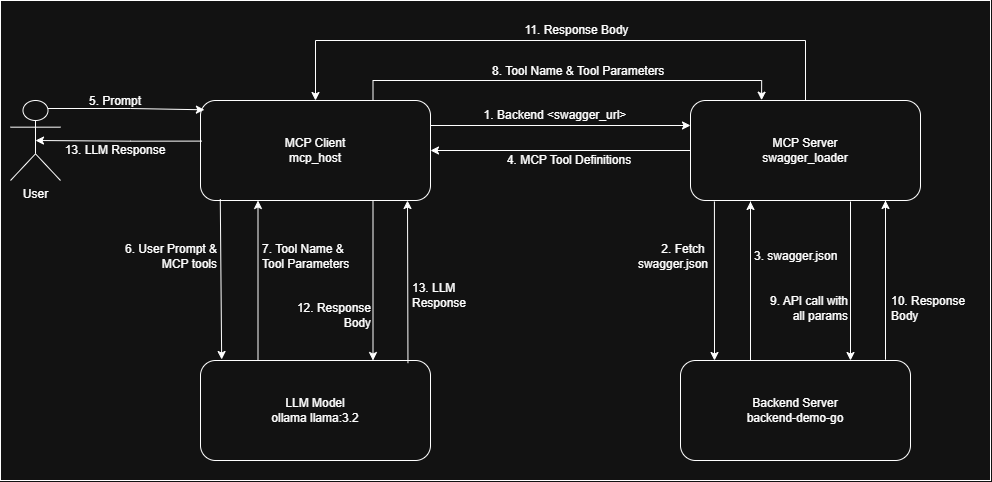
I am working on improving tool definitions to enhance:
✅ Better error handling for more accurate responses
✅ LLM behavior control to ensure it relies only on API responses and does not use its own memory
✅ Preventing hallucinations and random data generation by enforcing strict data retrieval from APIs
If you have insights or suggestions on improving these aspects, please contribute by:
Your input will be invaluable in making this tool more reliable and effective! 🚀
mcp server which will dynamically define tools based on swagger
工具
尚無工具清單。遠端伺服器會在首次健康檢查後取得工具清單。
常見問題
在本頁複製適用於 Cursor、Claude Desktop、Claude Code 或 VS Code 的 stdio 設定。它使用發布者的安裝方式,而不是 PlugMCP 代理伺服器。
這筆記錄未列出必要的環境變數。
Swagger 透過 stdio 在本機執行。
上次檢查時間:2026-11-05。 mcp server which will dynamically define tools based on swagger
