D365 F&O MCP Server
22 AI tools that know every X++ class, table, form, and EDT in your D365FO codebase
接入你的智能体
發布者自己的指令。不是 PlugMCP 端點。
用我們的金鑰與日誌託管一份副本。
npx -y [email protected]Claude Code 沒有本機指令的安裝連結。複製下方指令並在終端機中執行。
claude mcp add dynamics365ninja-d365fo-mcp-server -- npx -y d365fo-mcp@1.21.0在終端機中執行。
{ "mcpServers": { "dynamics365ninja-d365fo-mcp-server": { "command": "npx", "args": [ "-y", "[email protected]" ] } }}claude_desktop_config.json
遠端 URL 還是本機指令? 兩種安裝方式的差異
Grounded AI development for Dynamics 365 Finance & Operations — works with GitHub Copilot and Claude Code
These connect an editor to a server that is already deployed — see Quick Start if you still need to set one up.
AI assistants excel at C#, Python, and JavaScript. X++ is different: your D365FO codebase is private, deeply customized, and invisible to every model — so AI confidently generates code that doesn't compile.
This server pre-indexes your entire D365FO installation (580 000+ symbols across standard, ISV, and custom models) and exposes it as 22 specialized MCP tools (axdb_sql and trace_d365fo only once configured). Every signature, every CoC wrapper, every label, every form pattern — verified against your real metadata before the AI writes a single line.
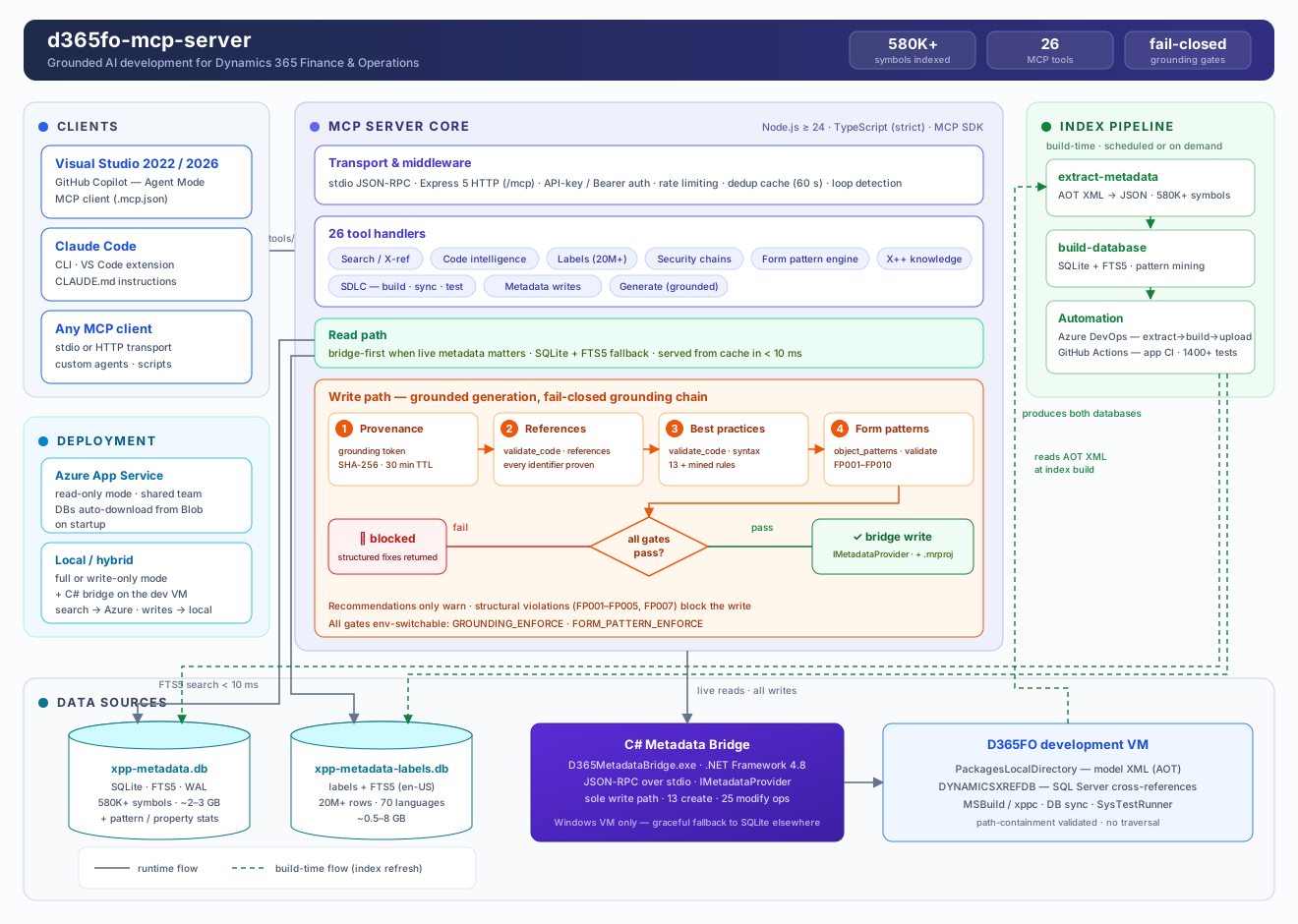
Forms are the hardest artifact to generate correctly — each pattern dictates required containers, ordering, and allowed sub-patterns. The form pattern engine makes it a guided pipeline:
flowchart LR
    A["object_patterns<br/>(domain=form, action=analyze)"] --> B["object_patterns<br/>(domain=form, action=spec)"]
    B --> C["generate_object<br/>objectType=form, cloneFrom"]
    C --> D["object_patterns<br/>(domain=form, action=validate) FP001–FP010"]
    D -->|clean| E["d365fo_file<br/>(action=create) write + project"]
    D -->|errors| C
Structural violations (wrong order, missing container, disallowed control) block the write — recommendations only warn. Mined pattern statistics from your own environment ground every suggestion in reality.
From D365FO platform update 10.0.49 (PU74), Visual Studio 2026 is the supported IDE for X++ development — Microsoft no longer supports VS 2022. Earlier platform versions still use VS 2022 ≥ 17.14. Details
Installing on your own D365FO VM — the usual case. One line in PowerShell installs Node.js if it is missing, installs the server from npm, and runs the setup wizard, which asks where the index should live and builds the C# bridge for you:
irm https://raw.githubusercontent.com/dynamics365ninja/d365fo-mcp-server/main/install.ps1 | iex
Already have Node.js 24+? Then the one-liner has nothing to bootstrap and you can skip it:
npm install -g d365fo-mcp
d365fo-mcp setup
Re-running either is safe. An installation made before the npm package existed is a git checkout, and both are left exactly where they are and updated in place.
Your team already runs a shared server? Then you install nothing — point your editor at it:
npx d365fo-mcp connect https://your-server.azurewebsites.net
Both paths in full — prerequisites, editor configuration for every scenario, the required instruction file, and how to verify grounding actually works: docs/QUICK_START.md
One shared instance for the whole team — the metadata index lives in Blob Storage and downloads automatically on startup.
Deployment guide: docs/SETUP_AZURE.md — includes CI/CD pipeline automation
MIT
Exposes MCP tools that prove every method, field, label and form pattern against your real metadata before the AI writes code.
{ "mcpServers": { "dynamics365ninja-d365fo-mcp-server": { "command": "npx", "args": [ "-y", "[email protected]" ] } }}工具
尚無工具清單。遠端伺服器會在首次健康檢查後取得工具清單。
常見問題
在本頁複製適用於 Cursor、Claude Desktop、Claude Code 或 VS Code 的 stdio 設定。它使用發布者的安裝方式,而不是 PlugMCP 代理伺服器。
這筆記錄未列出必要的環境變數。
D365fo 透過 stdio 在本機執行。
上次檢查時間:2026-10-28。 Exposes MCP tools that prove every method, field, label and form pattern against your real metadata before the AI writes code.
