MCP server that gives AI coding agents (Claude Code, Codex, Cursor)
accurate knowledge of the Siemens NXOpen .NET API — eliminating
hallucinated API calls via hybrid retrieval over your own NX installation's
official documentation.
MCP server giving AI coding agents accurate Siemens NXOpen .NET API knowledge via hybrid retrieval (BGE-M3 + sqlite-vec), built from your own licensed NX installation
星數
15
工具
—
可用率
—
Why
LLMs hallucinate NXOpen APIs: it's a niche domain (Siemens NX CAM/CAD
automation) with sparse public training data, so models confidently invent
classes, methods, and parameters that don't exist. This server grounds
agents in the real docs instead of guesses:
Semantic search (BGE-M3 dense + sparse embeddings) so natural-language
queries in English or 中文 find the right API even without exact names.
Exact-name channel: a literal CamelCase name in your query (e.g.
CavityMillingBuilder) is looked up directly and pinned to the top
(types first) — never left to approximate matching.
RRF fusion available to combine channels — though evaluation made
dense + exact the default (see Evaluation).
Everything runs locally and offline against an index built from your own
licensed NX installation — no Siemens files are ever bundled with this
repo or sent anywhere.
Quick start
Requires Python 3.11+.
# 1. Install from PyPI (or run without installing: uvx nxopen-mcp)
pip install "nxopen-mcp[embed,reflect]"

# 2. Build the index from YOUR NX installation (one-time — see time note below)
nxopen-mcp index --nx-path "D:\Siemens\NX12.0"

# 3. Register with Claude Code (user scope: available in every project)
claude mcp add -s user nxopen -- nxopen-mcp serve

# 4. Ask Claude Code to write NXOpen code — it now queries real APIs.
index looks for NXOpen*.xml doc files under <nx-path>\UGII\managed
(falling back to <nx-path> itself), and for NXOpen*.dll assemblies in
the same folder.
Extras: [embed] pulls in FlagEmbedding (downloads the ~2GB BGE-M3
model on first use) — required for indexing and semantic search.
[reflect] pulls in pythonnet so get_class can show inherited
members; skip it and indexing still works, just without inheritance
chains.
How long does indexing take? Honest numbers: a full NX 12 doc set is
~100k members; on an 8-core laptop CPU that's several hours of
embedding (memory-bandwidth-bound — --workers N helps mainly on
machines with more memory channels; a CUDA GPU helps a lot). Plan to run
it overnight, or copy a teammate's index (see
Sharing a pre-built index).
First semantic query is slow by design.serve starts instantly, and
get_class / get_member respond immediately, but the first
search_api / find_builder call loads the BGE-M3 model (~1–2 min).
After that, semantic queries take seconds. If your MCP client shows the
first search "hanging", it's the one-time model load — let it finish.
By default the index is written to ~/.nxopen-mcp/index.db; override with
--db <path> on both index and serve.
If nxopen-mcp isn't on your PATH (e.g. installed into a venv), use the
full path to the executable (Windows: <venv>\Scripts\nxopen-mcp.exe)
in the commands and configs below.
Alternatively, one CLI command does the same thing:
codex mcp add nxopen -- nxopen-mcp serve
Restart Codex, then verify with codex mcp list (or just ask it to look
up an NXOpen class — you'll see the nxopen tool calls). Note the same
first-semantic-query model load (~1–2 min) applies here.
Cursor
Add the same JSON block as .mcp.json above to Cursor's MCP settings
(project .cursor/mcp.json, or global via Settings → MCP).
Tools
tool
purpose
search_api
Hybrid semantic search over the API (dense + exact-name by default, sparse optional). Accepts English or 中文 queries; use when you don't know the exact class/member name.
get_class
Full member list for a class, including members inherited from its ancestor chain. Use when you know the class name.
get_member
Exact signature, parameters, return value, NX version, and license requirement for one member.
find_builder
Given a CAM operation name (e.g. "cavity milling", "hole drilling"), finds the matching *Builder class, its creator method, and a Builder → Commit → Destroy code skeleton.
Architecture
NXOpen*.xml / *.dll  (your NX install)
        │
        ▼
  indexer/parser.py        one XML doc-comment member -> one MemberRecord
  indexer/inheritance.py   optional: reflect DLLs (pythonnet) for base-class chains
        │
        ▼
  indexer/embedder.py      BGE-M3 dense vector + sparse token weights per record
        │
        ▼
  indexer/build.py         writes members, dense_vec (sqlite-vec), sparse_postings
        │                  into a single SQLite file (index.db)
        ▼
  retrieval/store.py       exact-name lookup, class/member/inheritance queries
  retrieval/hybrid.py      dense ANN + exact CamelCase match (default),
                           optional sparse channel, RRF fusion
        │
        ▼
  server.py                4 MCP tools (FastMCP, stdio transport)
  cli.py                   `nxopen-mcp index` / `nxopen-mcp serve`
Design decisions:
BYO-Docs licensing. This repository contains no Siemens XML/DLL
files. Users point nxopen-mcp index at their own licensed NX
installation; the resulting index is a local SQLite file that never
leaves the machine and is never committed (see .gitignore).
One-member-one-chunk. Each indexed unit is a single API member
(type, property, method, field, or event) rather than an arbitrary text
window, so retrieval results map 1:1 onto something an agent can act on
(a class, a method signature) instead of a fragment of a doc page.
RRF fusion, not score blending. When the sparse channel is enabled,
dense and sparse rankings are combined with Reciprocal Rank Fusion,
which is scale-free and doesn't require calibrating dense-vs-sparse
score magnitudes against each other (the evaluated default runs
dense + exact only).
Exact CamelCase name matches are promoted ahead of the fused list
outright, since a literal name in the query is a much stronger signal
than similarity.
Inheritance via reflection, with graceful degradation. Ancestor
chains (needed by get_class to show inherited members) are extracted
by reflecting the NXOpen DLLs with pythonnet ([reflect] extra) at
index time. If the extra isn't installed or DLLs aren't found alongside
the XML docs, indexing still succeeds — get_class simply has no
inherited members to show.
Evaluation
Measured on a real index built from an NX 12 installation (97,913 API
members) against a 73-query golden set (eval/golden.jsonl, mixed
English / Traditional Chinese, four query styles — semantic description,
exact class name, member lookup, builder idiom — spanning CAM, Features,
Sketch, Assemblies, Drawings, UF, and BlockStyler):
Same model (Claude Haiku), the original 33 golden questions, one
variable — whether the nxopen-mcp tools are available. Answers were graded against the golden
set; "hallucinated" means the proposed member does not exist anywhere in
the real 97,913-member index:
metric
closed-book (no tool)
with nxopen-mcp
exactly correct
13/33 (39.4%)
31/33 (93.9%)
wrong but real API
13/33 (39.4%)
2/33 (6.1%)
hallucinated (API does not exist)
7/33 (21.2%)
0/33 (0%)
time to answer all 33
84 s
321 s (44 tool calls)
The closed-book hallucinations are the dangerous kind — plausible names
like NXOpen.CAM.MillGeometryBuilder (real name: MillGeomBuilder) or
NXOpen.Session.Parts.Open (real: NXOpen.PartCollection.Open) that
read fine and fail at compile time. Tool-assisted answering costs ~7 s
per question and eliminated hallucinations entirely.
Evaluation-driven default. The original design fused dense, sparse
and exact-name channels with uniform RRF. Measurement showed BGE-M3's
sparse channel hurt on this corpus — on the initial 33-query set a
weight sweep (w_sparse ∈ {0.5, 0.3, 0.15}) never recovered the
dense-only baseline, and expanding the golden set to 73 queries
replicated the finding (Recall@5 58.9% → 49.3% when sparse is fused).
The exact-name channel — after reordering its matches (types first,
shortest name first, capped at 3) — matches dense recall while
improving MRR (0.420 → 0.445) and guaranteeing literal-name hits. The
default is therefore dense + exact; the sparse channel remains
available via the channels parameter of search().
Demo
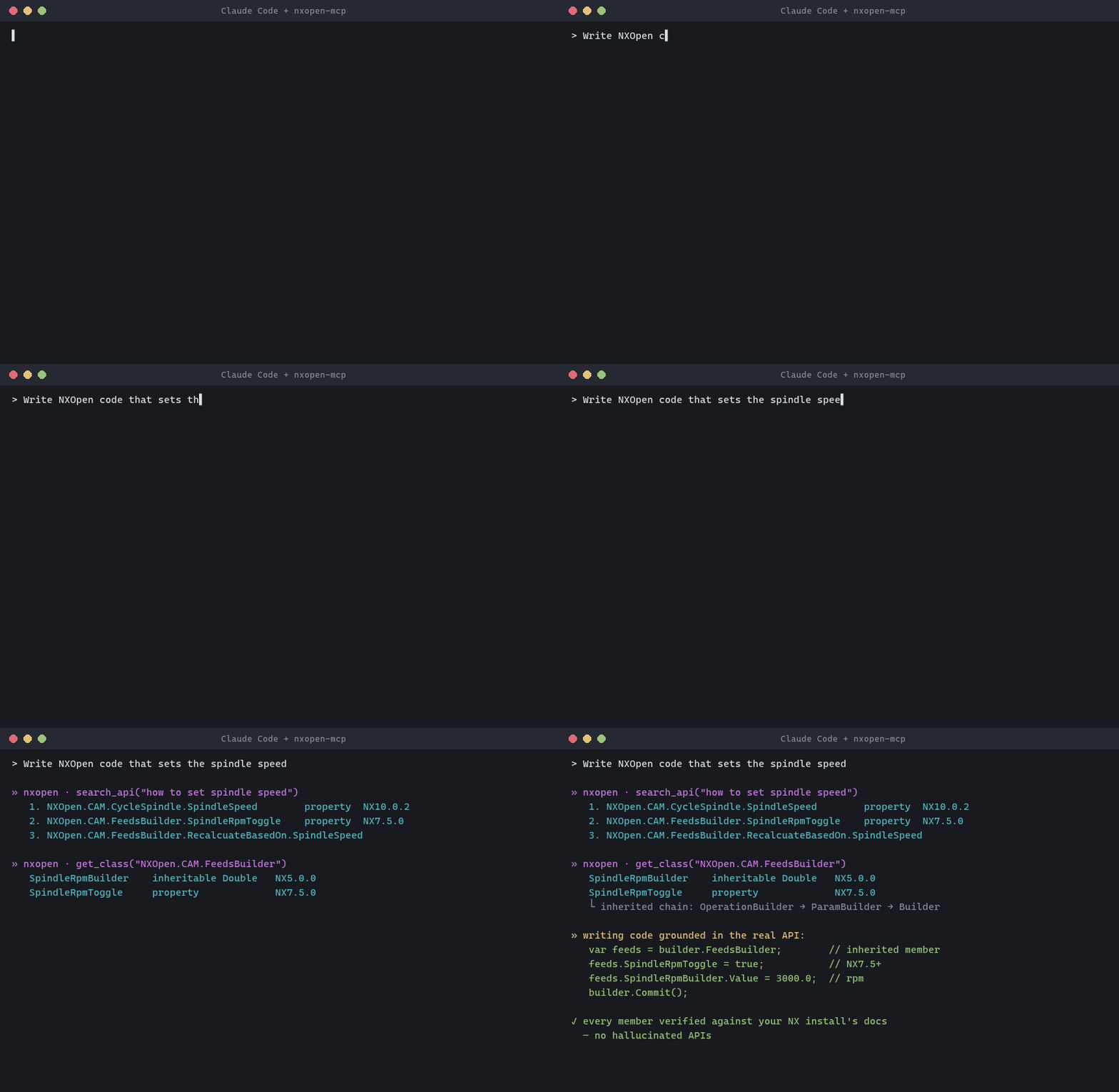
A real session: asked to write NXOpen code that sets the spindle speed,
Claude Code calls search_api (semantic search, English or Chinese) and
get_class (members + inheritance chain), then writes code in which every
member — FeedsBuilder, SpindleRpmToggle, SpindleRpmBuilder.Value —
exists in the real API, with NX version info to prove it.
Sharing a pre-built index
The index is a single SQLite file (~500 MB for a full NX 12 doc set), so
teammates can skip the hours-long build:
Install nxopen-mcp (the [reflect] extra is not needed — inheritance
chains are already baked into the index).
Copy the index file to ~/.nxopen-mcp/index.db (or keep it elsewhere
and pass --db <path> to serve).
Register the server: claude mcp add -s user nxopen -- nxopen-mcp serve
The BGE-M3 model (~2 GB) still downloads on the first semantic query —
it encodes the query text, independent of the index. Exact lookups
(get_class / get_member) never need the model.
Licensing boundary: the index embeds text from Siemens' API
documentation. Sharing it within an organization whose seats are
licensed for NX is reasonable; do not redistribute index files
publicly — anyone outside your license should build their own with
nxopen-mcp index.
License & IP
Code: MIT (see LICENSE). This repository contains no
Siemens files — no NXOpen XML docs, no DLLs. The index is built locally
from your own licensed NX installation's documentation via
nxopen-mcp index and never leaves your machine.
N
Nxopen
mingfeng6684·15 顆星·
MCP server giving AI coding agents accurate Siemens NXOpen .NET API knowledge via hybrid retrieval (BGE-M3 + sqlite-vec), built from your own licensed NX installation
上次檢查時間:2026-10-28。 MCP server giving AI coding agents accurate Siemens NXOpen .NET API knowledge via hybrid retrieval (BGE-M3 + sqlite-vec), built from your own licensed NX installation