image-gen-mcp
Generate and edit images from your coding agent, with your own API keys. Ask for a blog cover, a logo tweak, or a placeholder illustration, and the file lands directly in your project where the agent can read it and iterate.
接入你的智能体
發布者自己的指令。不是 PlugMCP 端點。
用我們的金鑰與日誌託管一份副本。
npx -y @nuver-labs/[email protected]Claude Code 沒有本機指令的安裝連結。複製下方指令並在終端機中執行。
claude mcp add nuver-labs-image-gen-mcp -- npx -y @nuver-labs/image-gen-mcp@0.2.1在終端機中執行。
{ "mcpServers": { "nuver-labs-image-gen-mcp": { "command": "npx", "args": [ "-y", "@nuver-labs/[email protected]" ] } }}claude_desktop_config.json
遠端 URL 還是本機指令? 兩種安裝方式的差異
來自發布者
Generate and edit images from your coding agent, with your own API keys. Ask for a blog cover, a logo tweak, or a placeholder illustration, and the file lands directly in your project where the agent can read it and iterate.
Stdio MCP server that generates and edits images with Gemini and OpenAI using your own API keys
Google Gemini image models (the Nano Banana family) and OpenAI GPT image models behind one interface. Configure one provider or both.
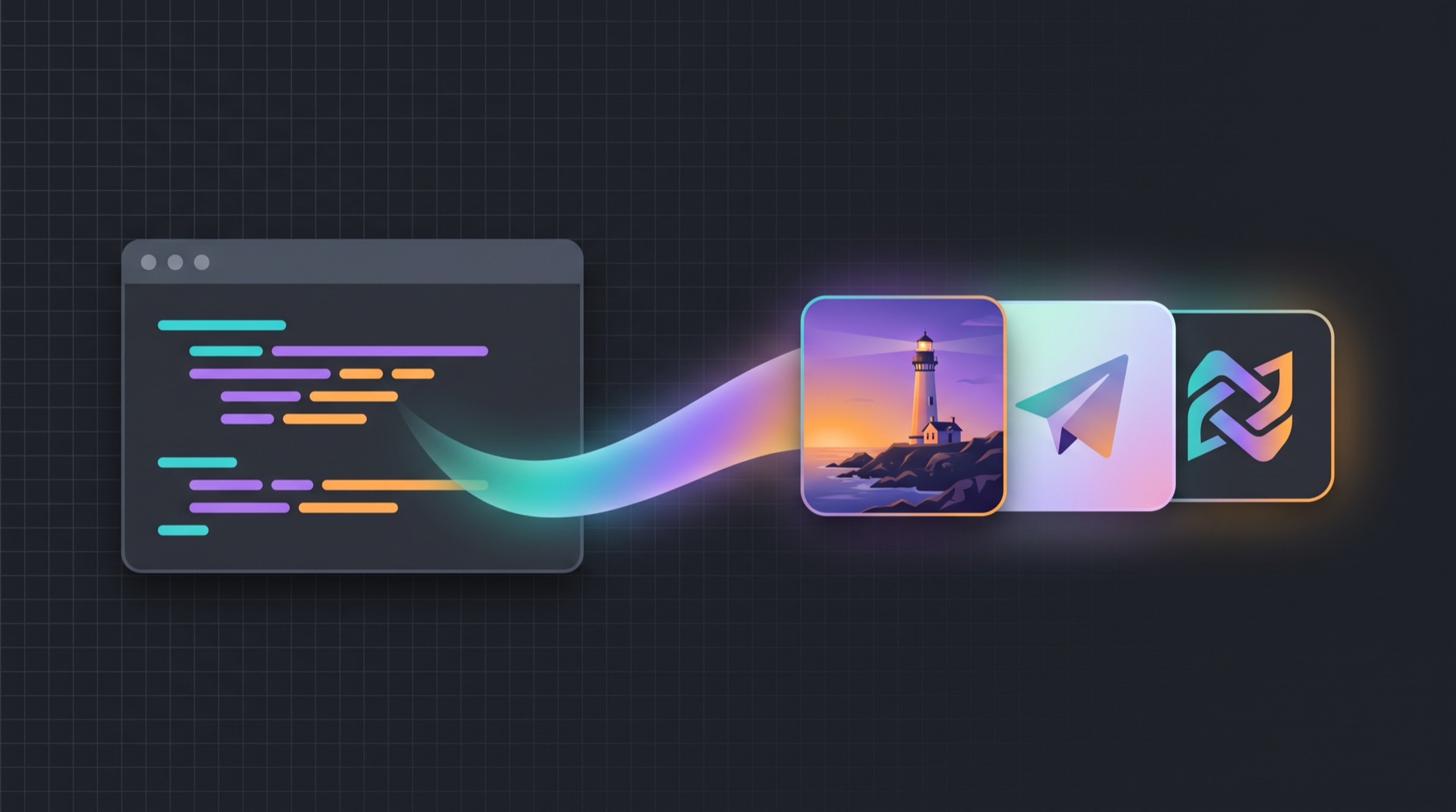
This banner and the repository's social preview card were both generated by
this server, with gemini-3.1-flash-image at 16:9 2K. Prompts are in
assets/README.md.
claude mcp add image-gen --scope user \
  --env GEMINI_API_KEY=your-gemini-key \
  --env OPENAI_API_KEY=your-openai-key \
  -- npx -y @nuver-labs/image-gen-mcp
Start a new Claude Code session to pick it up, then check claude mcp list.
Three things that trip people up:
--env and the server name.
Above, --scope does that job. Put the name straight after an --env pair and
the CLI reads it as another KEY=value.-- before the command is mandatory. Without it the server's own arguments
get parsed as Claude Code's.--env line for any provider you do not use. You need at least one.Get keys from Google AI Studio and the OpenAI platform.
Same package everywhere. For .mcp.json (project scope, commit it) and Claude
Desktop (~/Library/Application Support/Claude/claude_desktop_config.json):
{
  "mcpServers": {
    "image-gen": {
      "command": "npx",
      "args": ["-y", "@nuver-labs/image-gen-mcp"],
      "env": {
        "GEMINI_API_KEY": "your-gemini-key",
        "OPENAI_API_KEY": "your-openai-key"
      }
    }
  }
}
Claude Code also accepts a per-server "timeout": 600000, which Claude Desktop
does not. Cursor uses the same shape in .cursor/mcp.json. On Windows, GUI hosts
cannot always find npx, so use "command": "cmd" with
"args": ["/c", "npx", "-y", "@nuver-labs/image-gen-mcp"].
Just ask, in plain language:
assets/hero.png"public/logo.png and give it a transparent background"design/drafts/"The agent calls generate_image or edit_image with an absolute output_path
inside your project, the file lands on disk, and the agent can then read the saved
path to look at the result and refine it. If a call fails, ask it to run
list_capabilities to see what is actually configured.
Everything above, plus:
When output_path is omitted, the result is saved next to the first source image.
No arguments. Reports configured providers as booleans (never key values), the default provider and models, known model options, the output directory fallback chain, and any directory restriction in force.
With no output_path, files go to the first of: IMAGE_GEN_MCP_OUTPUT_DIR,
CLAUDE_PROJECT_DIR (set by Claude Code, points at the current project), the
server working directory.
This server runs locally with your full user privileges and is not sandboxed by the MCP client. Worth understanding before you grant it blanket tool approval.
What it can do. Writes image files to disk. Reads the image files you point
edit_image at. Sends your prompt, and any edit_image source image, to the
provider you selected. Makes billable API calls. That is the whole surface: three
tools, no shell execution, no arbitrary URL fetching, no telemetry.
File access. The model chooses output_path and source_paths, and by
default they are unrestricted, because that is what makes the tool useful: your
agent saves into whichever project you are working in. Note that Claude Code's
working-directory boundary does not extend to MCP servers, and Anthropic
does not security-audit third-party MCP servers.
To draw a hard boundary, set IMAGE_GEN_MCP_ALLOWED_DIRS:
IMAGE_GEN_MCP_ALLOWED_DIRS=/Users/you/projects,/Users/you/Desktop
Every output path and every edit_image source must then resolve inside one of
those roots. Paths are compared after realpath resolution, so a symlink pointing
out of a root is refused, and containment uses path segments rather than a string
prefix, so a sibling directory like /Users/you/projects-private does not slip
through. If none of the configured entries exist, the server refuses all file
access rather than silently running unrestricted.
API keys. Keys are read only from the environment, passed to the provider SDK
constructors, and used nowhere else. They are never logged, never written to the
ledger, and never returned by list_capabilities, which reports booleans.
The risk is where you put them, not what this server does with them. Keys inlined
into ~/.claude.json or claude_desktop_config.json sit in plaintext, readable by
any process running as you, and an agent asked to read its own config can print
them into a transcript. Prefer exporting from a shell profile or a secret manager,
chmod 600 the config files, and use a dedicated key with a spend limit rather
than a shared production key.
Spend. There is no built-in rate limit or cap. An agent in a retry loop can generate a lot of images quickly. Set OpenAI hard spend limits and Google Cloud budget alerts.
Local log. The ledger at ~/.image-gen-mcp/images.jsonl contains a truncated
copy of each prompt in plaintext and grows without bound. Disable it with
IMAGE_GEN_MCP_LOG_FILE=none, and do not commit it.
Prompt injection. Tool results re-enter the model's context. Prefer per-call
approval over blanket-allowing this server, and glance at the output path and any
edit_image source path when approving. Pin a version and review the diff before
upgrading.
Found a vulnerability? See SECURITY.md. Please do not open a public issue.
Every successful call records one structured JSON entry, two ways:
[image-gen-mcp] image {...} line, visible in /mcp
output and Claude Code logs.~/.image-gen-mcp/images.jsonl, one line per call. Ledger write failures never
break a generation, they warn once on stderr.Each entry captures the provider, model, requested size, elapsed seconds, a truncated prompt with its full character count, token usage when the provider reports it, and per-image details: saved path, byte size, human-readable size, mime type, and actual pixel dimensions.
tail -n 20 ~/.image-gen-mcp/images.jsonl
jq 'select(.usage) | .usage.totalTokens' ~/.image-gen-mcp/images.jsonl
Every call hits a paid API, typically cents per image, varying by provider, model,
quality, and size. Cheap options for drafts: OpenAI quality: low (roughly $0.006
for a low-quality 1024x1024 on gpt-image-2) or gpt-image-1-mini, and Gemini
gemini-3.1-flash-lite-image. Gemini's gemini-2.5-flash-image may have a free
tier on unbilled keys, so IMAGE_GEN_MCP_GEMINI_MODEL=gemini-2.5-flash-image
makes it the default.
Generation takes roughly 10 to 120 seconds depending on model and size. Claude
Code's defaults are generous and this server sends progress notifications during
long calls, so no tuning is normally needed. If you set a tight global
MCP_TOOL_TIMEOUT, add a per-server "timeout": 600000 in .mcp.json.
[image-gen-mcp] prefix. Claude Code surfaces
them in /mcp output and its logs.claude mcp list
and claude mcp get image-gen.Provider 'x' is not configured: that key is missing from the MCP server
environment. Re-register with the --env flag or edit your config.IMAGE_GEN_MCP_ALLOWED_DIRS is
set. Run list_capabilities to see the roots.return_image inlines a full image and can exceed the
MCP output token limit (MAX_MCP_OUTPUT_TOKENS, default 25k). Leave it off and
let the agent read the saved file.Requires Node 22+ and pnpm.
git clone https://github.com/nuver-labs/image-gen-mcp.git
cd image-gen-mcp
pnpm install
pnpm build
Then point your client at node /abs/path/to/image-gen-mcp/dist/index.js instead
of npx -y @nuver-labs/image-gen-mcp.
pnpm test      # unit tests, no API keys needed
pnpm inspect   # list the tools over real MCP stdio

# Live tests. These cost real API credits.
GEMINI_API_KEY=... node dist/smoke.js --provider gemini
OPENAI_API_KEY=... node dist/smoke.js --provider openai
node dist/smoke.js --provider gemini --edit ./smoke-output/smoke-gen-gemini.png
Bug reports, provider quirk fixes, and documentation improvements are welcome. See CONTRIBUTING.md. For anything larger, open an issue first.
Planned: OpenAI mask and inpainting support, migration off the legacy Gemini
generateContent image path to the Interactions API, and more providers.
Built by Nuver Labs.
Stdio MCP server that generates and edits images with Gemini and OpenAI using your own API keys
{ "mcpServers": { "nuver-labs-image-gen-mcp": { "command": "npx", "args": [ "-y", "@nuver-labs/[email protected]" ] } }}工具
尚無工具清單。遠端伺服器會在首次健康檢查後取得工具清單。
常見問題
在本頁複製適用於 Cursor、Claude Desktop、Claude Code 或 VS Code 的 stdio 設定。它使用發布者的安裝方式,而不是 PlugMCP 代理伺服器。
這筆記錄未列出必要的環境變數。
@nuver Labs/image Gen 透過 stdio 在本機執行。
上次檢查時間:2026-11-16。 Stdio MCP server that generates and edits images with Gemini and OpenAI using your own API keys
