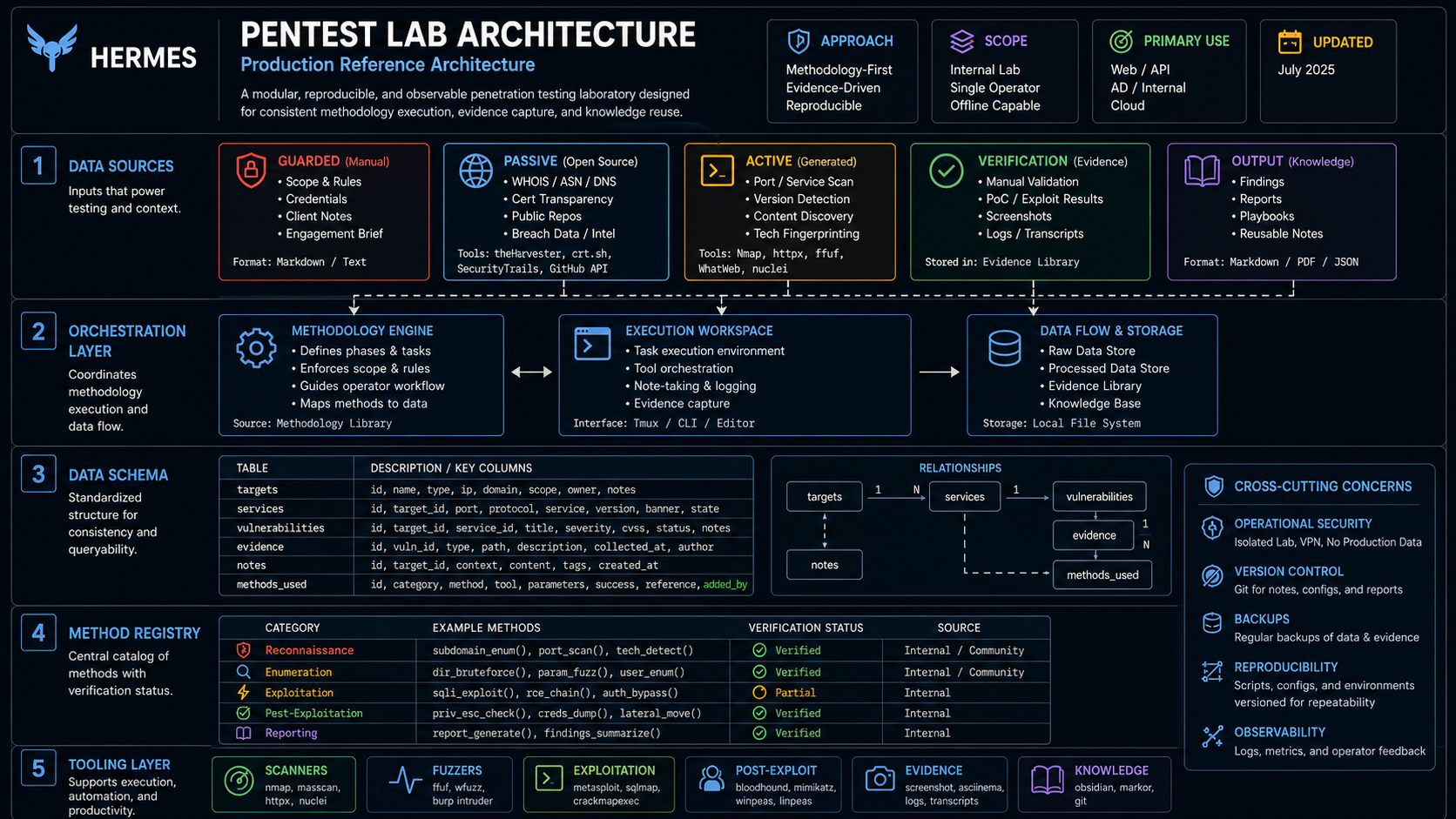
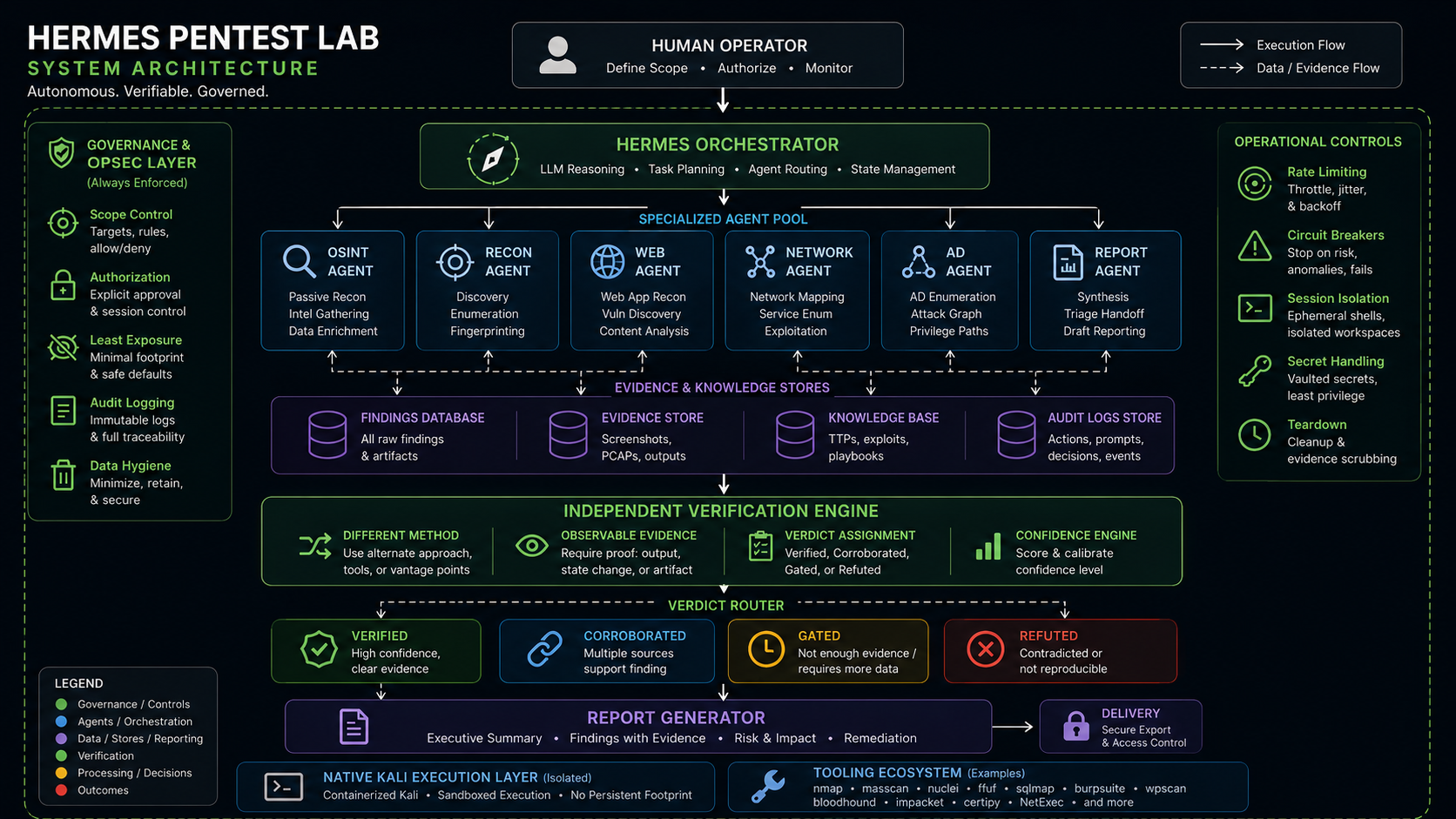
Turn any Kali Linux laptop into a production-grade pentesting workstation — with AI agent orchestration, native tooling, VPN OPSEC, encrypted storage, and automated report generation.
— tools run natively on the host for raw sockets, SMB, and packet capture. Docker is used only for lab targets and Neo4j.
AI-orchestrated, Kali-native pentesting lab: an MCP tool-server with scope/VPN/rate/audit enforced in code, independent finding verification, MITRE ATT&CK + OWASP mapping, a reusable findings library, retest tracking, WireGuard OPSEC, LUKS encryption, and automated PDF reports.
You tell Hermes what to test (e.g., "Scan 192.168.1.0/24")
Hermes checks the scope, starts the VPN, and dispatches 7 subagents in parallel
Each subagent runs tools natively on the Kali host
Findings flow into a shared SQLite v5 database
Verify agent independently reproduces every DRAFT finding — benign only
Report agent generates a professional PDF with verdict badges and confidence tiers
Audit trail logs every action
🆕 New Capabilities
Four additions layered on the safety-first core — each shipped independently with its own stdlib test suite:
🔌 MCP tool-server — guardrails enforced in code
The toolchain is exposed over the Model Context Protocol so any MCP client (Claude Code / Desktop, Cursor) can drive it. Unlike the skill docs — which ask an agent to check scope and keep rate limits on — every target-touching tool routes through scope-check.py before running and appends to the tamper-evident audit chain after. The scope, VPN, rate-limit, and audit guardrails are enforced in code and cannot be bypassed by the calling agent. Destructive tools (sqlmap/hydra/metasploit/responder) stay operator-run.
make mcp # stdio server — full detail in mcp_server/README.md
🎯 MITRE ATT&CK + OWASP Top 10 mapping
Findings carry optional attack_technique / owasp_category tags that render a Framework Mapping coverage section in the report, so defenders can align remediation with the frameworks they already track. Delivered as an additive, idempotent DB migration (migrate-add-attack-owasp.py, v4 → v5).
📚 Reusable findings library
15 pre-approved, generic finding templates (reports/findings-library.json) with {placeholder} text and pre-applied ATT&CK/OWASP tags + CVSS — render one instead of writing a finding from scratch:
Mark findings open / fixed / regressed across retest rounds (retest.py); the report renders a Remediation Progress section with the remediation rate and per-finding status. Status is asserted after re-testing — never guessed — and every mark is written to the audit chain.
📊 Sample Reports
Two reports from live assessments — one vulnerable target, one hardened production site.
sudo apt install -y nmap metasploit-framework ffuf gobuster wpscan sqlmap   hydra john enum4linux whatweb responder impacket-scripts evil-winrm seclists   wireguard-tools age cryptsetup
pipx install netexec bloodhound certipy-ad theHarvester holehe sherlock
On a non-Kali host, use the tool containers instead:
make images                          # build kali-web / kali-net / osint-tools
# then set PENTEST_USE_CONTAINERS=true in your config
Stuck at any point:
make doctor # what is missing, and the command that fixes it
Daily use
mount-pentest-vault                       # open the encrypted vault
bash scripts/init-engagement.sh acme-2026 # start an engagement
bash scripts/preflight.sh acme-2026       # authorization gate (VPN + signed scope)
# ... work ...
bash scripts/build-report.py acme-2026    # PDF report
unmount-pentest-vault                     # close when done
AI orchestrator
In a Hermes Agent session: /skill pentest-engage, then describe the engagement.
MCP tool-server (any MCP client)
Drive the same toolchain from Claude Code / Desktop or Cursor — with the scope,
VPN, rate-limit, and audit guardrails enforced in code, not just documented:
make mcp # launches the stdio server (mcp_server/)
Point a client at scripts/pentest-mcp.sh (see
mcp_server/mcp.json.example). Every
target-touching tool refuses out-of-scope targets, injects the engagement's
rate tier, and appends to the tamper-evident audit chain before it runs.
Destructive tools stay operator-run. Details:
mcp_server/README.md.
🛠️ Tools Included
💻 = Native host 🐳 = Docker service :port = web access
Hermes Pentest Lab is built for the practicing professional — it prioritizes safety, audit trails, and client deliverables over autonomous exploitation.
🆕 Verification Pass (Phase 5.5) — Just Added
Every DRAFT finding is independently reproduced before it reaches the report.
The verification pass sits between discovery (Phases 2-5) and reporting (Phase 6). It runs a benign, independent method against each finding — re-fetching headers with a plain stdlib client, observing TLS with a different tool, checking open ports with a socket probe. It never fires an exploit.
Portfolio reports — see sample reports above in reports/samples/
⚠️ Legal
This toolkit is for authorized security testing only. Never use it on systems you don't own or have explicit written permission to test. Every engagement requires a signed scope document (scope/contract-template.md). Every tool run is logged to an audit trail. Every report includes a data destruction certificate.