Microbe
A fast, lightweight IDE for MicroPython: every board, every connection, one small native app.
Tauri 2 · Rust · Svelte 5 · CodeMirror 6 · ty language server
接入你的智能体
从发布者处安装。不是 PlugMCP 端点。
远程 URL 还是本机命令? 两种安装方式的区别
来自发布者
A fast, lightweight IDE for MicroPython: every board, every connection, one small native app.
Tauri 2 · Rust · Svelte 5 · CodeMirror 6 · ty language server
A fast, native MicroPython IDE built with Tauri and Rust: any board over USB, Wi‑Fi, BLE or TCP, with a real language server, an on-device debugger and tests, firmware flashing, and an MCP server for AI agents.
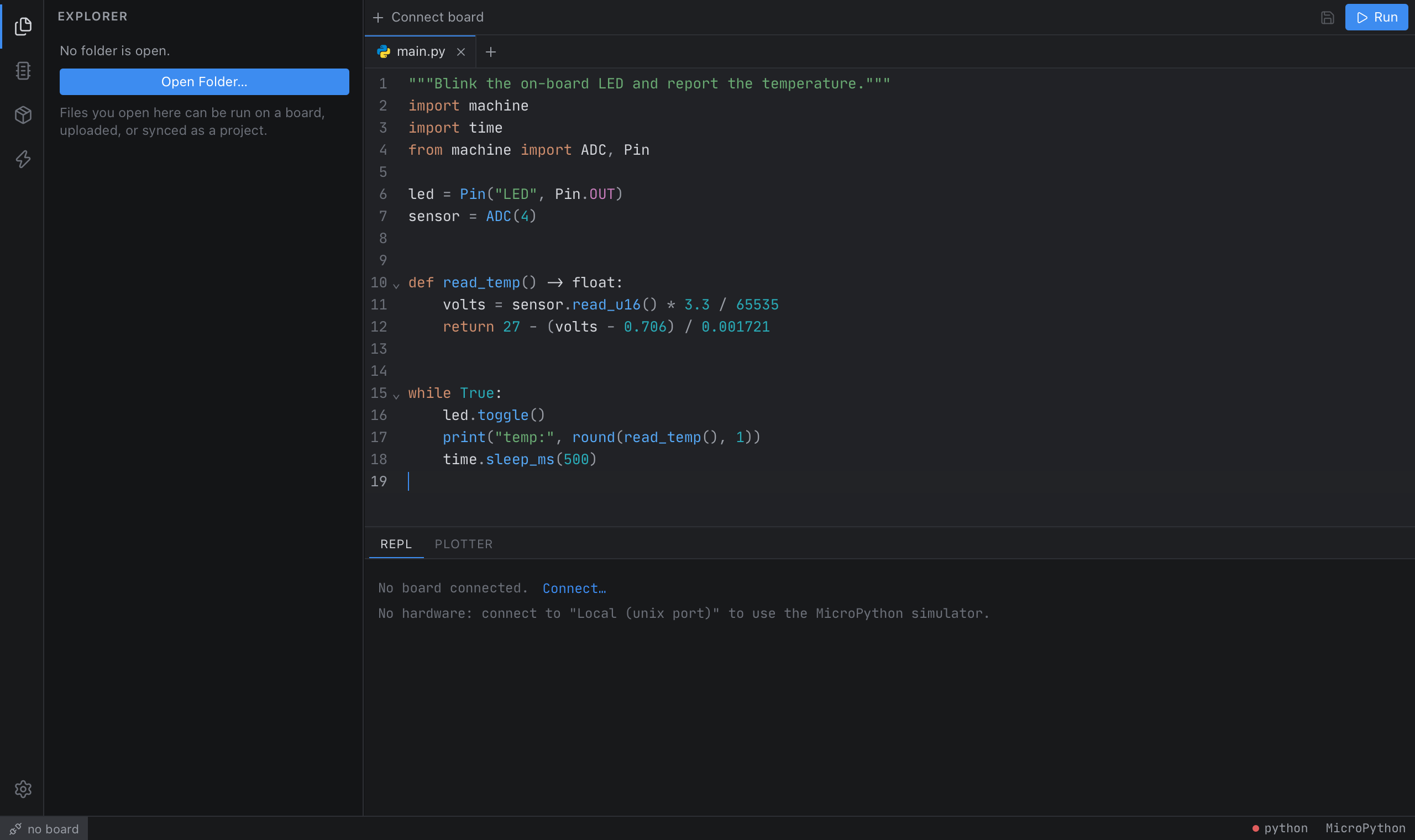
Microbe is a desktop IDE for MicroPython. It talks to your board directly, gives you a real Python language server that knows machine, rp2 and network, and flashes firmware for you. It is built on Tauri instead of Electron, so it uses the operating system's webview and a Rust core rather than shipping a browser.
brew install micropython (or your distro's package) for the simulator and the end‑to‑end testsdialout group for serial access; BlueZ is needed for BLEnpm install
npm run sidecars # downloads the ty language server for your platform
npm run tauri dev # builds the Rust core and opens the app
No board? Open the connect dialog (⌘K) and choose Local (unix port) to run code in the MicroPython simulator.
npm run tauri build # .app / .dmg on macOS, .msi on Windows, .deb/.AppImage on Linux
CI builds all platforms (.github/workflows/build.yml). To release, bump version in package.json, src-tauri/Cargo.toml and src-tauri/tauri.conf.json, then push to main. CI builds Linux, Windows and macOS (Apple Silicon and Intel) installers and publishes them as release v<version>. Pushes that don't change the version build nothing. Running the workflow by hand builds the installers as artifacts without publishing.
Installer names don't include the version, so these links always point at the latest release:
The macOS app is ad-hoc signed but not notarized (D-030). On first launch macOS says it can't verify the app. Right-click the app and choose Open, or use System Settings → Privacy & Security → Open Anyway. You can also run xattr -dr com.apple.quarantine /Applications/Microbe.app.
On Windows and Linux, use Ctrl instead of ⌘.
Turn on Settings → MCP server. Microbe then serves the Model Context Protocol at http://127.0.0.1:7357/mcp. Copy for Claude Code puts the registration command on the clipboard:
claude mcp add --transport http microbe http://127.0.0.1:7357/mcp --header "Authorization: Bearer <token>"
The tools are list_boards, board_info, exec, run_program, stop_program, read_output, list_files, read_file, write_file, make_dir, delete_path, reset and check_code. If you clear Allow running code and changing files, only the read-only tools are offered.
npm run check           # svelte-check (types + a11y)
npm test                # frontend unit tests (vitest)
npm run test:e2e        # UI tests in WebKit, the macOS app's engine (Playwright)
cd src-tauri && cargo test   # Rust unit tests + end-to-end tests against the unix port
                             # (sessions, debugger, tests, asyncio, OTA, network transports, MCP)
Opt-in diagnostics against real hardware and the network:
cd src-tauri && cargo test --test hardware -- --ignored --nocapture
macOS note. Some Command Line Tools releases ship an SDK that their own linker can't read ("unknown architecture arm64e.x1").
npm run tauridetects this and switches to an older installed SDK automatically. For plaincargocommands, see the workaround inAGENTS.md.
src/                 Svelte frontend
  lib/features/      sidebar panels (files, board, debug, tests, packages, firmware, settings)
  lib/runtime/       live data from running programs (heap, asyncio tasks)
  lib/components/    shared UI (editor, file tree, terminal, dialogs, tooltips…)
  lib/state/         rune-based stores (boards, editor tabs, project, settings…)
  lib/editor/        CodeMirror setup, completion ranking, LSP client, diagnostics
  lib/bindings/      TypeScript types generated from Rust (ts-rs), do not edit
src-tauri/
  src/               Rust core: transports, raw REPL, sessions, files, firmware, LSP bridge, analysis, MCP
  platforms/*.toml   one profile per MicroPython port (including GPIO maps)
  analysis.toml      tables for the MicroPython checks
  builders.toml      Docker recipes for building firmware from source
  quirks.toml        firmware-version protocol quirks
  py/*.py            device-side scripts (templated, overridable per port)
  tests/             end-to-end tests against the MicroPython unix port (sessions, MCP over HTTP)
e2e/                 Playwright UI tests (WebKit, backend stubbed)
docs/                architecture and decision log
Most extensions are a single file or a single trait implementation. AGENTS.md has step‑by‑step recipes for adding a port, transport, flasher, detector, language server, lint rule, MCP tool, firmware build recipe, runtime feature, sidebar feature or icon.
docs/ARCHITECTURE.md: how the pieces fit togetherdocs/DECISIONS.md: why things are the way they areAGENTS.md: conventions and recipes for contributors and coding agentsMicrobe builds on Tauri, CodeMirror, xterm.js, uPlot, ty, espflash, micropython-stubs, Lucide and the Material Icon Theme. Protocol behaviour follows MicroPython's own mpremote.
A fast, native MicroPython IDE built with Tauri and Rust: any board over USB, Wi‑Fi, BLE or TCP, with a real language server, an on-device debugger and tests, firmware flashing, and an MCP server for
概览
A fast, native MicroPython IDE built with Tauri and Rust: any board over USB, Wi‑Fi, BLE or TCP, with a real language server, an on-device debugger and tests, firmware flashing, and an MCP server for AI agents.
工具
暂无工具列表。远程服务器在首次健康检查后会获得工具列表。
常见问题
在本页复制适用于 Cursor、Claude Desktop、Claude Code 或 VS Code 的 stdio 配置。它使用发布者的安装方式,而不是 PlugMCP 代理。
此记录未列出必需的环境变量。
Microbe 通过 stdio 在本地运行。
上次检查时间:2026-10-28。 A fast, native MicroPython IDE built with Tauri and Rust: any board over USB, Wi‑Fi, BLE or TCP, with a real language server, an on-device debugger and tests, firmware flashing, and an MCP server for AI agents.
