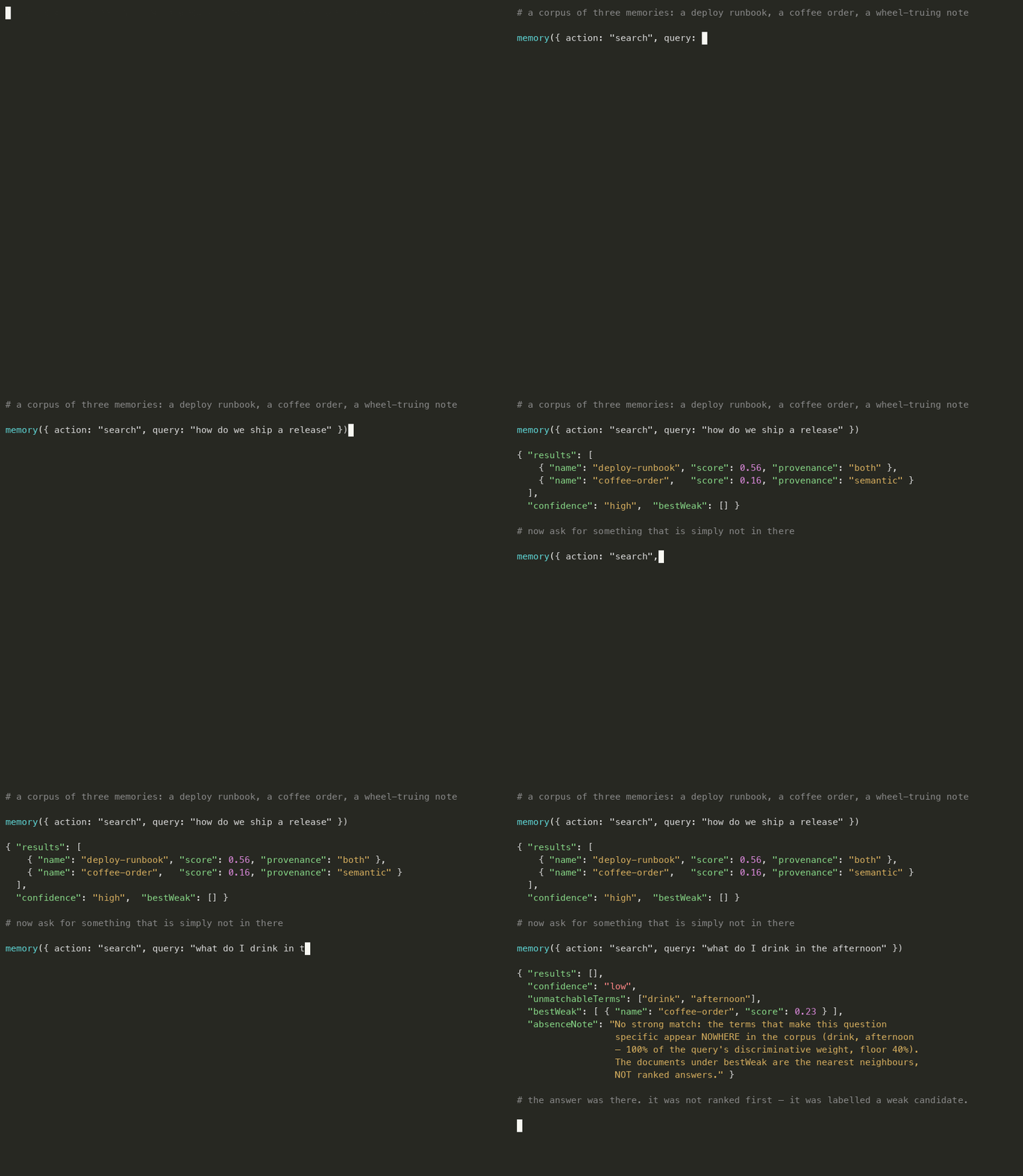
Long-term memory for agentic tasks. It tells you when it doesn't know.
An MCP server that gives Claude Desktop and Claude Code a persistent memory across
sessions — and, unlike a plain vector store, an explicit answer when the corpus does
not contain what you asked for.
Long-term memory for agentic tasks. It tells you when it doesn't know.
That is the whole install. MEMORY_DIR is the one path you supply, and that is deliberate:
the server does not go looking through your disk for your notes.
🟥 Note the @2 — pin the major version.npx -y agentic-recall with no version asks npm for
whatever is tagged latestevery time its cache is cold, so a new major arrives silently and
a config that worked yesterday breaks today. That is not hypothetical: 2.0.0 moved five actions to
a second tool, and a tester's in-flight session started failing with
received 'index' at action mid-task — because npx had re-resolved latest underneath a running
workflow. The cache is what makes an unpinned spec feel stable, and a cache is not a pin: it is
cleared by npm cache verify, by disk cleanup, and by every new machine.
@2 takes fixes and features, never a breaking major. [email protected] pins exactly.
🟥 A warm npx cache does NOT pick up a fix on its own. Measured 2026-09-22: 2.0.3 had been on the
registry for over an hour, and three servers spawned with npx -y agentic-recall@2 still ran the cached
2.0.1. To take a fix, clear the cached copy and re-resolve once — macOS/Linux:
rm -rf ~/.npm/_npx && npx -y agentic-recall@2 --version; Windows: the Remove-Item line below —
then restart your client. serverVersion in every response tells you which version actually answered.
🟥 Windows users: use this config instead. Bare npx does not work for a Node MCP client
on Windows. This is measured, not inferred — CI spawns the published package on windows-latest
every push, and reports bare npx -> FAILED: spawn npx ENOENT while cmd /c npx connects:
On Windows npx is a
batch shim (npx.cmd), and Node's spawn will not resolve it without shell: true. A
Node-based MCP client using the config above gets spawn EINVAL and the server silently never
connects — it appears configured and does nothing. This is the standard Windows MCP gotcha, not
specific to this server (claude-code#58510).
npm i -g is not an escape — that installs a .cmd shim too. The only shim-free form is
pointing node at the file directly:
"command": "node", "args": ["C:/Users/<you>/AppData/Roaming/npm/node_modules/agentic-recall/index.js"].
Whether Claude Desktop itself is affected is still unconfirmed — it may spawn through a shell.
The cmd /c form works either way, so it is the one to use on Windows.
🟥 Windows: if npx fails with ECOMPROMISED / Lock compromised, clear the npx cache.
Node 24/25 with npm 11 leaves a stale lock in npx's cache directory that it then refuses to
refresh (npm/cli#8710). Nothing to do with this server
— it hits MCP Inspector and Gemini CLI identically. Measured on a real Windows machine: it
reproduced twice, and clearing the cache fixed it (then a 98 s first download):
If it still fails, two alternatives that avoid npx entirely — both verified end to end:
npm install -g agentic-recall (then "command": "agentic-recall", "args": []), or Node 22,
where npx works normally.
Requires Node 20 or newer. Nothing else — the embedding model downloads on first index
and then runs locally. Your memories never leave the machine.
Prefer to read the code first, or run the suite?
git clone https://github.com/dfrancislyondflabc-tech/agentic-recall.git
cd agentic-recall && npm install && npm test    # 268 checks, no corpus of your own needed
Built by Daniel Francis-Lyon — questions, bug reports and criticism all welcome, either as an
issue on this repo or at [email protected].
Privacy Policy
Nothing leaves your machine. Memories are plain files in a folder you choose; the embedding model
runs locally after a one-time download; there is no telemetry, no analytics and no phone-home. The
author receives no data from your installation and has no means of doing so.
Retrieval always returns something. Ranked by similarity, the least-bad match comes back
looking like an answer, and an agent acting on it cannot tell the difference between "here is
what you wrote" and "here is the closest thing to it".
This server separates those two cases and says which one you got:
// asked about something that isn't in the corpus
{ "results": [],
  "confidence": "low",
  "bestWeak": [{ "name": "wheel-truing", "score": 0.31 }],
  "absenceNote": "no strong match — 'afternoon' appears nowhere in this corpus" }
Nothing was invented, nothing was silently ranked into first place, and the nearest thing is
offered as a candidate rather than as an answer. Everything below is about how that verdict is
reached and how it is measured.
The same refusal, applied to engineering claims
A memory saying "I fixed that in abc123" is a sentence. Classifying sentences has failed here
three times — a correction vocabulary that fired on 76% of exchanges, an unresolved-statement
vocabulary that fired on 24%. But a SHA is not a sentence to classify. It either exists or it does
not.
Point MEMORY_GIT_REPOS at your repositories and every hex-shaped token in a retrieved memory is
looked up. Four commands, and only what they prove:
command
what it establishes
cat-file
the token is a real commit, not something SHA-shaped
merge-base
it landed on the mainline, rather than an abandoned branch
log
its date, author, subject, and how many files it touched
rev-list
how many commits have landed since the newest memory was written
Measured over 2,319 ingested exchanges: 707 SHA-shaped candidates collapsed to 355 real commits.
Half of what looks like a commit isn't one, which is why every token is checked rather than trusted
for its shape. Those rejects are not invented commits: re-measured on the current,
larger corpus, 79% of reject occurrences are hex prefixes of conversation session IDs that the
deliberately loose 7-10 character pattern sweeps up, so this gap measures how little the shape
tells you rather than how often a memory fabricates a SHA.
What this does not tell you, deliberately. It does not check whether the change was later
reverted, or whether the thing still exists at HEAD. A commit that landed and was undone the next
day still reports as landed. So this is not a claim that the memory is currently true — it is a
verified fact about the past, plus rev-list telling you exactly how much has happened since that
nothing in the corpus can know about. The gap is measured rather than closed, which is the same
discipline as the absence verdict above: never imply knowledge you do not have.
Repos are configured, never inferred — an earlier draft counted commits "in this repo", meaning
wherever the process happened to be running, which is a different repository from the one the
memories are about.
Two-tier hybrid retrieval over Claude's persistent memory corpus, exposed to
Claude Desktop and Claude Code as two MCP tools: memory, which is read-only and
never writes to your memory folder, and memory_write, which is the only way
anything this server does can change it.
The curated corpus is the folder you point MEMORY_DIR at (see Environment overrides).
MEMORY.md, if you have one, is treated as a hand-curated tier-1 index.
Figures quoted throughout this README — "121 .md files, ~2.7 MB", timings, hit rates — are
measurements of the author's own corpus, not properties of yours. They are here because a
claim with a number behind it can be checked; treat them as the conditions a result was obtained
under, not as promises about your data.
Three more work corpora sit beside it, each with its own index and its own
statistics: other projects' memory folders (projects), auto-ingested
conversation exchanges (staging) and the institutional handoff documents
(handoff, read-only) — plus the library: imported reference material
(books, manuals, policies) in per-category corpora that are searched only
when named (scope:'books', or scope:'everything') and can never touch a
work score. See Four work corpora + the library, one index each.
Why it exists
Reading the whole memory folder into context costs ~2.7 MB and buries the
relevant three lines. This server answers the question "which memories matter
for what I'm doing right now?" with three retrievers whose failure modes cancel:
retriever
field
good at
blind to
BM25F
title + description + headings + body, each length-normalised separately
slugs, part numbers, file names, jargon, any literal string in the text
paraphrase
dense cosine
~200-word body chunks + a per-doc summary vector
"how do I restart the email app server" → a memory that never says restart
exact identifiers
phrase proximity
the tightest window of body tokens covering the query's terms
telling a quoted sentence apart from a document with the same vocabulary
anything not stated literally
Scores are normalised, fused 42/42/16, then adjusted by a long-document
correction, the hot-tier boost and a mild recency decay. Every result
reports its provenance (keyword / semantic / phrase / both) so a
surprising rank is diagnosable rather than mysterious — and when nothing
matched well enough, search says so instead of guessing (see below).
v1.1 — the three defects the 2026-08-14 benchmark measured
retrieval-features-baselines/memory-systems-benchmark.md scored this server
against a pre-loaded MEMORY.md over 32 probes and found three real defects.
All three are fixed; the numbers are in that file's v1.1 section.
BM25 was blind to bodies. It indexed title + description + headings only,
so a distinctive phrase living in a body paragraph had to be recovered by the
dense leg — structurally the wrong tool for a literal string. The body is now
a fourth BM25F field (its own length normalisation, weight 0.3), and a
phrase-proximity leg reads the body directly. Verbatim recall went from
4/6 found and 1/6 sentence-located to 6/6 and 6/6, every one at rank 1.
Snippets are now cut around the matching window rather than the top of the
document, so a quote search returns the sentence you quoted.
It could not say "nothing".search always returned limit results; on
the four absent probes it handed back confident-looking wrong documents, one
at 0.75 — higher than 20 of the 28 correct answers. It now returns
noStrongMatch: true with the candidates moved to bestWeak, on 4/4
absent probes with 0/28 false absences. There is no clean score
threshold — the distributions overlap across their whole middle — so the
verdict is a conjunction of measured weaknesses plus a vocabulary test.
the derivation and its margins are recorded in the author's test/ tree.
🟥 The absence verdict gets less reliable as your corpus gets smaller, and a new corpus is
small.orphanShare asks what fraction of your question's distinctive words appear nowhere
in the corpus — so on a thin vocabulary, ordinary synonyms are genuinely absent and a question
the corpus CAN answer gets refused. Measured here on 122 files: 5 of 20 answerable questions
called absent. Measured by an independent reviewer on 13 files: 3 of 4. It fails safe —
the right document is in bestWeak, not invented — but on a young corpus read bestWeak
before believing a refusal, and expect this to improve as you write more. test/… paths in
this README are citations to where a number was measured, not files in this distribution —
the suite is not shipped, because it asserts against one private corpus. See CONTRIBUTING.
One enormous document was winning everything. A 616 KB changelog took a
top-3 slot on 21 of 32 test questions — questions about deployment, about
pricing, about a bug in a scraper. It had no business in most of them.
The cause is in how a document is scored. Documents are split into chunks,
and a document's score is the score of its best chunk. That changelog
splits into 517 chunks; the typical memory in the corpus splits into
4. So the long document gets 517 chances to have one paragraph that
happens to sit near your question, and the short one gets 4. Ask about
anything and something in 616 KB of release notes is vaguely on topic.
It's the same effect as a library where one book runs to 3,000 pages and
everything else is a five-page note. Ask any question and the huge book
contains a page that looks relevant — not because it is the best answer,
but because it had the most chances to match.
The giveaway was keywordScore: 0 on almost every one of those 21 hits:
none of the words in the question appeared in the document at all. It
was winning purely on one chunk out of 517 landing near the question in
embedding space.
The fix is to shrink the semantic score of documents that are far longer
than that corpus's own normal length. "Normal" is measured per corpus rather
than hard-coded, since a corpus of books and a corpus of notes disagree about
what long means. And the shrink is waived in proportion to keyword
evidence: if your words really are in the document, the penalty lifts. Long
is only suspicious when the document didn't match what you actually asked.
Result: top-3 appearances 21 → 0. It is de-prioritised, not hidden —
ask for that changelog by name and it still comes back at rank 1 with
keywordScore: 1.0, because now the words match.
The keyword score is on an absolute scale
Fusing two retrievers only works if both scores mean the same thing on every
query. A per-query-max normalisation does not: it hands 1.0 to whatever scored
best, so on a paraphrase where nothing really matched, an accidental match still
carried half the fused score. (A question about which zip packages to maintain
returned an unrelated note about a download link at #1, on the token download alone.)
So the keyword leg is scored against measured reference points instead — a raw
noise floor, the score a genuine lexical match earns, and the share of the
query the document actually answered — each capped by what the query can
possibly achieve, so a short exact query like MEMORY is not punished for
having little to match. npm run measure-keyword-scale re-runs the measurement
those constants came from (four query populations: title-literal,
description-literal, in-domain paraphrase, out-of-domain) and prints where the
shipping constants sit against it. The derivation lives next to the numbers in
lib/config.js.
The fused path only. In bm25-only mode there is no second score to be
comparable with, so the per-query-max form is kept and degraded-mode ranking is
unchanged.
Install
Did you get this as a zip? Then none of this section applies: open START-HERE.txt and
double-click SETUP-WINDOWS.cmd or SETUP-MACOS.command. A zip carries its dependencies and its
search model already — there is nothing to clone and nothing to npm install. (Up to 1.7.1 the
zips also shipped a dist/ install guide that said the opposite; it is gone.)
From npm — the short way. Nothing to clone and nothing to build; paste the config block at
the top of this README into your Claude config and you are done.
npx -y agentic-recall@2 --version # optional: fetch it now rather than on first launch
From source, if you would rather read it first or run the suite:
git clone https://github.com/dfrancislyondflabc-tech/agentic-recall.git
cd agentic-recall
npm install
Node 20 or newer. There is nothing to build.
Where it keeps its 35 MB. A clone keeps the model cache, the vector cache and the index
beside the code, as it always has. A package install (npx, npm i -g) writes them to
~/.agentic-recall instead, because npm's npx cache is disposable and re-downloading the model
on eviction would be miserable. MEMORY_ROOT overrides both. Your memories themselves are never
in either place — they stay wherever MEMORY_DIR points.
Not the recall-mcp on npm. That name belongs to a different project (a different self-hosted
memory server). This one is published as agentic-recall.
Then tell it where your memories are. It does not search your disk for them — there is no
sensible default, so it does not guess. MEMORY_DIR (or memoryDir in local-config.json, copied
from local-config.example.json; gitignored, never indexed) is the whole of the discovery logic.
If you already use Claude Code's memory, you are done in one line. Point it at that folder and
it indexes those files in place — nothing is copied, nothing is converted, and Claude carries on
writing them as it always did:
(The slug is your project's path with the separators replaced — ls ~/.claude/projects to find
yours.) Reading Claude's own directory, rather than a copy of it, is the reason this server's
corpus cannot silently drift out of date.
If your history lives somewhere else, import it once. A ChatGPT export .zip, a folder of
Obsidian/Notion markdown, or a single file:
This one does write files into MEMORY_DIR, converting as it goes. memory_write({action: "import"})
is the same thing from inside a conversation.
Remembering the conversations themselves is controlled by the connector toggle, and there is
nothing else to configure. While the connector is on, the server spawns a capture walk every five
minutes by itself. The only thing a hook adds is the FINAL exchange of a chat you walk away from,
captured as it ends rather than on a later sweep — node packaging/install-hooks.mjs adds
scripts/auto-ingest.js on Stop and SessionEnd for this install (it backs up
~/.claude/settings.json first, touches no other hook, does nothing on a second run, and reverses
with --uninstall). After that the switch you already use in Claude's UI is the switch:
connector on means this server is running, which it advertises by leaving a dated mark on disk;
the hook reads that mark and captures the session. Connector off, no mark, nothing captured,
silently. Captured conversations land in a separate staging corpus at a lower tier, so they are
searchable but never outrank a memory you wrote deliberately.
Two overrides live in local-config.json — and it has to be that file rather than an environment
variable, because hooks are spawned without your shell environment:
captureAlways: true remembers every session, connector on or off. autoIngest: false
remembers none, ever. Set one or neither — the default, with both absent, is "remember the
sessions you had the connector on for".
And if you had it switched off and only realised afterwards that the work mattered, nothing is
lost — the transcript was on disk the whole time, it simply was not ingested. Ask for it after the
fact:
memory_write({action: "capture", sinceMinutes: 60})   // remember the last hour
memory_write({action: "capture"})                     // remember this whole session
Already-captured exchanges are skipped, so running it twice is safe. It answers with two counts,
because on a live chat the common outcome is neither "new" nor "nothing": exchangesCaptured is
exchanges that were not in the store at all, and exchangesRefreshed is exchanges already there
whose text had GROWN — normally the turn you are in the middle of. sinceMinutes is measured
against each exchange's last activity, so a turn that has been running for an hour is still inside
sinceMinutes: 30.
A memory is just a markdown file with a name: and a description: in its frontmatter:
---
name: freehub-service-log
description: Symptoms and fix for the loaner-wheel freehub pawls disengaging under load
---

The pawls stop engaging when the grease thickens, usually on a climb — the cranks turn and
the wheel does not. Strip and re-grease with a light oil, not the heavy grease in the tub.

Related: [[wheel-build-notes]]
name is how the memory is addressed (get, [[wikilinks]]); description is what a search
sees first, so it is worth writing as the sentence you would want back. Everything after the
frontmatter is the body. Nothing else is required — no metadata: block, no tier, no id. Then:
npm run index        # first build downloads the embedding model, then embeds: ~3 min
npm test             # self-contained: builds its own fixture corpus, needs none of yours
npm run verify       # the same check under its other name
npm test drives the real server over raw stdio JSON-RPC and exercises both tools and all fourteen actions
against a temporary corpus it writes itself, so it is meaningful on a machine with no memories at
all. The exit code is the verdict. (The author's full suite is not public — it asserts against one
particular corpus and would fail for you. See CONTRIBUTING.md.)
Measurement scripts, read-only and re-runnable — the tuning constants in lib/config.js each cite
the measurement they came from:
npm run measure-keyword-scale   # the absolute keyword scale
npm run analyse-queries         # what has been asked of it
The tool
Two tools, fourteen actions. memory reads and never writes your notes: search, get, neighbors,
latest, sessions, thread, verify, index_status, probe_status. memory_write holds every
action that changes something: import, capture, index, promote, demote.
The four you will use daily are documented in full below.
memory({action: "search", query, limit?, scope?})
Hybrid retrieval. Returns name, description, tier, score,
keywordScore, semanticScore, phraseScore, provenance, snippet,
links, path, readOnly, corpus (which of the four indexes answered), the
attribution block (account, project, sessionId, sessionTitle, type),
plus a top-level mode
(hybrid | bm25-only | unavailable) and, when degraded, a
degradedReason. Default limit 8.
Every response says when its index was built — see Freshness below:
field
meaning
indexBuiltAt
ISO time the index these results came from was built
indexBuiltAtByScope
scope: "all" only — one build time per corpus
indexStale
the corpus has changed since, and the repair did not happen
staleFiles
how many files moved
staleWarning
one sentence saying so, with the files named and why it was not repaired
indexReindexedInline / indexReindexSeconds
the guard rebuilt it before answering
indexBuiltInline
that corpus had no index at all and was small enough to build before answering
corpusNote
for projects / handoff: what this corpus is and that it has its own statistics
indexCheckedFiles / indexCheckMs
the cost of the check itself (1–2 ms for 122 files)
newestSourceModified
the newest mtime in the corpus, live
modifiedFieldNote
states that a result's modified is index-time, not live
serverVersion / serverStartedAt
which build of this server answered, and when it started
A result's modified is the file's mtime AT INDEX TIME, not a live read.memory({action: "get"}) returns a live stat, as liveModified. Reading one as
the other is what produced a confidently wrong conclusion about project state on
2026-08-19.
Search always covers both tiers. Archived memories are fully searchable;
they simply do not get the hot boost.
A single document takes at most one top-N slot (RETRIEVAL.maxSlotsPerDoc).
When nothing matched, it says so. Instead of ranking the least-bad
document, search can return:
{
  "noStrongMatch": true,
  "confidence": "low",
  "signals": { "topScore": 0.40, "topPhrase": 0.25,
               "lexicalCoverage": 0.24, "orphanShare": 0.46 },
  "absenceNote": "No strong match: the term(s) that make this question specific
                  appear NOWHERE in the corpus (kubernete — 46% of the query's
                  discriminative weight, floor 40%). …",
  "results": [],
  "bestWeak": [ /* the nearest documents, NOT answers */ ]
}
results is emptied and the candidates move to bestWeak, so a caller that
checks results cannot accidentally report a non-answer, while one that wants
to overrule the verdict still has the candidates. signals is always present on
the fused path, verdict or not, so a surprising call is diagnosable.
Two independent rules produce it (constants and margins:
measured, not guessed):
vocabulary — the terms that make the question specific exist nowhere in
the corpus (orphanShare ≥ 0.40) and nothing holds the remaining words
together. Compound forms are forgiven: de-duplication is absent while
duplication is present, and the corpus clearly knows the concept.
evidence — every word is familiar, but nothing scored (< 0.38), nothing
is phrased that way (< 0.40), and most of the question went unanswered
(lexical coverage < 0.20). All three, because each alone fires on real
questions.
The verdict is advisory and calibrated on this corpus. Never use it to prove
a negative that matters — on a held-out set of deliberately vocabulary-free
in-domain questions, 5 of 20 are called absent. grep proves a negative; a
score does not.
Never claimed in bm25-only mode: the constants are calibrated on the fused
three-leg score, so degraded mode reports confidence: "unrated" instead.
What a multi-corpus response is made of
scope: "all" (and an array scope) returns one ranked section per corpus under groups,
because the corpora do not share statistics and blending them measurably costs recall. Three rules
govern the shape of that envelope; all three came out of one real response, measured on
2026-09-07, which was 56,550 bytes for ten results and told its reader the opposite of the truth.
groups.<corpus>.resultsRef: "results" + count
that section's rows are the top-level results entries carrying corpus: "<corpus>", in that order. They are serialized once — the duplicate copy was 30 % of that response. Everything else in the section is its own.
groups.<corpus>.empty: true + emptyNote
that corpus holds 0 files and has no index: nothing to rank and nothing to build. An empty corpus is not a stale one, contributes nothing to the top-level indexStale, and makes no claim about the others. A corpus that has files and no index is still stale, still says so, and still sets the top-level verdict — with a warning that names it ([staging] …) and says the rest of the response stands.
bestWeak capped to names and scores
in a response where another corpus answered, a section that ranked nothing keeps three nearest neighbours as {name, score} and drops its absenceNote; the top-level guidance names every section this happened to and gives the call that returns the whole verdict. When nothing hit anywhere, the fallback is the answer and both stay in full.
brief: true on search or latest trims the rows — name, corpus, score, snippet,
provenance and the timestamp, nothing else. The envelope is untouched: indexStale,
staleWarning, recencyVoid, recentUnindexed, uncapturedSessions, captureHealth,
configWarning and guidance are all still there. A caller asking for fewer bytes has not asked
to be told less about what was never read.
Measured on the reporting caller's own query against the same corpora, read-only, before and
after: 56,634 → 26,842 bytes, and 17,123 with brief: true. The ten ranked rows are 12,426
bytes of that, in both runs — they are the answer, and they are what is left.
Query expansion — queries?, expand? (on by default since 2.1.0; can be turned off completely)
A three-position switch: on (default) | shadow | off. latest ignores it.
To turn it off completely, any one of these (the first that is set wins):
per call: expand: "off" (or false)
for the server: MEMORY_QUERY_EXPANSION=off in the connector's env
for the machine: "queryExpansion": "off" in local-config.json
off adds nothing to any response and writes nothing to the log. An unknown value falls back to the
default.
How it is meant to be used: search first, rephrase only on a miss. The server never invents
synonyms and never re-queries by itself; the caller owns the guessing. A first search is sent with
query alone and costs exactly what it did before. If that search is refused, the response invites
a second try. If it answered but the rows do not actually answer the question, the caller judges
that and tries again the same way:
queries: [...] — up to 4 alternative phrasings of the same question, ranked in one call
beside query. Each is judged on its own words; a phrasing that refuses adds nothing. results
stay the question as asked — same rows, order and scores — each gaining matchedVia, the
phrasing(s) that also reached it. Rows only a phrasing reached come back under
viaVariants.results with queryScore (what the original question gave them) and
alsoBestWeak when the row was already the nearest weak neighbour.
The verdict stays on query. If the question as asked has no strong match, noStrongMatch
stays true and results stays empty, whatever the phrasings found. Read a viaVariants row
before relying on it, and say it came from a rephrasing. On a bm25-only index expansion does
nothing and says why.
Why the second try is left to the caller: the server cannot see a miss. In the evaluation below,
15 of 17 wrong answers came back at confidence: high, so a server-side "retry when unsure" rule
would have kept only 2 of the 7 recoveries.
Measured on a real 4,700-document corpus (pre-registered; 90 answerable questions written by agents
that never searched, 20 absent controls): with 3 phrasings, 7 of the 20 questions the first search
missed were recovered into viaVariants, 0 results changed, 0 controls answered because of it.
Cost per call with phrasings: ~+50 ms on 500 documents, ~+370 ms on 4,200, ~+1.6K tokens. A first
search with no phrasings costs nothing extra.
requeryHint is off by default. On an empty result it lists words the nearest documents use and
the query did not. It pointed at the right memory 0 times in 3 real refusals, because on a true
absence the nearest documents are the wrong ones. It is still computed and logged; turn it on with
MEMORY_REQUERY_HINT=on or "requeryHint": "on" in local-config.json.
shadow computes all of this, records it on the query-log row (expansion, redacted like q),
and returns the unexpanded baseline plus an expansion: {mode: "shadow"} marker.
For state questions — "did X finish", "what happened after Y", "where did we leave X".
search ranks by relevance, and relevance cannot separate "we are starting X" from "X is
finished": both are equally about X. That is not a ranker that needs improving, it is the wrong
axis for the question. latest filters on every term (no ranking at all) and orders newest
first.
It exists because of a specific failure. A session was asked whether a re-parse had completed. It
searched, got the exchange where the work started at score 0.88, saw no completion ranked above
it, and reported the answer unknowable. The answer was in the corpus the whole time, one
term-filter away.
ts = when the words were said. mtime = file bookkeeping, not chronology.
scopeHint
which corpus answered, and whether that was your choice or the default.
threadPosition / threadLast
an exchange is one moment in a conversation. If laterInThread > 0, fetch threadLast before reporting what happened.
unmatchableTerms / termWarning
this is an AND-filter, so one unknown term takes it to zero — that zero is named, not silent.
filterWarning
fires when account/project names a label this corpus does not use at all (e.g. project:"this" against staging, where every doc is labelled store).
indexStale / staleWarning
latest is the action most damaged by staleness: new material is exactly what a stale index lacks.
Query it with identifiers, not prose. This is a literal string filter. Measured over six
real questions with known answers:
query
result
"pushed commit with failing test semicolon"
nothing — the corpus says ';', never "semicolon"
"pushed c509e0f"
the exact exchange, immediately
"high RAM usage cause overnight run"
a coincidental match on "overnight" in a JSON schema
"max-old-space-size heap 20000 rows"
the exact answer — 8 GB heap ceiling, .all() on 20,000 rows
Same corpus, which held every answer the whole time. Commit SHAs, file names, flags, function
names, error strings and exact numbers work; prose belongs in search, which ranks. When the
strict filter finds nothing it relaxes to the best available match and sets relaxed +
droppedTerms — a dropped term is often the one that mattered.
Compaction summaries are demoted, not dropped. When a session runs out of context the harness
reopens it with a summary of everything so far, and that gets ingested as an exchange (34 of 2,318
here). It restates a whole conversation, so it matches almost any filter while carrying a recent
timestamp for old content — one took first place on 5 of 6 test questions, once purely because it
restated the question. Excluding them outright measured worse: it fixed one question and broke
another whose answer existed only inside a summary. So they are labelled isCompactionSummary,
sorted below first-hand exchanges, and removable with includeSummaries: false.
scope: "all" returns one section per corpus, never a merged list. The corpora do not share a
clock — staging documents carry ts, curated documents carry none — and merging them by time
compares incomparable things. Concretely: the 2026-08-19 account backfill rewrote all 118 curated
files in one pass, so in a merged list every one of them would outrank a genuine 08-22
conversation. Each section declares its own orderedBy.
The limit no field can fix. The corpus records what conversations said, never what happened
after the newest one. Measured: the newest exchange said "nothing queued, v111 tagged" — 13
commits landed after it. When the answer matters, check the world.
memory({action: "thread", name, forward?, back?})
Read forward from a hit, in sequence.threadLast gives the end of a thread, which is the
wrong end of a long one: the resolution to a claim at exchange 200 of a 650-exchange thread is at
201–210. Relevance can't bridge that gap either — the exchange that resolves something often
shares almost no vocabulary with the one that raised it ("done", "shipped", "you were right").
Sequence can, and sequence is already in the x-<session>-<ask timestamp> names (e.g. x-fb357616-20260903T054233800Z, which sort as time), so this is arithmetic, not
retrieval.
offset is relative to the anchor. remainingAfter says how much of the thread the window did
not cover, so a long thread stays reachable in one more hop.
memory({action: "verify", name? , text?})
Check a claim against git instead of judging its wording. The corpus records what was said;
whether it happened is a question about the world, and for engineering claims the world keeps a
record. A cited SHA — the unique fingerprint git gives every commit, 47f71d3 and the like,
naming one specific saved change — either exists, landed on the mainline, on a date, touching
files, or it does not.
memory({action: "verify", name: "x-df6d25fe-20260818T214812690Z"})
  -> c509e0f [recall-mcp] 2026-08-18  ON MAINLINE  "dream + auto-ingest: a correction signal…"  2 files
     3c1a440 [recall-mcp] 2026-08-18  ON MAINLINE  "auto-ingest: the debounce must run BEFORE the lock"  2 files
latest and thread rows carry verifiedCommits automatically wherever a cited SHA checks out.
Measured coverage: 404 of 2,319 exchanges (17%) name a real commit. 707 hex-shaped
candidates collapse to 355 actual commits, so shape alone proves nothing and every token is
checked against git.
Repos are configured, never inferred — set MEMORY_GIT_REPOS to a :-separated list
(; on Windows — the code splits on path.delimiter, so use your platform's).
Unconfigured, this stays silent rather than guessing: this server lives in a different repo from
the codebase the corpus is about, and guessing would answer confidently about the wrong project.
onMainline is separate from existence. A commit can sit in the object store after being
amended away, or live only on an abandoned branch. "It exists" and "it shipped" are different
claims, so both are reported.
Absence proves nothing. A row with no verifiedCommits cited no SHA.
The reverse join — git → corpus, on time
Every check above reads a commit SHA out of an exchange. That only works when the conversation wrote one down, and measured on a known day it usually
doesn't: of 12 commits made during one session, that session's text named 2. The commits happen
inside tool calls, while capture records the prose around them — so the identifier normally never
appears in the text at all. Reading the corpus harder cannot recover what was never written.
Time can. A conversation has timestamps and so do commits, so the join needs no SHA, no vocabulary
and no judgment:
thread returns commitsDuringWindow — what landed in the configured repos while that
stretch of conversation was happening. This turns "I'll commit the fix" — a promise, and the
hardest thing in a corpus to resolve — into the record of whether anything actually landed.
latest returns corpusCurrency — how far behind the world the corpus is, as a count:
"N commits have landed since the newest exchange was written." The guidance already says the
last word isn't current truth; a sentence is easy to skip and a number isn't.
Evidence, not proof, and labelled that way: a commit inside the window may be unrelated work,
and related work can land days later. It narrows "did this ever happen" to "here is what
happened at that moment".
Measuring it
npm run analyse-queries # what callers actually did, and whether retries recovered
eval:state (author's tree only — not in the published package) runs test/state-questions.json, whose answers were written down before the corpus
was queried — grading after seeing results produces a test that passes for the wrong reason.
Each case also carries a proseControl that is expected to fail; those controls are the
measurement behind "query a term filter with identifiers, not prose". Baseline: 6/6 answered,
4 of 6 controls failing as expected. It needs the local store/ corpus, which is gitignored, so
it is deliberately not part of npm test.
memory({action: "neighbors", name})
The [[wikilink]] graph, free relevance expansion:
outbound — links this memory makes
inbound — backlinks from other memories (verify-protocol has 11)
unresolvedLinks — [[slugs]] with no matching file
semantic — top-3 nearest by cosine, which surfaces relatives nobody linked
Two-tier mechanics. demote sets metadata.tier: archive in the file's
frontmatter, creating a frontmatter block if the file has none. promote
removes the line.
Your body text is never deleted or moved — only that one metadata line changes.
The round trip is byte-for-byte reversible only if the file already had frontmatter. If it
had none, demoting creates a frontmatter block (including a description synthesised from the
body), and promoting afterwards removes the tier line but leaves that block behind. The body is
untouched either way. Files with no frontmatter are common enough that this is worth knowing
before you demote one.
Hot tier = everything not archived. Anything MEMORY.md lists is hot by definition, so demoting
a memory that MEMORY.md still names is refused rather than silently reverted; the response
says which.
A get of the 103 KB build checklist used to blow the MCP output limit outright — so the tool
could not read the documents it exists for, and the caller fell back to cat. Three ways in:
outline: true
headings only, with sizes and offsets. One cheap call to see what is in there.
section: "## Gate #24"
that heading's whole block, to the next heading of the same or higher level. The primary read path for a large memory.
maxChars / offset
the bounded fallback. Default 20,000, and the outline rides along so one call is enough to aim the next.
brief: true
the text and where it came from — name, path, body, and the truncation bookkeeping — without the ~25 provenance and freshness fields.
Every truncated response carries totalChars, returnedChars and truncated. A slice that looks
like a whole document is how a caller concludes something is absent when it is merely past the cut.
Those three fields survive brief: true as well. Brevity may drop provenance; it may never drop
the statement of what was left out.
The full response is the right default when you are deciding whether to trust a memory — who
wrote it, when, from which account. brief is for when you have already decided to read one and
just want the content: most often after a search says the corpus may hold your answer in other
words and tells you to open the best weak match. It saves a fixed ~1 KB per call, which is
marginal against a long document and most of the response against a one-paragraph note.
Slicing happens after the secrets scrub, so paging cannot reassemble a removed region.
Fenced code is not a heading. This corpus is full of shell snippets whose lines begin
# 2. ONLY the intended entries changed…. Read naively those are level-1 headings, and
## MASTER PRE-SHIP GATES returned 426 chars instead of 26,785 — it ended at the first shell
comment. The outline went 94 → 50 headings, level-1 count 94 → 1.
Point it at an absolute path — a file, a folder, or a ChatGPT export — and it brings those
memories in. Eighteen formats, no new dependencies:
md markdown txt text log csv tsv json zip rtf rtfd doc docx odt html htm webarchive pdf
textutil (macOS) covers the office and HTML formats and pdftotext covers PDF; archives need
nothing — lib/zip.js reads them in-process with node:zlib. A format whose converter is
missing is refused by name with the reason — never imported as binary that would poison every
search touching it. A ChatGPT export is recognised (conversations.json or its .zip) and its
mappingtree is walked in create_time order, because a branched conversation has no single
linear list.
converters in the response reports the platform, the probe used (where on Windows, which
elsewhere) and what each converter actually is on this machine.
Refuses any item containing a credential, and names it. A plaintext secret in a corpus is
permanent in a way its author rarely intends.
Never overwrites, so re-running is safe — it reports how many were already imported.
Skips nothing silently: too-short, refused and unreadable are each counted and named.
dry: true writes nothing and says so in the future tense: written: 0, plus wouldWrite
and wouldWriteNames for what a real run would file (and wouldReplace in place of replaced).
The skip counters are unchanged, so a dry run still tells you what it would pass over.
An argument this tool does not know is refused, by name, on any action that writes —
import, capture, index, demote, promote. Read actions stay tolerant.
It starts the index build itself. An import that wrote at least one file kicks the async
index job for the corpus it wrote to and returns indexJobId (+ indexScope); poll it with
index_status. Until it finishes the new documents are served from the store rather than ranked.
A dry run starts nothing, an import that wrote nothing starts nothing, and a build already
running for that corpus is JOINED rather than raced — the response then carries
indexAlreadyRunning: true, because that build may have begun before your files landed.
MEMORY_IMPORT_AUTOINDEX=0 switches the kick off; the direct read still serves the documents.
Why the import builds the index. Measured over eight import shapes, twice: every imported
document was still unindexed 300 s later and would have stayed so indefinitely. Nothing rebuilds
a curated index — the 5-minute walker reconciles staging only, and the inline rebuild refuses
anything past 8 changed files as a full rebuild in disguise. Retrieval never broke, which is why
it went unnoticed: the answers came through the direct store read, a substring scan that answers
a token but not a paraphrase and re-reads those files on every query.
Why an archive needs no unzip. The converter probe ran command -v through
shell: '/bin/bash', which does not exist on Windows: the spawn failed, every converter read as
missing, and .zip import was refused there outright — with the one public check that covers it
skipping itself on windows-latest for want of the zip binary to build its fixture. The probe
is now where/which spawned with no shell, archives are read in-process, and the fixture is
written by writeZipSync, so the check runs on every platform. A stored symlink is still
restored and still refused if it points outside the archive, and an entry name that climbs out of
the destination is refused by name.
Why a dry run may not say written: 3. It used to. Zero files reached disk and the response
said written: 3 with three filenames, because the dry branch reported its intention through
the same field a real write uses; only dry: true and one sentence of prose disagreed with the
other two signals. A response may not make a claim it cannot back, so the tenses are now separate
fields and no field is true of both a dry run and a real import.
Why a write refuses an unknown argument.memory_write({action: 'import', path, dryRun:true}) — a
typo for dry — imported for real: the tool is registered with a plain object schema and zod
strips unknown keys, so the flag was deleted before the handler ran (measured: written=2,
dry=false, curated 19 → 21). The schema now passes unknown keys through so the handler can see
them, and a write action refuses one by name, suggesting the argument you meant. A stray key on
search still costs nothing and is still tolerated — refusal is for the places where a near-miss
costs files.
scripts/import-memories.js is the same thing on the command line, and additionally runs the index
and a first dream pass for you.
The corpus knows what kind of corpus it is
This server was built against one software project, and its advice said so: "QUERY WITH
IDENTIFIERS, NOT PROSE" was told to every caller. That is measured advice — on a code corpus.
Told to someone whose memories are notes for a novel it inverts: they have no SHAs, no flags and no
paths, and prose is the only thing they can search with.
Advice now resolves in three layers, most authoritative first:
An explicit domain: — code | writing | business | research | planning | prose | mixed.
The shape of the query — a SHA, path, CONSTANT_CASE or --flag means technical retrieval
whatever the corpus is.
The corpus profile — derived once per index by counting structural markers, never by
reading a document and classifying it. Reported as corpusProfile with a confidence.
Why both layers. Counting is the floor that needs no cooperation, so a corpus somebody just
imported gets sane advice on its first query. But counting can only separate code from not-code:
measured across eight corpora, a novel, a business plan, case notes, research notes, recipes and a
book about software all score codeScore 0. Only a caller who names the domain can separate
those, which is why domain: is first-class rather than a fallback.
The first threshold was codeScore >= 0.35, fitted to this repo's own curated corpus (0.43). It
scored 3/8 on pre-registered corpora. Real separation is an order of magnitude lower — prose
0–0.017, code 0.117–0.43. Re-derived on the principle rather than the example: 8/8.
test/domain-corpora.json pins all eight.
memory_write({action: "index"}) returns a job
Indexing runs off the request. It used to await buildIndex inline — ~73 s for curated, minutes
for staging — so the stale warning told callers to run index and running it returned
Error: Request timed out. A tool must never recommend an action it cannot itself complete.
One build per index file at a time — a second concurrent index for the same scope reports
already being built by job … rather than racing it. wait: true keeps a blocking path for the CLI
and tests.
Freshness — an index is a cache of a directory
The incident (2026-08-19). The curated index was last built at 06:18. The
corpus files changed at 07:13 and again at 20:46. Every search for the rest of
the day answered from the 06:18 snapshot, silently. A session in another chat
built a conclusion about the state of the project on top of those snippets — and
compounded it by reading each result's modified field, which is the file's
mtime at index time, as though it were a live stat.
Two defects: no invalidation rule, and no provenance. Both are fixed.
CHECK. Before answering, search stats the corpus files and compares each
one against the mtime the index recorded for it. Exact rather than heuristic:
edited, added and deleted files are each detected on their own terms. Measured on
this Mac — 122 curated files: 1.00 ms cold, 0.69 ms warm; the 2,104-file
staging store: 11.5 ms cold, 8.7 ms warm. Cached for 3 s so a burst pays once.
REPAIR. If anything moved, the existing incremental indexer
(lib/index-store.js) runs inline, before the answer. There is one indexer in
this repo and the guard calls it; nothing is reimplemented. A one-file edit costs
~3 s end to end (120 files reused, 1 re-embedded).
ADMIT. When the repair cannot be cheap, the query is not blocked. It is
answered from the stale index and stamped:
{
  "indexStale": true,
  "indexBuiltAt": "2026-08-20T05:33:03.019Z",
  "staleFiles": 1,
  "staleWarning": "STALE INDEX — these results come from an index built at
     2026-08-20T05:33:03.019Z, and 1 corpus file(s) have changed since:
     1 edited (commit-changes-when-done.md). Not repaired inline because …
     Run memory({action:\"index\"}) before trusting these snippets, and note
     that each result's `modified` is the file's mtime AT INDEX TIME."
}
The repair is refused, by design, when it would not be cheap:
condition
why
header refused
every vector would have to be recomputed — that is a full build, minutes
no index on disk and more than FRESHNESS.firstBuildMaxFiles (40) files
a full build. Under the bound it is built inline — the day-2 case, when another project has just written its first memories
more than FRESHNESS.maxInlineFiles (8) changed
a full rebuild in disguise; 8 ≈ 40 s worst case, 25 ≈ two minutes
the embedding model will not load
the rebuild would produce a BM25-only index — worse than the stale one
the last inline rebuild failed < 60 s ago
otherwise a broken model turns every query into a fresh failed build
MEMORY_INLINE_REINDEX=0
kill switch; keeps the check and the stamp, drops the rebuild
One rebuild at a time per index file (a burst of queries does not start a burst
of writers over the same 16 MB), and a failure never fails the search.
Staging is checked and stamped the same way — the mtime comparison is just as
cheap there — but it is not repaired inline: its rebuild writes 130 MB in
~14 s and its own ingest hook owns it. Its stamp adds lastIngestAt, from
store/.last-ingest.json, because "when did material last arrive" is the more
useful question for that corpus.
Which build is answering. Node caches every module at spawn, so an MCP
process the client started this morning is still running this morning's code no
matter how often the repo is edited — and nothing used to say so. The server now
logs its git SHA, branch, pid and start time to stderr at startup, and stamps
serverVersion / serverStartedAt on every search response. A running server
keeps the old code until the client is restarted (Claude Desktop: full ⌘Q and
relaunch; Claude Code: a new session).
Four work corpora + the library, one index each
corpus
roots
index
written by
tier
writable
in 'all'
curated
the canonical ~/.claude/projects/<this project>/memory
.memory-index.json
Claude, by hand
hot
yes
yes
projects
every OTHER~/.claude/projects/<project>/memory
.projects-index.json
Claude, by hand
hot
yes
yes
staging
store/
.staging-index.json
scripts/auto-ingest.js
archive
yes
yes
handoff
any dir named by MEMORY_HANDOFF_DIRS, files matching HANDOFF* / PHASE* / *-HANDOFF*
.handoff-index.json
nobody — read-only
archive
no
yes
library (one corpus per category)
$MEMORY_LIBRARY_DIR/<category>/
.lib-<category>-index.json
import with category: — read-only otherwise
archive
no
never
scope: "all" searches each work corpus against its own statistics and
returns them as separate ranked sections under .groups. They are never
blended, and that is measured twice:
Putting 499 auto-ingested exchanges in the curated index cost three probes
their answer (22 → 19) and MRR 0.826 → 0.681.
Putting the 14 handoff documents in the curated index cost MRR
0.8194 → 0.7986 and one absence verdict — while taking zero top-3
slots. Nothing was crowded out. The damage was done entirely by
referenceChunks, the corpus-derived p90 chunk count the long-document
correction normalises against: 14 long documents moved it 16 → 19, which
raised the dense score of every curated memory above 16 chunks and pushed
partner-email-rules to 0.3842 against an absence floor of 0.38 — a 0.0042
margin, and the server could no longer say "I have no memory of a Postgres
migration".
Putting 15 other-project memories in the curated index cost MRR
0.8125 → 0.7917 and a rank-1 (measured 2026-08-20; see the next section).
With the handoff documents in their own index, the 32-probe benchmark is
bit-identical to the curated-only baseline: MRR 0.8194, absent 4/4, exact
10/10, verbatim 6/6, enum 33/41, and not one rank changed.
The projects corpus — other projects' memory folders
Claude keeps memories per project (~/.claude/projects/<project>/memory), and
this server is pointed at one of them. Every other project's folder is
discovered automatically, and until 2026-08-20 it was routed into staging by
primary: false — so hand-written rules from another project were ranked as
though they were raw transcript exchanges (archive tier, no hot boost) and were
unreachable at the default scope. Exactly one memory folder exists on this
machine, so the defect had never fired. This is the fix before it arms.
They are curated-type content: hot tier, demote/promote allowed, their own
account label per file, their project folder carried on every hit. What they
do not get is a share of the curated index, and that was measured the same way
the handoff corpus was — with a 17-file fixture second project
(test/fixtures/projects/…-cli-mcp-server/memory, 15 indexable) pointed at by
MEMORY_EXTRA_PROJECT_DIRS:
metric
curated only
+15 other-project memories inside the curated index
MRR (24 ranked probes)
0.8125
0.7917
probes in top-3
22/24
22/24
absence verdict
4/4
4/4
enum items
34/41
34/41
P2 "what do I have to run after editing the huge single-page web file"
rank 1
rank 2 — a memory from the other project took rank 1
every other probe's top score
—
moved, −2.3% to +6.3%, with no content changed
Two separate damages, worth telling apart:
Shared statistics — the one that generalises. Not one curated document
changed and every probe's score moved (V2 +5.1%, E9 +4.2%, N2 −2.3%): 15
documents joining 122 move BM25's average document length and every idf, so
queryIdealScore moves, so the absolute keyword scale moves, so every fused
score moves. That is the same mechanism that cost the handoff experiment an
absence verdict on a 0.0042 margin. Here it crossed no floor. There is nothing
to say it would not next month.
Competition — the specific one. P2 asks about this project's UI-syntax
rule and a memory from another project outranked it. Not by being better; by
being in the same ranked list.
Kept separate, the curated index built with the fixture present is bit-for-bit
the control: corpusHash 56b48c09…, 122 docs, 1,586 chunks, all three unchanged.
The fixture's 15 documents are a 33-chunk index of their own with its own
referenceChunks (4, against curated's 16).
Reachable without a scope argument. A memory in its own index cannot be found
by a default-scope search, and a standing rule that needs an explicit scope is a
standing rule nobody finds. So the advisory router widens to scope: "all"
whenever a project corpus exists — the same "widen, never narrow" rule the
handoff phrasing uses, and free here because all returns each corpus as its own
ranked section. With one memory folder on the machine (today) nothing about
routing changes at all.
Read the project field. A rule from another project is a rule about
another project. Every search row and every get carries project, account
and corpus; project: "this" restricts to the canonical folder.
Day 2 — what happens when a real second project appears
Zero configuration. A session run from another project writes
~/.claude/projects/<other>/memory/foo.md, and:
discoverProjectMemoryDirs() finds the folder on the next call — no list to
edit, no env var to set. It becomes a projects root, namespaced by the last
three dash-segments of its folder name (store/foo.md-style ids, so two
projects may hold the same basename).
The first search finds the projects index missing and builds it inline
before answering — bounded at FRESHNESS.firstBuildMaxFiles (40) files, ~2 s
for a 15-document project. Over that bound the search is answered and stamped
indexStale with the sentence saying what to run. (Curated at 122 files and
staging at 2,100 are both far over the bound, so their behaviour is unchanged.)
memory_write({action: "index"}) rebuilds it by default (curated + projects +
handoff — the three hand-edited corpora; staging stays opt-in).
The router widens, so the new memories are reachable with no scope argument.
scripts/auto-ingest.js rebuilds rootsForCorpus('staging'), which no longer
contains project roots — so the new folder is not double-ingested as
transcript material.
Its own MEMORY.md acts as its tier-1 index (inMemoryIndex, the larger hot
boost). The bare name MEMORY still resolves to the canonical one — every
project has a MEMORY.md, and loadCorpus warns about the shadowing — so ask
for the other one by its namespaced id: get({name: "cli-mcp-server/MEMORY"}).
One caveat that is not code: a running MCP server keeps the code and the module
state it was spawned with. A client started before this change picks it up only
after a restart (Claude Desktop: full ⌘Q; Claude Code: a new session).
The library — category-isolated reference corpora
Books, manuals, policies: imported reference material, which is a different
thing from a memory. Daniel's rule (2026-08-26): nothing imported may dilute or
even touch work retrieval unless a search names it. Both halves are enforced:
Isolation by construction. Each immediate subdirectory of
each library category is its own corpus with its own
.lib-<category>-index.json — own BM25 statistics, own referenceChunks,
own profile. The suite's a48 group proves the stronger claim bit-identically:
curated corpusHash, every RECALL name and score, and every absence verdict
are byte-for-byte the same with library corpora present as with the whole
class switched off (MEMORY_LIBRARY=0) — with an absence-probe term planted
inside the library fixture the entire time.
Reach isolation.'all' stays the four work corpora, and the router never
volunteers a category. A category is searched only when named —
scope:'books', scope:['all','books'] — or via scope:'everything'
(work + every category). Unknown scope names error, listing what exists.
Read-only (doTier refuses; import's own fs path is the sole writer),
archive tier, never rebuilt inline (a changed book is a full re-embed;
rebuild with memory_write({action: "index", scope:"<category>"})).
Import routes and refuses.import with category:'books' files into the
category (created on demand). Anything over 200 KB of text, or book-shaped
(PDF), without a category is refused before any write — the accident this
prevents is a book quietly landing in curated. replace:true supersedes a
re-issued document (old version → <category>/archive/, stamped
supersededAt, out of the flat scan, never deleted).
Structure is recovered at import. PDF form feeds become ## p.N page
anchors (and running page headers are stripped); docx/html headings become
real ##; a plain-text book's CHAPTER lines are promoted (last occurrence
of a duplicated designator — a Gutenberg ToC stays plain text). The existing
section splitter then chapters the document, so a manual answer cites
ts-x73a-user-guide#p-7 — a page a human can open.
Optional memory-library/<category>/.category.json ({domain, description, note}) declares the category's domain for the advice layer — a statute and a
novel are statistically identical prose. Starter categories: books,
manuals, policy, legal.
Validation is pre-registered in test/library-questions.json — bar, grading,
and the measured result (invented facts 12/12, manual pages 11/12, absence
10/10, leaks 0; famous-book chapter precision 8/12, honestly short of its 80%
bar and recorded as a known limitation).
The handoff corpus
The institutional handoff documents record the state of a phase of work for
whoever picks it up next. They lived outside both corpora, so no query could
reach them — "what was the state of the corpus refresh" returned the memory
summary and never the handoff holding the detail. Daniel approved indexing them
(2026-08-19). Fourteen documents, 217 chunks, 2.2 MB.
Read-only, structurally.readOnly: true travels from the root onto every
document, and doTier() — the only writer in the whole tool — refuses. No
action can promote, demote, edit or delete one; the test suite asserts the file
is byte-identical after both attempts.
type: "handoff-doc", with the absolute path as provenance (their
project is deliberately null — a handoff document is cross-project, and a
null project is never filtered out).
Secrets policy applies unchanged. The pattern guard fired on a bearer
token in one of them at index time and redacted it.
Same staleness guard. These documents change; the check and the inline
repair cover them exactly as they cover curated memories.
Findable by default. They are in their own index, so a default-scope search
cannot reach them — which would leave them exactly as unfindable as before. The
advisory router therefore widens to scope: "all" on handoff phrasing
(handoff, handed over, phase 2, where did we leave, next session,
state of the project). It widens; it never narrows, so the curated section is
returned untouched alongside.
Graph spread — the [[wiki-links]] finally do something
Every curated memory carries links a person wrote on purpose, and retrieval
never read them. After the three legs fuse, each of the top 10 documents now
lends alpha (0.15) of its score along its links and backlinks — but only to
a document the query already reached, and only if that document clears a
similarity gate of its own (0.25). Single hop, computed from pre-spread
scores, so a cycle cannot amplify itself. The absence verdict is computed on
the pre-spread ranking: spreading reorders, it never answers a refused
question.
Measured against a bar fixed before the code existed
(test/graph-spread-preregistration.md): curated gold 9/10 → 10/10, MRR
0.850 → 0.950, absence 4/4 and the razor pair unmoved, zero
regressions, holding across a plateau of five adjacent grid points. The
10th was "when should I escalate…", which had failed since before the
truth-and-recall campaign began: verify-protocol sat at rank 5 while two
documents that literally contain [[verify-protocol]] sat above it. ON by
default; MEMORY_GRAPH_SPREAD=0 disables. 🟥 alpha 0.30 costs two gold
answers — the cliff is one grid step from the default.
Probes — machine-checkable current truth
A memory can record its own check: metadata.probe (a command from the CLOSED
eleven-predicate vocabulary in lib/probes.js) plus metadata.probe_expected,
compared by equality — arithmetic, never language. The nightly dream pass
sweeps them (also memory({action:"probe_status", run:true})), verdicts
(FRESH | STALE | UNKNOWN | UNPROVABLE, UNKNOWN-never-STALE on any error) go
to the gitignored sidecar .probe-results.json, and memory files are never
rewritten. Exact frontmatter grammar + one worked example per predicate:
test/PROBE-SYNTAX.md. Dial: MEMORY_PROBE_LEVEL off|cheap|all (default
cheap — local file/git/date predicates only; the nightly sweep runs there).
Surfacing (Phase 3b). Twenty claims sampled across the stale-belief
taxonomy were hand-adjudicated against reality and written down BEFORE the
evaluator ever ran on them (test/probe-calibration.json, bar: ≥12/20 agree
and ≤1 false-STALE). The machine agreed on 18/20 with zero false-STALEs,
so search results now carry a probeVerdict and the response a
probeVerdicts summary. Advisory only, and structurally so: the
attachment happens in lib/probe-surface.js, called from the tool boundary
aftersearch() has returned — the ranking libraries contain no probe
identifier at all, and the suite pins that a STALE verdict leaves the
[name, score] list byte-identical. Kill switch MEMORY_PROBE_SURFACE=0
(the sweep keeps running; only the annotation stops).
Proposals (Phase 3c). The nightly dream pass also drafts probes from
prose it can already read as a claim — a ship tag beside its sha, a loopback
endpoint, an absolute path — and queues them under probe-proposal with the
evidence line and the exact frontmatter to paste. It never writes them and it
cannot run them: lib/probe-proposals.js imports no evaluator and no process
API, and the sweep only reads frontmatter, so an unconfirmed proposal is
invisible to it by construction. The rules are narrow on purpose (curated
corpus only, loopback/private hosts only, no /tmp, nothing inside a code
fence, and the expected value must appear in the prose): the first
unrestricted draft produced 1,660 proposals over 659 documents — including a
nightly GET at a payment gateway. Today's corpus yields 19 proposals over
11 memories.
Will this touch my memories?
Short answer: it writes frontmatter stamps (tier, modified, provenance), creates new files on
import, archives rather than overwrites on import … replace, and never deletes anything from
your memory folder. Every one of those writes goes through one door that refuses any edit whose
body differs, snapshots the previous bytes to .memory-snapshots/ first, and writes atomically.
If you would rather have the guarantee than the argument, set MEMORY_CURATED_READ_ONLY=1 and the
server writes nothing to your memory folder at all — it still indexes, searches, and captures
conversations into its own store/. Nothing in retrieval depends on the stamps.
The full inventory, the mutation-tested guards and the recommended setup for imported memories are in
MEMORY-SAFETY.md.
Upgrading to 1.6 — exchange names changed on disk
Auto-captured exchanges used to be named by their position in the transcript
(x-<session>-0042). 1.6.0 names them by the time the question was asked
(x-<session>-20260903T054233800Z). Position was the root of a week of store defects — a changed
extractor rule renumbered hundreds of files and left duplicate memories behind, and a deletion bound
computed from the ordinal removed a real one. A name that belongs to the exchange cannot do that.
If you have an existing store, migrate once (the server keeps reading either shape in the meantime,
and files sort into the same order before and after):
npm run migrate:names            # dry run — prints the plan and every pre-check, writes nothing
npm run migrate:names -- --apply # renames, rewrites name: and Previous:, verifies, refuses on any failure
memory_write({action: "index", scope: "staging"})   # then rebuild the staging index
Back up your store/ first — it is gitignored, so that copy is the only one. The migration refuses
to apply unless every file's timestamp compacts cleanly, no two files would share a name, and the new
order equals the old order in every session; afterwards it verifies the count is unchanged, every
name: equals its filename, no Previous: link dangles and nothing old-shaped remains.
Two related additions: npm run audit:store compares the store against the transcripts it came
from (orphans, duplicate bodies, order, dangling links; run it whenever something looks off), and
npm run release:capture + npm run install:capture-hooks make the capture hooks run a released
copy of the code under dist/capture/ instead of your working tree — so an edit you are still
testing can never touch your store on the next hook tick.
The hourly store audit — and the one copy that is not derived
Every other freshness channel this server has trusts something derived. uncapturedSessions
compares a transcript to the debounce stamp; captureHealth reads the run log; the recall
canary compares the store to the index. When the stamp itself lied — a test fixture wrote
store/.last-ingest.json for a live transcript at its full size, so the next real capture decided
nothing had grown and skipped — six exchanges were lost and all three said everything was fine.
So once an hour the loaded server spawns scripts/store-audit-tick.mjs, which compares the
transcript to the store: it re-runs the real extractor for the 20 most recently touched sessions
into a scratch directory and diffs the filenames. That comparison reads the stamp never, which is
the point. A missing file younger than the grace window is normal (the exchange being written
right now is deferred by design); one older than it is an exchange that had every chance to be
written and was not, and the tick repairs it by re-running the extractor with the stamp ignored,
under the capture lock, then rebuilds the staging index. Every tick appends one line to
store/.ingest-runs.jsonl, and captureHealth — already stamped on every staging answer — now
carries both the audit's verdict and the last row of .vanish-report.jsonl (indexed documents that
disappeared from disk), which until now nothing read.
variable
default
what it does
MEMORY_STORE_AUDIT_MIN
60
minutes between audits; 0 switches it off
MEMORY_STORE_AUDIT_DELAY_MIN
5
how long after boot the first audit runs
MEMORY_STORE_AUDIT_GRACE_MIN
15
younger than this, a missing exchange is normal, not an alarm
MEMORY_STORE_AUDIT_MAX_SESSIONS
20
how many sessions one tick looks at, newest first
MEMORY_STORE_AUDIT_HEAL
on
0 reports and repairs nothing
MEMORY_VANISH_REPORT_DAYS
7
how long a vanish row stays news
The same tick takes a daily snapshot of store/*.md — one gzipped JSONL, {name, mtimeMs, body}
a line, in store/.snapshots/store-YYYY-MM-DD.jsonl.gz, keeping fourteen and skipping any day the
store has not changed. It exists for one reason: Claude Code prunes transcripts after 30 days by
default, and on day 31 the store stops being a derived artefact and becomes the only copy. To put
files back:
node scripts/store-restore.mjs store/.snapshots/store-2026-09-05.jsonl.gz --dry    # what it would do
node scripts/store-restore.mjs store/.snapshots/store-2026-09-05.jsonl.gz          # missing files only
node scripts/store-restore.mjs <snapshot> --only x-b58a69af-20260905T044521647Z.md # just one
node scripts/store-restore.mjs <snapshot> --force                                  # also overwrite
It restores missing files only unless you ask for --force: the reason to run it is that
something removed files, and overwriting the ones still present would roll the store back to the
snapshot — turning a partial loss into a total one. MEMORY_STORE_SNAPSHOT_HOURS=0 turns snapshots
off; MEMORY_STORE_SNAPSHOT_KEEP changes how many are kept.
Versioning the memory folder
The curated memories had no version control, so a bad overwrite was unrecoverable — and the folder
already held two hand-made .bak files someone created because there was no other way to undo a
change. scripts/commit-memories.js gives it a history:
npm run memories-status    # what has changed since the last commit
npm run commit-memories    # commit it now (the Stop hook does this automatically)
It runs from the Stop hook as its own entry, not appended to the ingest command — if they
shared a shell line, a git failure would take memory capture down with it, and capture matters
more than versioning. At most one commit per turn, only when something changed, and every path
exits 0 so a hook can never fail a turn.
Local only, deliberately. A memory corpus tends to accumulate credentials — an SSH password
pasted into a note, a token in a runbook. On disk that is a pre-existing fact you can fix; in a
pushed history it is permanent and off-machine, surviving any later deletion unless the history
is rewritten. The script therefore never adds a remote, never pushes, and refuses to run if a
remote is configured while an unmistakable secret is still present, naming the offending files.
"Unmistakable" is deliberately narrower than the redaction vocabulary, because this decision blocks
you from versioning your own notes and a false positive there is expensive. Three shapes block a
commit: sshpass -p '…', a -----BEGIN … PRIVATE KEY----- block, and an AWS AKIA… key. A line
like password: hunter2 is redacted everywhere it could be served — the index, search results,
get — but does not block a local commit. The asymmetry with import, which refuses such a file,
is intentional: declining to copy a file in is cheap and tells you which one, whereas declining to
record your own history is not. Offsite backup is a separate decision that needs the credentials
moved out first.
Secrets policy
Assume the corpus will contain plaintext credentials sooner or later. Four mechanisms, each enforced
at index time and again at output time:
Filename denylist — secrets-exclude.json → excludeFiles. A file
listed there is never indexed; get and neighbors return a refusal.
Ships empty: add your own, and note that the list itself is public, so name
files by path rather than by what they contain.
Frontmatter opt-out — metadata.secret: true gets the same treatment.
Re-checked on every get, so marking a file secret takes effect immediately,
before any rebuild.
Section scrub — for the case where one section of an otherwise useful
file is the problem. Name the file and its heading in sectionScrub and the
file is indexed with that section stripped, with get return
Noch keine Tool-Liste. Remote-Server erhalten eine nach dem ersten Health-Check.
FAQ
Fragen
Wie installiere ich Agentic Recall?
Kopieren Sie auf dieser Seite die stdio-Konfiguration für Cursor, Claude Desktop, Claude Code oder VS Code. Sie nutzt die Installation des Herausgebers, keinen PlugMCP-Proxy.
Benötigt Agentic Recall einen API-Schlüssel?
In diesem Eintrag ist keine erforderliche Umgebungsvariable aufgeführt.
Welchen Transport verwendet Agentic Recall?
Agentic Recall läuft lokal über stdio.
Wann wurde Agentic Recall zuletzt geprüft?
Zuletzt geprüft: 2026-10-27. Long-term memory for agentic tasks. It tells you when it doesn't know.