An autonomous, risk-gated trading agent on Alpaca: LLM agents research strategies from arXiv and verify them out of
sample; a deterministic runtime trades options, equities and crypto on Alpaca paper through the Alpaca CLI.
Write-up:docs/writeup.pdf — one page on the AI logic, the risk gates and the Alpaca
infrastructure. .
.
.
An autonomous, risk-gated quantitative trading agent powered by LLM reasoning and the Alpaca MCP server.
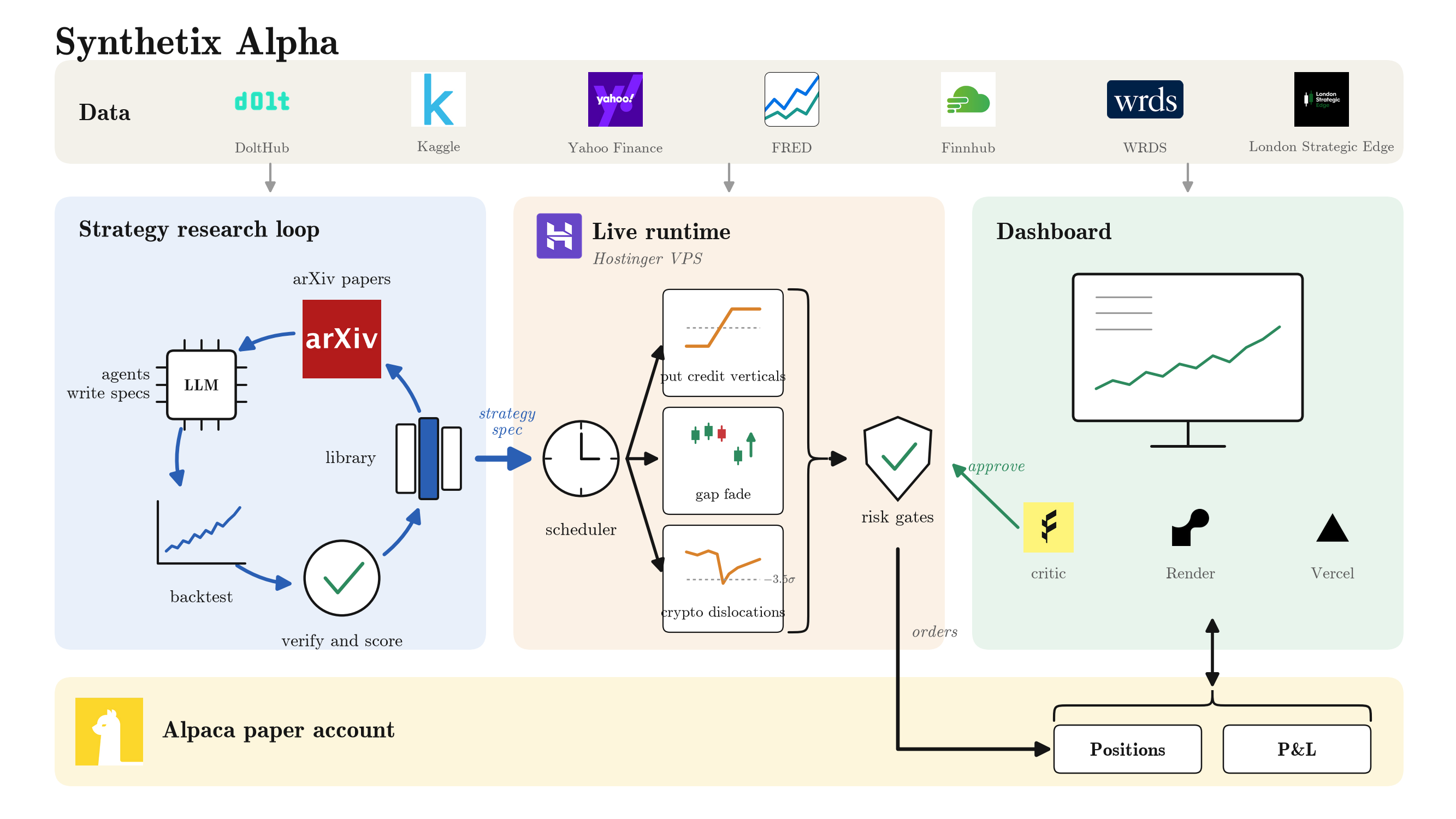
One rule runs through the whole system: LLM agents research, a deterministic runtime trades. The model reads papers,
writes strategy specs and reviews candidates in the dashboard; it never sees a broker key and is never in the order
path.
the critic; without a key it runs in mock mode and says so
WRDS, LSE_API_KEY
research validation only, nothing live reads them
Strategy research
synthetix_alpha/strategy: a declarative Spec (legs by delta, moneyness or width; DTE window; signal gates over 22
trailing-only features; exits; sizing; costs) interpreted by a deterministic daily backtester over real end-of-day
chains. Fills at mid plus half the spread, $0.65 per contract and leg, a same-day volume floor, OCC split adjustment,
settlement at intrinsic. Research agents mutate specs, never code.
Candidates are scored on 0.5*mean_sharpe + 0.5*min_sharpe + 2*worst_year + 3*max(maxDD, -1) + (positive_years - 1),
with fewer than 40 trades scoring -9. The progress log (docs/progress.md) is append-only and keeps
corrections even when the score falls.
Agentic research loop
New arXiv papers feed the strategy search. The deterministic half (search, relevance filter, PDF download, the library
of papers already seen, backtesting what comes back) lives in synthetix_alpha/research/; the reading and spec-writing
is done by agents via workflows/paper_research.js.
python -m synthetix_alpha.research.loop find --limit 5     # queue papers, print the agent brief
# hand the brief to the workflow, which writes Spec JSON files
python -m synthetix_alpha.research.loop evaluate           # backtest them against the incumbent
Papers already seen are in docs/papers.jsonl. The brief tells the agent that a mean-Sharpe gain
under 0.54 is inside this sample's noise, the floor measured in the research log. synthetix_alpha/pipeline/ holds the
LLM client and a benchmark harness that scores open models on spec generation and critic consistency.
Live runtime
synthetix_alpha/live/ is the part that trades. A scheduler fires the runner at 09:31 (enter), 09:45 (top-up), 15:50
and 15:56 (flatten) ET, each in a clean subprocess, marking state before each fire so a crash never retries. Three
sleeves ride along with every entry run:
Options: put credit verticals from the screen, strategies/put_vertical_ivrv.json and its single-name variant.
Gap fade: 198 large caps, the ten most negative volatility-scaled overnight gaps bought at the open, flat by the close.
Crypto dislocations: 18 pairs, a 24-hour move below -3.5 sigma of hourly volatility, held 48 hours, at most three open.
python -m synthetix_alpha.live.run --intraday-top 10 --intraday-budget 1.5   # dry run of one entry
python -m synthetix_alpha.live.run --flatten                                 # dry run of the close
python -m synthetix_alpha.live.schedule --execute                            # the loop, live on paper
Everything is a dry run unless --execute is passed. Entries are refused outside 09:31-10:30 ET, flattening outside
15:30-15:58, and weekends always. In production the scheduler runs in a tmux session on a Hostinger VPS with a cron
watchdog that restarts it within five minutes.
Risk gates
Every order, from the scheduler or the dashboard, passes the same code before it reaches the broker. Limits live in
config/governance.yaml and config/universe.yaml, so they are
auditable without touching code.
Account: positive NAV; halt at 20% total or 5% daily drawdown; leverage 1x; 10% of NAV per name; 12 open
positions; defined-risk structures only; 3% of equity at risk per position on the payoff grid.
Screen (live/screen.py, over the ~1,500-name DoltHub vol history): IV/RV between 1.25 and 2, price above $5,
$20M average daily volume, chain spread under 10% of mid measured from OptionMetrics, no earnings within 30 days.
Order: credit at least 5% of max loss; the credit re-priced at bid and ask must clear 60% of the mid credit; 25
contracts of same-day volume; whole contracts only.
Intraday: a corporate-action guard on gaps beyond 25%; the ranking refuses a stale session; exits are sized to
the actual fill; flattening covers only what is held, in two passes.
Idempotency: the client order id is a hash of the legs and the date, checked in a local ledger and against the
broker; status is never reported as filled unless Alpaca said so.
Paper only: the runner asserts paper mode and strips the live-trading switch from every child environment.
from synthetix_alpha.live import Rules, apply, submit
decision = apply(orders, positions, nav, Rules.load())   # defined-risk only, per-position and NAV caps, drawdown halts
submit(legs, contracts, limit_price)                      # dry-run by default; deterministic client_order_id
Alpaca: the CLI for trading, the SDK for data
Every account read and every order goes through Alpaca's CLI (alpacahq/cli); synthetix_alpha/live/cli.py is the
transport. Spreads are multi-leg limit orders (--order-class mleg, up to four legs, day time in force); the equity
basket and crypto use market orders. The dashboard's Docker image builds the CLI from source so Render runs the same
transport as the VPS.
go install github.com/alpacahq/cli/cmd/alpaca@latest   # or: brew install alpacahq/tap/cli
# or drop the release binary at tools/alpaca.exe; override with ALPACA_BIN
alpaca account get                                     # ALPACA_API_KEY / ALPACA_SECRET_KEY from .env
Market data goes through the alpaca-py SDK (synthetix_alpha/data/alpaca.py): option-chain snapshots with implied
vol and greeks, split-adjusted stock bars down to one minute, crypto hourly bars. Backtests, the intraday ranking and
the screen are bulk data jobs that the SDK's historical clients batch and page; the CLI is a per-call tool and is not
the right instrument for them. The SDK's trading client is used only to read option-contract metadata.
import datetime as dt
from synthetix_alpha.data import AlpacaClient, BarStore, OptionBarsDataSource, chain_bars, register
from synthetix_alpha.data import dolt, kaggle
from gs_quant.backtests.data_sources import DataManager

c = AlpacaClient()
chain = c.option_chain("SPY", expiration_date="2026-09-02")      # bid/ask/IV/greeks per contract
bars = c.option_bars(chain.index[:5], "15Min", start="2026-08-20")  # OHLCV history (Feb 2024+)

store = BarStore(c)
store.ensure("option", "1Day", chain.index, dt.date(2026, 8, 1), dt.date.today())  # one batched fetch for the whole chain
dm = DataManager()
option = register(dm, OptionBarsDataSource(symbol=chain.index[0], store=store))  # use `option` in gs-quant triggers/actions

chains = kaggle.load_chains("QQQ")                 # EOD chains 2016-2023: AAPL, NVDA, QQQ, SPY, TSLA; (date, symbol) x CHAIN_COLUMNS
surface = dolt.load_chains(["SPY", "QQQ"], dt.date(2023, 1, 1), dt.date(2024, 12, 31))   # DoltHub post-no-preference/options
vol = dolt.load_volatility(["SPY"], dt.date(2023, 1, 1), dt.date(2024, 12, 31))
Other sources: Yahoo Finance (earnings dates, splits), FRED (VIX, VXN, VXV, NFCI, macro), Finnhub (news, sentiment),
FOMC dates, and for validation only WRDS (OptionMetrics, CRSP) and London Strategic Edge.
Dashboard and the Featherless critic
synthetix_alpha/api/ is a FastAPI adapter over the live modules; frontend/ is a Next.js command centre (pipeline
trace, opportunities, positions, execution ledger, research view from the progress log). The pipeline is
screen → gather (Finnhub, FRED) → critique → form → risk → operator approval → paper execution. The critic is a
Featherless-hosted model prompted as a risk officer; it is advisory, every approval re-runs the deterministic risk
gate, and the operator confirms in two steps.
python -m synthetix_alpha.api                              # http://127.0.0.1:8000, GET /v1/overview
cd frontend && npm install && npm run dev                  # NEXT_PUBLIC_DASHBOARD_API_URL=http://127.0.0.1:8000
python -m synthetix_alpha.pipeline.orchestrator --dry-run  # the pipeline end to end, no orders
docker build -t synthetix-alpha . && docker run -p 8000:8000 --env-file .env synthetix-alpha
Production runs the API on Render from the Dockerfile and the frontend on Vercel.
Deployed strategy
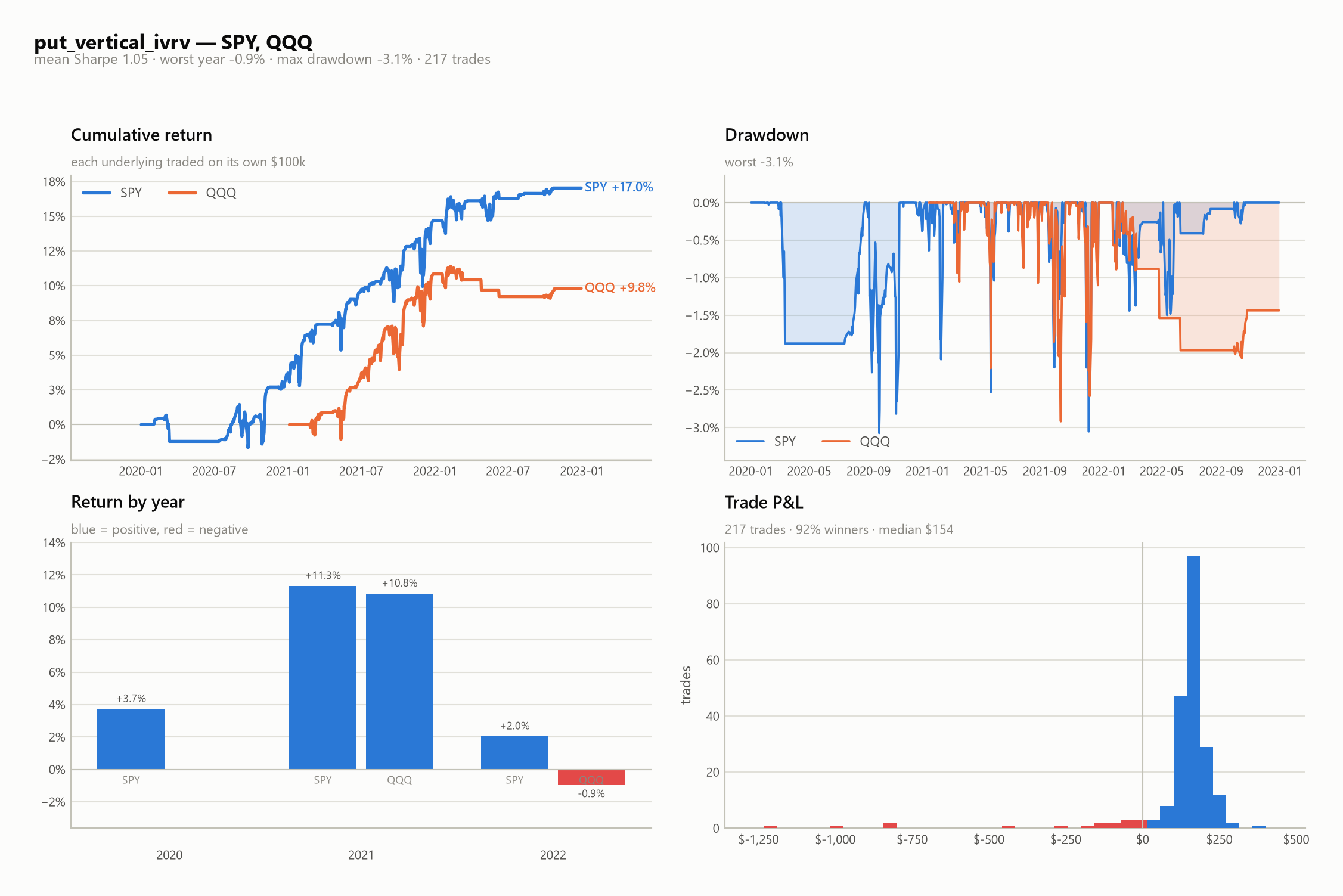
strategies/put_vertical_ivrv.json: put credit vertical on SPY and QQQ (sell the 20-delta put, buy the 10-delta,
about 65 DTE), entered only when both the option chain and the matching CBOE index (VIX or VXN) say implied vol is
rich versus realised; exit at 65% of the credit, a 2x stop or 21 DTE; 3% of equity at risk, 12 slots, daily entry. In
sample 2020-2022: Sharpe 0.92, max drawdown 2.0%, 102 trades. Out of sample: Sharpe 0.65 on independent 2019-2026
vendor data, 0.49 on AAPL, which was never used to fit it. The number to plan around is the out-of-sample one.
strategies/put_vertical_singlename.json applies the same rule to single names with a yfinance earnings blackout
(AAPL: Sharpe 0.46 -> 0.90, max drawdown -7.7% -> -2.1%). strategies/portfolio.json runs three sleeves at equal
weight; every optimised weighting beat equal weight in sample and lost to it out of sample.
Three findings from the research log worth knowing before reading any number above: a same-day volume floor cut the
in-sample Sharpe from 1.15 to 0.92 and closed the gap to out-of-sample, so the earlier figure was partly quotes that
never traded; on OptionMetrics with overlap-corrected errors the IV/RV gate's premium advantage sits inside the noise;
and the gap fade's backtested edge, re-measured on minute bars from the price a market order actually gets, was an
artefact of the opening print.
S
Synthetix Alpha
alan-d-smith·4 Sterne·
An autonomous, risk-gated quantitative trading agent powered by LLM reasoning and the Alpaca MCP server.
Noch keine Tool-Liste. Remote-Server erhalten eine nach dem ersten Health-Check.
FAQ
Fragen
Wie installiere ich Synthetix Alpha?
Kopieren Sie auf dieser Seite die stdio-Konfiguration für Cursor, Claude Desktop, Claude Code oder VS Code. Sie nutzt die Installation des Herausgebers, keinen PlugMCP-Proxy.
Benötigt Synthetix Alpha einen API-Schlüssel?
In diesem Eintrag ist keine erforderliche Umgebungsvariable aufgeführt.
Welchen Transport verwendet Synthetix Alpha?
Synthetix Alpha läuft lokal über stdio.
Wann wurde Synthetix Alpha zuletzt geprüft?
Zuletzt geprüft: 2026-10-28. An autonomous, risk-gated quantitative trading agent powered by LLM reasoning and the Alpaca MCP server.