✨ AI Gateway Labs

Explore the enterprise-grade gateway for managing AI Models, Tools, and Agents
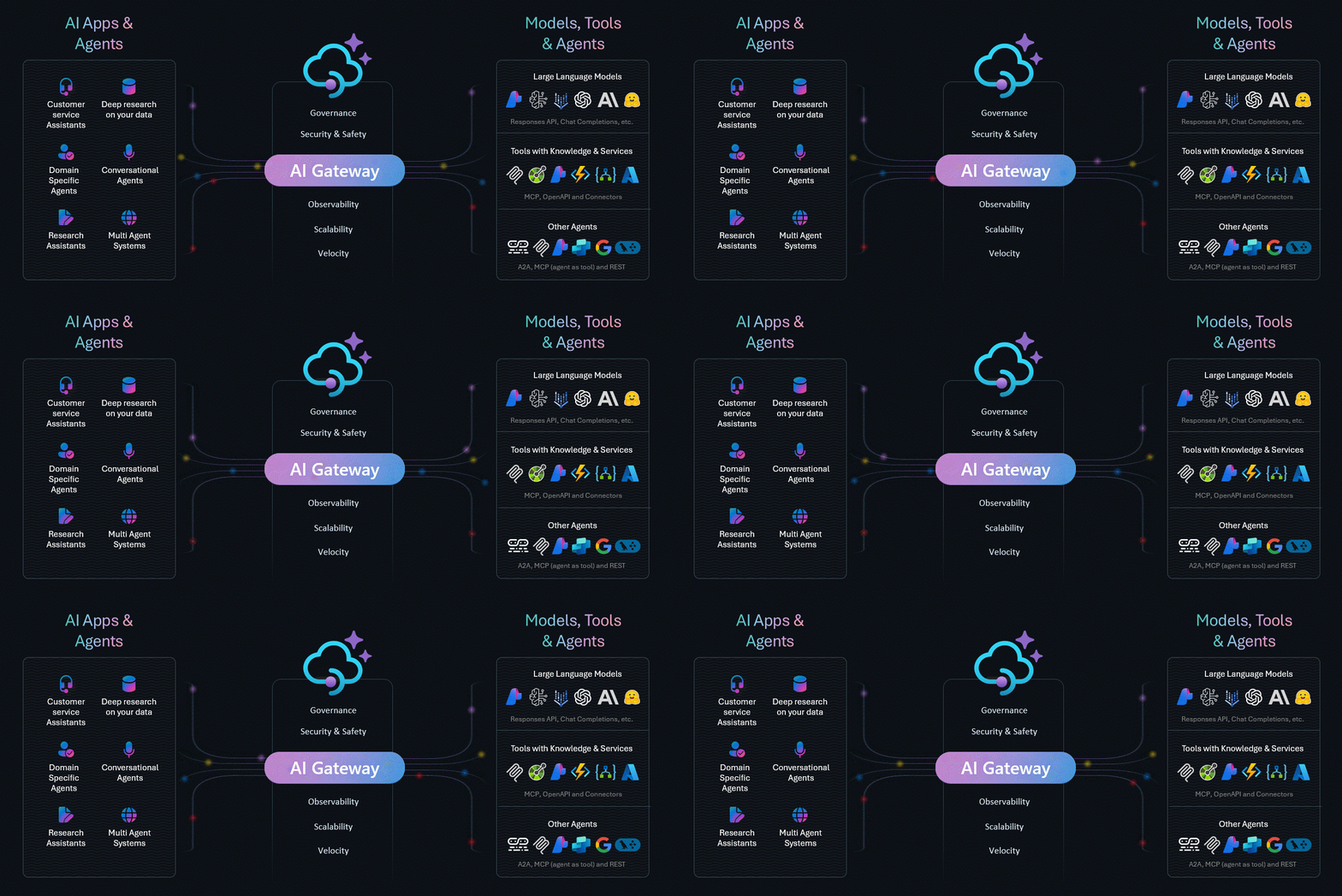
📰 New! The AI Gateway Dev Portal is now live — A starting point for building your own developer portal on top of Azure API Management AI Gateway's. Fork it, open it in VS Code with GitHub Copilot (or any coding agent), and shape it to fit your needs!
Why AI Gateway?
Building production-ready AI applications requires more than just calling model APIs. You need security, reliability, observability, and cost control—without slowing down innovation.
AI Gateway powered by Azure API Management provides:
- 🔐 Security — OAuth 2.0, managed identities, content safety filtering
- ⚡ Performance — Load balancing, semantic caching, request routing
- 📊 Observability — Token metrics, built-in logging, tracing
- 💰 Cost Control — Rate limiting, quota management, FinOps framework
- 🔌 Extensibility — MCP protocol support, function calling, multi-model routing
📚 Explore the Labs
🔗 Browse all 30+ labs at aka.ms/ai-gateway/labs
Each lab is a hands-on Jupyter notebook with step-by-step instructions, Bicep infrastructure templates, and APIM policies you can deploy to your Azure subscription.
🧠 AI Gateway for Models
Manage and control access to Large Language Models with enterprise-grade policies.
🔧 AI Gateway for Tools
Enable secure tool access with MCP protocol and function calling capabilities.
🤖 AI Gateway for Agents
Build and control agentic applications with orchestration frameworks.
🚀 Quick Start
Prerequisites
- Python 3.12+
- uv (fast Python package manager) — install via
curl -LsSf https://astral.sh/uv/install.sh | sh(Linux/macOS) orpowershell -c "irm https://astral.sh/uv/install.ps1 | iex"(Windows) - VS Code with Jupyter extension
- Azure Subscription with Contributor + RBAC Administrator roles
- Azure CLI authenticated to your subscription
Get Started
# Clone the repository
git clone https://github.com/Azure-Samples/AI-Gateway.git
cd AI-Gateway

# Create the virtual environment and install dependencies
uv sync
uv pip install -r pyproject.toml

# Open VS Code and start with a lab
code .
When opening a notebook, select the .venv interpreter created by uv sync as the Jupyter kernel.
Or launch instantly with GitHub Codespaces ☁️
🔨 Developer Tools
The tools/ folder provides utilities for testing and development:
👩💻 Build Your Own Labs with AI
This repository includes Copilot Agent Skills that help you create new labs using AI-assisted development in VS Code.
Available Skills
Example: Create a New Lab
Open this repo in VS Code with GitHub Copilot and use this prompt:
Create a new lab called "multi-model-failover" that demonstrates how to
implement automatic failover between different AI models when the primary
model is unavailable or throttled. Include:
- A backend pool with priority-based routing
- Retry policy with exponential backoff
- Circuit breaker pattern for unhealthy backends
- Built-in LLM logging to track usage across all backends
- Test the model with a LangChain agent: https://docs.langchain.com/oss/python/langchain/agents
Use gpt-4.1-mini as primary and gpt-4.1-nano as fallback, deploy to Sweden Central.
Copilot will generate the complete lab structure including:
- 📓 Jupyter notebook with step-by-step instructions
- 🦾 Bicep infrastructure template
- ⚙️ APIM policy XML
- 📖 README documentation
- 🧹 Cleanup notebook
🏛️ Well-Architected Framework
Labs are designed following Azure Well-Architected Framework principles:
📕 Enterprise AI Gateway e-Book
Download the Enterprise AI Gateway e-Book for comprehensive end-to-end view of the Enterprise AI Gateway pattern, explaining why a centralized governance layer is essential for organizations adopting AI at scale and how it can be practically implemented using Azure API Management and Microsoft Foundry.
It describes the AI Gateway as a control plane that mediates all interactions between AI apps and agents and the underlying models, data, and tools, enabling consistent enforcement of security, safety, cost controls, resiliency, scalability, observability, and governance. Overall, the e-Book positions the Enterprise AI Gateway as a foundational architectural component that allows enterprises to innovate rapidly with AI while maintaining trust, compliance, visibility, and control.
🎬 Conferences & Webcasts
Learn from experts through these videos covering AI Gateway concepts and implementations.




📖 Resources
- 📘 AI Gateway Documentation
- 🎓 AI Gateway Workshop
- ⚙️ APIM Samples
- 📚 APIM Learning Modules
- 💡 Landing Zone Accelerator
- 🏛️ Foundry Ctadel
- 📰 API Management News
🤝 Contributing
Contributions are welcome! Please read CONTRIBUTING.md for guidelines.


