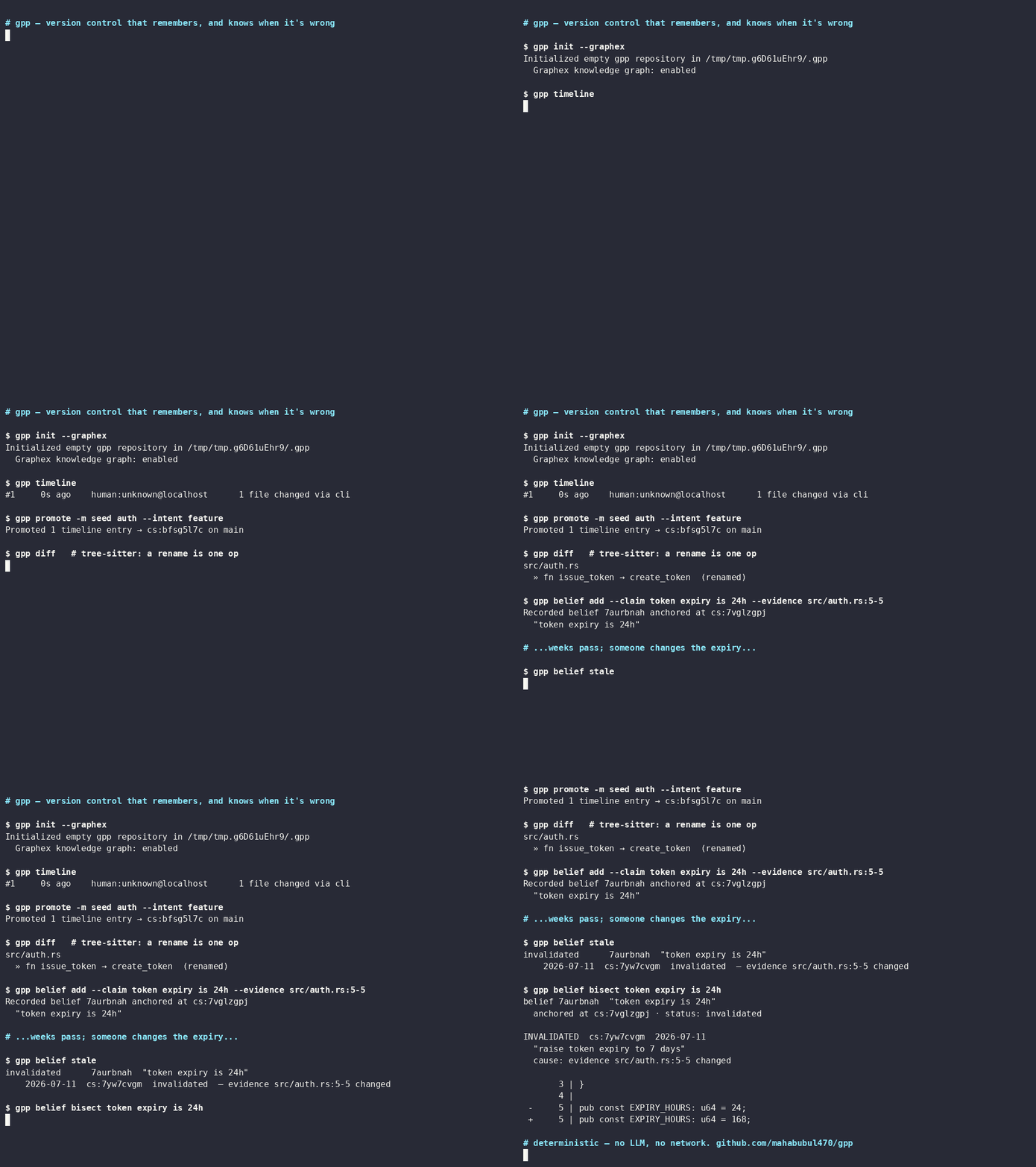
AI agents change code continuously, then lose the work that happened
between commits — and the notes they keep about your codebase
(, memory banks, knowledge files) go stale silently when the
code moves on. gpp is a version control system built for that reality: it
, promotes curated changesets with
intent and provenance, and hosts project knowledge — so when a commit invalidates something you believed about the
code, gpp can name that commit.
Deterministic — diff intersection and blob hashes, zero LLM or network
calls. (For scale: asked to judge whether a stored memory has been
invalidated, the best frontier model manages 55.2% accuracy on the
STALE benchmark — here it's a
history query, not a judgment.) Validated on real history across five
repos in four languages — axum 0.6→0.7, flask 1.1→2.0, clap 3→4, zod
3→4, go-redis 8→9 — where every invalidated belief bisects to a pinned,
documented culprit commit and the control beliefs survive: see
demos/belief-bisect/ for the full matrix.
What makes it different
Continuous capture. A high-frequency timeline records every file
change (SQLite WAL, debounced watcher); curated changesets are
promoted from it with an explicit intent, author kind (human/agent),
and cost record. Nothing is lost between commits.
Graphex: versioned, encrypted project knowledge. Architecture,
conventions, decisions, and beliefs live in an encrypted knowledge
graph inside the repo, tier-gated per agent trust level, audited on
every read — and staleness-checked against the history it rides on.
Agent governance. First-class agent identity with reputation
scoring, compliance-as-code policies enforced at capture/promote/sync,
anomaly detection, and per-changeset token/cost attribution.
Everything else — P2P sync over Noise, replay, review/RBAC, a relay node,
a TUI — is the platform underneath: see
docs/ARCHITECTURE.md.
Git is the substrate, not the competition. The bridge
(gpp git-import / git-export / git-bridge) round-trips real Git
commits, so GitHub and existing workflows keep working — gpp's knowledge,
provenance, and governance layers ride alongside. The axum demo above
runs entirely on history imported through this bridge.
Connect Claude Code (or any MCP client)
gpp ships an MCP server; agents query the knowledge graph (every belief
with a freshness envelope — anchor, commits since, and the changeset that
staled it), write their own evidence-anchored beliefs with
propose_belief (human-approved, then policed by history), propose
changesets, and report costs. Drop this in .mcp.json at your repo root:
Full client setup (Claude Desktop, generic stdio) and the exposed tool
list: docs/MCP.md.
Status
All 9 roadmap phases (0–8) implemented. See
docs/ROADMAP.md for per-phase deliverables and
documented deviations, docs/TODO.md for the prioritized
backlog, and docs/WORKLOG.md for the running
engineering log.
Verified 2026-08-23: 184 workspace tests pass, cargo clippy and
cargo fmt clean, full workspace builds. No stub crates remain — every
crate has a working implementation. Coverage is measured in CI
(cargo llvm-cov; 65.7% line at baseline, being raised).
Test depth is still uneven: foundational layers are well covered
(gpp-core, gpp-graphex, gpp-diff, gpp-tui ≥ 80% line; the CLI has
end-to-end suites for policy enforcement, cost reporting, reviewer
assignment and belief bisect), while several integration crates remain at
smoke-level (gpp-sdk, gpp-notify, gpp-rbac, gpp-replay).
"Implemented" here means built and tested against its milestone, not
exhaustively hardened everywhere. Closing that gap is the top item in
docs/TODO.md.
The full layer table
Layer
Crate
What's implemented
Storage
gpp-core
Content-addressed store (BLAKE3 + zstd), Blob/Tree, raw verified frame transfer
Documented follow-ups (recorded in the ROADMAP/TODO, not silently
skipped): registry/license APIs for deps, native PyO3/napi bindings,
outbound platform-review sync, apt/dpkg packages.
Install / build
cargo install gpp-cli                    # the `gpp` binary (crates.io)
cargo install gpp-relay                  # relay node (optional)

# or from a clone
cargo build --release
cargo test --workspace
cargo bench -p gpp-core -p gpp-diff      # criterion perf suite
Prebuilt binaries for Linux, macOS (ARM + Intel), and Windows are
attached to each release;
cargo install --git https://github.com/mahabubul470/gpp gpp-cli tracks
unreleased development.
More to try
# Governance
gpp policy template secrets-scan
gpp trust show
gpp audit --include-cost --include-graphex

# Decentralized: sync two repos over Noise
gpp sync serve 127.0.0.1:9473             # on peer A
gpp sync add a 127.0.0.1:9473 && gpp sync # on peer B

# GitHub-compatible
gpp remote setup --platform github --repository acme/webapp
gpp remote pr-create --base main
See CLAUDE.md for project context, docs/ for the
full specification (architecture, data model, CLI, protocols, roadmap),
and docs/book/ for the user guide + tutorials.
Noch keine Tool-Liste. Remote-Server erhalten eine nach dem ersten Health-Check.
FAQ
Fragen
Wie installiere ich Gpp?
Kopieren Sie auf dieser Seite die stdio-Konfiguration für Cursor, Claude Desktop, Claude Code oder VS Code. Sie nutzt die Installation des Herausgebers, keinen PlugMCP-Proxy.
Benötigt Gpp einen API-Schlüssel?
In diesem Eintrag ist keine erforderliche Umgebungsvariable aufgeführt.