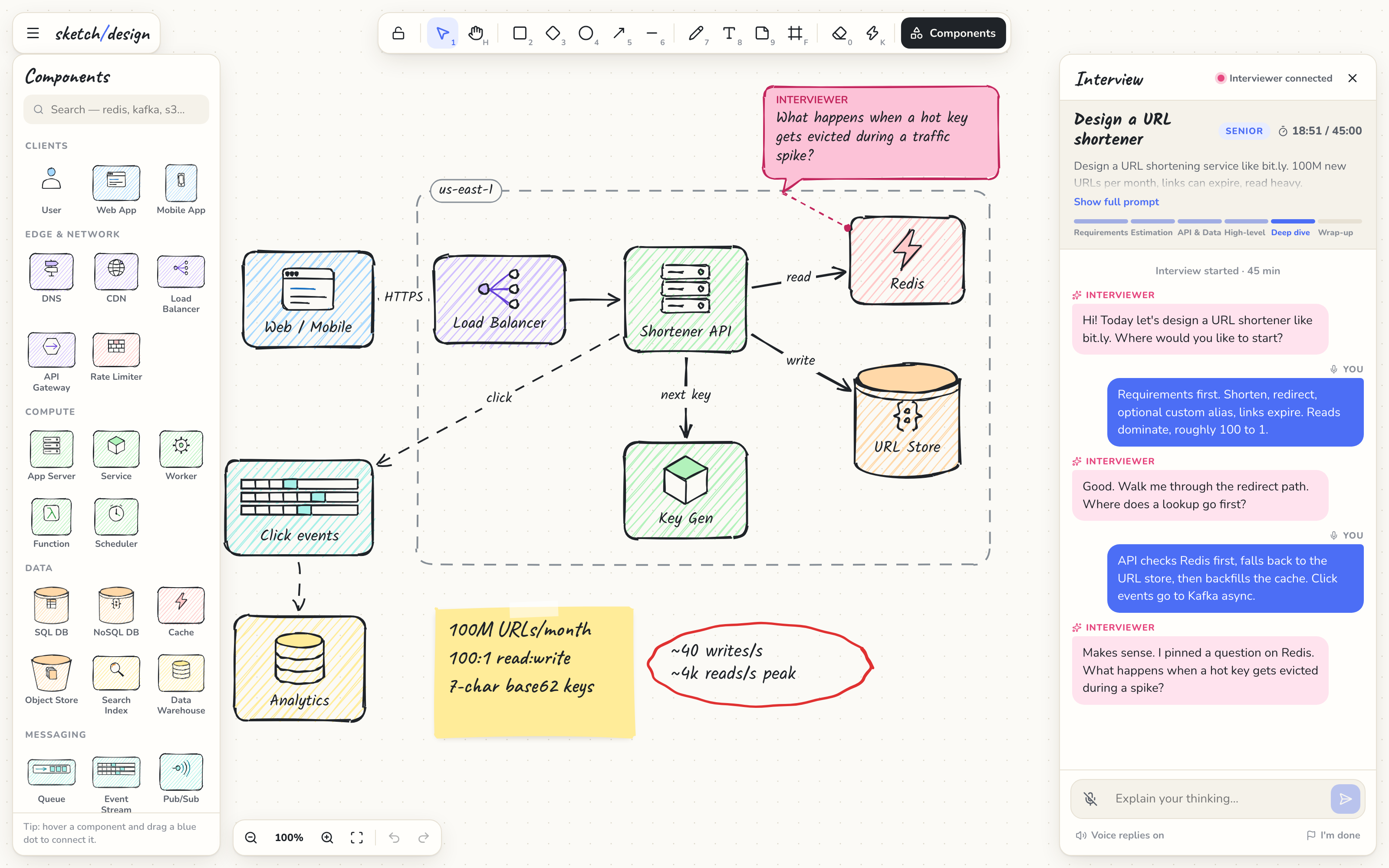
A hand-drawn whiteboard for system design mock interviews, plus an MCP server that turns Claude or ChatGPT into your interviewer. It sees your board, listens to you, talks back, pins questions on your components, and ends with scored feedback.
Hand-drawn whiteboard for system design mock interviews; your AI watches, asks and gives feedback.
SYSDESIGN_PORT
Zuletzt geprüft
2026-11-10
Sterne
—
Tools
—
Uptime
—
Pencil-style canvas: a paper or chalkboard theme, with shapes that look drawn by hand (rough.js + perfect-freehand)
27 system design components: load balancer, API gateway, CDN, cache, SQL and NoSQL databases, object store, queue, Kafka-style stream, pub/sub, workers, serverless functions, auth, monitoring, ML and more
Arrows that stay attached to components, with labels, curved or elbow routes, and dashed lines for async flows. Hover a component and drag its blue dot to connect it.
Interview panel: the problem, a timer, a phase tracker, chat, voice in (speech-to-text) and voice out (the interviewer's replies are read aloud)
The interviewer can read your diagram as structured data, look at a picture of it, pin comments on components, highlight things, sketch reference designs, and grade you at the end
Runs entirely on your machine. The AI runs in your own Claude or ChatGPT app, on your existing subscription, with no API keys.
Install
Requires Node.js 18+.
Your AI app
How to connect
Billed to
Claude Desktop
Double-click sysdesign-board-x.y.z.mcpb from Releases, or run npx -y sysdesign-board install
Claude Pro / Max
Claude Code
claude mcp add sysdesign-board -- npx -y sysdesign-board
The .mcpb one-click file is Claude Desktop only. Every other app runs the same npm package.
Claude Desktop
Option A: one-click. Download the .mcpb file from Releases and double-click it. Claude Desktop shows an install dialog.
Option B: command line. First quit Claude Desktop completely (macOS: ⌘Q; Windows: tray icon → Quit). Claude rewrites its config file from memory when it quits, which would drop the new entry. Then run:
npx -y sysdesign-board install
Reopen Claude Desktop.
Option C: edit the config yourself (again, with Claude Desktop quit). The file is at:
On Windows, use "command": "cmd", "args": ["/c", "npx", "-y", "sysdesign-board"]. If Claude can't find npx (common with nvm, Volta or asdf), use the absolute path from which npx (macOS/Linux) or where npx (Windows).
Claude Code
Either add the server directly:
claude mcp add sysdesign-board -- npx -y sysdesign-board
Or install the plugin, which also adds an interview skill, from this repo's marketplace. Run these inside Claude Code:
ChatGPT connects to MCP servers over public HTTPS, so you run the board locally and expose only its /mcp endpoint through a tunnel. The board itself, its API and its WebSocket refuse any request that doesn't come from localhost.
Start the board, and keep this running:
npx -y sysdesign-board serve
In another terminal, open a tunnel (here with cloudflared):
cloudflared tunnel --url http://localhost:4321
Get your private connector token:
npx -y sysdesign-board token
In ChatGPT, go to Settings → Apps & Connectors → Advanced, enable Developer Mode, then Create a connector with the URL https://<your-tunnel>.trycloudflare.com/mcp?token=<token> and no authentication.
Treat that URL like a password. To change the token, delete ~/.sysdesign-board/token, or set SYSDESIGN_TOKEN yourself.
Start a system design interview with me on my sketch board.
Or use the interview prompt from your app's prompt or slash menu. The board opens at http://localhost:4321.
Draw your design. Talk with the 🎤 mic (your message is sent when you pause) or type in the panel.
The interviewer keeps listening between replies. It is woken by what you say, and when you stop drawing for a few seconds.
Click I'm done when you're finished to get a feedback card with scores.
The board also works without any AI: run npx -y sysdesign-board serve and open http://localhost:4321.
Tools the interviewer gets
Tool
What it does
start_interview
Sets the problem, level and duration, opens the board, and speaks the opening line
wait_for_candidate
Waits for your speech or messages, or for board changes once you stop drawing
say
Sends a chat message, read aloud
get_board
Structured diagram: components, connections (with labels; dashed means async), zones, notes, and what changed
get_board_image
A PNG of the whole board (for handwriting and sketches)
annotate / clear_annotations
Pin or remove "INTERVIEWER" comment bubbles on components
highlight
Makes components glow, optionally zooming to them
draw_on_board
Adds components, connections, notes and zones in the same sketchy style
set_phase
Requirements → Estimation → API & Data → High-level → Deep dive → Wrap-up
end_interview
Feedback card with 1–5 scores, strengths and improvements
get_transcript, open_board
Housekeeping
Voice
Speech-to-text uses the browser's Web Speech API. Use Chrome, Edge or Safari; Firefox doesn't support it.
Text-to-speech uses your system voices. Toggle it with "Voice replies" in the panel. The mic pauses while the interviewer speaks, so it doesn't transcribe itself.
The native voice modes inside the ChatGPT and Claude apps can't be piped into another page. Those voice models are only available through paid APIs.
Keyboard
V select · H hand / hold Space · R rect · D diamond · O ellipse · A arrow · L line · P pen · T text · N sticky note · F zone · E eraser · K laser · C components · I interview panel · Q tool lock · G grid snap · ⌘/Ctrl Z undo · ⌘/Ctrl D duplicate · ⇧1 fit · ? all shortcuts
What it handles: your board, the interview chat and voice transcripts, your settings, and a local access token.
Where it's stored: only on your machine, in the browser's local storage for the board page and in ~/.sysdesign-board/. The author runs no server, and there are no accounts, analytics or telemetry.
What leaves your computer:
When the AI interviewer calls a tool, the AI app you connected receives the board description, a picture of the board, your messages and your transcripts, under that provider's privacy policy.
The mic uses your browser's speech recognition. Chrome sends the audio to Google; Safari uses Apple's speech service.
npx downloads the package from npm.
With the optional tunnel, /mcp requests pass through the tunnel provider.
Security:
The board, its API and its WebSocket only answer localhost requests from localhost pages. Other websites and tunnels are refused, which also blocks DNS-rebinding attacks.
The HTTP endpoint (/mcp) always requires the token.
Sharing and retention: nothing is sold or shared. Data stays until you clear the board or delete ~/.sysdesign-board/.
The server doesn't appear in Claude Desktop. Claude was probably running when the config was edited and saved over it. Quit it fully, run npx -y sysdesign-board install, then reopen.
"npx: command not found" in Claude's logs. Use an absolute path to npx (see Option C), or run npx -y sysdesign-board install, which writes absolute paths for you.
Port 4321 is taken. Set SYSDESIGN_PORT (or --port=5000). In the .mcpb extension it's a setting.
The mic does nothing. Open the board in Chrome, Edge or Safari and allow microphone access.
Several apps connected at once? That's fine. The first one hosts the board and the others share it.
CLI
sysdesign-board            MCP server over stdio (what AI apps launch)
sysdesign-board serve      Board + HTTP MCP endpoint only
sysdesign-board install    Add to Claude Desktop (quit it first)  [--npx | --local]
sysdesign-board token      Print the HTTP MCP token / URL
Development
git clone <this repo> && cd sysdesign-board
npm install
npm run dev
npm run dev starts the hub on :4321 with reload, and Vite on :5173. Other scripts:
Command
What it does
npm run build
Builds the board UI and bundles the server into one file
npm run build:mcpb
Packs build/sysdesign-board-<version>.mcpb
npm run typecheck
Type-checks the web and server code
node scripts/mcp-smoke.mjs
Drives every MCP tool against a running board
npm run lock:plugin
Refreshes the Claude plugin's package-lock.json (run after the new version is on npm)
Releasing a new version:
Run npm version <x.y.z> --no-git-tag-version. This also updates server.json and the plugin's version and pinned dependency.
Run npm publish.
Run npm run lock:plugin. The lockfile needs the published package's checksum, so this comes after publishing.
Commit, then tag and push.
Make a GitHub release with npm run build:mcpb.
Run mcp-publisher publish for the MCP Registry.
The code lives in three folders:
web/: the board (React UI plus the canvas engine in web/src/engine.ts; renderer and component glyphs in web/src/render/)
server/: the hub (HTTP, WebSocket and persistence), the MCP tools and the CLI
shared/: the data model, component catalog and geometry
Noch keine Tool-Liste. Remote-Server erhalten eine nach dem ersten Health-Check.
FAQ
Fragen
Wie installiere ich Sketch/design — System Design Interview Board?
Kopieren Sie auf dieser Seite die stdio-Konfiguration für Cursor, Claude Desktop, Claude Code oder VS Code. Sie nutzt die Installation des Herausgebers, keinen PlugMCP-Proxy.
Benötigt Sketch/design — System Design Interview Board einen API-Schlüssel?
Der Herausgeber nennt diese Umgebungsvariablen: SYSDESIGN_PORT.
Welchen Transport verwendet Sketch/design — System Design Interview Board?
Sketch/design — System Design Interview Board läuft lokal über stdio.
Wann wurde Sketch/design — System Design Interview Board zuletzt geprüft?
Zuletzt geprüft: 2026-11-10. Hand-drawn whiteboard for system design mock interviews; your AI watches, asks and gives feedback.