Open Second Brain
Agenten stärken
Installation vom Herausgeber. Kein PlugMCP-Endpunkt.
Host a copy with our keys and logs.
Noch kein paketiertes Release in der Registry. Folgen Sie der README des Repositorys.
Remote-URL oder ein Befehl auf Ihrem Rechner? Worin sich die beiden Installationen unterscheiden
Auf PlugMCP ausführen
A new server you create. It is not this listing's official endpoint. Use the publisher install when you want their URL and their credentials.
StartenVom Herausgeber
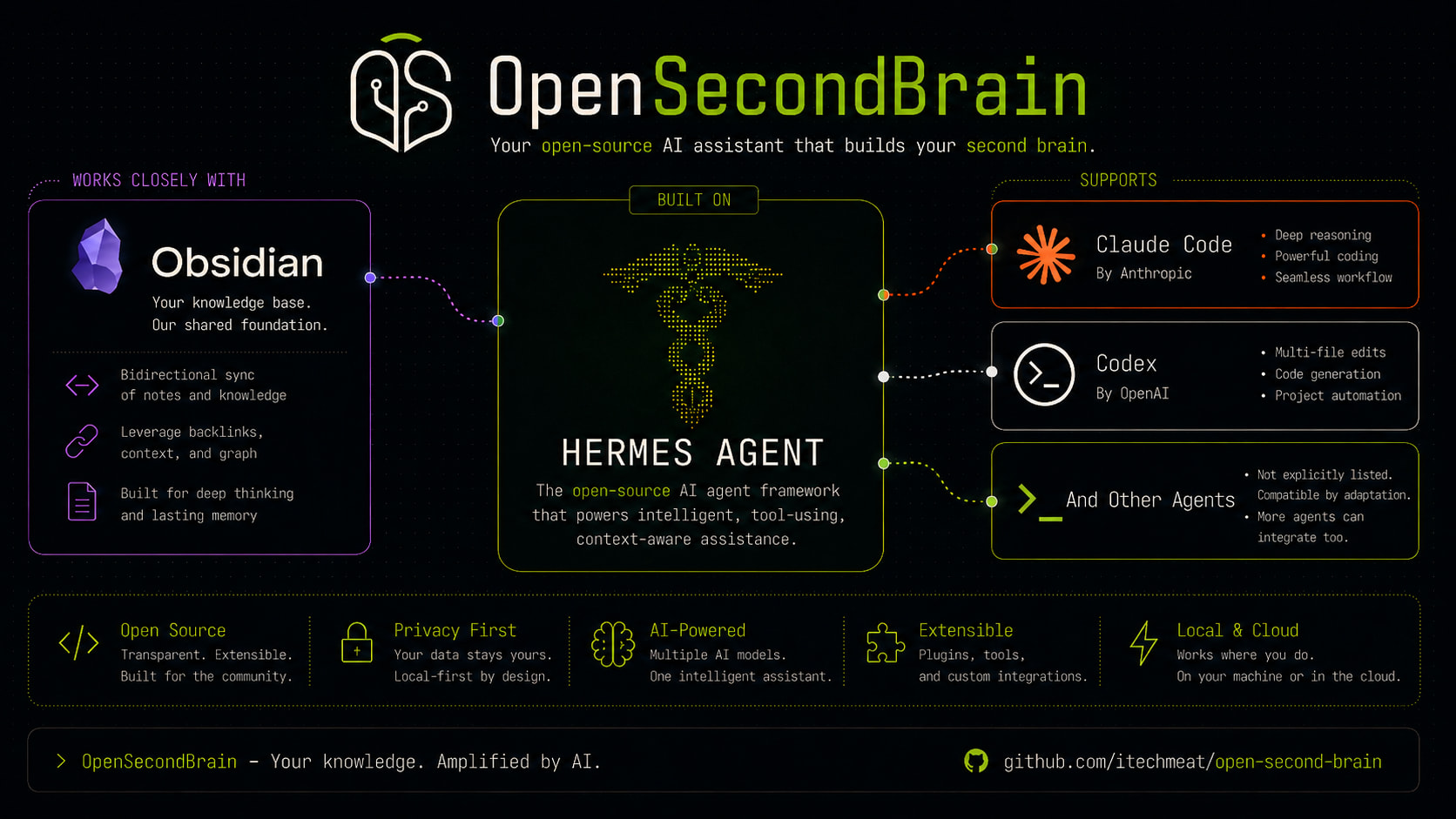
Local-first 🧠 memory for Hermes Agent that lives in your Obsidian vault and remembers project context. Nightly 😴 dream passes turn repeat corrections into confirmed preferences with measurable confidence. Adapters ship for Claude Code, Codex, and OpenClaw, with an MCP server for anything else.
Open Second Brain is a memory layer for AI agents that lives in an Obsidian vault. Agents read and write it through MCP servers, lifecycle hooks and the o2b CLI. Everything the agent learns is a Markdown file under Brain/, so you can open, edit, grep and version it like any other note. A deterministic dream pass turns repeated signals into rules and retires the ones nothing uses; no model runs inside that algorithm.
flowchart LR
    subgraph Clients["Agent clients"]
        Plug["Plugins: Claude Code, Codex,<br/>Hermes, opencode, Grok Build"]
        Mcp["MCP config: Cursor, kiro, Copilot CLI,<br/>Gemini CLI, ZCode, any MCP host"]
        Claw["OpenClaw<br/>in-process plugin"]
        Cliu["Aider, Pi<br/>CLI and context file"]
    end
    subgraph Product["Open Second Brain"]
        Srv["MCP servers<br/>open-second-brain, open-second-brain-writer"]
        Hooks["Lifecycle hooks<br/>o2b-hook"]
        Cli["CLI<br/>o2b"]
        Core["Core"]
    end
    subgraph Vault["Your vault"]
        Brain["Brain/<br/>Markdown the agent writes"]
        Notes["Your notes"]
        Index[(".open-second-brain/brain.sqlite<br/>rebuildable search index")]
    end
    Plug --> Srv
    Plug --> Hooks
    Mcp --> Srv
    Claw --> Core
    Cliu --> Cli
    Srv --> Core
    Hooks --> Core
    Cli --> Core
    Core --> Brain
    Core --> Index
    Core -. reads, writes a named note on request .-> Notes
Each client reaches the same core through a plugin, an MCP registration or the CLI. The core keeps its own records under Brain/ and a generated search index under .open-second-brain/ that it can rebuild from the files. Your notes are read; the note tools write one only at a path the caller names.
flowchart LR
    Agent["Agent"] -->|brain_feedback| Inbox["Brain/inbox/<br/>signal"]
    Inbox -->|dream pass| Pref["Brain/preferences/<br/>rule"]
    Pref -->|rendered into| Active["Brain/active.md"]
    Active -->|read at session start| Agent
    Agent -->|brain_apply_evidence| Log["Brain/log/"]
    Log -->|next dream pass| Pref
The learning loop: signals become rules, rules reach the next session through Brain/active.md, and applied or violated evidence confirms, quarantines or retires them. Details: docs/how-it-works.md.
Install Bun 1.1 or later: install/prerequisites.md.
Install the plugin for your client (guides below), or get the o2b CLI: install/prerequisites.md.
Create the vault files:
o2b init       --vault /path/to/vault --name "My Second Brain"
o2b brain init --vault /path/to/vault
Connect the client (table below), then check the result:
o2b doctor --vault /path/to/vault
o2b install --check
The full router with readiness criteria is install.md; native Windows is covered in install/windows.md.
o2b uninstall --target <name> --apply removes what o2b install wrote; the vault is never touched (install.md).
o2b brain rollback restores it: snapshots.o2b brain writes lists every note write by agent and device, writes revert plans a restore, o2b brain freeze stops all writers, and o2b brain log verify checks the hash-chained log: Brain CLI.search_iterative_recall_enabled, default off) keeps querying when coverage gaps survive, pausing with a plan the caller answers through brain_search's round trip; and an opt-in per-source-session cap (search_pool_max_per_session, default off) keeps one long imported session from filling the candidate window, so diversity spreads across sessions: search CLI, iterative recall, pool cap, ranking.o2b brain session-grep --operation coverage --char-budget <n>, with --entity-key seeding the fan-out from mined entity mentions): session logs, coverage.o2b brain hygiene scan finds contested, duplicate, stale and unused memories; apply runs only the findings you pick: maintenance.o2b brain truth ingest records an entity claim with an optional validity window (--valid-from/--valid-until; with the flags absent, a window on the source record's frontmatter is adopted and frozen at ingest), truth events recalls a windowed slice of the ledger, and truth state grounds an agent-stated claim with an anchoring verdict - committed, or reported back with reason codes. truth state accepts an optional opaque --sample-id naming the context-pack sample the claim drew on, and claim reads report the receipt and outcome provenance behind it at the caller's reach - "receipt known, outcome unknown", never an invented verdict: entity truth CLI.o2b brain lifecycle correct <target> reports a correction's blast radius and retires the affected records - validity-closed by default, tombstoned with --flatly-wrong, dry run by default and --apply to write. A retired record that recall can still serve is served only beside its correction, never alone: belief lifecycle CLI.o2b brain bank-export writes a one-file backup bundle: knowledge packs.$secret:NAME references resolve at the use sites, o2b brain secret unlock wraps the keyfile under a passphrase, and secret export/import move the store between installs as one passphrase-encrypted bundle: custody CLI.o2b brain today, @osb loop and @osb set markers: Brain CLI.o2b version, o2b install --friction and o2b state status report what is installed and where state lives: CLI reference.docs/mcp.md.sqlite-vec; the embeddings-setup skill walks through it: skills/embeddings-setup/SKILL.md.docs/decision-models.md.OPEN_SECOND_BRAIN_SEARCH_TRAVERSAL_* environment variable or a search_traversal_* config key; entity co-occurrence bridges join the walk by default and switch off separately (OPEN_SECOND_BRAIN_SEARCH_ENTITY_BRIDGES): retrieval quality.write_approval.notes / OPEN_SECOND_BRAIN_WRITE_APPROVAL_NOTES_ENABLED and write_approval.ingest / OPEN_SECOND_BRAIN_WRITE_APPROVAL_INGEST_ENABLED (each falling back to the write_approval.enabled master, default off) stage note creates and ingest summary pages into Brain/pending/ beside the staged signals, where they stay out of the search index until an operator runs o2b brain pending list and applies or rejects them; write-path integrity.Brain/_permissions.yaml (an operator-edited vault file) resolves allow/ask/deny per agent, role and target for the write, ingest and owner-write actions; with the file absent every check behaves exactly as today. ask stages the write, deny refuses with the write-refused token and the next command o2b brain permissions show, and every ask/deny verdict lands in a queryable decision ledger under Brain/logs/decisions/; o2b brain permissions show dry-runs the decision table, ledger reads the rows; Brain CLI.integrity.owner_scope_writes in Brain/_brain.yaml (off | warn | fail, default off) refuses a caller-named owner that differs from the caller's resolved identity on the preference and note lanes (warn allows and records one decision-ledger row); a document owner_write verdict composes most-restrictive-wins with the gate; write-time integrity.o2b mcp token mint|rotate|revoke|list keeps a hash-at-rest token per agent (.open-second-brain/secrets/mcp-tokens.json; material shown exactly once). Over HTTP a valid token authenticates as its agent per request, the shared --api-key stays valid as the operator master credential, and mcp_tokens_required / OPEN_SECOND_BRAIN_MCP_TOKENS_REQUIRED (default false) makes a non-empty token map refuse credential-less requests. o2b bootstrap --target <harness> [--token] [--rotate] [--check] provisions MCP registration, token and receipt in one idempotent command, and o2b bootstrap --remove <harness> tears a provision down again; the minted token authenticates HTTP clients configured by hand, while the registered stdio harness presents no credential and keeps its config-derived identity; core CLI.guardrails.ambient_writeback: false suppresses the ambient extraction lane with a counted ambient-withheld event (absent keeps today's behavior), and guardrails.ambient_ttl_days stamps an expiration_date on ambient-extracted signals so reads drop them after the window (absent stamps nothing); a TTL-stamped signal still stages when the review gate is on and survives apply verbatim.o2b brain decision open --title <t> --question <q> --option <o> [...] parks a question with enumerated options at Brain/decisions/open-<slug>.md; resolve mints the real type: decision page, discard closes without deciding, and the morning brief renders up to five open questions: belief lifecycle.Open Second Brain 1.93.0 makes the configured budget, the provenance and the install path hold at the edges where the model, the filesystem and the package manager move under them. Chunks charge long whitespace-free runs like URLs at a conservative token rate and split them across chunks, so the declared budget bounds what the embedding model actually receives. Preference retirement names the log shard the device actually writes, so a fresh retirement is never a broken link. The decision model accepts an ordered provider list with automatic fallback inside the existing budgets, records name the model that answered, and per-model enforce thresholds live in the installation - keyed by the model id the server reports, kept for every model ever tuned, and settable with o2b decision-model thresholds fit. The launchers re-install a dependency tree that a Codex marketplace add or upgrade removes, so the documented install path starts. The release also closes every finding of the previous release's external review, including two paths that let marker-private content leave the vault. Every release is described in the CHANGELOG.
Local-first 🧠 memory for Hermes Agent that lives in your Obsidian vault and remembers project context. Nightly 😴 dream passes turn repeat corrections into confirmed preferences with measurable confi
Übersicht
Local-first 🧠 memory for Hermes Agent that lives in your Obsidian vault and remembers project context. Nightly 😴 dream passes turn repeat corrections into confirmed preferences with measurable confidence. Adapters ship for Claude Code, Codex, and OpenClaw, with an MCP server for anything else.
Tools
Noch keine Tool-Liste. Remote-Server erhalten eine nach dem ersten Health-Check.
FAQ
Kopieren Sie auf dieser Seite die stdio-Konfiguration für Cursor, Claude Desktop, Claude Code oder VS Code. Sie nutzt die Installation des Herausgebers, keinen PlugMCP-Proxy.
In diesem Eintrag ist keine erforderliche Umgebungsvariable aufgeführt.
Open Second Brain läuft lokal über stdio.
Zuletzt geprüft: 2026-10-27. Local-first 🧠 memory for Hermes Agent that lives in your Obsidian vault and remembers project context. Nightly 😴 dream passes turn repeat corrections into confirmed preferences with measurable confidence. Adapters ship for Claude Code, Codex, and OpenClaw, with an MCP server for anything else.
