Hermes Pentest Lab
Turn any Kali Linux laptop into a production-grade pentesting workstation — with AI agent orchestration, native tooling, VPN OPSEC, encrypted storage, and automated report generation.
Agenten stärken
Installation vom Herausgeber. Kein PlugMCP-Endpunkt.
Host a copy with our keys and logs.
Noch kein paketiertes Release in der Registry. Folgen Sie der README des Repositorys.
Remote-URL oder ein Befehl auf Ihrem Rechner? Worin sich die beiden Installationen unterscheiden
Auf PlugMCP ausführen
A new server you create. It is not this listing's official endpoint. Use the publisher install when you want their URL and their credentials.
StartenVom Herausgeber
Turn any Kali Linux laptop into a production-grade pentesting workstation — with AI agent orchestration, native tooling, VPN OPSEC, encrypted storage, and automated report generation.
AI-orchestrated, Kali-native pentesting lab: an MCP tool-server with scope/VPN/rate/audit enforced in code, independent finding verification, MITRE ATT&CK + OWASP mapping, a reusable findings library, retest tracking, WireGuard OPSEC, LUKS encryption, and automated PDF reports.
⚠️ Requires Kali Linux — tools run natively on the host for raw sockets, SMB, and packet capture. Docker is used only for lab targets and Neo4j.
$ hermes
/skill pentest-engage

Agent: Validating scope...  ✓ 192.168.1.0/24 authorized
       VPN check...  ✓ wg0 UP
       LUKS check...  ✓ /dev/mapper/pentest mounted
       Pre-flight checks complete. 7/7 subagents ready.

Agent: OSINT agent → 12 subdomains, 47 email addresses found
       Recon agent → 14 live hosts, 3 high-value services
       Web agent → SQLi confirmed on /login (CVSS 9.8)
       Network agent → Kerberoastable account: svc_sql
       Verify agent → 5 DRAFT findings verified: 2 CORROBORATED, 1 GATED

Agent: Building report...
       Findings: 2 Critical, 1 High, 4 Medium, 3 Low
       Risk level: Critical
       Verification: 2 corroborated · 1 gated · 2 unverified · 0 refuted

Report saved: reports/acme-corp-2026-07/report-2026-07-01.pdf
Engagement complete. All actions logged to audit trail.
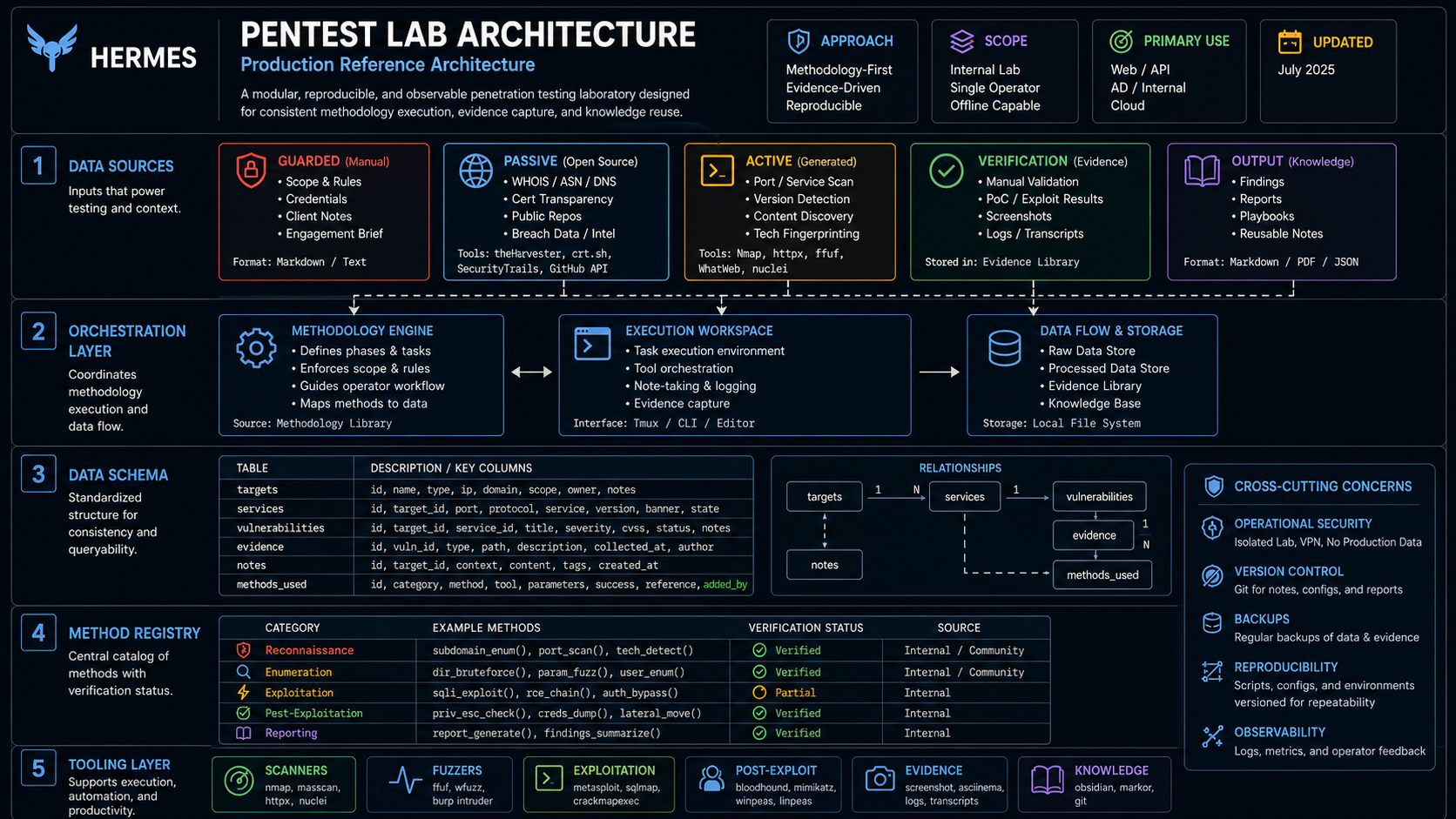
System Architecture — full inventory: subagents, DB schema, OPSEC
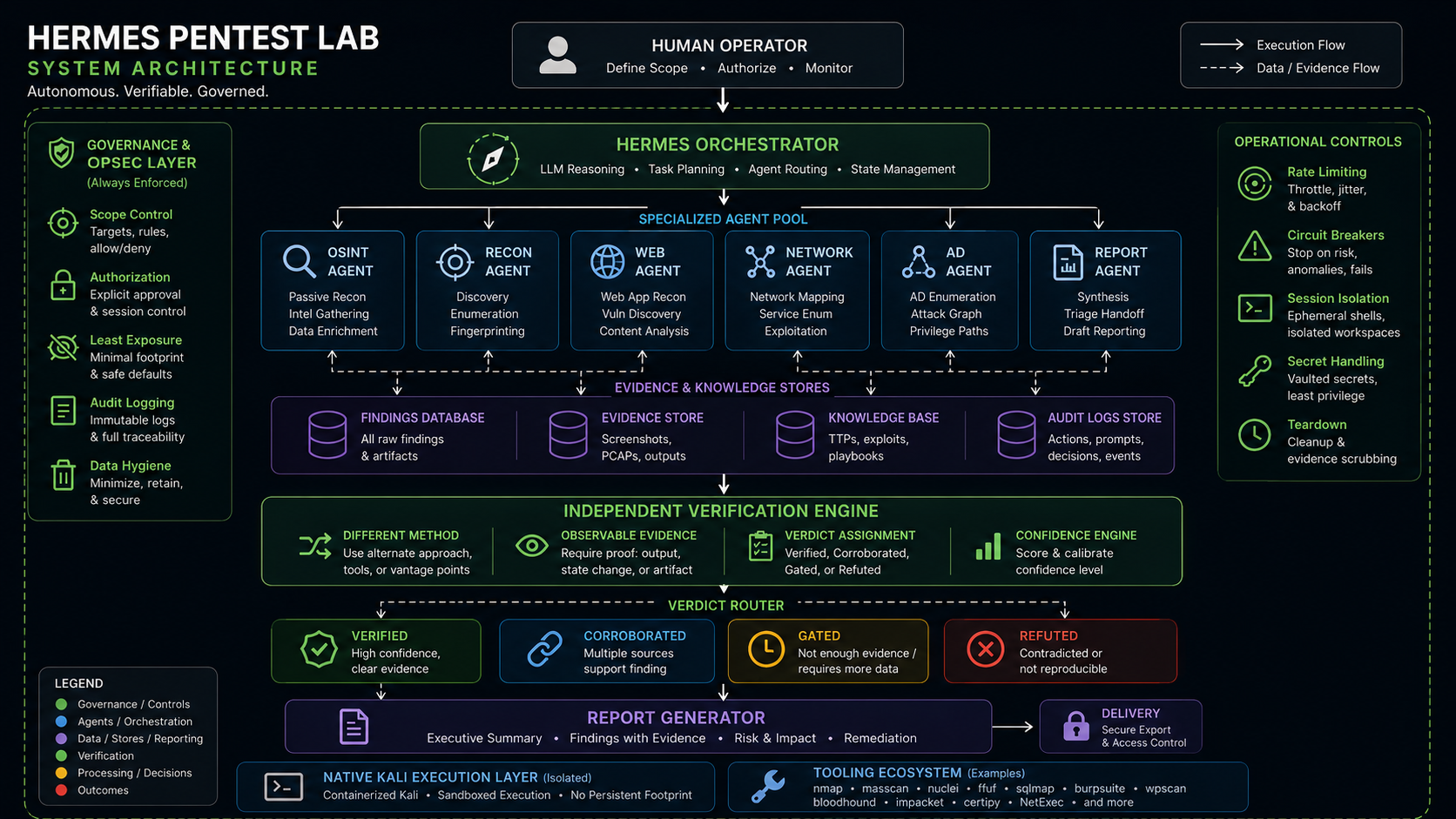
Verification Pipeline — verdict router, taxonomy, L1-L6
Four additions layered on the safety-first core — each shipped independently with its own stdlib test suite:
The toolchain is exposed over the Model Context Protocol so any MCP client (Claude Code / Desktop, Cursor) can drive it. Unlike the skill docs — which ask an agent to check scope and keep rate limits on — every target-touching tool routes through scope-check.py before running and appends to the tamper-evident audit chain after. The scope, VPN, rate-limit, and audit guardrails are enforced in code and cannot be bypassed by the calling agent. Destructive tools (sqlmap/hydra/metasploit/responder) stay operator-run.
make mcp # stdio server — full detail in mcp_server/README.md
Findings carry optional attack_technique / owasp_category tags that render a Framework Mapping coverage section in the report, so defenders can align remediation with the frameworks they already track. Delivered as an additive, idempotent DB migration (migrate-add-attack-owasp.py, v4 → v5).
15 pre-approved, generic finding templates (reports/findings-library.json) with {placeholder} text and pre-applied ATT&CK/OWASP tags + CVSS — render one instead of writing a finding from scratch:
python3 scripts/add-finding.py <engagement> sql-injection --set host=10.0.0.5 endpoint=/login parameter=id
Mark findings open / fixed / regressed across retest rounds (retest.py); the report renders a Remediation Progress section with the remediation rate and per-finding status. Status is asserted after re-testing — never guessed — and every mark is written to the audit chain.
Two reports from live assessments — one vulnerable target, one hardened production site.
Design: Dark gradient cover · 4-category scorecards · findings heatmap · inline evidence screenshots · business-first descriptions · observed controls with values · remediation checklist · A4 portrait print-native
Generated by build-report.py v4 — automated CVSS impact generation, per-finding screenshot embedding, findings heatmap, 6-phase methodology (incl. verification pass).
Three levels, depending on how much you want. Full detail in INSTALL.md.
Reference only — the skills, scope engine, and tests, nothing installed:
git clone https://github.com/jayelbotvibe-web/hermes-pentest-lab.git
cd hermes-pentest-lab
make test        # needs only Python 3.8+
Practice lab (~15 min) — bundled vulnerable targets, no VPN or vault. For learning against Juice Shop / DVWA on localhost:
./install.sh --minimal
docker compose -f docker/docker-compose.yml --profile lab up -d   # targets
make doctor
Full engagement setup (~30 min) — encrypted vault, VPN OPSEC gate, and the full toolchain (native on Kali, or the kali-* containers elsewhere):
./install.sh                                    # interactive
bash scripts/create-pentest-vault.sh --size 40G # encrypted client-data vault
On Kali, tools run natively — install them once:
sudo apt install -y nmap metasploit-framework ffuf gobuster wpscan sqlmap   hydra john enum4linux whatweb responder impacket-scripts evil-winrm seclists   wireguard-tools age cryptsetup
pipx install netexec bloodhound certipy-ad theHarvester holehe sherlock
On a non-Kali host, use the tool containers instead:
make images                          # build kali-web / kali-net / osint-tools
# then set PENTEST_USE_CONTAINERS=true in your config
Stuck at any point:
make doctor # what is missing, and the command that fixes it
mount-pentest-vault                       # open the encrypted vault
bash scripts/init-engagement.sh acme-2026 # start an engagement
bash scripts/preflight.sh acme-2026       # authorization gate (VPN + signed scope)
# ... work ...
bash scripts/build-report.py acme-2026    # PDF report
unmount-pentest-vault                     # close when done
In a Hermes Agent session: /skill pentest-engage, then describe the engagement.
Drive the same toolchain from Claude Code / Desktop or Cursor — with the scope, VPN, rate-limit, and audit guardrails enforced in code, not just documented:
make mcp # launches the stdio server (mcp_server/)
Point a client at scripts/pentest-mcp.sh (see
mcp_server/mcp.json.example). Every
target-touching tool refuses out-of-scope targets, injects the engagement's
rate tier, and appends to the tamper-evident audit chain before it runs.
Destructive tools stay operator-run. Details:
mcp_server/README.md.
💻 = Native host 🐳 = Docker service
:port= web access
7 specialized agents — each with deep domain knowledge, Pre-flight checks, and rate limiting.
Findings DB (SQLite) → Verify Pass (independent reproduction)
           ↓                        ↓
    Jinja2 Templates  ←  Verdicts + Confidence
           ↓
      WeasyPrint → PDF
           ↓
      Pandoc → DOCX (editable reports)
hermes-pentest-lab/
├── README.md
├── .gitignore
├── ruff.toml                                ← pinned lint rule set (version-stable CI)
├── mcp_server/                              ← 🆕 MCP tool-server (scope/rate/audit enforced in code)
│   ├── server.py                            ← FastMCP tools (scan, osint, findings, retest, report)
│   ├── enforce.py                           ← the gates: scope · VPN · rate · audit
│   ├── catalog.py                           ← rate-limit lookups from tool-catalog.yaml
│   ├── requirements.txt / mcp.json.example  ← venv deps + example client config
│   └── README.md
├── docs/
│   ├── index.html                           ← GitHub Pages landing page
│   ├── pentest-architecture-complete.html   ← interactive system diagram
│   ├── pentest-architecture.html
│   ├── pentest-ops-architecture.html
│   ├── verification-pass-architecture.html  ← 🆕 verification pass system diagram
│   ├── pentest-reference.html               ← 🆕 complete production reference
│   ├── TROUBLESHOOTING.md
│   ├── WORKFLOW.md
│   └── reports/samples/
│       ├── juice-shop-benchmark-report.{html,pdf}  ← 14 findings, 38/100
│       ├── zerodaybrief-report.{html,pdf}           ← 1 finding, 94/100
│       ├── report-preview.png
│       └── screenshots/                      ← evidence screenshots (F-XXX-*.png)
├── docker/
│   ├── docker-compose.yml                   ← 4 services, 3 profiles (lab, sandbox, neo4j)
│   ├── Dockerfile.kali-web                   ← (deprecated — tools now native)
│   ├── Dockerfile.kali-net                   ← (deprecated — tools now native)
│   └── Dockerfile.osint-tools               ← (deprecated — tools now native)
├── scripts/
│   ├── pentest-canary.sh                    ← validates all tools before session
│   ├── pentest-up.sh                        ← starts containers + LUKS mount
│   ├── pentest-down.sh                      ← graceful shutdown + cleanup
│   ├── pentest-verify.sh                    ← post-startup verification
│   ├── init-engagement.sh                   ← creates forensics-style engagement dir
│   ├── init-engagement-db.py                ← SQLite schema (6 tables, v5 + verdict/ATT&CK/OWASP/retest)
│   ├── build-report.py                      ← findings → Jinja2 → HTML + PDF (verdict + framework + retest aware)
│   ├── verify-findings.py                   ← 🆕 independent finding reproduction engine
│   ├── migrate-add-verification.py          ← 🆕 additive, idempotent DB migration (v3→v4)
│   ├── migrate-add-attack-owasp.py          ← 🆕 additive, idempotent DB migration (v4→v5)
│   ├── framework_map.py                     ← 🆕 ATT&CK + OWASP lookups + report coverage
│   ├── findings_library.py / add-finding.py ← 🆕 reusable finding templates (module + CLI)
│   ├── retest.py                            ← 🆕 open/fixed/regressed lifecycle + progress
│   ├── report_verification.py               ← 🆕 partition (body/ruled-out), verdict→confidence
│   ├── pentest-mcp.sh                        ← 🆕 launches the MCP tool-server (venv, stdio)
│   ├── audit-log.sh                         ← scope-validated audit entries
│   ├── preflight.sh                         ← VPN + LUKS + DNS + scope checks
│   ├── wipe-engagement.sh                   ← encrypted archive + destruction cert
│   ├── capture-evidence.sh                  ← headless Chromium screenshots
│   └── convert-docs.py                      ← MarkItDown: PDF/DOCX → markdown
├── reports/
│   ├── templates/report.html                ← unified Jinja2 template (v2)
│   └── findings-library.json                ← 🆕 15 pre-approved, pre-tagged finding templates
├── tools/
│   └── tool-catalog.yaml                    ← tools with version, fallback, rate limits
├── skills/
│   ├── pentest-context.md                   ← system map — loaded every session
│   ├── pentest-engage.md                    ← orchestrator — dispatches 7 subagents
│   ├── pentest-ops.md                       ← startup/shutdown/repair/troubleshooting
│   ├── pentest-verify.md                    ← 🆕 7th subagent — independent reproduction skill
│   ├── pentest-mcp.md                        ← 🆕 driving the toolchain over MCP
│   ├── pentest-findings/SKILL.md            ← finding encyclopedia — 14 interpretations + library
│   ├── subagent-{osint,recon,web,net,report,scope}.md
│   └── safety-guards.md                     ← 13-item refusal list + rate limits
└── scope/
    ├── _template.json                       ← scope template (copied into engagements)
    └── contract-template.md                 ← rules of engagement
init-engagement.sh)engagements/<name>/
├── ENGAGEMENT.yaml ← client, dates, status, assessor
├── scope.json ← scope definition (IPs, domains, signed)
├── findings.db ← SQLite v5 database (6 tables, verdict + ATT&CK/OWASP + retest columns)
├── findings.json ← machine-readable findings export
├── metadata.json ← controls, observations, methodology
├── audit/
│ └── actions.jsonl ← every tool run, scope-validated (incl. verification actions)
├── evidence/ ← client documents (auto-converted via MarkItDown)
├── screenshots/ ← tool evidence (F-XXX-*.png auto-attach in report)
├── raw/scans/ ← nmap XML, nuclei JSON, tool output
└── reports/ ← generated HTML + PDF reports
Based on publicly available documentation as of June 2026. Features may have changed. Verify independently.
Hermes Pentest Lab is built for the practicing professional — it prioritizes safety, audit trails, and client deliverables over autonomous exploitation.
Every DRAFT finding is independently reproduced before it reaches the report.
The verification pass sits between discovery (Phases 2-5) and reporting (Phase 6). It runs a benign, independent method against each finding — re-fetching headers with a plain stdlib client, observing TLS with a different tool, checking open ports with a socket probe. It never fires an exploit.
  DRAFT findings → verify-findings.py → 5 possible verdicts:
                                          ├─ VERIFIED       — manual confirmation
                                          ├─ CORROBORATED   — independent signal agrees
                                          ├─ GATED          — destructive class, abstained
                                          ├─ UNVERIFIED     — couldn't confirm (probe error ≠ refute)
                                          └─ REFUTED        — evidence contradicts finding → ruled-out appendix
python3 scripts/verify-findings.py <engagement>            # write verdicts
python3 scripts/verify-findings.py <engagement> --dry-run   # preview only
python3 scripts/migrate-add-verification.py --all           # migrate existing DBs
CORROBORATED, UNVERIFIED, GATED, etc.)docker compose --profile lab up -d → http://127.0.0.1:3000reports/samples/This toolkit is for authorized security testing only. Never use it on systems you don't own or have explicit written permission to test. Every engagement requires a signed scope document (scope/contract-template.md). Every tool run is logged to an audit trail. Every report includes a data destruction certificate.
MIT — use it, modify it, share it. Built by @jayelbotvibe-web.
AI-orchestrated, Kali-native pentesting lab: an MCP tool-server with scope/VPN/rate/audit enforced in code, independent finding verification, MITRE ATT&CK + OWASP mapping, a reusable findings library,
Übersicht
AI-orchestrated, Kali-native pentesting lab: an MCP tool-server with scope/VPN/rate/audit enforced in code, independent finding verification, MITRE ATT&CK + OWASP mapping, a reusable findings library, retest tracking, WireGuard OPSEC, LUKS encryption, and automated PDF reports.
Tools
Noch keine Tool-Liste. Remote-Server erhalten eine nach dem ersten Health-Check.
FAQ
Kopieren Sie auf dieser Seite die stdio-Konfiguration für Cursor, Claude Desktop, Claude Code oder VS Code. Sie nutzt die Installation des Herausgebers, keinen PlugMCP-Proxy.
In diesem Eintrag ist keine erforderliche Umgebungsvariable aufgeführt.
Hermes Pentest Lab läuft lokal über stdio.
Zuletzt geprüft: 2026-10-27. AI-orchestrated, Kali-native pentesting lab: an MCP tool-server with scope/VPN/rate/audit enforced in code, independent finding verification, MITRE ATT&CK + OWASP mapping, a reusable findings library, retest tracking, WireGuard OPSEC, LUKS encryption, and automated PDF reports.