Deft
Where humans and agents work together.
| |
Agenten stärken
Installation vom Herausgeber. Kein PlugMCP-Endpunkt.
Host a copy with our keys and logs.
Noch kein paketiertes Release in der Registry. Folgen Sie der README des Repositorys.
Remote-URL oder ein Befehl auf Ihrem Rechner? Worin sich die beiden Installationen unterscheiden
Auf PlugMCP ausführen
A new server you create. It is not this listing's official endpoint. Use the publisher install when you want their URL and their credentials.
StartenDeft is a self-hostable, open-source workspace where people and AI agents share chat, tasks, knowledge, calendar context, approvals, and action history.
Capture a team discussion into knowledge, ask Defty to propose a task using that context, review and approve the proposal, and keep the agreed details in the resulting task.
Alpha: for technical evaluation and controlled pilots. The walkthrough uses seeded demo data; it is not evidence of a live customer workspace or an active external agent runtime.

Use the prebuilt v0.3.0-preview.15 release for evaluation. It targets Linux amd64 and needs Docker Desktop or Docker Engine with Compose v2. An AI provider is optional. No source build, Node.js, or pnpm is needed for this path.
Download docker-compose.yml, compose.prod.yml, compose.release.yml, and default.env.example from that release into a new directory. In Bash (macOS, Linux, or Git Bash on Windows):
cp default.env.example .env
openssl rand -hex 32  # POSTGRES_PASSWORD
openssl rand -hex 32  # JWT_SECRET
openssl rand -hex 32  # JWT_REFRESH_SECRET
openssl rand -hex 32  # ENCRYPTION_KEY
Paste each independently generated secret into its corresponding .env variable. All four are required for Docker, including local evaluation. Keep the encryption key with your backups. Leave AI keys empty and OLLAMA_URL commented unless you intend to configure a provider.
Add this pinned release image to .env:
DEFT_IMAGE=ghcr.io/maneek21/deft@sha256:665a66083adaaf9db876fa815203c854509c5fdde72b89a0db212fe2e07d398b
Then run, from that directory:
docker compose -f docker-compose.yml -f compose.prod.yml -f compose.release.yml config --quiet
docker compose -f docker-compose.yml -f compose.prod.yml -f compose.release.yml pull
docker compose -f docker-compose.yml -f compose.prod.yml -f compose.release.yml up -d postgres
docker compose -f docker-compose.yml -f compose.prod.yml -f compose.release.yml run --rm init
docker compose -f docker-compose.yml -f compose.prod.yml -f compose.release.yml up -d deft
docker compose -f docker-compose.yml -f compose.prod.yml -f compose.release.yml run --rm doctor
docker compose -f docker-compose.yml -f compose.prod.yml -f compose.release.yml run --rm smoke
Open http://localhost:3000 and create the first account, which owns the workspace. Subsequent users join by invitation. This creates an empty workspace with the platform bundle, not the video's demo records. Create a chat message and a task to try the core workspace without AI.
Use init only with a fresh database. For custom ports, public URLs, image verification, source builds, backups, and upgrades, follow the self-hosting guide. Versioned upgrades start at v0.2.0-preview.1; use the backup-first upgrade flow for existing workspaces. Historical releases through v0.2.0-preview.4 retain their shipped BSL 1.1 license; the selected release is AGPL-3.0-only.
Try Deft: install a workspace, connect your AI client, or build an internal App. See the current availability map before enabling an experimental feature.
Optional video chapters: Knowledge capture — 1:09 · Defty task request and approval — 2:06 · ChatGPT connection and workspace read/write — 3:25.
Personal MCP connections use a different authority model. ChatGPT and other personal clients act as the authorizing user within their granted scopes and normal permissions. Their writes do not automatically enter Deft's agent approval queue. Defty and Agent Employees use agent identities and policy-based approval flows. See MCP access and agents.
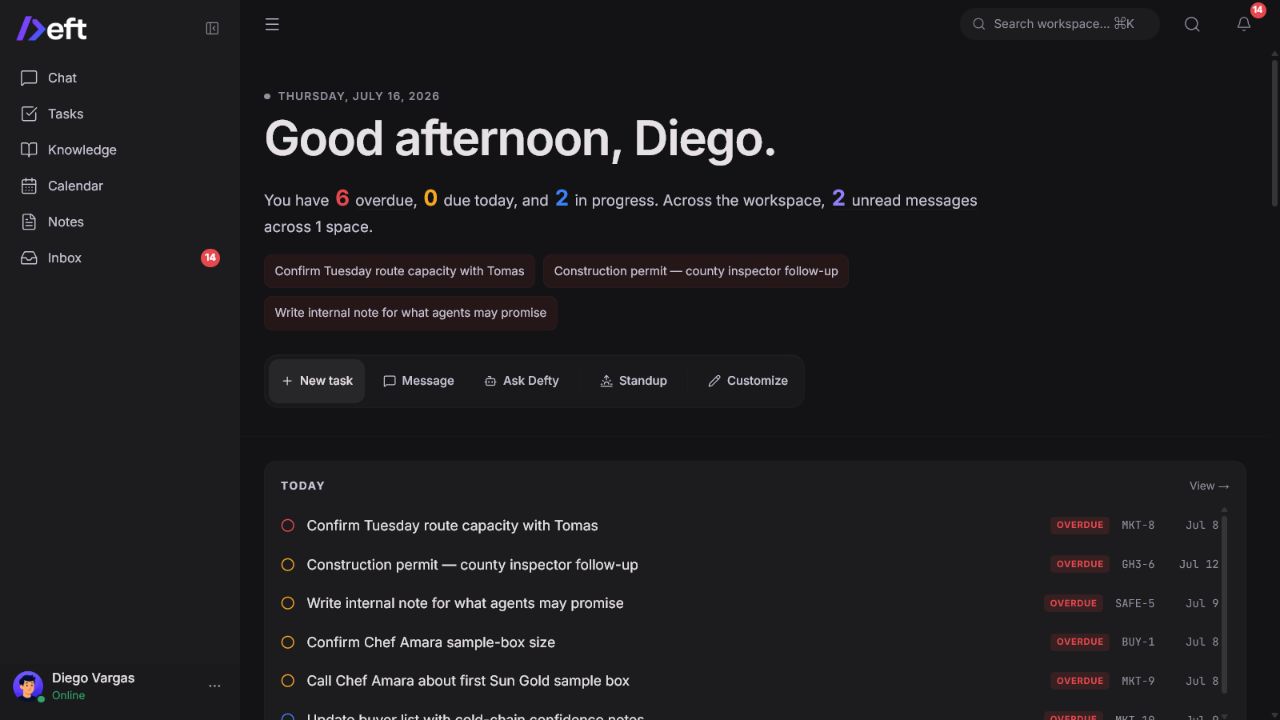
Deft still works as a normal workspace without an AI provider key. Chat, tasks, notes, knowledge, calendar, people, and teams remain available; AI features stay disabled until a provider is configured.
Modules add domain records, relationships, and native views. Apps package Module resources and may request supported connected actions. They use different manifests and installation flows; start with Modules and Apps. Declarative internal Apps, connected Apps, and bounded scheduled actions are opt-in alpha capabilities. General release defaults remain off; the explicitly Apps-enabled developer-preview profile described below compiles the supported browser gates on. Arbitrary custom UI and public portals are planned rather than part of the current contract.
The bundled Contacts module is the first example of this model. The goal is not to turn Deft's core into every application a company might need, but to let new capabilities live on the same shared substrate instead of becoming another disconnected system.
See Deft, App Kit and domain App boundaries for authoring contracts, permissions and execution limits. The Apps developer preview exposes generic Protocol 7 forms, external Runtime and source contracts. Standalone Email is the reference implementation, with App Kit alpha.38 and Runtime Kit alpha.35 on Host preview.122/schema 120. Follow the connected App author guide and authoritative compatibility manifest. Use the explicitly Apps-enabled preview image; enabling runtime variables cannot turn on browser features omitted at build time. This is an operator-managed developer preview, not a production Gmail replacement.
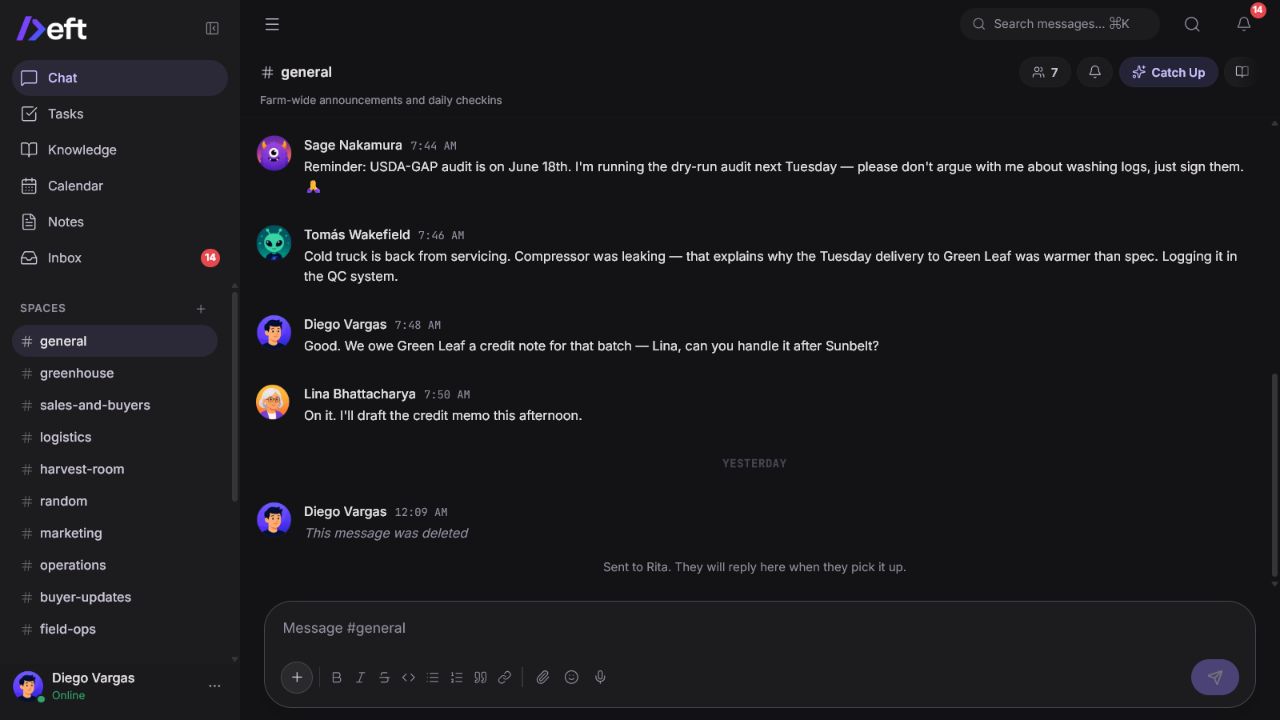
Chat is both a human communication surface and part of the workspace record. Threads, structured mentions, quiet knowledge capture, and agent replies keep decisions close to their source.
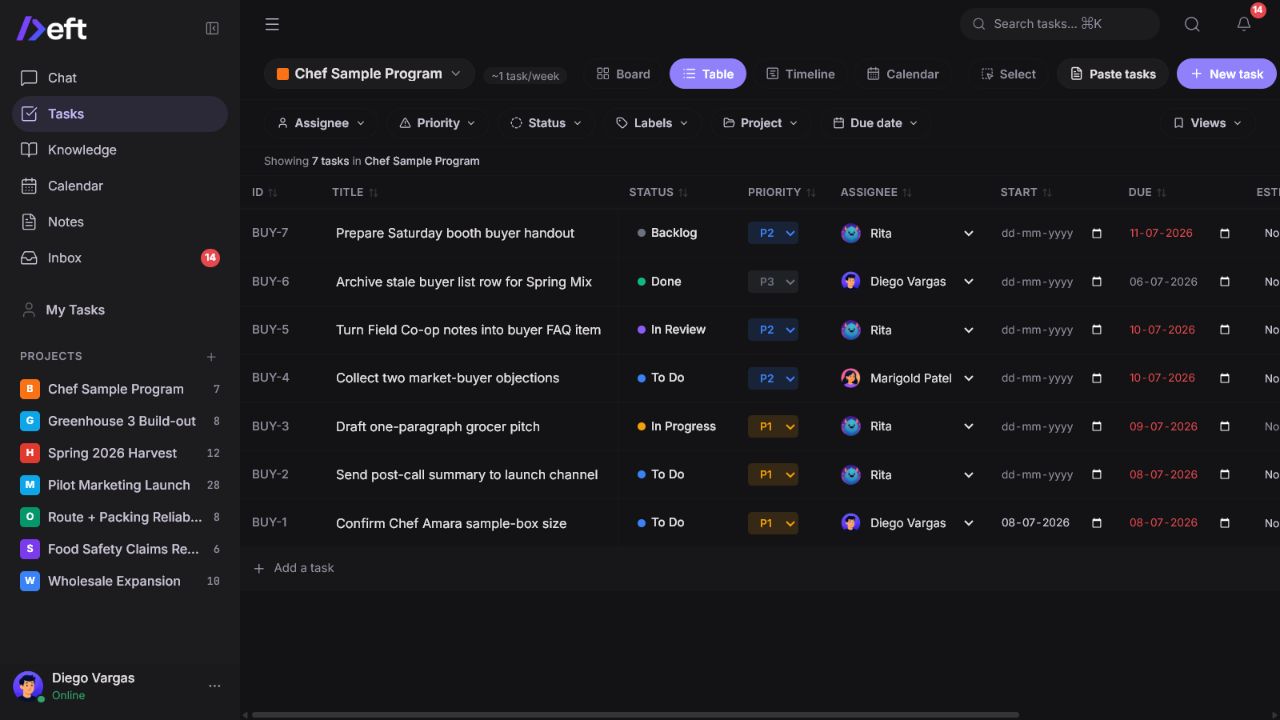
Projects support Board, Table, Timeline, and Calendar views, plus dependencies, subtasks, recurrence, comments, activity diffs, bulk actions, and agent-created drafts.
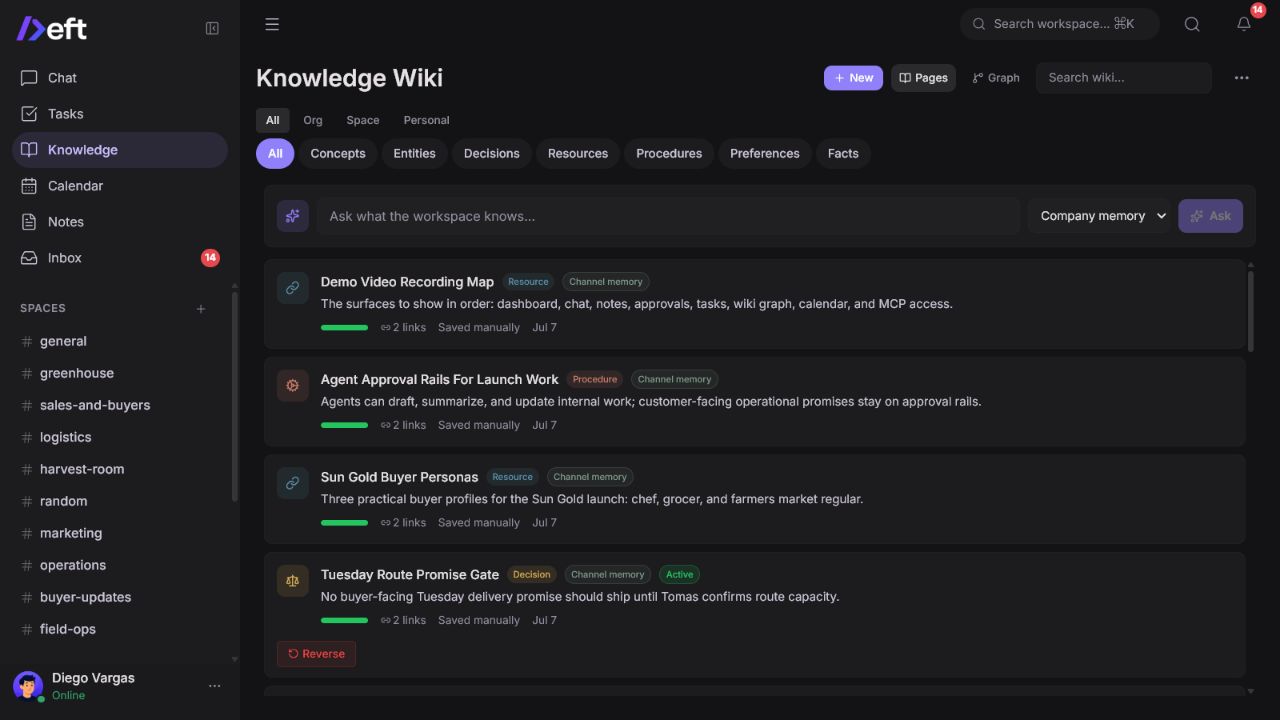
Deft separates transient conversation from durable concepts, entities, decisions, resources, procedures, preferences, and facts. Agents can ask for org-wide or channel-specific context instead of reading an undifferentiated transcript.
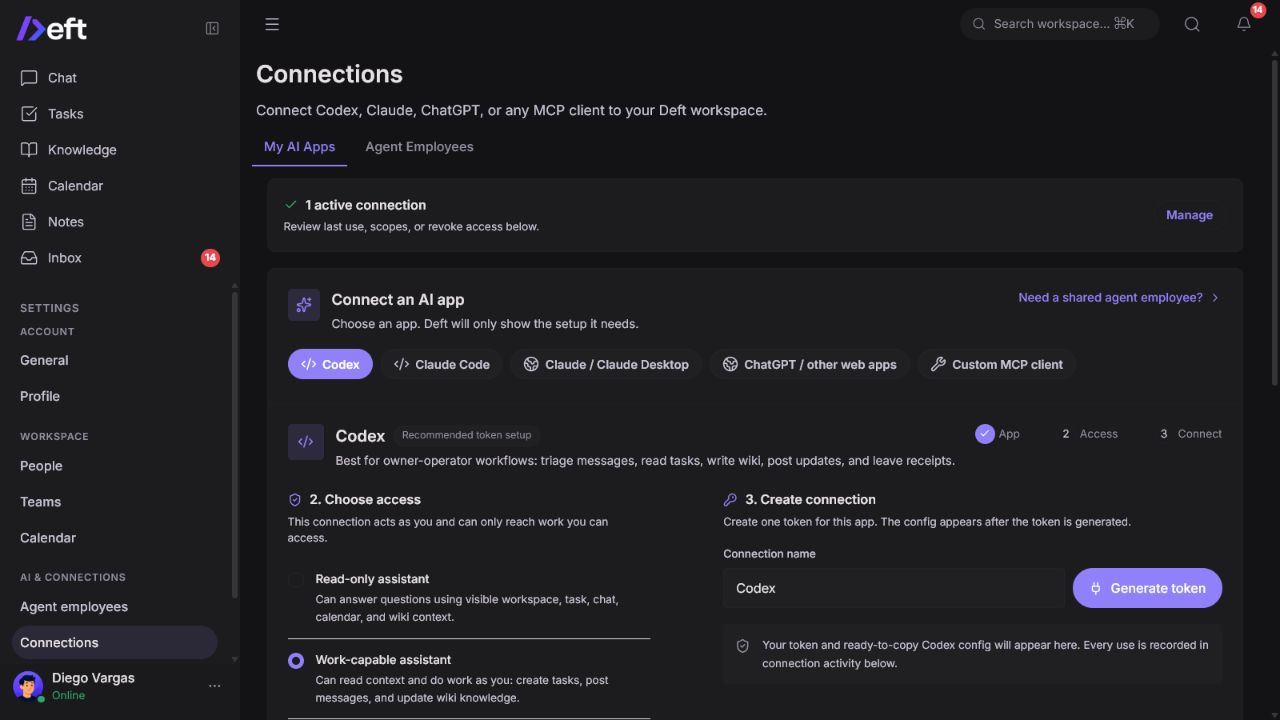
The Connections page guides each user through the setup required by their client. Personal connections act as that user, inherit their access boundaries, expose explicit scopes, and can be revoked.
Requirements: Node.js 22.13+, the pnpm version pinned in package.json, and a running PostgreSQL 16 database with pgvector. Set the four secrets in .env and DATABASE_URL for your disposable development database before initialization; see Contributing.
git clone https://github.com/Maneek21/Deft.git
cd Deft
pnpm install
cp .env.example .env
# Set the four secrets and DATABASE_URL before continuing.
pnpm db:push-full
pnpm db:seed
pnpm dev
Useful development seeds:
pnpm db:seed:demo   # Testers Tomatoes demo data
pnpm db:seed:pilot  # Demo data plus pilot fixtures
Both development seeds reset the database. Never run them against a production workspace.
deft/
|-- apps/
|   |-- web/       Next.js 16, React 19, Tailwind CSS, TipTap
|   `-- api/       Hono, Socket.io, PostgreSQL job workers, agent and MCP runtime
|-- packages/
|   |-- db/        PostgreSQL, pgvector, Drizzle schema and migrations
|   |-- mcp/       Shared MCP protocol support
|   `-- shared/    Shared types, schemas, and constants
|-- docker-compose.yml
`-- pnpm-workspace.yaml
Deft is an alpha. It is suitable for technical evaluation, internal dogfooding, and controlled pilots. Expect breaking changes before a stable release.
Important current boundaries:
v0.2.0-preview.1 baseline forward; older untracked alpha databases require a reviewed migration or fresh install.Security reports should follow SECURITY.md. Operational support boundaries are documented in docs/self-hosted-v1-contract.md.
Contributions are welcome. Start with CONTRIBUTING.md, run the relevant tests, and open a focused pull request.
If Deft is useful to you, starring the repository helps more teams find the project.
Email [email protected] for questions, demos, or private support requests. See SUPPORT.md for community support and SECURITY.md for private vulnerability reporting.
Deft is free software licensed under the GNU Affero General Public License
v3.0 only (AGPL-3.0-only). You may use, study, modify, and
redistribute it subject to the license terms. If you modify Deft and let users
interact with that version over a network, section 13 requires you to offer
those users its Corresponding Source.
Public modified deployments should set DEFT_SOURCE_CODE_URL to the
public URL for the exact source they run. See NOTICE for the project
copyright notice and THIRD-PARTY-LICENSES.md for
third-party attribution.
Self-hostable AGPL workspace where humans and AI agents share chat, tasks, knowledge, approvals, and MCP context.
Tools
Noch keine Tool-Liste. Remote-Server erhalten eine nach dem ersten Health-Check.
FAQ
Kopieren Sie auf dieser Seite die stdio-Konfiguration für Cursor, Claude Desktop, Claude Code oder VS Code. Sie nutzt die Installation des Herausgebers, keinen PlugMCP-Proxy.
In diesem Eintrag ist keine erforderliche Umgebungsvariable aufgeführt.
Deft läuft lokal über stdio.
Zuletzt geprüft: 2026-11-15. Self-hostable AGPL workspace where humans and AI agents share chat, tasks, knowledge, approvals, and MCP context.