mcp-server-go-quality
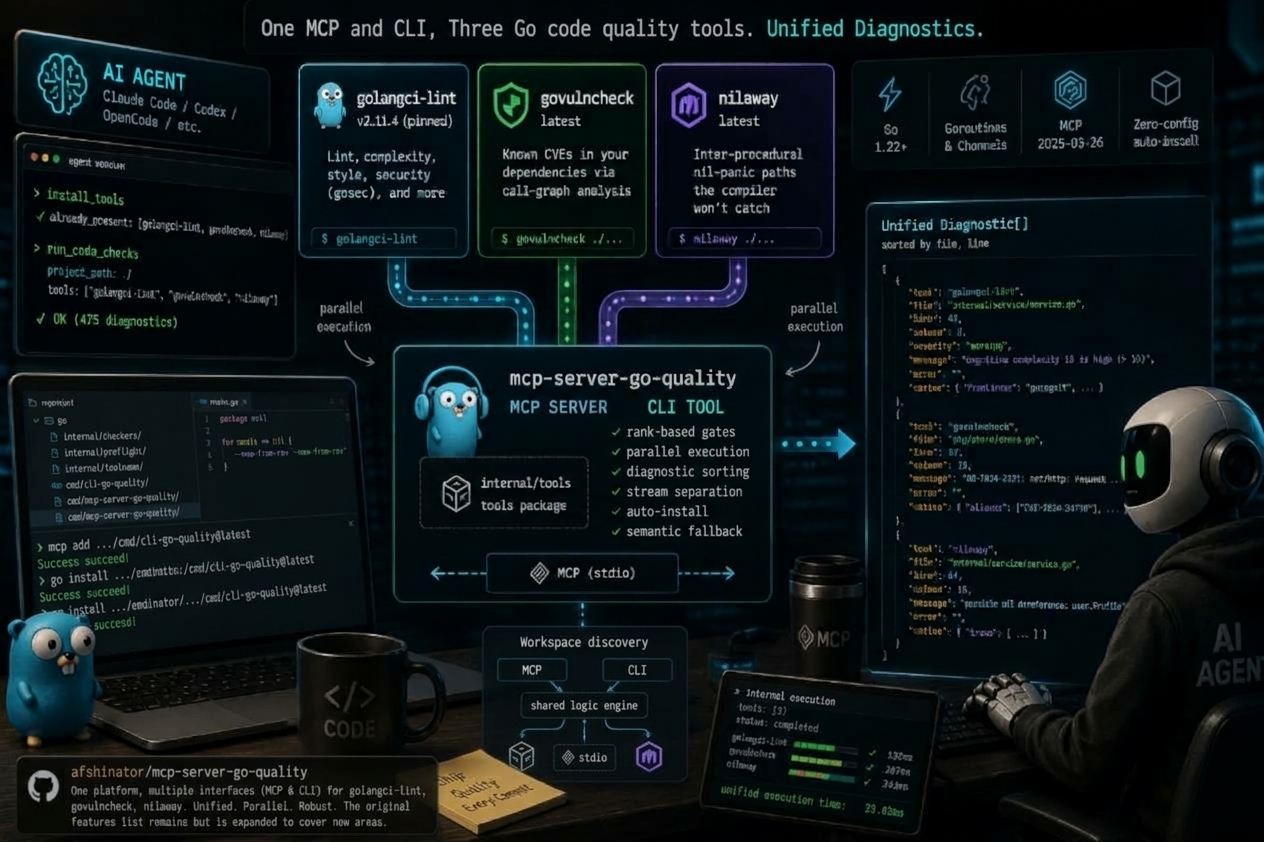
One MCP server for golangci-lint, govulncheck, and nilaway — a unified result with consistent file:line:column navigation, parallel execution, and zero-config auto-install.
Power your agent
Install from the publisher. Not a PlugMCP endpoint.
Host a copy with our keys and logs.
No packaged release in the registry yet. Follow the repository README.
Remote URL or a command on your machine? How the two installs differ
Run on PlugMCP
A new server you create. It is not this listing's official endpoint. Use the publisher install when you want their URL and their credentials.
LaunchFrom the publisher
One MCP server for golangci-lint, govulncheck, and nilaway — a unified result with consistent file:line:column navigation, parallel execution, and zero-config auto-install.
One MCP server for golangci-lint, govulncheck, and nilaway — a unified `Diagnostic[]` array with consistent file:line:column navigation, parallel execution, and zero-config auto-install.
Diagnostic[]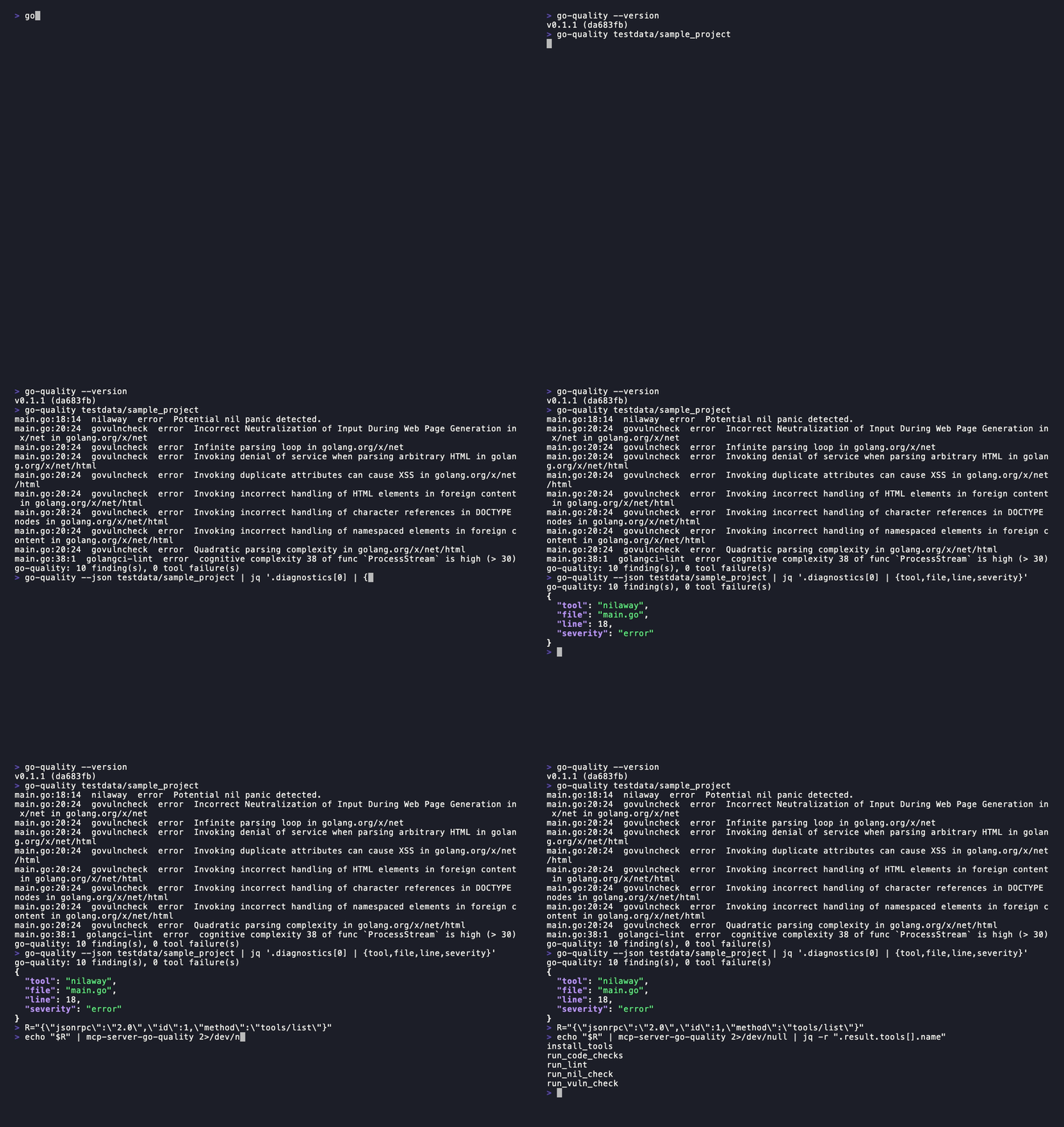
Wraps three Go code quality tools behind one normalized result, and ships that as two entrypoints over one engine:
Both run the same three checkers in parallel under independent timeouts, return
the same {"diagnostics": [...]} envelope, resolve the same .go-quality.yaml,
and auto-install the same pinned tool versions. Pick by how you want to call it,
not by what it can do.
One caveat worth knowing before you build a gate on it: severity is populated
from the tool's own reporting where it exists, but govulncheck and nilaway have
no severity concept and golangci-lint reports one only when the repository
config defines severity rules. Findings with no tool-reported severity are
labelled error, so an unlabelled finding never sorts below a style warning —
but that also means --fail-on=warning and --fail-on=error currently behave
alike. Gate on --fail-on=any, or on --tools=govulncheck for security only.
The CLI's --json output is byte-identical to the MCP tools' structuredContent
— same envelope, same field order, same values — so one consumer works against
either:
jq '.diagnostics' <(go-quality --json .)
The only difference is stream usage: the CLI writes the payload to stdout and progress/summary to stderr, while the MCP server writes JSON-RPC to stdout and logs to stderr.
Every check tool returns a sorted Diagnostic[] wrapped in a diagnostics
object, sorted by file then line. The same JSON is returned as
structuredContent (validated against each tool's declared outputSchema) and
as a text content block for backward compatibility:
{
  "diagnostics": [
    {
      "tool": "golangci-lint",
      "file": "cmd/main.go",
      "line": 115,
      "column": 1,
      "severity": "warning",
      "message": "cognitive complexity 18 is high (> 15)",
      "error": "",
      "native": {"FromLinter": "gocognit", "Text": "...", "SuggestedFixes": [...]}
    }
  ]
}
install_tools returns its own object: { "installed": [], "already_present": [], "failed": [] }.
claude mcp add go-quality -- go run github.com/afshinator/mcp-server-go-quality/cmd/[email protected]
For other MCP clients, add to your config:
{
  "mcpServers": {
    "go-quality": {
      "command": "mcp-server-go-quality",
      "args": []
    }
  }
}
Two binaries share one engine. The CLI is what you want in a terminal, a pre-commit script or CI; the MCP server is for agents that speak the protocol.
Stable install — release v0.1.1:
# CLI
go install github.com/afshinator/mcp-server-go-quality/cmd/[email protected]

# MCP server
go install github.com/afshinator/mcp-server-go-quality/cmd/[email protected]
Or grab a release archive from the releases page — one per platform (linux/darwin/windows, amd64/arm64), each containing both binaries plus the CHANGELOG and LICENSE.
Tracking the default branch: @latest resolves to the newest commit on
main, so it can move between releases. Fine for trying it out; pin @v0.1.1
for anything a gate depends on.
cd ~/my-go-project
go-quality                      # text on stdout, non-zero if anything is found
go-quality --json | jq '.diagnostics'   # the same envelope the MCP tools return
go-quality --tools=golangci-lint        # fast subset
go-quality --fail-on=none               # report but never fail on findings
Exit codes: 0 clean, 1 a finding reached --fail-on, 2 the run did not
complete (a checker failed to run, the config was unusable, or a flag was
invalid). A tool that failed to run is always exit 2, even under
--fail-on=none — a checker that never ran is not a clean result.
stdout carries only the payload for the mode. Progress, install messages and the
summary go to stderr, so go-quality --json | jq is never corrupted by a
first-run tool install. Tools auto-install into $GOBIN (or $GOPATH/bin when GOBIN is unset) on first use; use
--install-only to pre-warm them in CI without running a check.
--json is byte-identical to the MCP tools' structuredContent: same envelope,
same field order, same values. One jq query works against either entrypoint.
cd ~/my-go-project
mcp-server-go-quality
# Or specify a project path and config:
mcp-server-go-quality --config ./my-config.yaml
The server starts in stdio mode — connect any MCP client or test it interactively by piping JSON-RPC. Tools auto-install into $GOBIN (or $GOPATH/bin when GOBIN is unset) on first use.
Prerequisites: Go 1.21+ on PATH (the go directive in go.mod requires 1.26.0, which the toolchain mechanism downloads automatically).
install_tools at session start. Returns installed, already_present, and failed lists. A fast no-op if binaries are at the correct version.run_code_checks with project_path set to the project root (or any subdirectory — the server walks up to go.work or go.mod).error first (non-empty = tool failure), then navigate to file:line:column. The native field carries full raw output for remediation.Full contract and processing loop: docs/agents/AGENTS.md
Error tables, remediation, and troubleshooting: docs/agents/reference.md
.go-quality.yaml)Place at the project root. All fields optional. Omit version for a tool and it
uses the pinned default.
timeout: 5m          # per-tool deadline; increase for big monorepos or first vuln DB download

tools:
  golangci-lint:
    extra_args: []
  govulncheck:
    extra_args: []
  nilaway:
    extra_args: ["--exclude-pkgs=github.com/myorg/vendor"]
Precedence: --config flag > .go-quality.yaml at server CWD > compiled-in defaults.
Supports single-module go.mod and go.work multi-module workspaces. Pass any subdirectory as project_path — the server walks up to find go.work first, then go.mod. Nilaway automatically collects module paths from use directives and passes them via -include-pkgs.
TDD enforced — nearly every source file has a companion _test.go file. Integration tests run against testdata/sample_project/, a small Go module with intentional issues for all three tools.
Open work and known gaps are tracked in TODO.md. The MCP-currency audit and its evidence are in docs/mcp-spec-currency.md.
Use make bump-tool-pins to resolve the latest versions and update every tool pin.
Cutting a release is documented in RELEASING.md.
The scheduled pin-drift workflow checks those pins against the module proxy.
Example configs live under examples/config/, and
examples/mcp-clients/ covers registering the MCP
server with Claude Desktop, Cursor, Gemini CLI, Codex and other harnesses.
examples/agents/AGENTS.md is a drop-in
instruction file a project can ship so any MCP-capable agent knows to run the
checks and how to act on them.
make test       # unit tests (fast)
make test-all   # full suite including integration
make lint       # golangci-lint
make fmt        # gofumpt + goimports
make build      # compile the binary
make demo       # re-record the README demo GIF from demo.tape (needs vhs)
MIT License
One MCP server for golangci-lint, govulncheck, and nilaway — a unified `Diagnostic[]` array with consistent file:line:column navigation, parallel execution, and zero-config auto-install.
Tools
No tool list yet. Remote servers get one after the first health check.
FAQ
Copy the stdio config for Cursor, Claude Desktop, Claude Code, or VS Code on this page. It uses the publisher's install, not a PlugMCP proxy.
No required environment variable is listed on this record.
MCP Server Go Quality runs locally over stdio.
Last checked 2026-10-27. One MCP server for golangci-lint, govulncheck, and nilaway — a unified `Diagnostic[]` array with consistent file:line:column navigation, parallel execution, and zero-config auto-install.
