
uvx seo-desk audit yoursite.com
No account, no API key, nothing to configure. (No uv? pip install seo-desk, then seodesk audit yoursite.com.)
Want to see the dashboard first? uvx seo-desk demo opens it on eight weeks of sample data.
Why SEO Desk
AI assistants answer the question and cite a handful of sources. Ranking on Google doesn't make you one of them; being readable, quotable and known does. SEO Desk checks all three, every day if you like:
- Can AI crawlers read you? robots.txt read the way GPTBot, ClaudeBot and Google read it (RFC 9309 wildcards and
longest match, which Python's own robots parser gets wrong), plus
llms.txtandllms-full.txt. - Is each page quotable? Question headings, a 25-90 word answer straight under them, FAQ schema, tables, structured data, and every classic on-page check.
- Do AI models name you? Ask ChatGPT, Perplexity, Gemini or Claude what your customers ask and see who they cite instead, and whether they repeat something false about you.
- What should you do first? Rule-based quick wins on every audit; with a model key, an AI analyst reads the evidence and writes a prioritised to-do list that doesn't repeat itself day after day.
What it checks
Pages are read without running JavaScript, as most AI crawlers read them: a page that only renders in the browser shows up thin here, and that's worth knowing.
Use it your way
Terminal
seodesk audit https://www.example.com                       # text report
seodesk audit example.com --format markdown -o report.md     # or json
seodesk audit example.com --keyword "invoice template"       # + Google rank (SERPER_API_KEY)
seodesk audit example.com --brief                            # + the AI analyst's actions (LLM_API_KEY)
seodesk audit example.com --fail-under 70                    # exit 1 under 70, for CI
seodesk llms-txt example.com -o llms.txt                     # draft an llms.txt from the site's pages
Claude Code plugin
/plugin marketplace add Anas660/claude-seo-desk
/plugin install seo-desk@seo-desk
Then ask "audit www.example.com for AI search" or run /seo-desk:audit https://www.example.com. Claude runs the
audit, explains the scores, and, when you're in the site's repo, finds where robots.txt, titles, structured data and
llms.txt come from and fixes them with you, then checks the result. /seo-desk:llms-txt writes the site's llms.txt
from its real pages. The bundled MCP server needs uv.
MCP server
Four read-only tools for any MCP client: Claude Code, Claude Desktop, Cursor, Windsurf, VS Code.
claude mcp add seo-desk -- uvx --python ">=3.10" --from "seo-desk[mcp]" seodesk mcp
{
  "mcpServers": {
    "seo-desk": {
      "command": "uvx",
      "args": ["--python", ">=3.10", "--from", "seo-desk[mcp]", "seodesk", "mcp"]
    }
  }
}
Or pip install "seo-desk[mcp]" (Python 3.10+) and use "command": "seodesk", "args": ["mcp"].
GitHub Action
# .github/workflows/seo.yml
on:
  push:
    branches: [main]
jobs:
  seo:
    runs-on: ubuntu-latest
    steps:
      - uses: Anas660/[email protected]
        with:
          url: https://www.example.com
          fail-under: 60          # optional: fail the job under this overall score
          # keywords: |           # optional: needs SERPER_API_KEY in env
          #   invoice template
The report lands in the job summary. Outputs: overall, seo, aeo, geo and report (the JSON file).
Daily agent
mkdir my-seo && cd my-seo
seodesk init                    # config.yaml, sites/example.yaml, .env.example
# put your site in sites/example.yaml; copy .env.example to .env and add the keys you have
seodesk check                   # keys, and each site's sitemap
seodesk run                     # crawl, check, score, brief: every site in config.yaml
seodesk dashboard --no-password # http://127.0.0.1:5380, this machine only
Each run lands in data/seo.db (SQLite) and compares each week and each month with the one before. The AI analyst
reads the day's evidence, can read pages and run a few live Google checks, and returns 3-8 specific actions, each
with the numbers it rests on. An action suggested again tomorrow updates its row instead of piling up; one you mark
done or dismissed stays that way.
Schedule it with cron (0 7 * * * cd /path/to/my-seo && seodesk run) or the systemd units in deploy/. To
reach the dashboard from elsewhere, set a password (seodesk password) and put HTTPS (Caddy, nginx) in front of it.
LLM_API_KEY is an OpenRouter key by default (one key, hundreds of models; the default is
deepseek/deepseek-v4.1-flash). Any OpenAI-compatible API works: set llm.base_url and llm.model in config.yaml
(OpenAI, a local Ollama or LM Studio, your company's gateway). Spending caps stop paid steps per run, per site per
month and for every site per month, and every cent is recorded and shown on the dashboard.
The dashboard
| Progress, week by week and month by month | What AI models answer |
|---|---|
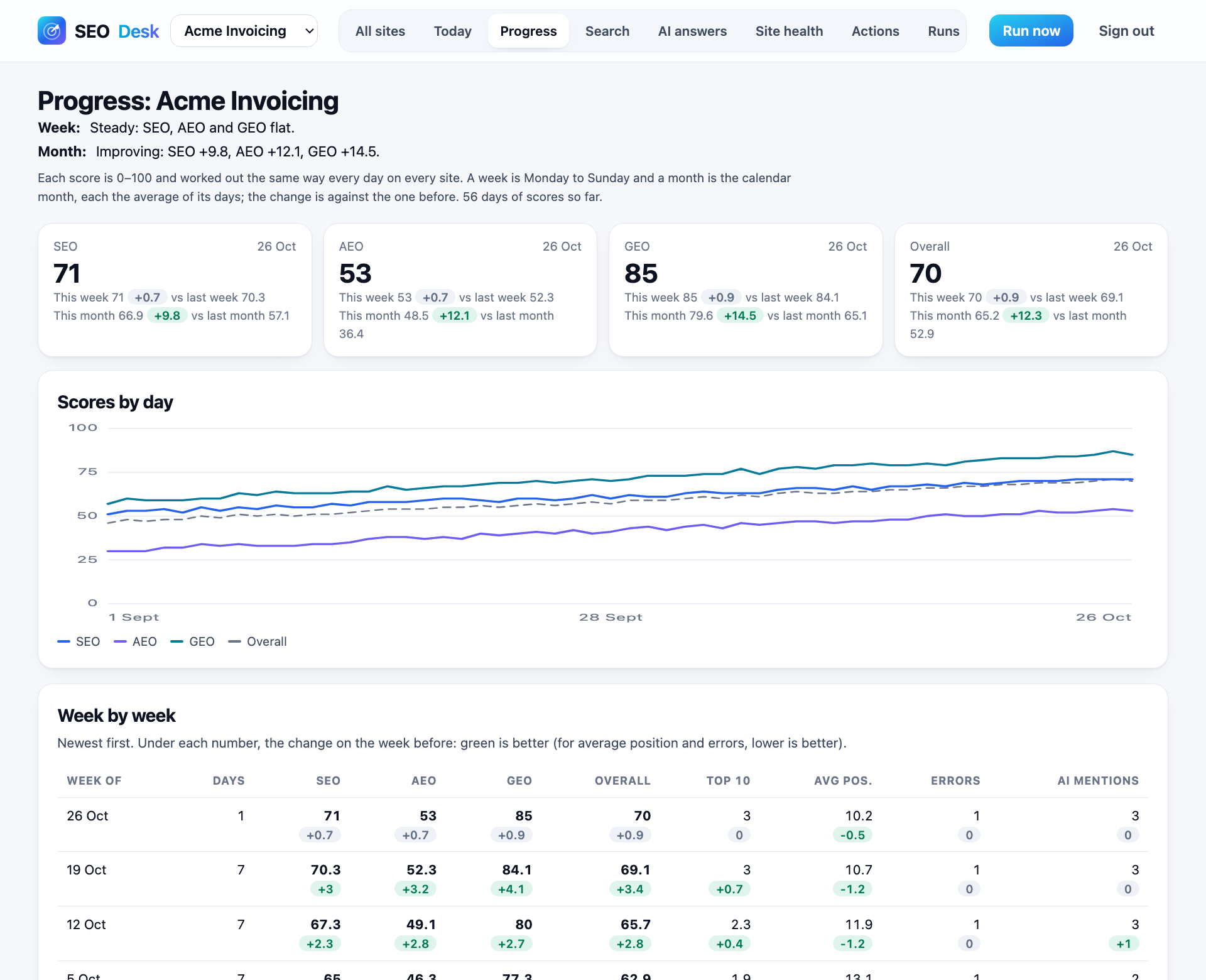 | 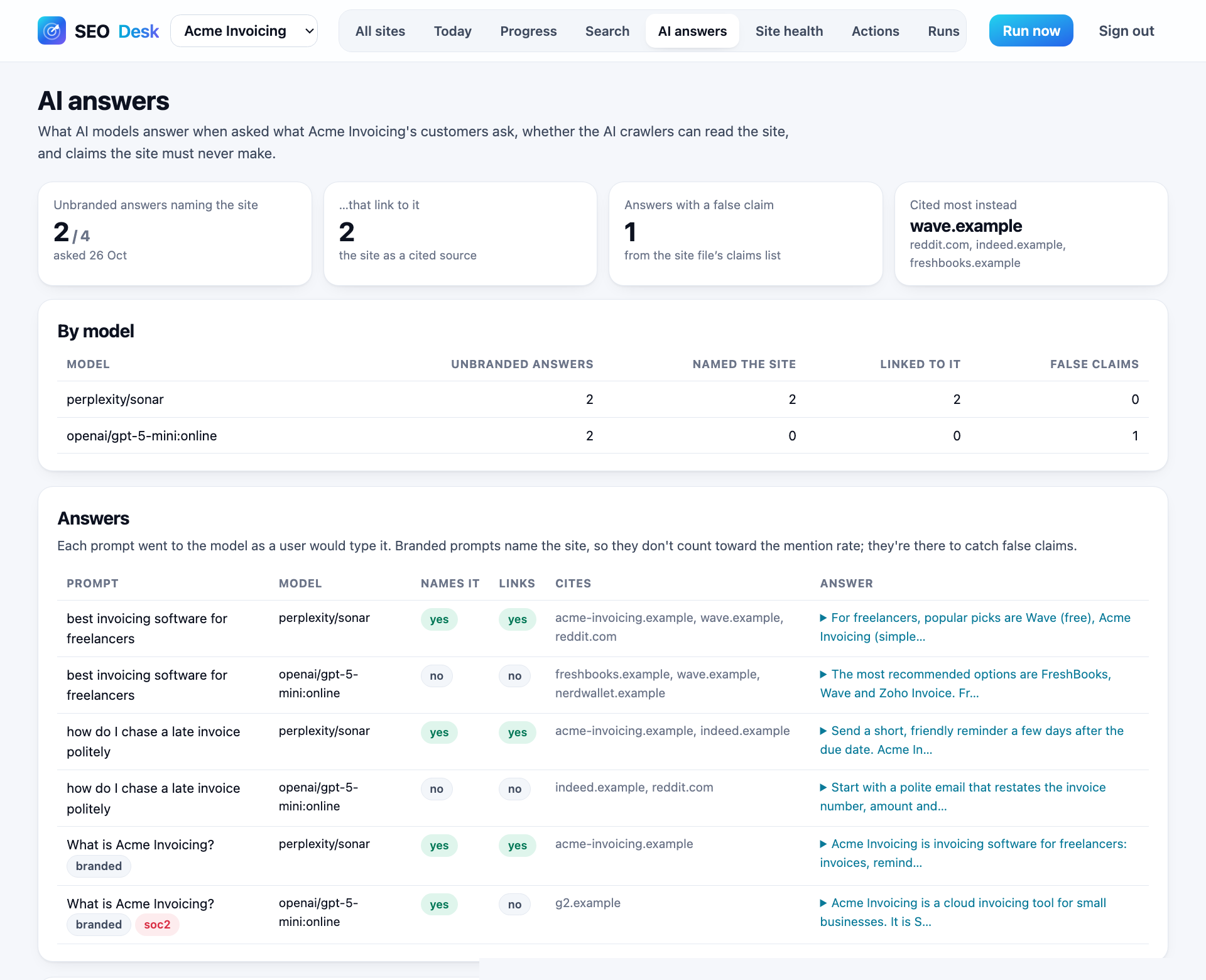 |
Sample data from seodesk demo: two fictional sites on the reserved .example domain.
AI visibility
Ask AI models the questions your customers ask, the way they ask them:
# sites/example.yaml
ai_visibility:
  models: [perplexity/sonar, openai/gpt-5-mini:online]   # OpenRouter names; ":online" adds web search
  prompts:
    - best invoicing software for freelancers
    - how do I make an invoice as a freelancer
    - {prompt: "What is Example invoicing?", branded: true}
  every_days: 7
For every answer: does it name you, does it link to you, which sites it cites instead, and does it repeat a false claim from your claims list. The share of unbranded answers that name you feeds the GEO score; branded prompts catch what AI gets wrong about you. Each prompt goes to the model with no system prompt and nothing that hints at your site.
Claims your site must never make
List what isn't true ("SOC 2 certified", an old price, a dropped feature). SEO Desk scans every live page, both llms files and the AI answers for it. Rules can count only sentences about you and skip sentences that deny the claim, so "we have no SOC 2 report" and "insist on SOC 2 from any vendor" don't trip them:
claims:
  - {id: soc2, pattern: '\bSOC[\s-]?2\b', about_us: true, unless: '\bno\b|\bnot\b', why: there is no SOC 2 report}
How the scores work
Each score is 0-100, the same formula every day on every site (progress.py). A part with no data is left out and the others count for more.
- SEO = keyword visibility 50% (#1 100 points, #2 90, #3 80, #4-5 65, #6-10 50, #11-15 25, #16-20 15) + pages without errors 30% + pages with clean on-page tags 20%. Without rank checks, SEO is the last two.
- AEO = content pages with question headings 30% + an answer-first paragraph 30% + FAQPage schema 20% + tables or lists 20%.
- GEO = AI crawlers allowed 25% + llms.txt (60) and llms-full.txt (40) 15% + pages with structured data 20% + no false claims 15% + AI models naming you in unbranded answers 25% (a quarter of answers or more scores 100).
- Overall = the mean of the three. Change the formula, then
seodesk rescorerecomputes every stored run.
How it compares
A polite crawler
- One identifiable user agent,
SEODesk/<version> (+https://github.com/Anas660/claude-seo-desk), four pages at a time. - It skips pages robots.txt disallows for
SEODesk(or*). On your own site you can turn that off. - Google results come from Serper's API, never by scraping Google.
FAQ
SEO (search engine optimisation) is ranking in Google's links. AEO (answer engine optimisation) is being the passage quoted in featured snippets, AI Overviews and People also ask. GEO (generative engine optimisation) is being named and cited by AI assistants like ChatGPT, Perplexity, Gemini and Claude. They overlap: a crawlable, well-structured page with a direct answer helps all three.
No. Without keys SEO Desk crawls, runs every GEO and AEO check, scores the site, keeps history and serves the dashboard. Keys add Google rank checks (Serper), search volumes (DataForSEO), the AI analyst and AI visibility (any OpenAI-compatible model API).
That's your call, and SEO Desk only reports it. Know the split: search and answer crawlers (OAI-SearchBot, ChatGPT-User, Claude-SearchBot, PerplexityBot) decide whether AI answers can cite you; training crawlers (GPTBot, ClaudeBot, CCBot, Google-Extended, Applebot-Extended) decide whether your pages train future models. Blocking the first group usually costs visibility.
It's a proposal (llmstxt.org), not a standard. Google has said it doesn't use it; some AI tools
and agents do read it. It's cheap to publish and keep current, so SEO Desk checks it and counts it for 15% of GEO, and
seodesk llms-txt drafts one from your pages.
No, on purpose: most AI crawlers don't either. If a page you care about scores thin, it probably renders on the client; server-side rendering or prerendering fixes that for every crawler.
Yes, politely: SEO Desk identifies itself, fetches four pages at a time and skips what robots.txt disallows for it.
Nowhere you didn't choose. Everything is stored in a SQLite file on your machine; page text goes only to the model API you configure, and only when you turn on the brief or AI visibility.
Contributing
git clone https://github.com/Anas660/claude-seo-desk && cd claude-seo-desk
python -m venv .venv && .venv/bin/pip install -e ".[dev]"
.venv/bin/pytest -q          # offline, a few seconds: every network call is faked
Ideas that would help most: a Google Search Console connection, optional JavaScript rendering, more answer-engine
checks, and a native Anthropic API client. See CONTRIBUTING.md; issues labelled
good first issue are a good place to start.
Contributors
If SEO Desk saved you an afternoon, a ⭐ helps other people find it.
Star history
License
MIT © Syed Anas
SEO Desk is an independent open-source project. It isn't made or endorsed by Anthropic; Claude and Claude Code are Anthropic's trademarks, named here because SEO Desk works with them.