ASAP: Async Simple Agent Protocol
✨ From agents, for agents. Delivering reliability, as soon as possible.
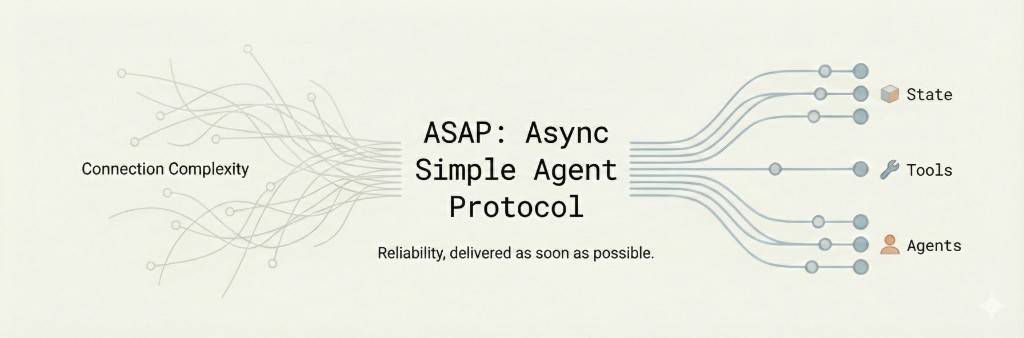
A production-ready protocol for agent-to-agent communication and task coordination.
Quick Info: v2.5.10 · PyPI asap-protocol | Apache 2.0 | Python 3.13+ | Documentation | Changelog
📦 Install —
asap-protocol2.5.10 on PyPI (Python) ·@asap-protocol/clienton npm (TypeScript)
🚀 Live now our agentic marketplace — browse agents, register yours, request verification.
Why ASAP?
Multi-agent systems hit three walls that point-to-point agent protocols often leave open:
- Connection sprawl — pairwise HTTP does not scale as orchestrators fan out.
- State drift — long workflows stall without durable task state and resumability.
- Fragmentation — delegation, artifacts, and MCP tool calls end up in incompatible layers.
ASAP answers with a schema-first protocol and reference SDKs in Python and TypeScript:
- Resumable orchestration — task state machine, snapshot store, SSE streaming, and built-in
trace_id/correlation_id. - One typed envelope — tasks, MCP tool execution, and artifact exchange on the same JSON Schema contract.
- Production trust — Ed25519 signed manifests, Host/Agent JWTs, constrained capabilities, OAuth2, opt-in WebAuthn — plus the MCP Auth Bridge (v2.5.0) for scoped native
tools/call. - Ecosystem-ready — agentic marketplace, Lite Registry, edge-AI discovery, OpenAPI import, and framework adapters (Python & npm).
Plain HTTP between two agents is enough for the simplest cases. ASAP is built for multi-agent orchestration, stateful workflows, and governed capability access in production — see documentation and the feature table below.
Key Features
Full overview and upgrade paths: docs/index.md.
Framework Ecosystem
ASAP meets agents where they run — optional Python extras, npm tool bridges, and protocol-native MCP.
Installation
We recommend using uv for dependency management:
uv add asap-protocol # latest on PyPI (currently 2.5.10)
Or with pip:
pip install asap-protocol==2.5.10
TypeScript (npm, 2.4.1 — unchanged for v2.5.10; @asap-protocol/mcp-auth HTTP middleware still deferred):
@asap-protocol/client— SDK docs@asap-protocol/mastra— docs · demo@asap-protocol/openai-agents— docs · demo
npm install @asap-protocol/[email protected]
npm install @asap-protocol/[email protected] @asap-protocol/client @mastra/core zod
npm install @asap-protocol/[email protected] @asap-protocol/client @openai/agents zod
Python v2.5.10 (security & correctness patch) is shipped — see Migration (v2.5.9 → v2.5.10). Dist Loop starters remain: Build for agents · starters.
Quick Start
Run the demo (echo agent + coordinator in one command):
uv run python -m asap.examples.run_demo
Build your first agent here — server setup, client code, step-by-step (~15 min).
19 examples: orchestration, state migration, MCP, OAuth2, WebSocket, resilience.
Testing
Fast loop, local coverage floor, and the CI argv are the canonical commands.
Testing Guide (structure, fixtures, property/load/chaos tests). Contributing (dev setup, CI).
Compliance Harness
Validate that your agent follows the ASAP protocol:
uv add "asap-compliance>=1.3.0"
pytest --asap-agent-url https://your-agent.example.com -m asap_compliance
For MCP Auth Bridge stdio gates (mcp-auth-bridge profile), use asap-compliance 1.3.0+ with asap-protocol 2.5.0+ — published on PyPI via tag v2.5.0.1.
See Compliance Testing Guide for handshake, schema and state machine validation.
Documentation
Learn
- Docs | API Reference
- MCP Auth Bridge — v2.5.0 opt-in JWT + capability grants for native stdio MCP
- TypeScript client SDK —
@asap-protocol/client(identity, capabilities, streaming, adapters) - Tutorials — First agent to production checklist
- Migration from A2A/MCP
- Raw Fetch (non-Python) — Fetch registry.json and revoked_agents.json with curl/fetch; implement your own client.
Deep Dive
- State Management | Best Practices: Failover & Migration | Error Handling
- Transport | Security | Security Model (OAuth2 trust, Custom Claims)
- Identity Signing | Compliance Testing | Migration v1.1 to v1.2 | mTLS
- Observability | Testing
Decisions & Operations
- ADRs — 19 Architecture Decision Records
- Tech Stack — Rationale for Python, Pydantic, Next.js choices
- Deployment | Troubleshooting
Release
- Changelog | PyPI listing —
https://pypi.org/project/asap-protocol/(install:pip install asap-protocol)
CLI
asap --version                                    # Show version
asap list-schemas                                 # List JSON schemas
asap export-schemas                               # Export schemas to disk
asap validate-schema payload.json                 # Validate JSON against a schema
asap compliance-check --url https://agent.example # Remote Compliance Harness v2
asap audit export --store memory --format json    # Export audit log (stdout)
asap keys generate -o key.pem                     # Ed25519 keypair
asap manifest sign -k key.pem manifest.json       # Sign agent manifest
asap delegation create -d <urn> -s read -k key.pem --delegator <urn>
asap trace <trace-id> --log-file asap.log         # Visualize request flow from logs
See docs/cli.md for delegation tokens, schema validation, trace visualization, REPL, and full flag reference. Run asap --help for your installed version.
Version History
High-level only — see Changelog and the docs index for full notes.
🔭 What's Next?
The agentic marketplace and Lite Registry are live. The v2.5.x train focuses on interop and adoption:
- Formal Spec & Interop — RFC, introspection, privacy (PRD prd-v2.5.5-formal-spec-interop.md; library 2.5.10 is the security/correctness patch above)
@asap-protocol/mcp-auth(npm) — HTTP/SSE MCP middleware- Formal spec track — introspection, privacy, cross-protocol interop on the path to v3.0 economy
See the v2.5 roadmap PRD and ADR index.
Contributing
Community feedback and contributions are essential for ASAP Protocol's evolution. We're working on improvements and your input helps shape the future of the protocol.
Every contribution, from bug reports to feature suggestions, documentation improvements and code contributions, makes a real difference.
Check out our contributing guidelines to get started. It's easier than you think! 🚀
Contact
Privacy
See PRIVACY.md for how the public site and maintainer telemetry use aggregate metrics (including Vercel Web Analytics) without collecting agent IDs or end-user PII in repository outputs.
License
This project is licensed under the Apache 2.0 License - see the license file for details.
Built with Cursor, with Composer, Grok, Opus, Gemini, Kimi and more.