
Voice and Chat Hotel Assistant
This virtual assistant platform is a comprehensive real-time speech-to-speech conversational AI system built on AWS and LiveKit with Amazon Bedrock Nova Sonic for voice and Amazon Bedrock AgentCore Runtime for chat. While designed as a hotel guest services assistant, this platform is easily adaptable to any industry by simply changing system prompts and integrating industry-specific tools. It provides natural, context-aware conversations through multiple interfaces including voice, chat, and web applications.
Key Adaptability Features:
- Industry-Agnostic Architecture: Core platform works for hospitality, retail, healthcare, finance, and more
- Simple Customization: Adapt to any industry by modifying system prompts and available tools
- Flexible Tool Integration: Easy integration with any backend system via standardized MCP protocol
- Reference Implementation: Complete hotel use case demonstrates platform capabilities
Key Value Propositions
- Multi-Modal Customer Interactions: Support voice calls (LiveKit), web chat, and text messaging across any industry
- Real-Time Natural Speech Processing: Natural, conversational interactions with Amazon Nova Sonic
- Easy Industry Adaptation: Customize for any vertical by changing system prompts and tools - no code changes required
- Backend Service Integration: Easy integration with any backend system via standardized MCP protocol
- Scalable AWS Architecture: Auto-scaling infrastructure with Amazon ECS with AWS Fargate and Aurora Serverless
- Complete Reference Implementation: Hotel use case demonstrates full platform capabilities
Core Capabilities (Hotel Reference Implementation)
- Room Management: Check availability, make reservations, modify bookings
- Guest Services: Concierge information, amenities details, service requests
- Housekeeping Coordination: Schedule services, track requests, room status updates
- Multi-Language Support: English and Spanish with localized system prompts
- Conversation Memory: Persistent context across interactions using Amazon Bedrock AgentCore Memory
Note: These hotel-specific capabilities demonstrate the platform's flexibility. The same architecture supports any industry by replacing the hotel PMS tools with industry-specific integrations.
Example


Architecture

Cost
You are responsible for the cost of the AWS services used while running this solution. As of December 2025, the cost for running this prototype with the default settings in the US East (N. Virginia) Region is approximately $342.01 per month for 500 voice calls and 500 chat conversations.
The costs shown represent pricing without consideration of AWS free tier benefits.
We recommend creating a budget through AWS Cost Explorer to help manage costs. Prices are subject to change. For full details, refer to the pricing webpage for each AWS service used in this solution.
The following table provides a sample cost breakdown for deploying this solution with the default parameters in the US East (N. Virginia) Region for one month:
Cost estimate (500 voice calls, 500 chat conversations per month)
Component Overview
Backend Integration & Database - $6.78/month
Virtual Assistant Voice (LiveKit) - $284.63/month
Note: Voice infrastructure is optional. If you only need chat/messaging, you can skip LiveKit configuration and save $284.63/month (including $81.30 in VPC costs).
Virtual Assistant Chat - $28.34/month
Alternative Messaging Configuration:
For production WhatsApp messaging via AWS End User Messaging Social (instead of simulated messaging backend):
Note: WhatsApp Business API pricing varies by region and message type. This estimate assumes average costs.
The actual cost will vary based on:
- Number of voice calls and chat conversations processed
- Average duration of voice calls (default estimate assumes 10 minutes)
- Complexity of conversations and token usage
- Selected AWS region for deployment
- Whether production backend integration replaces simulated database
Important: This estimate excludes telephony and messaging integration costs. Voice telephony (Twilio/Amazon Connect) and messaging connectors (WhatsApp/SMS) require separate providers. When using the optional WhatsApp integration with AWS End User Messaging Social, additional costs apply based on message volume and WhatsApp Business API pricing.
Deployment and Development
Project Structure
This project is organized as an NX monorepo with pnpm workspaces, providing efficient build caching, task orchestration, and dependency management across multiple technologies:
virtual-assistant/
├── packages/
│   ├── demo/                        # React web application
│   ├── virtual-assistant/           # Python workspace with:
│   │   ├── virtual-assistant-chat/  #   - AgentCore chat agent
│   │   ├── virtual-assistant-livekit/ #   - LiveKit voice agent
│   │   ├── virtual-assistant-common/ #   - Shared utilities
│   │   └── virtual-assistant-messaging-lambda/ # - Message processing
│   ├── hotel-pms-simulation/            # Hotel PMS API & MCP server (reference)
│   ├── infra/                       # AWS CDK infrastructure
│   └── common/constructs/           # Shared CDK constructs
├── documentation/                   # Shared documentation
├── hotel_data/                      # Sample hotel data and scripts (reference)
├── .kiro/                           # Kiro IDE configuration
    ├── specs/                       # Feature specifications
    └── steering/                    # Development guidelines
Adapting to Different Industries
The Virtual Assistant Platform is designed for easy adaptation to any industry. The hotel implementation serves as a complete reference.
What you customize:
- System prompts and conversation flows
- Industry-specific tools via MCP protocol
- Knowledge base content
- Backend API integrations
What stays the same:
- Core infrastructure (voice, chat, messaging)
- AWS architecture and deployment
- Authentication and security
The platform uses the Model Context Protocol (MCP) to connect your existing APIs as tools. AgentCore Gateway wraps any REST API with an OpenAPI specification, eliminating the need to implement MCP protocol yourself.
For complete step-by-step instructions, see the Industry Adaptation Guide.
Prerequisites
- Configure the AWS Credentials in your environment. Refer to Authentication and access.
- A free LiveKit Cloud account. About LiveKit. Click "Start building" to sign up.
- Download and install AWS CLI. Refer to Installing the AWS CLI.
- Install and configure AWS CDK. Refer to Installing the AWS CDK.
- Download and install Docker. Refer to Docker.
- NodeJS >= 18.0.0. You can manage NodeJs versions with nvm or pnpm
- Python >= 3.13. You can manage Python versions with uv.
- uv >= 0.6.0. Refer to uv installation guide.
- pnpm >= 8.6.3. Refer to pnpm installation guide.
# Install pnpm
curl -fsSL https://get.pnpm.io/install.sh | sh -

# Install uv
curl -LsSf https://astral.sh/uv/install.sh | sh

# Install required tools and versions
pnpm  env use --global 22
uv python install 3.14

# Install global packages
npm install -g aws-cdk
Activate Models in Amazon Bedrock
This prototype uses Amazon Nova and Anthropic Claude models on Amazon Bedrock. Amazon models are enabled by default, while Anthropic models require a marketplace subscription.
Recommended approach: Subscribe to all Anthropic models to ensure compatibility with current and future model versions:
# Subscribe to all Anthropic models (recommended)
uv run scripts/bedrock_subscribe.py "Anthropic*" \
  --company-name "Your Company Name" \
  --use-cases "AI-powered virtual assistant and conversational AI"

# Subscribe to specific Anthropic model only
uv run scripts/bedrock_subscribe.py "Anthropic Claude 3.5 Haiku"
The prototype requires these models:
- Amazon Nova 2 Sonic (enabled by default)
- Amazon Nova 2 Lite (enabled by default)
- Amazon Titan Text Embeddings V2 (enabled by default)
Configure LiveKit Project Secret
-
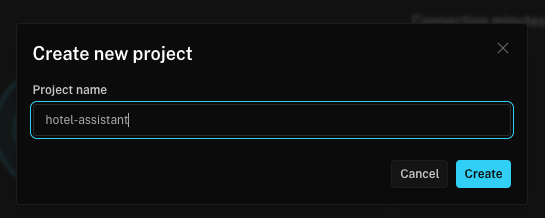
Create LiveKit Project:
-
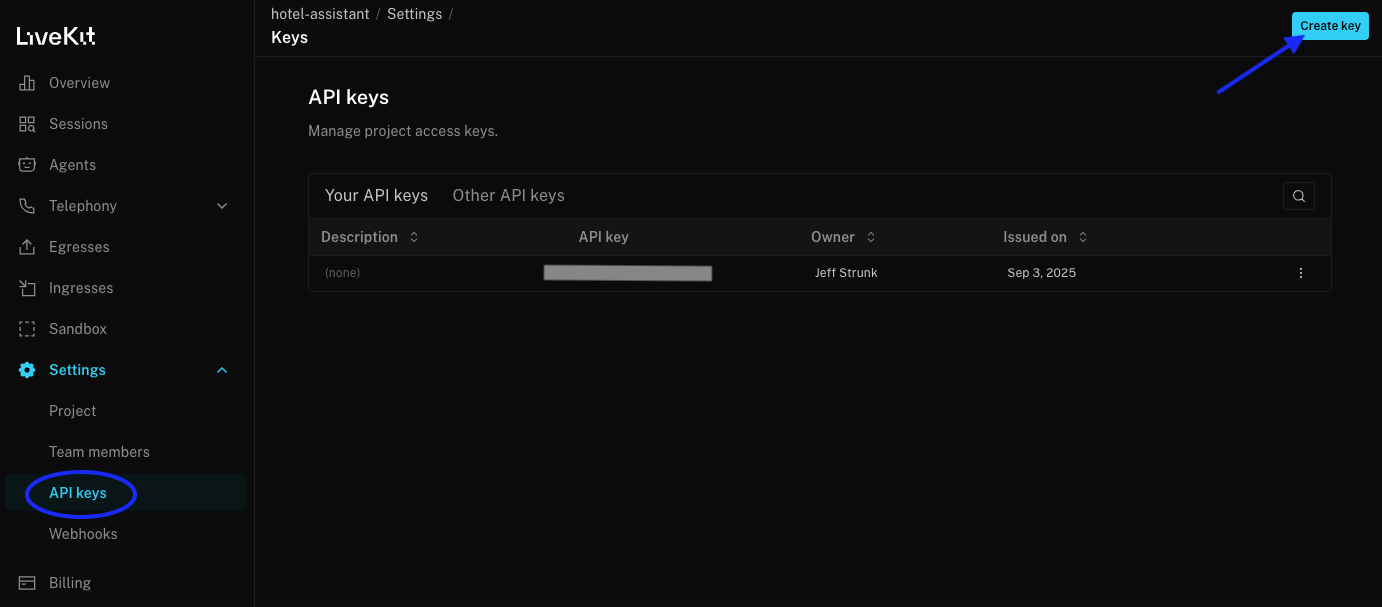
Navigate to project settings:
-
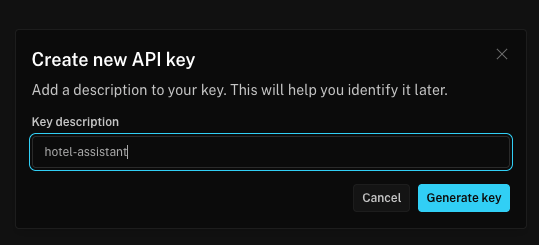
Create a new API key:
-
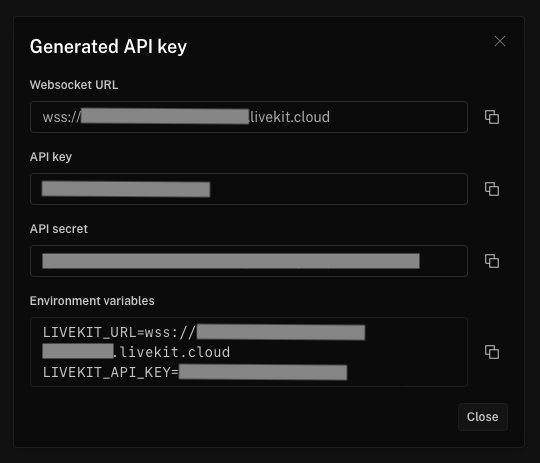
Copy the generated API key and secret:
-
Store the LiveKit credentials in AWS Secrets Manager with the secret name
"virtual-assistant-livekit":# Replace with your actual values from the LiveKit dashboard aws secretsmanager create-secret \ --name "virtual-assistant-livekit" \ --description "LiveKit credentials for Virtual Assistant" \ --secret-string '{ "LIVEKIT_URL": "wss://your-project-name-xxxxxxxx.livekit.cloud", "LIVEKIT_API_KEY": "your-api-key-from-step-4", "LIVEKIT_API_SECRET": "your-api-secret-from-step-4" }'
Configure WhatsApp Integration (Optional)
The Virtual Assistant Platform supports real WhatsApp messaging through AWS End User Messaging Social (EUM Social). This is optional - the system works with simulated messaging by default.
Prerequisites for WhatsApp Integration
- AWS End User Messaging Social set up in your account
- WhatsApp Business Account connected to EUM Social
- SNS topic for receiving WhatsApp webhook events
Quick Setup
-
Create SNS Topic for WhatsApp Events:
aws sns create-topic --name whatsapp-messages --region us-east-1 -
Create Phone Number Allow List:
# Allow specific phone numbers (recommended for production) aws ssm put-parameter \ --name "/virtual-assistant/whatsapp/allow-list" \ --value "+1234567890,+0987654321" \ --type "String" # OR allow all numbers (for development/testing) aws ssm put-parameter \ --name "/virtual-assistant/whatsapp/allow-list" \ --value "*" \ --type "String" -
Configure CDK Context Variables: Add to your
cdk.context.jsonor pass via command line:{ "eumSocialTopicArn": "arn:aws:sns:us-east-1:YOUR-ACCOUNT:whatsapp-messages", "eumSocialPhoneNumberId": "your-eum-social-phone-number-id" } -
Deploy with WhatsApp Integration:
nx deploy infra --context eumSocialTopicArn=arn:aws:sns:us-east-1:123456789012:whatsapp-messages --context eumSocialPhoneNumberId=phone-number-id-01234567890123456789012345678901
For detailed WhatsApp integration setup, cross-account configuration, and
troubleshooting, see the WhatsApp Integration Guide
(documentation/whatsapp-integration.md).
Build and Deploy
The entire build and deployment can be done with just a few commands:
pnpm install
pnpm exec nx bootstrap infra     # First time only
pnpm exec nx deploy infra        # Deploy to AWS (~2.5 min)
The deploy command will automatically trigger the necessary builds and then deploy the infrastructure.
CDK Context Variables
The infrastructure supports various configuration options through CDK context
variables. These can be set in packages/infra/cdk.context.json or passed via
command line.
Core Configuration
bedrock_xacct_role(Optional): Cross-account IAM role ARN for Bedrock access when models are in a different AWS account- Format:
arn:aws:iam::account-id:role/role-name - Example:
arn:aws:iam::123456789012:role/BedrockCrossAccountRole
- Format:
WhatsApp Integration Configuration (Optional)
For real WhatsApp messaging through AWS End User Messaging Social, configure these variables:
-
eumSocialTopicArn(Required for WhatsApp): SNS topic ARN that receives WhatsApp webhook events from EUM Social- Format:
arn:aws:sns:region:account-id:topic-name - Example:
arn:aws:sns:us-east-1:123456789012:whatsapp-messages - Note: You must create and manage this SNS topic
- Format:
-
eumSocialPhoneNumberId(Required for WhatsApp): EUM Social phone number ID for sending WhatsApp messages- Format: 36-character alphanumeric string
- Example:
phone-number-id-01234567890123456789012345678901 - Location: Found in EUM Social console under your WhatsApp phone number configuration
-
eumSocialCrossAccountRole(Optional): IAM role ARN for cross-account EUM Social access- Format:
arn:aws:iam::account-id:role/role-name - Example:
arn:aws:iam::123456789012:role/WhatsAppCrossAccountRole - Use Case: When EUM Social is deployed in a different AWS account
- Format:
-
whatsappAllowListParameter(Optional): SSM parameter name for phone number allow list- Default:
/virtual-assistant/whatsapp/allow-list - Format: SSM parameter path
- Example:
/virtual-assistant/whatsapp/allow-list
- Default:
Setting Context Variables
Method 1: Configuration File
Create packages/infra/cdk.context.json:
{
  "eumSocialTopicArn": "arn:aws:sns:us-east-1:123456789012:whatsapp-messages",
  "eumSocialPhoneNumberId": "phone-number-id-01234567890123456789012345678901",
  "eumSocialCrossAccountRole": "arn:aws:iam::123456789012:role/WhatsAppCrossAccountRole",
  "whatsappAllowListParameter": "/virtual-assistant/whatsapp/allow-list"
}
Method 2: Command Line
pnpm exec nx deploy infra \
  --context eumSocialTopicArn=arn:aws:sns:us-east-1:123456789012:whatsapp-messages \
  --context eumSocialPhoneNumberId=phone-number-id-01234567890123456789012345678901
Deployment Behavior
- With EUM Social Configuration: Deploys WhatsApp integration, skips simulated messaging backend
- Without EUM Social Configuration: Deploys simulated messaging backend (default behavior)
- Partial EUM Social Configuration: Deployment fails with clear error message if required variables are missing
Load the Sample Hotel Data
The prototype uses a sample hotel data set. The data is loaded into Amazon S3 and ingested with Amazon Bedrock Knowledge Bases.
python ./hotel_data/scripts/generate_metadata.py
python ./hotel_data/scripts/upload_and_ingest_documents.py
Demo
Voice Assistant
Navigate to the LiveKit Agents Playground. Enter with your LiveKit Cloud account. Select your project and connect.
Chat Assistant
Set up
You will need the VirtualAssistantStack.UserPoolId output from deployment.
For the demo, user sign up is disabled. You will need to
create your user on the Amazon Cognito console
in the VirtualAssistantStack.UserPoolId so you can log in.
- Navigate to the Amazon Cognito console.
- Find your User Pool using the
VirtualAssistantStack.UserPoolIdfrom the stack deployment outputs. - In the "Users" section, click "Create user" and follow the instructions.
Use the Chat Assistant
Navigate to http://localhost:5173 after running nx serve demo.
Conversation suggestions
Look for a hotel
You: "¿Dónde puedo hacer meditación maya con cuencos tibetanos?" Agent: should respond with information about Paraíso Tulum You: "¿Qué hay de rico para comer allí?" Agent: should respond with information about Paraíso Tulum
Book a Room
You: "Quiero reservar una habitación para dos personas." Agent: should collect required details and respond with a booking confirmation.
Request Maintenance
You: "¿Puedes hacer mantenimiento en la habitación 101?"
Check Out
You: "¿Puedes hacer checkout de la habitación 101?"
Cleanup
In the event that you decide to stop using the prototype, we recommend that you follow a tear-down procedure. Most of the services used have no cost when there is no active use with the notable exception of storage in S3 and CloudWatch Logs. AWS CloudFormation via CDK will tear down all resources except for Amazon S3 buckets and AWS CloudWatch Logs log groups with data.
1. Destroy CDK Stacks
nx run infra:destroy
2. Clean Up Remaining S3 Buckets
Due to versioning, lifecycle rules are the most thorough approach for complete cleanup.
# Find virtual-assistant related bucket names
ASSISTANT_BUCKETS=$(aws s3api list-buckets --query 'Buckets[?contains(Name, `virtualassistant`) || contains(Name, `cdk-hnb659fds`)].Name' --output text)

# Apply lifecycle rules to expire all objects and versions after 1 day
for bucket in $ASSISTANT_BUCKETS; do
  echo "Setting lifecycle rule for bucket: $bucket"
  aws s3api put-bucket-lifecycle-configuration \
    --bucket "$bucket" \
    --lifecycle-configuration '{
      "Rules": [{
        "ID": "DeleteEverything",
        "Status": "Enabled",
        "Filter": {},
        "Expiration": {"Days": 1},
        "NoncurrentVersionExpiration": {"NoncurrentDays": 1},
        "AbortIncompleteMultipartUpload": {"DaysAfterInitiation": 1}
      }]
    }'
done

# After 24+ hours, delete the empty buckets
for bucket in $ASSISTANT_BUCKETS; do
  echo "Deleting bucket: $bucket"
  aws s3 rb s3://"$bucket"
done
3. Delete CloudWatch Log Groups
# Delete virtual-assistant related log groups
aws logs describe-log-groups \
  --query 'logGroups[?contains(logGroupName, `VirtualAssistant`) || contains(logGroupName, `HotelPms`)].logGroupName' \
  --output text | xargs -I {} aws logs delete-log-group --log-group-name {}
Important Notes:
- The CDKToolkit stack should remain as it's used by other CDK deployments
- Wait 24+ hours after setting lifecycle rules before attempting to delete S3 buckets
Troubleshooting
For common issues and debugging guidance, see the troubleshooting guide. This includes specific guidance for WhatsApp integration, voice processing, deployment issues, and performance optimization.
Improvements
As part of the prototype process, we have some improvement ideas for your path to production.
Amazon Connect Integration: If your use case requires telephone support, human agent escalation, or complete contact center capabilities, we recommend using Amazon Connect. The AWS Workshop for Amazon Connect Integration provides comprehensive guidance for building virtual assistants with Amazon Connect, including integration with Amazon Bedrock Nova Sonic for natural conversations.
Security Guideline
Please see the security guidelines.
Legal Disclaimer
Sample code, software libraries, command line tools, proofs of concept, templates, or other related technology are provided as AWS Content or Third-Party Content under the AWS Customer Agreement, or the relevant written agreement between you and AWS (whichever applies). You should not use this AWS Content or Third-Party Content in your production accounts, or on production or other critical data. You are responsible for testing, securing, and optimizing the AWS Content or Third-Party Content, such as sample code, as appropriate for production grade use based on your specific quality control practices and standards. Deploying AWS Content or Third-Party Content may incur AWS charges for creating or using AWS chargeable resources, such as running Amazon EC2 instances or using Amazon S3 storage.