Power your agent
Install from the publisher. Not a PlugMCP endpoint.
Host a copy with our keys and logs.
No packaged release in the registry yet. Follow the repository README.
Remote URL or a command on your machine? How the two installs differ
Run on PlugMCP
A new server you create. It is not this listing's official endpoint. Use the publisher install when you want their URL and their credentials.
LaunchJudging AI agent work with a deterministic floor and an LLM critic — the stricter score wins, and a Bayesian policy decides when to stop.
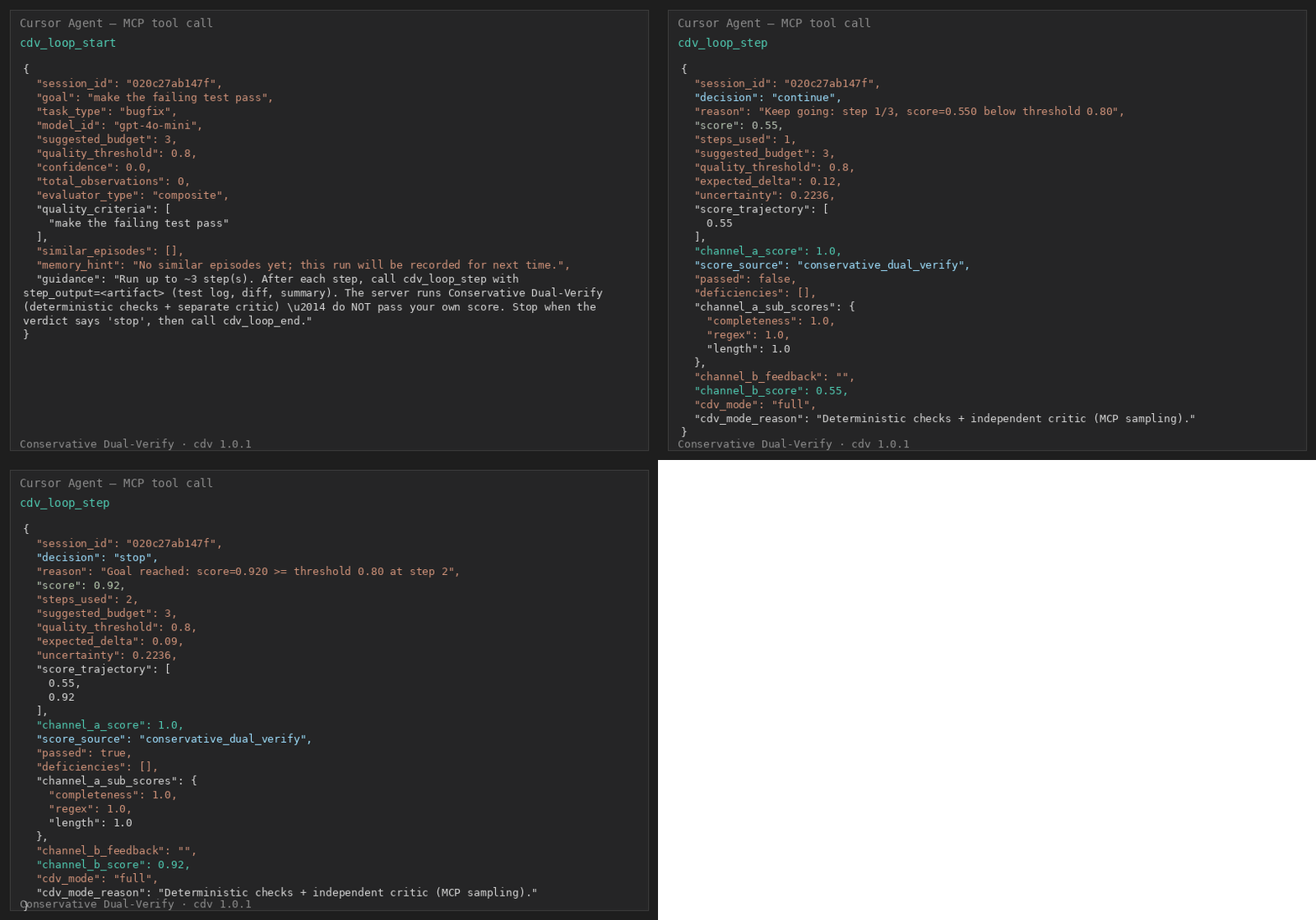
An agent claims "tests pass." Channel A (deterministic) finds no evidence and vetoes; the loop continues. Only when both channels agree does the run stop — and the verdicts are stamped onto git history.
Status: research preview. This repository is the published concept, frozen at v1.0.1. Active development continues privately; issues and PRs here may not be answered. The code is MIT — read it, cite it, fork it.
Agent loops today end in one of two ways:
max_iterations — cheap and wrong: either the loop stops while the
work is unfinished, or it burns tokens long after the work is done.Both failure modes come from the same place: the entity deciding to stop is the entity being judged. CDV separates them.
Two loops, one handoff:
        elicitation loop                        judgment loop
 ┌──────────────────────────┐   intent    ┌───────────────────────────────┐
 │ score prompt (5 dims)    │  (goal +    │  agent runs — externally,     │
 │ clarify via Thompson-    │  criteria + │  in your IDE                  │
 │ sampled questions        │  patterns)  │        │                      │
 │ refine until specific    │ ──────────► │        ▼                      │
 └──────────────────────────┘             │  step artifact (test log,     │
                                          │  diff, summary)               │
                                          │        │                      │
                                          │        ▼                      │
                                          │  Channel A: deterministic     │
                                          │  Channel B: LLM critic        │
                                          │  score = min(A, B)  ← veto    │
                                          │        │                      │
                                          │        ▼                      │
                                          │  Bayesian stop/continue       │
                                          └───────────────────────────────┘
min(A, B), deliberately. Not a weighted average — either
channel can veto. Weighted ensembles let a lenient channel dilute a
strict one; min-fusion can't be diluted, only vetoed.Pointers into the code for the concepts being explored:
src/cdv/step_scorer.py.
min(A, B) treats verification like a security property: the paranoid
channel sets the ceiling.src/cdv/priors.py,
src/cdv/adaptive_exit.py, src/cdv/guards.py. Bayesian ROI: stop when the
expected score gain of another step falls below its cost.src/cdv/engine.py,
src/cdv/elicitation.py. Five deterministic dimensions composited by
weights updated online via SGD on user feedback; the VS Code extension
scores live with a 350 ms debounce.src/cdv/episodes.py, src/cdv/store.py.
Episodic memory recalls what worked on similar past tasks; meta memory
learns how many steps a task type actually takes. Both per-project, keyed
from the git remote.src/cdv/agent_loop.py.
Every verified step is checkpointed; a restarted server rehydrates
in-progress loops instead of restarting cold.src/cdv/cli.py (audit,
audit-gate), .github/actions/cdv-gate. Every episode is stamped with
the commit that was HEAD when it was verified, exportable as a CI-gateable
artifact.Test rigor is part of the claim. 309 tests (~4.4k lines against ~11.5k source), all fast (~3 s), strict mypy, ruff, CI matrix across Python 3.11–3.13:
Benchmark: adaptive vs fixed max_iterations. Reproducible simulation
(seed=7, 300 test tasks, threshold 0.80):
Adaptive stopping uses ~41% fewer steps than a fixed 6-step budget while reaching the bar on 99.7% of tasks.
This is a synthetic simulation of the decision policy, not a live-LLM evaluation: it exercises the real
AgentLoopController/AdaptivePriorsagainst a hand-crafted diminishing-returns curve, not real dual-channel trajectories. Treat it as a lower bound on rigor — the honest number, not the flattering one.
~/.cdv/; no
cloud execution, no multi-repo view.The preview is installable and functional:
pipx install "cdv[mcp]"
cdv install-mcp --ide all --rules   # registers the server + drops agent rules
cdv (formerly loopllm — old
installs forward here automatically)AgentLoopController, AdaptivePriors, AdaptiveStopper
(drop-in should_continue for LangGraph/CrewAI-style loops)MIT — the preview is yours to read, cite, and fork.
Conservative Dual-Verify — judging AI agent work with a deterministic floor + LLM critic (stricter score wins) and Bayesian stopping. Research preview, frozen at v1.0.1; active development continues p
Overview
Conservative Dual-Verify — judging AI agent work with a deterministic floor + LLM critic (stricter score wins) and Bayesian stopping. Research preview, frozen at v1.0.1; active development continues privately. MIT.
Tools
No tool list yet. Remote servers get one after the first health check.
FAQ
Copy the stdio config for Cursor, Claude Desktop, Claude Code, or VS Code on this page. It uses the publisher's install, not a PlugMCP proxy.
No required environment variable is listed on this record.
Cdv runs locally over stdio.
Last checked 2026-10-28. Conservative Dual-Verify — judging AI agent work with a deterministic floor + LLM critic (stricter score wins) and Bayesian stopping. Research preview, frozen at v1.0.1; active development continues privately. MIT.
